
Special Feature
A GLIMPSE AT THE LONDON MUSIC HALLS
THE TYPICAL AMUSEMENT RESORTS OF THE BRITISH METROPOLIS
BY HORACE BARNES
This month's 'Special Feature' is taken from the pages of 'Munsey's Magazine' 1908. What you will see here is an American Magazine article on British Music Hall from the 1908 edition of the Magazine, featuring the complete text and accompanying images.
The Feature was first created in June 2003 but was updated in March 2015 when all the pages were replaced with this one.
Please note that some of the text here regarding 'Negro performers' would be considered quite objectionable nowadays, and rightly so, but I don't believe it is in the best interests of my readers to edit such material out. Therefore please don't take offense at what is, after all, an almost one hundred year old piece of prose.
 THE music-halls of the world's great
cities afford a study of human interests and characteristics to be had
in no other way. This is not so true of New York, where so-called "vaudeville"
is not more than an incident in civic life, and its standards are never
fixed and dependable, as it is of Paris, and above all of London.
THE music-halls of the world's great
cities afford a study of human interests and characteristics to be had
in no other way. This is not so true of New York, where so-called "vaudeville"
is not more than an incident in civic life, and its standards are never
fixed and dependable, as it is of Paris, and above all of London.
In New York, the music-halls are by no means the foremost and most popular resort for amusement -seekers. In Paris, they are the French pulse. In London, they are the English heart itself.
In New York, the vaudeville houses are very much of a makeshift. In Paris, they are a recognized diversion of a known standard of excellence. In London, they rise to the dignity of an institution.
In New York, not one person in a thousand could tell you, off hand, the names of the head-liners at the vaudeville theaters--no, not even at one theater. In Paris, fully half the public can inform you where Fregoli is doing his wonderful protean turns; and any one, upon glancing at the nearest illuminated poster-pillar, can advise you what performers to see that evening, and why. In London, it seems as if every second person you meet can tell you not only who the stars are, but where they are playing-and that usually means from three to five appearances, in as many halls, each night-- what new songs they are singing, and what the prices of the house are. As a rule, he can throw in choice scraps of gossip as to the "'all hartiste's" (sic) home life.
In America, the vaudeville stage is at best a mongrel product--a cross between what is known by courtesy as "straight" Drama, on the one hand, and the circus and prize-ring on the other. It is without standard either of effort or of talent. It is always fluttering between being good musical comedy and bad hod-carrying. For every true music-hall entertainer like Marshall P. Wilder, we are treated to a score of ex-prize-fighters and barroom waiter-singers. And when a " big " name does appear on the American vaudeville posters--a name that stands for fifteen minutes or a half-hour of real artistry--whence has the wonder come? Either from the London halls-like Albert Chevalier, or Harry Lauder, or Vesta Victoria, or R. G. Knowles (once Anierican)--or from the American "legitimate " field.
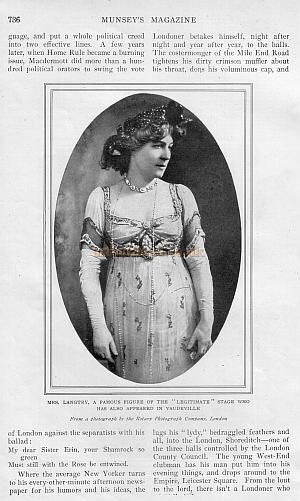
Do these waifs and strays from the legitimate " come over to the stage because they recognize it as a worthy avenue to earnest effort and permanent plaudits? Alas, No! They come because Lillian Russell, or Mrs. Langtrv, or somebody else, didn't have just the play they wanted for the minute, and were dragged " on the circuit " for a few weeks by a big cash offer. The minute a play comes along--good-by to the makeshift vaudeville!
 The
one redeeming feature of vaudeville in New York, and throughout America,
as contrasted with Paris and London, is its comparative freedom from
Vulgarity. The Americans are careful to relegate downright indecency
to the cheapest grade of touring burlesques, whereas in Paris the finest music-hall stars are not above
employing it and in London there are few who are not more or less guilty
of it. If one medium of music-hall expression in England were to be taken as the most characteristic type,
it would probably be the song containing
at regular intervals a word most obviously riming with some other word
impossible to speak in decent company, and having some totally different,
harmless, and non-riming word shoved in the place of the naughty one.
The
one redeeming feature of vaudeville in New York, and throughout America,
as contrasted with Paris and London, is its comparative freedom from
Vulgarity. The Americans are careful to relegate downright indecency
to the cheapest grade of touring burlesques, whereas in Paris the finest music-hall stars are not above
employing it and in London there are few who are not more or less guilty
of it. If one medium of music-hall expression in England were to be taken as the most characteristic type,
it would probably be the song containing
at regular intervals a word most obviously riming with some other word
impossible to speak in decent company, and having some totally different,
harmless, and non-riming word shoved in the place of the naughty one.
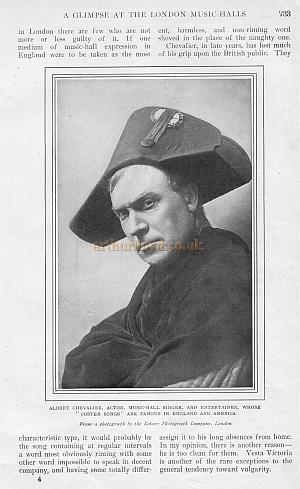
Chevalier, in late years, has lost much of his grip upon the British public. They assign it to his long absences from home. In my opinion, there is another reason he is too clean for them. Vesta Victoria is another of the rare exceptions to the general tendency toward vulgarity.
Left - Caption reads: Albert Chevalier, Actor, Music-Hall Singer, and Entertainer, whose 'Coster Songs' are famous in England and America. From a photograph by the Rotary Photograph Company, London.
 The
London public carries its admiration for the music-hall star almost to the extreme of hero-worship. During the last quarter
century there have been few men in any branch of English public life
who have enjoyed more universal admiration than the late Dan Leno. To
the mass of Londoners, he was a national hero. His was the reward of
taking his music-hall mission seriously. He brought to his audiences
such caricatures of well known types that they became snap-shot classics
of character. Such, for instance, was his impersonation of the "Beef
Eaters," those scarlet-clad relics of ancient times before whom
the American tourist stands in such wonderment at the Tower of London.
The
London public carries its admiration for the music-hall star almost to the extreme of hero-worship. During the last quarter
century there have been few men in any branch of English public life
who have enjoyed more universal admiration than the late Dan Leno. To
the mass of Londoners, he was a national hero. His was the reward of
taking his music-hall mission seriously. He brought to his audiences
such caricatures of well known types that they became snap-shot classics
of character. Such, for instance, was his impersonation of the "Beef
Eaters," those scarlet-clad relics of ancient times before whom
the American tourist stands in such wonderment at the Tower of London.
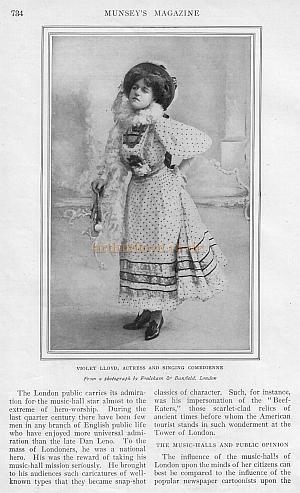
Right - Caption Reads: Violet Lloyd, Actress and Singing Comedienne. From a photograph by Foulsham & Banfield, London.
THE MUSIC-HALLS AND PUBLIC OPINION
The influence of the music-halls of London upon the minds of her citizens can best be compared to the influence of the popular newspaper cartoonists upon the mind of the average New Yorker.
 Just as we of New York get our wit secondhand from the Sunday "comic
sections," so does the Londoner get his from the halls.
But the influence of the halls goes deeper still. It combines the vogue
of the caricaturist's humor with the force of the editorial writer's
reasoning. Thirty years ago when a Russian army was threatening Constantinople,
and a British fleet, with decks cleared for action, passed through the
Dardanelles, the late G. H. Maedermott sang a song in the London music-halls
containing the famous refrain :
Just as we of New York get our wit secondhand from the Sunday "comic
sections," so does the Londoner get his from the halls.
But the influence of the halls goes deeper still. It combines the vogue
of the caricaturist's humor with the force of the editorial writer's
reasoning. Thirty years ago when a Russian army was threatening Constantinople,
and a British fleet, with decks cleared for action, passed through the
Dardanelles, the late G. H. Maedermott sang a song in the London music-halls
containing the famous refrain :
We don't want to fight, but, by jingo, if we do,
We've got the ships, we've got the men, we've got the money too!
This little verse--which is said to have been the one thing that James McNeil Whistler was ever known to sing-gave the word "jingo" to the English language, and put a whole political creed into two effective lines.
Left - Caption Reads: Adeline Genee, Premiere Danseuse of The Empire Music Hall in London, and now at the head of a musical comedy company in America. From a photograph by the Rotary Photograph Company, London.
 A few years later, when Home Rule became a burning issue, Macdermott
did more than a hundred political orators to swing the vote of London
against the separatists with his ballad:
A few years later, when Home Rule became a burning issue, Macdermott
did more than a hundred political orators to swing the vote of London
against the separatists with his ballad:
My dear Sister Erin, your Shamrock so green
Must still with the Rose be entwined.
Where the average New Yorker turns to his every- other-minute afternoon newspaper for his humors and his ideas, the Londoner betakes himself, night after night and year after year, to the halls. The costerrmonger of the Mile End Road tightens his dirtv crimson muffler about his throat. dons his voluminous cap, and lugs his "lydy," (sic) bedraggled feathers and all, into the London, Shoreditch--one of the three halls controlled by the London County Council. The young West-End clubman has his man put him into his evening things, and drops around to the Empire, Leicester Square. From the lout to the lord, there isn't a Londoner who doesn't look upon the halls as his very own--his solace when all others fail, his comfort in darkest gloom, and--accordingly as he picks his London or his Empire--the chosen club of his caste.
Right - Caption Reads: Mrs. Langtry, A famous figure of the 'Legitimate' stage who has also appeared in Vaudeville. From a photograph by the Rotary Photograph Company, London.
 For
the cosmopolitanism of London ceases when it comes to the halls, taken
individually. Each hall has its specific audience, its quota of
regulars, its own peculiar feeling and atmosphere in keeping with its
environment.
For
the cosmopolitanism of London ceases when it comes to the halls, taken
individually. Each hall has its specific audience, its quota of
regulars, its own peculiar feeling and atmosphere in keeping with its
environment.
Left - Caption Reads: Vesta Victoria, a favorite "Character Comedienne" of the London Music-Halls, Originator of the songs "Waiting At The Church" and "Poor John." From a photograph by the Otto Sarony Company, New York.
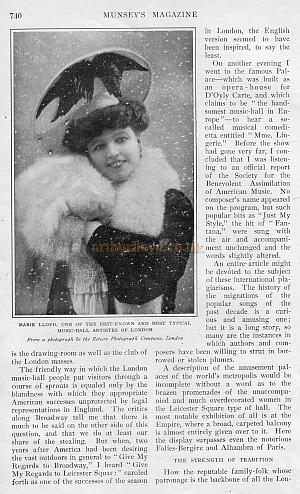
 Marie
Lloyd--" Mahrie," Londoners pronounce it-may sing a
song to-night at nine o'clock at the Oxford,
Oxford Street and Tottenham Court Road. We'll say that it's her pet,
a typically English one. " She Didn't Like to Tell Him What She
Wanted." If You take a cab, when You have heard her, and follow
her brougham to the London, you will hear her sing the same song, in
all its suggestiveness, to the sweltering mob of Shoreditchers.
But she is not the same: her song is not the same; the applause. is
not the same. For the character of that steaming, pipe-puffing houseful
has dominated the "star" -has absorbed her to be part of the
local class-club. The great Mahrie " will most likely "do"
at least two more halls before the evening is over, and if you follow
her you will find that in each instance, strong as is her personality,
it has been merged, chamelionlike, into the overpowering personality
of the hall.
Marie
Lloyd--" Mahrie," Londoners pronounce it-may sing a
song to-night at nine o'clock at the Oxford,
Oxford Street and Tottenham Court Road. We'll say that it's her pet,
a typically English one. " She Didn't Like to Tell Him What She
Wanted." If You take a cab, when You have heard her, and follow
her brougham to the London, you will hear her sing the same song, in
all its suggestiveness, to the sweltering mob of Shoreditchers.
But she is not the same: her song is not the same; the applause. is
not the same. For the character of that steaming, pipe-puffing houseful
has dominated the "star" -has absorbed her to be part of the
local class-club. The great Mahrie " will most likely "do"
at least two more halls before the evening is over, and if you follow
her you will find that in each instance, strong as is her personality,
it has been merged, chamelionlike, into the overpowering personality
of the hall.
Right - Caption Reads: Hetty King, A London Music Hall favorite who has recently appeared in America. From a photograph by the Rotary Photograph Company, London.
THE CLUBHOUSE OF THE LONDON MASSES
Here is a significant announcement from the bottom of a music-hall program:
On wet evenings the doors are opened earlier than the advertised time.
As a clubhouse for the poorer classes the music-hall is rivaled by only one other British institution - the public-house, known as a "pub " for short, and by Americans as a barroom. In the lowerclass neighborhoods the hall surpasses the " pub in popularity because it holds a bigger mob, furnishes entertainment of a fixed tvpe, and winds up by turning itself into a "pub" as well. For every hall, of every class and price, has its bar, and allows smoking throughout the house. In the days of the music-hall ,.chairman." who sat in state in an armchair. with his back to the stage, and kept his house in order by force of authority, principle. avoirdupois, and lung-power, each seat had its individual rack for holding a glass. Nowadays individual ashtrays still obtain, but one must rise and go to the bar to get liquor.
 If
You would see just how another -world-power stands in the eyes of Great
Britain, see first how it stands in the eyes of the Londoner, and to
learn that, see whether unofficial representatives of that power-such
as a detachment of men from a war-ship, or an athletic team -are invited
to some prominent music hall as guests in a body.
If
You would see just how another -world-power stands in the eyes of Great
Britain, see first how it stands in the eyes of the Londoner, and to
learn that, see whether unofficial representatives of that power-such
as a detachment of men from a war-ship, or an athletic team -are invited
to some prominent music hall as guests in a body.
Then observe how the audience treats them when they get inside. This ceremony of putting foreigners on exhibition--as were Admiral Top's men at the Alhambra and the Coliseum-is the barometer of English sentiment. Mrs. Longworth was put on exhibition, upon the occasion of her trip to England last year. in the very hall to which Togo's men were invited and she passed muster with flying colors. Her bearing, her appearance, her manner of taking the audience's demonstration, meant more, in the popular eye, than her success at a royal drawing-room; for the music-hall is the drawing-room as well as the club of the London masses.
Left - Caption Reads: R. G. Knowles, an American who has made his reputation in the London Music Halls. From a photograph by Cavendish, London.
 The
friendly way in which the London music-hall people put visitors through a course of sprouts is equaled only by the
blandness with which they appropriate American successes unprotected
by legal representations in England. The critics along Broadway tell
me that there is much to be said on the other side of this question,
and that we do at least our share of the stealing. But when, two years
after Arnerica had been desiring the vast outdoors in general to "
Give My Regards to Broadway," I heard " Give My Regards to
Leicester Square " caroled forth as one of the successes of the
season in London, the English version seemed to have been inspired,
to say the least.
The
friendly way in which the London music-hall people put visitors through a course of sprouts is equaled only by the
blandness with which they appropriate American successes unprotected
by legal representations in England. The critics along Broadway tell
me that there is much to be said on the other side of this question,
and that we do at least our share of the stealing. But when, two years
after Arnerica had been desiring the vast outdoors in general to "
Give My Regards to Broadway," I heard " Give My Regards to
Leicester Square " caroled forth as one of the successes of the
season in London, the English version seemed to have been inspired,
to say the least.
Right - Caption Reads: Marie Lloyd, one of the best known and most typical Music Hall artistes of London. From a photograph by The Rotary Photograph Company, London.
On another evening I went to the famous Palace-which was built as an opera - house for D'Oyly Carte, and which claims to be "the handsomest music-hall in Europe "-to hear a socalled musical comedietta entitled " Mme. Lingerie." Before the show had gone very far, I concluded that I was listening to an official report of the Society for the Benevolent Assimilation of American Music. No composer's name appeared on the program, but such popular bits as "Just My Style," the hit of " Fantana," were sung with the air and accompaniment unchanged and the words slightly altered.
An entire article might be devoted to the subject of these international plagiarisms. The history of the migrations of the popular songs of the past decade is a curious and amusing one; but it is a long story, so many are the instances in which authors and cornposers have been willing to strut in borrowed or stolen plumes.
A description of the amusement palaces of the world's metropolis would be incomplete without a word as to the brazen promenades of the unaccompanied and much overdecorated women in the Leicester Square type of hall. The most notable exhibition of all is at the Empire, where a broad, carpeted balcony is almost entirely given over to it. Here the display surpasses even the notorious Folies-Bergere and Alhambra of Paris.
THE STRENGTH OF TRADITION
 How
the reputable family-folk whose patronage is the backbone of all the
London music-halls tolerate this
condition, I never could understand. Yet the only hall, so far as I
know, that ever tried to get along without the overdecorated promenades,
and later without a bar and even without allowing smoking in the house,
was the Coliseum; and the Coliseum
went bankrupt.
How
the reputable family-folk whose patronage is the backbone of all the
London music-halls tolerate this
condition, I never could understand. Yet the only hall, so far as I
know, that ever tried to get along without the overdecorated promenades,
and later without a bar and even without allowing smoking in the house,
was the Coliseum; and the Coliseum
went bankrupt.
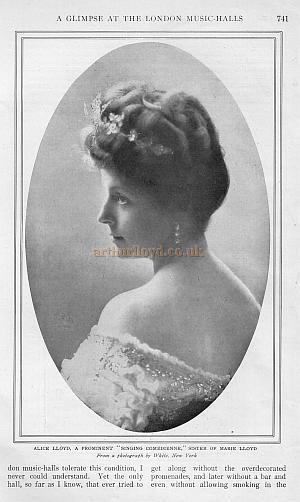
Right - Caption Reads: Alice Lloyd, A prominent "Singing Comedienne" sister of Marie Lloyd. From a photograph by White, New York.
 It had combated solid old British tradition. People came in droves at
first to see the beautiful building, a marvel of gorgeousness; to see
the royal box, with its luxurious "loungecar" anteroom, which
ran by electricity, sliding along brass rails from the auditorium to
the curbstone, to receive a royal party; to see the two " lifts,"
the only ones in any European theater; to see the great revolving triple
stage. And then, having seen once, they never came any more. It was
not their hall. It was not part
of the institution.
It had combated solid old British tradition. People came in droves at
first to see the beautiful building, a marvel of gorgeousness; to see
the royal box, with its luxurious "loungecar" anteroom, which
ran by electricity, sliding along brass rails from the auditorium to
the curbstone, to receive a royal party; to see the two " lifts,"
the only ones in any European theater; to see the great revolving triple
stage. And then, having seen once, they never came any more. It was
not their hall. It was not part
of the institution.
Left - Caption Reads: Harry Lauder, A versatile Entertainer from the London Music-Halls who has recently made a hit in America. From a photograph by The Rotary Photograph Company, London.
Furthermore, its prices were ridiculously low. The British public insists upon paying a traditional rate for everything It has for years been paying seven shillings and sixpence-only a fraction under two dollars-for a good seat at the better halls. Here was a hall asking this price for very few of its seats, with places as fine as any one could wish for three shillings -seventy-five cents-or even less. The Londoner had been paying twelve cents for his program, and the Coliseum charged only two.
 Charles
Frohman says that the only reason he has succeeded in London is that
he has respected British tradition. He has charged for program, spelling
them "programme"; he has employed female ushers; he has installed
no elevators, and, in short, has refrained from all modern improvements.
Charles
Frohman says that the only reason he has succeeded in London is that
he has respected British tradition. He has charged for program, spelling
them "programme"; he has employed female ushers; he has installed
no elevators, and, in short, has refrained from all modern improvements.
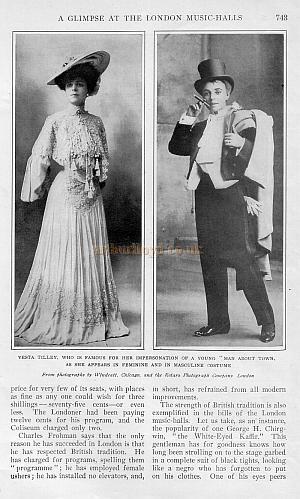
The strength of British tradition is also exemplified in the bills of the London music-halls. Let us take, as an instance, the popularity of one George H. Chirgwin, " the White-Eyed Kaffir." This gentleman has for goodness knows how long been strolling on to the stage garbed in a complete suit of black tights, looking like a negro who has forgotten to put on his clothes. One of his eyes peers forth from a lozenge-shaped splash of pure white.. This struck the British public as funny--goodness knows how many years ago.
Right - Caption Reads: Vesta Tilley, who is famous for her impersinations of a young "Man about town". As she appears in Feminine and Masucline costume. From photographs by Windeatt, Chicago, and The Rotary Photograph Company, London.
 The
white-eyed gentleman does nothing more than tell a few stories--which
were new goodness knows how many years ago--and play an odd instrument
or two. This last he does remarkably well. But do you know that if he
tried to change his make-up now, after goodness knows how many years,
he would be "booed" off the stage? So he will go on in the
same way, no doubt, for goodness knows how many years more. His get-up
was sufficient for the Londoner's father, so it is sufficient for the
Londoner, just as you still have a quill pen handed to you in many London
banks, when you are cashing a draft, and are being regarded by the bank
men as either an American millionaire or an American swindler--two of
our national types that have impressed themselves most strongly on the
British imagination.
The
white-eyed gentleman does nothing more than tell a few stories--which
were new goodness knows how many years ago--and play an odd instrument
or two. This last he does remarkably well. But do you know that if he
tried to change his make-up now, after goodness knows how many years,
he would be "booed" off the stage? So he will go on in the
same way, no doubt, for goodness knows how many years more. His get-up
was sufficient for the Londoner's father, so it is sufficient for the
Londoner, just as you still have a quill pen handed to you in many London
banks, when you are cashing a draft, and are being regarded by the bank
men as either an American millionaire or an American swindler--two of
our national types that have impressed themselves most strongly on the
British imagination.
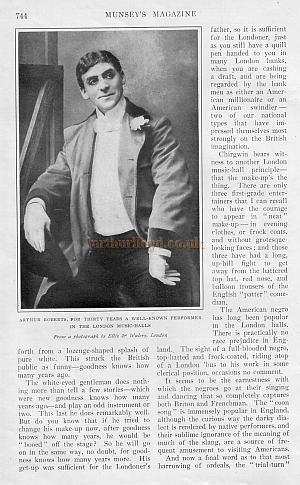
Left - Caption Reads: Arthur Roberts, for thirty years, a well known performer in the London Music-Halls. From a photograph by Ellis & Walery, London.
Chirgwin bears witness to another London music-hall principle that the make-up's the thing. There are only three first-grade entertainers that I can recall who have the courage to appear in "neat" make-up - in evening clothes, or frock coats, and without grotesque looking faces; and those three have had a long, tip-hill fight to get away from the battered top hat, red nose, and balloon trousers of the English "Patter" comedian.
 The American negro has long been popular in the London
halls. There is practically no race prejudice in England. - The sight
of a full-blooded negro, top-hatted and frock-coated, riding atop of
a London 'bus to his work in some clerical position. occasions no comment.
The American negro has long been popular in the London
halls. There is practically no race prejudice in England. - The sight
of a full-blooded negro, top-hatted and frock-coated, riding atop of
a London 'bus to his work in some clerical position. occasions no comment.
It seems to be the earnestness with which the negroes go at their singing and dancing that so completely captures both Briton and Frenchman. The "coon song" is immensely popular in England, although the curious way the darky dialect is rendered by native performers, and their sublime ignorance of the meaning of much of the slang, are a source of frequent amusement to visiting Americans.
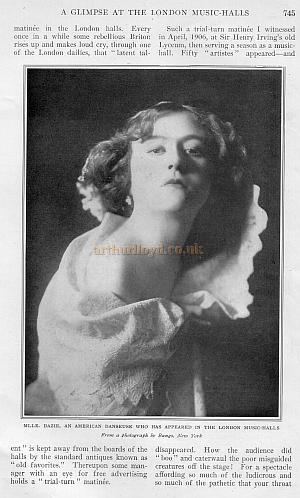
Right - Caption Reads: Mlle. Dazie, an American Danseuse who has appeared in the London Music-Halls. From a photograph by Bangs, New York.
 And
now a final word as to that most harrowing of ordeals, the " trial-turn
" matinee in the London halls.
Every once in a while some rebellious Briton rises up and makes loud
cry, through one of the London dailies, that "latent talent "
is kept away from the boards of the halls by the standard antiques known
as "old favorites." Thereupon some manager with an eye for
free advertising holds a " trial-turn " matinee. Such a trial-turn
matinee I witnessed in April, 1906,
at Sir Henry Irving's old Lyceum,
then serving a season as a music hall. Fifty " artistes "
appeared-and disappeared. How the audience did " boo " and
caterwaul the poor misguided creatures off the stage! For a spectacle
affording so much of the ludicrous and so much of the pathetic that
your throat is bursting with laughter while your heart is bursting with
pity, the trial-turn matinee in London could scarcely be equaled the
world over.
And
now a final word as to that most harrowing of ordeals, the " trial-turn
" matinee in the London halls.
Every once in a while some rebellious Briton rises up and makes loud
cry, through one of the London dailies, that "latent talent "
is kept away from the boards of the halls by the standard antiques known
as "old favorites." Thereupon some manager with an eye for
free advertising holds a " trial-turn " matinee. Such a trial-turn
matinee I witnessed in April, 1906,
at Sir Henry Irving's old Lyceum,
then serving a season as a music hall. Fifty " artistes "
appeared-and disappeared. How the audience did " boo " and
caterwaul the poor misguided creatures off the stage! For a spectacle
affording so much of the ludicrous and so much of the pathetic that
your throat is bursting with laughter while your heart is bursting with
pity, the trial-turn matinee in London could scarcely be equaled the
world over.
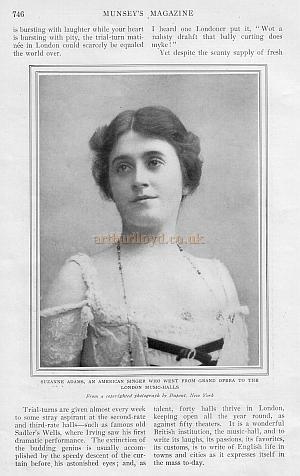
Left - Caption Reads: Suzanne Adams, An American singer who went from Grand Opera to the London Music-Halls. From a photograph by Dupont, New York.
Trial-turns are given almost every week to some stray aspirant at the second-rate and third-rate halls-such as famous old Sadler's Wells, where Irving saw his first dramatic performance. The extinction of the budding genius is usually accomplished by the speedy descent of the curtain before his astonished eyes; and, as I heard one Londoner put it, " 'Wot a nahsty drahft that bally curting does myke'"
Yet despite the scanty supply of fresh talent, forty halls thrive in London, keeping open all the year round, as against fifty theaters. It is a wonderful British institution, the music-hall, and to write its laughs, its passions, its favorites, its customs, is to write of English life in towns and cities as it expresses itself in the mass to-day.