
The Alhambra Cinema, Moseley Road, Balsall Heath, Birmingham
See Also - The Alhambra Theatre (Unbuilt)
Birmingham Index
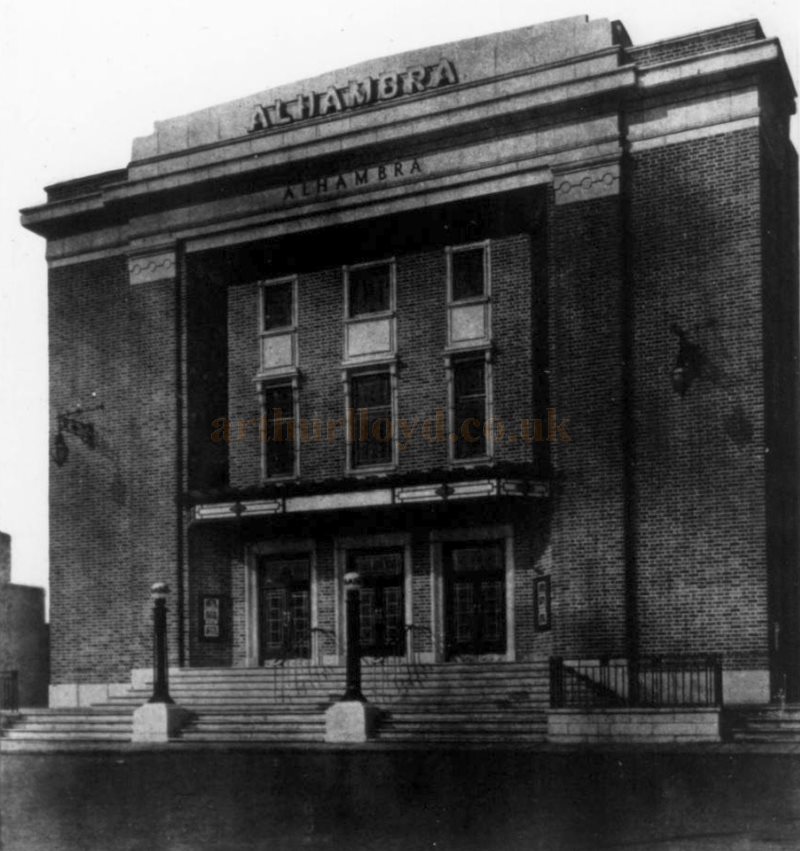
Above - The Exterior and Main Entrance of the Alhambra Cinema, Birmingham - From the Academy Architecture and Architectural Review of 1929.

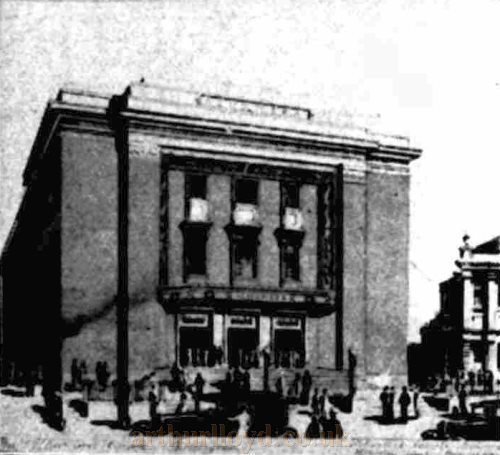 The Alhambra Cinema was situated on Moseley Road in the Balsall Heath area of Birmingham and first opened on Boxing Day, the 26th of December 1928, with a showing of the Film 'The Scarlet Pimpernel'.
Built Primarily as a Cinema it also had a small Stage and Orchestra Pit for the presentation of Variety acts and the like.
Right - The Exterior and Main Entrance of the Alhambra Cinema, Birmingham - From the Kinematograph Weekly, 3rd of January 1929.
The Alhambra was the first Cinema in Birmingham to have an Auditorium designed in the Atmospheric Style and was designed by the Birmingham Architects Satchwell and Roberts, with Construction by C. Bryant and Son. Ltd.
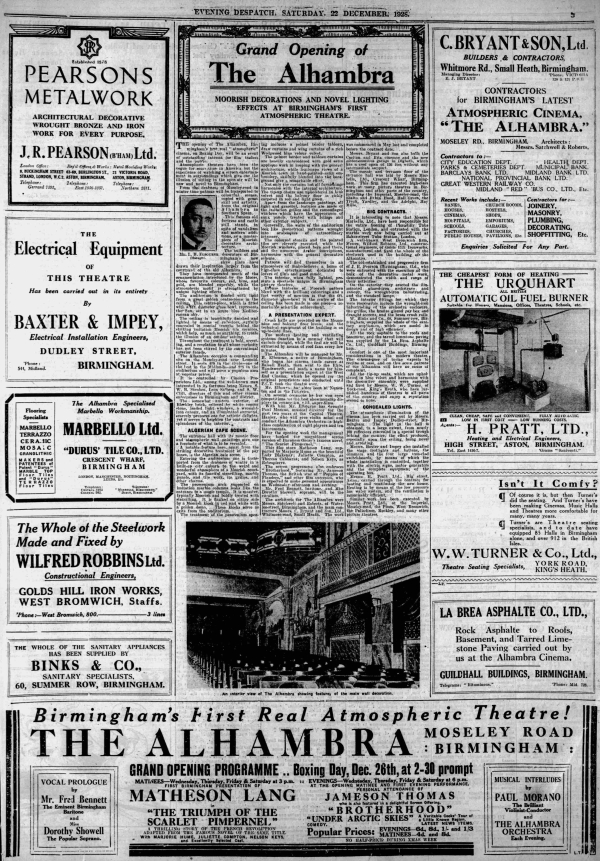
The Evening Despatch reported on the new Cinema in their 22nd of December 1928 edition saying:- 'The opening of The Alhambra, Birmingham's first real "atmospheric" cinema, on Boxing Day, will be an event of outstanding interest for film traders and the public. Atmospheric theatres have been the vogue for some time in America but the experience of watching a screen entertainment in surroundings which give one the illusion of sitting in the open air will be new and novel to Birmingham.
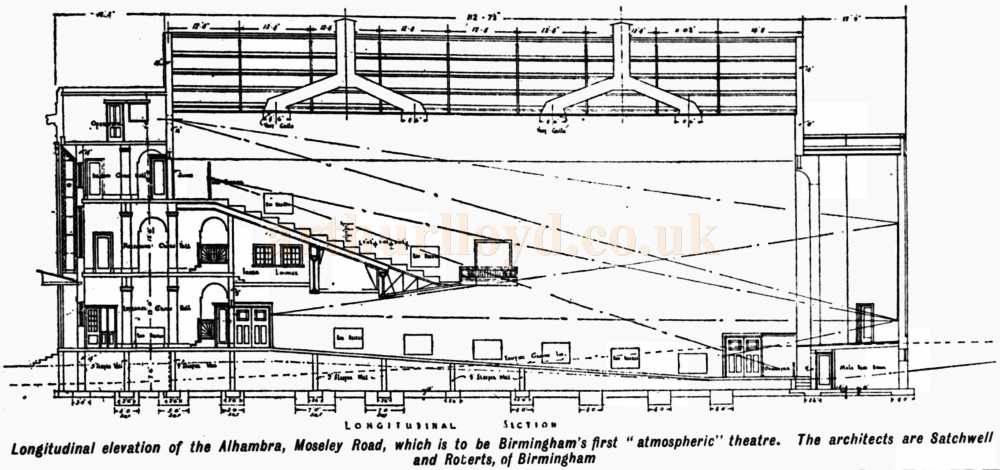
Above - An Early Longitudinal Elevation Plan of the Alhambra Cinema, Birmingham - From the Kinematograph Weekly, 19th of April 1928.
From the drabness of Moseley-road in winter time patrons will be transported to colourful scenes, copied with great skill and artistry, from the original Alhambra in Southern Spain. This famous old fortress and castle still stands, in spite of vandalism and modern additions, as a masters piece of Moorish decorative architecture.
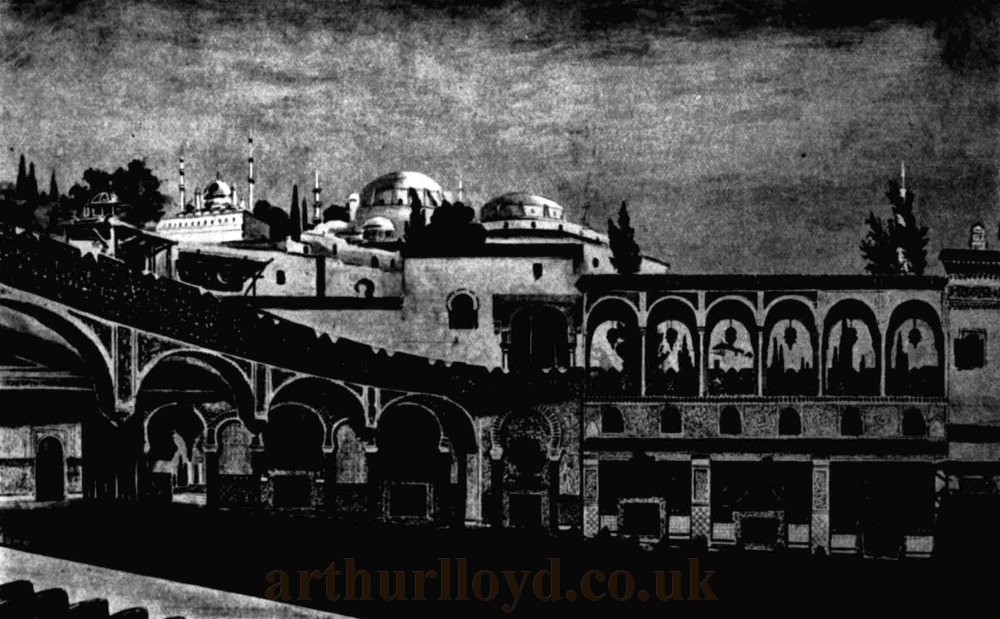
Above - Designs for the Auditorium of the Alhambra Cinema whilst under construction in 1928 - From the Kinematograph Weekly, 17th of May 1928.
The builders and decorators of Birmingham's new show place have drawn their inspiration largely from the courtyard of the old Alhambra. They have incorporated much of the ornamentation introduced by the Moors, whose favourite colours, red, blue, and gold, are blended superbly, while the atmospheric motif is strengthened by unique lighting effects.
The auditorium is flooded with light from a great golden centre-piece in the ceiling. This centre-piece, which is fitted with a 6ft diameter glass bowl, represents the sun set in an azure blue Mediterranean sky. The ceiling is beautifully finished and lighted by means of reflectors, artfully concealed in special troughs behind the striking imitation Moorish tile cornices, which help, as much as anything, to create the illusion of an outdoor setting. Throughout the treatment is bold, arresting, and a revelation to all whose curiosity has not been stirred by the conventional exterior facade.

Above - The Auditorium of the Alhambra Cinema when it first opened in 1928 - From an Advertisement for Turner Theatre Furnishers in the Kinematograph Weekly, 28th of March 1929.
The Alhambra occupies a commanding site on the Moseley-road near Leopold-street. It seats 420 in the circle - one of the best in the Midlands - and 928 in the auditorium and will serve a populous area at popular prices. It is controlled by Cinema Proprietors Ltd.., among the well-known men interested in its fortunes being Messrs, S. W. B. Stephen, Leon Sa'berg, and S. W. Clift, directors of this and other cinema enterprises in Birmingham and district.
The somewhat austere exterior of Blockley brick, relieved by white coping stone, leaded light windows, a wrought iron canopy, and an illuminated surround, scarcely prepares one for the artistic delights, yet it serves to heighten the contrasts and splendours of the interior.
The entrance hall with its mosaic floor and atmospheric wall paintings give one a foretaste of what is to be revealed. A notable feature here, apart from the striking decorative treatment of the pay boxes, is the Algerian cafe seen. Entering the auditorium one is transported from the drabness of winter, in a built-up city suburb, to the weird and wonderful atmosphere of a Moorish court-yard, with its fanciful stencilling, marble panels, and tile work, its grilles, and other charms.
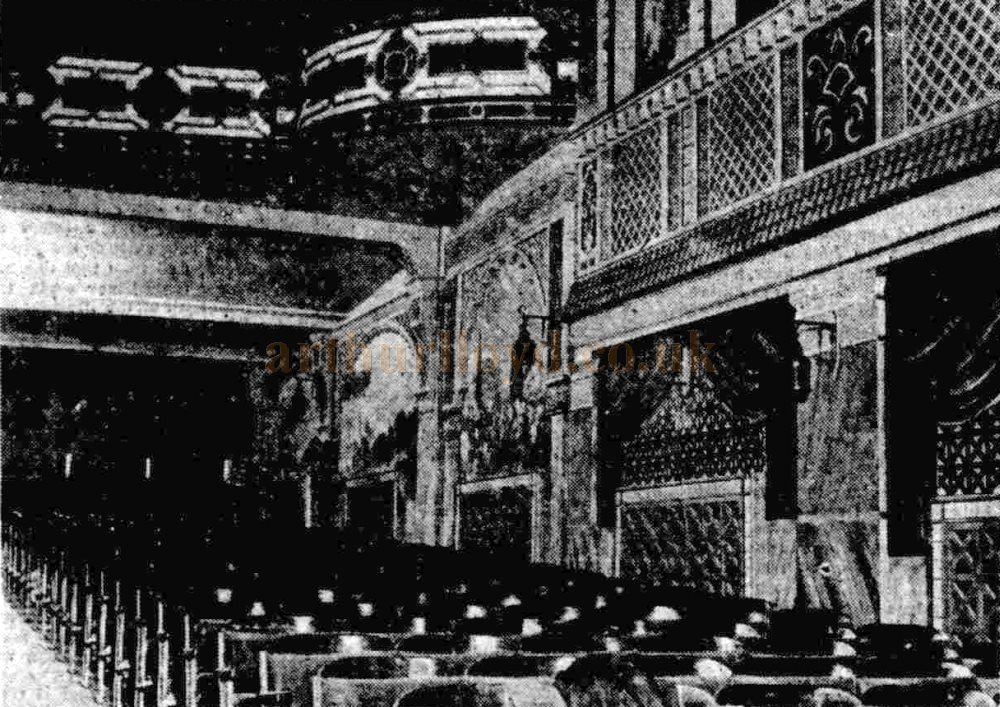
Above - The wonderful Atmospheric Auditorium of the Alhambra Cinema when it first opened in 1928 - From The Evening Despatch, 22nd of December 1928.
The proscenium area supported on imitation marble columns looks like the entrance to a magic temple. It is massive, typically Moorish and boldly treated with stencilling. It is flanked on either side by a Moorish kiosk in red and white with a golden dome. These kiosks serve as exits from the auditorium.
The treatment of the proscenium opening includes a pelmet border tableau, draw curtains end wing curtains of a rich Wedgwood blue velour velvet. The pelmet border and tableau curtains are heavily embroidered with gold satin applique work in keeping with the general architecture, while landscape views of a Moorish town in hand-painted satin embroidery, skillfully blended into the background give a remarkable effect.
Not only the curtains but all furnishings harmonise with the internal architecture. The tip-up chairs are upholstered in blue velvet and the balcony floor is richly carpeted in red and light green. Apart from the landscape paintings, all light and graceful, features are made of the imitation grilles and the camouflaged windows which have the appearance of sunk panels, treated with foliage and other exterior subjects.
Generally, the walls of the auditorium look like geometrical patterns wrought into arabesques of extraordinary intricacy. The coloured stencils and the painted tiles are cleverly executed, while the Moorish windows, placed here and there, and the numerous Arabic inscriptions, harmonise with the general decorative scheme. Patrons will find themselves in an atmosphere of make-believe; a home of entertainment dedicated to lovers of films and good music.
The interior, when fully lighted, presents a spectacle unique in Birmingham picture theatres. Bronze lanterns of Moorish pattern blend with the brilliant colourings and a fact worthy of mention is that the 6ft. diameter glass bowl in the centre of the ceiling has been made in one piece - a remarkable scientific achievement.
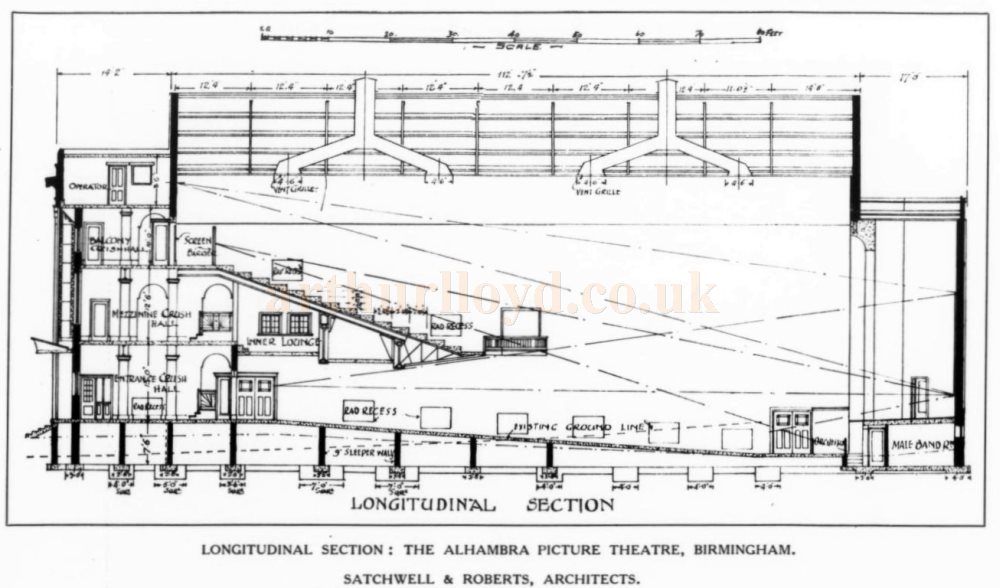
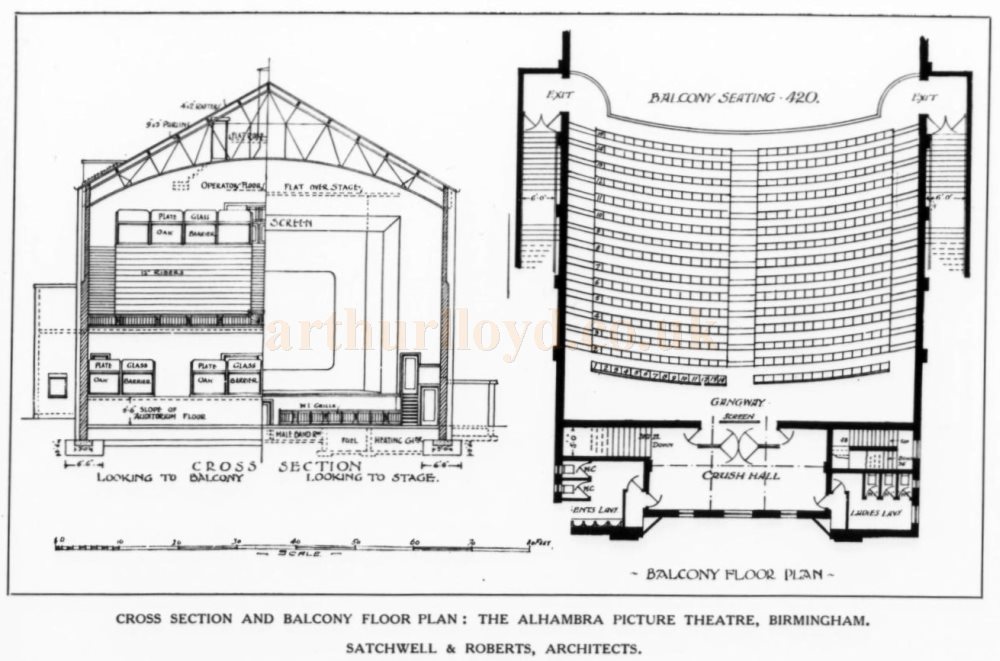
Above - Satchwell & Roberts Plans of the Alhambra Cinema, Birmingham - From the Academy Architecture and Architectural Review of 1929.
 Crush halls are provided on the Mezzanine and balcony floor and the technical equipment of the building is on up-to-date lines. The modern heating end ventilating systems function in a manner that will exclude draught, while the fowl air will be extracted by means of roof fans every few minutes.
The Alhambra will be managed by Mr. H. Elbourne, a native of Birmingham, who began his cinema trade career at Balsall Heath, then went to the Elite, Handsworth, and made a name for himself as a presentation expert at the West End Cinema, which he opened for the original proprietors and conducted until P.C.T. took the theatre over.
Right - L. H. Elbourne, Manager of the Alhambra Cinema, Birmingham when it opened in 1928 - From the Evening Despatch, 22nd of December 1928.
Mr. Elbourne has since been at Nuneaton and in the Potteries. On several occasions he has won open competitions tor the best showmanship displays in connection with super-films. With him Mr. Elbourne has brought Paul Marano, musical director for the past two years at the Capitol Theatre, Hanley, who will give violin solos and conduct the Alhambra Orchestra - a high-class combination of eight players and ten instruments.
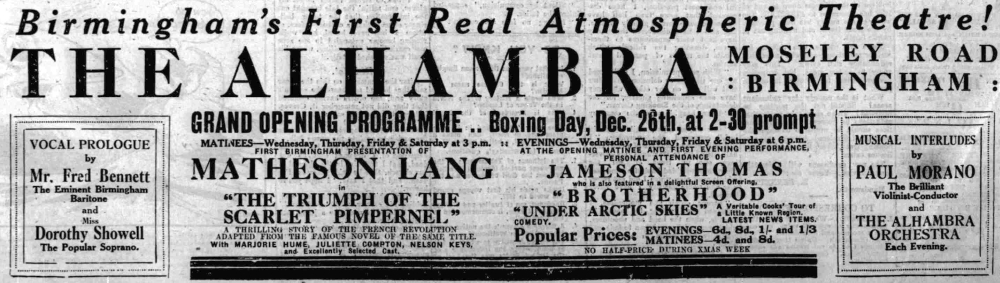
Above - An Advertisement for the Opening of the Alhambra Cinema, Birmingham in 1928 - From the Evening Despatch, 22nd of December 1928.
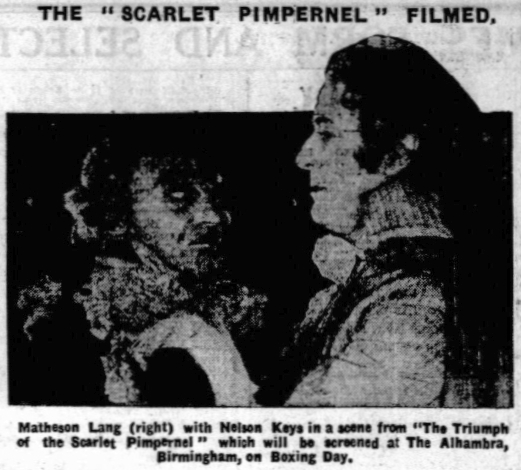 For the Opening week the management have booked the magnificent screen version of Baroness Orezy's famous novel, "The Scarlet Pimpernel." This film stars Matheson Lang, supported by Marjorie Hume us the beautiful Lady Blakenay; Juliette Compton, as Theresa Cabbaras; and Nelson Keys, as Robespierre.
Right - An Advertisement for 'Scarlet Pimpernel' the Opening Film at the Alhambra Cinema, Birmingham in 1928 - From the Evening Despatch, 24th of December 1928.
The screen programme also embraces "Brotherhood," featuring Mr. Jameson Thomas, the British star of "Poppies of Flanders," and other film successes, who is expected to make a personal appearances on Wednesday afternoon and evening. Mr. Fred Bennett, baritone, and Miss Dorothy Showell, soprano, will be the vocalists.
The architects for The Alhambra were Messrs. Satchwell and Roberts, of Waterloo-street, Birmingham, and the main contractors Messrs. C. Bryant and Son. Ltd., Whitmore-road, Small Heath. The work was completed in May last and completed before the contract date.
 Messrs. Bryant and Son also built the Carlton and Ritz cinemas and the new motor omnibus garage in Digbeth, which has a roof span of 130 feet without any intermediate support. The mosaic and terrazzo floor of the entrance hall was laid by Messrs Marbello, Ltd., Crescent Wharf, Birmingham. This firm has executed high-class work at many picture theatres in Birmingham and other parts of the country, including the Imperial, Moseley-road, the Rialto and Robin Hood, Hall Green, the Tivoli, Yardley, and the Adelphi, Hay Mills.
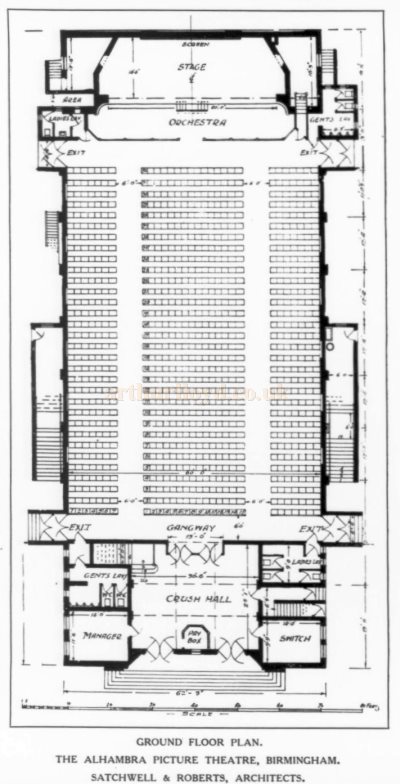
Left - Satchwell & Roberts Ground Floor Plan of the Alhambra Cinema, Birmingham - From the Academy Architecture and Architectural Review of 1929.
It is Interesting to note that Messrs Marbello, Ltd., have been responsible for the entire flooring of Piccadilly Tube Station in London, and entrusted with the marble work now being carried out at Baker-street Tube Station, London. A well-known West Bromwich firm, Messrs. Wilfred Robbins Ltd., constructional engineers, of Golds Hill Ironworks, manufactured and fixed the whole of the steel work used in the building of the Alhambra. The old-established and progressive firm of J. R. Pearson (Birmingham), Ltd., who were entrusted with the execution of the bulk of the decorative metal work, demonstrated the width and range of their activities. On the exterior they erected the illuminated glazed-iron architrave and canopy, the wrought-iron balustrading, and the standard lamps. The interior fittings for which they were responsible include the wrought-iron balustrading of the orchestra enclosure, the grilles, the bronze glazed pay box and draught screens, and the brass crush rails
W. Binks and Co., Summer-row, Birmingham, supplied the whole of the sanitary appliances, which are a model in design and of high efficiency, all the the rock asphalt to the roofs and basement, and the tarred limestone paving was supplied by the La Brea Asphalt Co., Ltd., Guildhall Buildings, Birmingham.
 Comfort is one of the most important considerations in the modern theatre. The cinema-goer of to-day expects to recline at ease and on this score patrons of the Alhambra will have no cause for complaint. All the tip-up seats, which are upholstered in blue velvet and harmonise with the decorative ensemble, were supplied and fixed by Messrs. W. W. Turner, of York-road, King's Heath, who have furnished hundreds of theatres in all parts of the country and enjoy a reputation second to none.
Right - An Illustrated Full Page Advertising Feature on the new Alhambra Cinema, Birmingham from which the text has been Transcribed here - From the Evening Despatch, 22nd of December 1928.
The atmospheric illumination of the cinema has been carried out by Messrs. Baxter and Impey, Dudley-street, Birmingham. The light in the hall is obtained, to a large extent, from nearly 100 reflectors concealed in a special trough behind the cornice, the effect produced, especially upon the ceiling, being novel and arresting.
Messrs. Baxter and Impey also installed the stage footlights and battens, the dimmers and the four large iron-clad switchboards, by means of which the whole installation is controlled, together with the electric signs, motor generators and the complete equipment of the operating box. Messrs H. Pratt Ltd., High-street, Aston, carried through the contract for heating and ventilating the new house. Heating is by means of the low pressure hot water system, and the ventilation is remarkably efficient. Similar work has been executed by Messrs. Pratt, Ltd., at the Imperial, Mosley-road, the Plaza, West Bromwich, the Palladium, Hockley, and many other picture theatres.'
The above text in quotes (edited) was first published in the Evening Despatch, 22nd of December 1928.
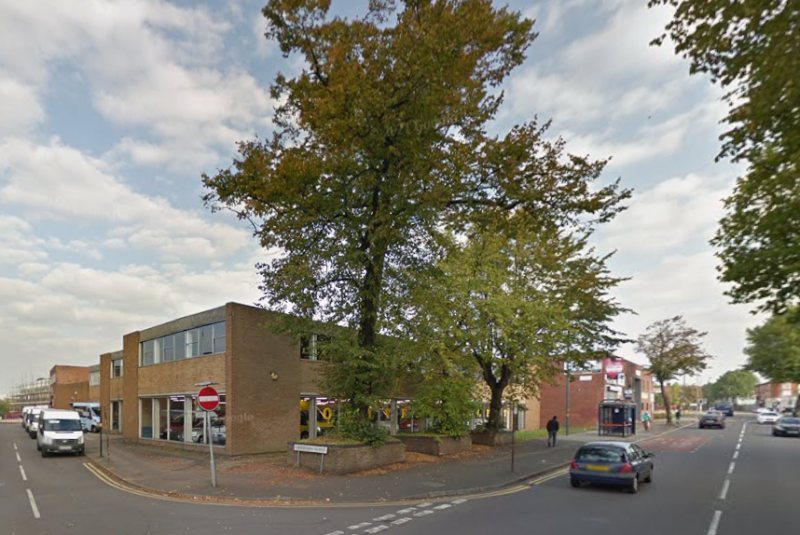
Above - A Google StreetView Image of the site of the former Alhambra Cinema, Birmingham - Click to Interact.
 The Alhambra Cinema had first opened on Boxing Day, the 26th of December 1928, but was taken over by Associated British Cinemas (ABC) in April 1930 who continued to run it until they eventually closed it on the 31st of August 1968.
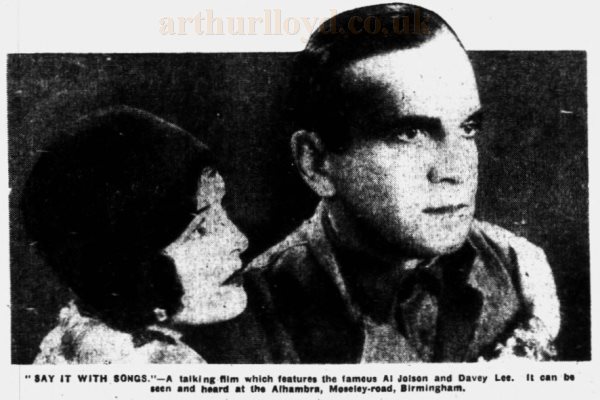
Right - An Image of Al Jolson and Davey Lee in 'Say it with songs' at the Alhambra Cinema, Birmingham in 1930 - From the Birmingham Weekly Mercury, 11th of May 1930.
Over the years the Cinema's wonderful Atmospheric Auditorium decoration was gradually painted over and it was later operated as an Asian Cinema showing Bollywood style Films. The Alhambra Cinema was finally closed in 1974 and was then demolished for the building of a School on its site. Today the site is occupied by Commercial buildings.
If you have any more information or Images for this Theatre that you are willing to share please Contact me.