
The Grand Theatre, 46 North Road, Brighton
Formerly - Ginnett's Hippodrome / The Eden Theatre / Grand Cinema
Brighton's Theatres Index

Above - The Grand Theatre, North Road, Brighton

 The
Grand Theatre, Brighton was
designed by the renowned Theatre Architect, Frank Matcham, who used the local architects Clayton and Black to oversea the construction. The Theatre originally opened as the Eden Theatre with a production of 'Little Christopher Columbus' on Monday the 10th of September 1894. The Theatre, which was situated on North Road, Brighton, and could accommodate 2,000 people, was a conversion of a former Circus building called Ginnett's Hippodrome which had opened some years earlier.
The
Grand Theatre, Brighton was
designed by the renowned Theatre Architect, Frank Matcham, who used the local architects Clayton and Black to oversea the construction. The Theatre originally opened as the Eden Theatre with a production of 'Little Christopher Columbus' on Monday the 10th of September 1894. The Theatre, which was situated on North Road, Brighton, and could accommodate 2,000 people, was a conversion of a former Circus building called Ginnett's Hippodrome which had opened some years earlier.
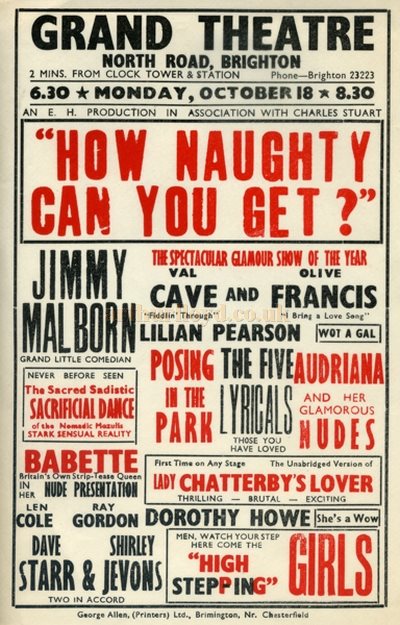
Right - A Poster for the Grand Theatre, Brighton in its later years - Courtesy Maurice Poole.
The ERA reported on the opening of the new Eden Theatre in their 15th of September 1894 edition saying:- 'On Monday evening the Eden Theatre, North-road, Brighton, was opened to the public. The new theatre was formerly known as Ginnett's Hippodrome, and has been reconstructed by the Brighton Empire Company. The chief alterations effected consist of the erection of a stage with dressing-rooms on the site of what was formerly the gallery of the Circus (the proscenium having been brought level with the wall at the extremity of the side promenade); the reflooring and seating of the whole of the space within the railings of the lower promenade; and the erection of a new gallery over the upper promenade.
 The new ground floor is appropriated for stalls, pit stalls, and pit. Seats have been placed within the promenade and upper-circle, a portion of the promenade being utilised as a foyer. The private boxes have been retained, but have been reupholstered and decorated in uniformity with the general scheme of embellishment. The prevailing hues are terra cotta - the colour of the wall papering - deepening to crimson in some of the seats and curtains and turquoise blue, the flooring being carpeted with blue felt.
Left - A Programme for Lupino Lane in 'Jack and the Beanstalk' at The Grand Theatre in 1947 -Click for details.
A spacious stage has been erected with all necessary mechanical appliances. Excellent precautions against lire and panic have been taken. The building is entirely isolated. and is provided with ample exits and entrances, the staircases being fireproof. The electric light has been installed everywhere, though the building is also fitted throughout for gas.
Right - A Programme for Lupino Lane in 'Me and My Girl' at The Grand Theatre in 1947 - Click for details.
 The theatre is calculated to afford accommodation for 2,000 persons. A fireproof curtain has been fitted by Bell's Asbestos Company. The architects who have superintended the alterations are Messrs Clayton and Black, of North-street, the contractors being Messrs V.P. Freeman and Co., of Kensington-place.
Left - A Programme for 'Peek A Boo' at the Grand Theatre, Brighton in August 1954 - Click for details.
The electric installation is by Messrs Paine and Thompson, of Queen's-road; the carpeting and furnishing by Messrs Broadbridge and Sons, Western-road; the new seating, by Messrs Dean, of Birmingham; Mr James Henry, late of the Theatre Royal, Birmingham; is responsible for the stage fittings; and some admirable scenes have been supplied by Mr Walter Drury, the scenic artist at the Eden Theatre. Mr Leolyn Hart, of London, has painted a new act-drop and the proscenium borders. Most of the iron work throughout the building is by Messrs Reed and Son, of the Regent Foundry; and the fire-extinguishing appliances have been all tested by Fire Superintendent Lacroix. The chairman of the Empire Company, Mr R. Clowes; the general manager, Mr J. A. Botham; the secretary of the company, Mr Fred Trussell; and the acting-manager, Mr Arthur M'Culloch, have all been most assiduous in bringing the undertaking to a satisfactory issue, and they and all concerned are to be congratulated on their success in this direction.
 On the opening night Mr J. A. Botham (general manager), in a short speech, said the new theatre would be carried on by the same company that had made the Empire Theatre in the New-road a success. Smoking would be allowed at all the performances excepting the matinees
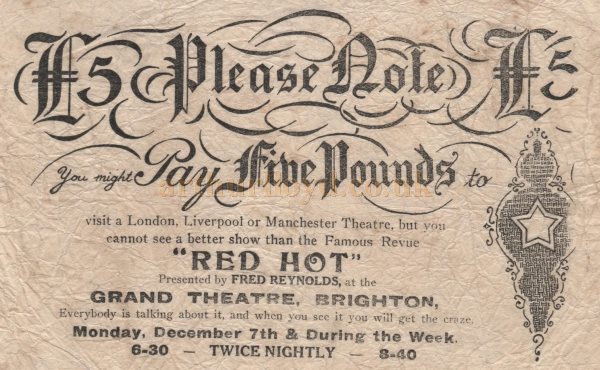
Right - An Advertising note for 'RED HOT' presented by Fred Reynolds at the Grand Theatre Brighton dating probably from the 1930s. The note is the same size as a Bank of England white fiver - Courtesy William McCreath.
He introduced Mr A. M'Culloch, the acting-manager, and alluded to that gentleman's experience with Mr Beerbohm Tree. The National Anthem was sung, Mr Welbye Wallace leading off the solo.'
The above text in quotes was first published in the ERA, 15th of September 1894.
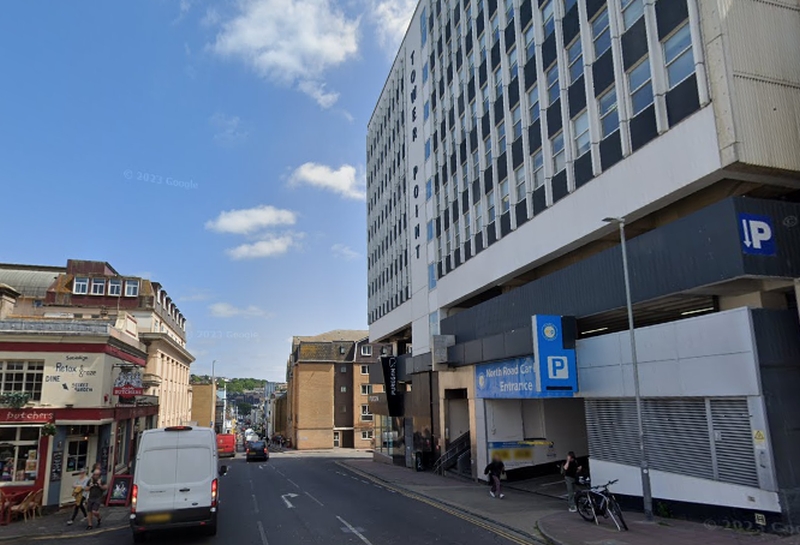
Above - A Google StreetView Image showing the site of the former Eden Theatre / Grand Theatre on North Road, Brighton in June 2023 - Click to Interact.
 The Eden Theatre had opened on the 10th of September 1894 and ran as such for a number of years before it was eventually taken over by Ernest Carpenter in 1904. He reopened it as the Grand Theatre on Monday the 18th of July 1904 with a production of 'Boy Bob', with a crowded house and the Mayor and Mayoress of Brighton in attendance.
Right - A Programme for 'Cheer-O' at the Grand Theatre, Brighton for the week of November the 24th 1919 - Click for details.
The Grand Theatre was converted for Cinema use in 1930 when it reopened as the Grand Cinema with a smaller capacity of 1,200 people. It was fitted with Western Electric sound equipment the following year to be able to show the latest 'Talkie' films.
 The Grand ran as a Cinema until October 1940 when it was converted back to live theatre use and reopened as the Grand Theatre again housing variety shows on its stage for the next 15 years.
Left - Ronne Conn on stage at the Grand Theatre, Brighton in 1941 - Courtesy Maxine Warner, Ronne Conn's Niece.
The Grand Theatre was closed on the 31st of January 1955 after the last performance of 'New Year Road Show'. It was then converted for use as a furniture factory but was destroyed by fire 10 years later in 1965. The Theatre was then demolished and an Office Building called Gresham House was constructed on the site.