
The Regent Theatre, Castle Street, Bristol
Later - Gaumont Cinema
Bristol Index
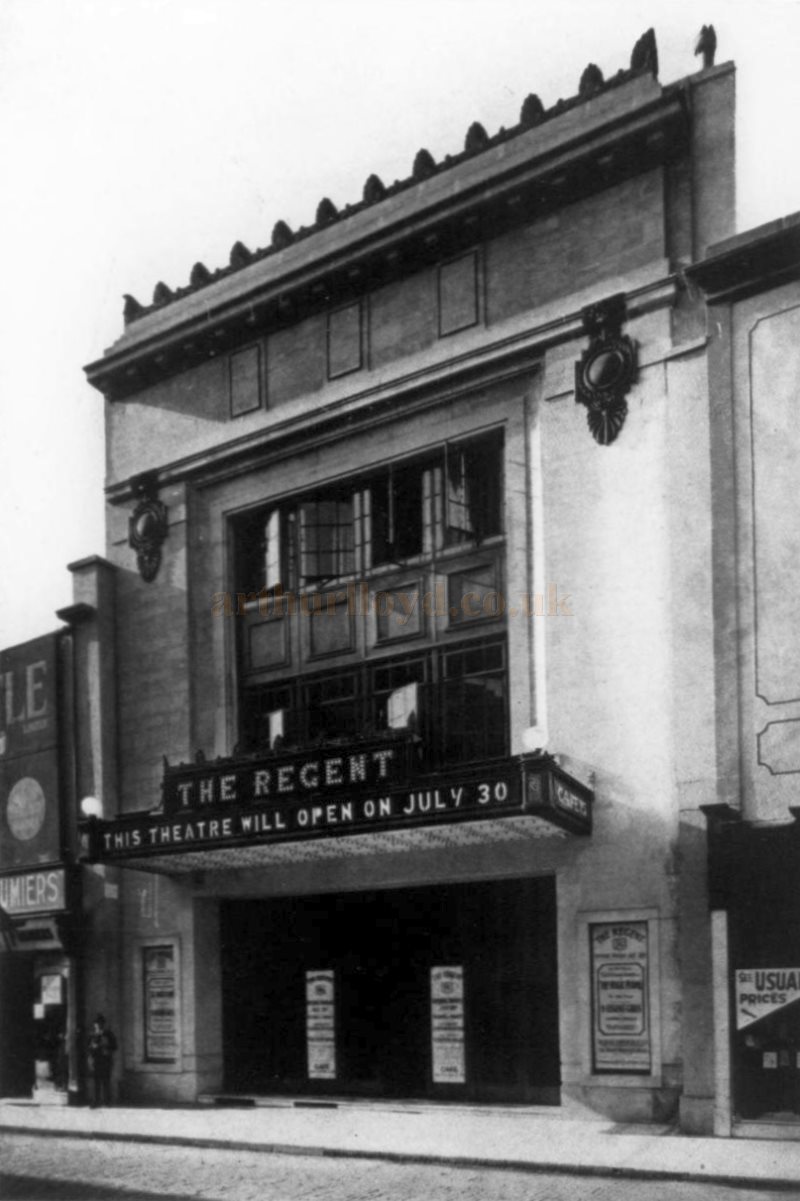
Above - The Regent Theatre, Bristol when it first opened in 1928 - From the Academy Architecture and Architectural Review of 1929.

 The Regent Theatre was situated on Castle Street in Bristol and was built for Provincial Cinematograph Theatres Ltd. (P.C.T.), and designed by the architect W. H. Watkins. The Theatre opened on the 30th of July 1928.
Right - Architect W. H. Watkins who designed the Regent Theatre, Bristol - From the Kinematograph Weekly, 26th of July 1928.
The Regent was built as a Super Cinema, primarily for the showing of Films, but it also and had large fully equipped stage, 80 feet wide by 40 feet deep, for the production of Variety shows and the like, along with Dressing Rooms for its Artists, and a Wurlitzer Theatre Organ on a rising lift from the Orchestra Pit.
The Theatre also had a Large Balcony Lounge above the Main Entrance, a Flat for the Manager above this, and a large Tea Lounge and Cafe situated under the Balcony which ran the whole width of the Theatre. The Theatre's Auditorium was constructed on two levels, Stalls and one Balcony, and could seat 2,100 people when it first opened in 1928.
The Kinematograph Weekly reported on the new Theatre in their 26th of July 1928 edition saying:- 'The Regent Picture House, the new P.C.T. house in Bristol, which is to be opened on July 30, marks a big advance in kinema construction in the West of England, and is the largest picture theatre in this part of the country. The house, which has been admirably planned by the architect, W. H. Watkins, F.R.I.B.A., of Bristol, occupies an extensive site, reaching from Castle Street to the river bank, a site which is within what were the precincts of old Bristol Castle.
The main entrance facade is carried out in a dignified treatment of stone and bronze, and has a striking canopy. On each side of the entrance are bronze frames flush with the wall for advertisements. Four pairs of entrance doors in bronze give access to a spacious vestibule, with a floor of black and white marble. Wide, staircases in marble mosaic lead to the café, tea lounge, balcony and all parts of the auditorium. There is a secondary entrance from Peter Street, opening into a spacious crush hall.
The café and tea lounge, which is 120 ft. long, and runs the whole width of the building below the balcony, has an arcade treatment, and is charmingly decorated in ivory and titian red, with a silhouette frieze of dancing nymphs.
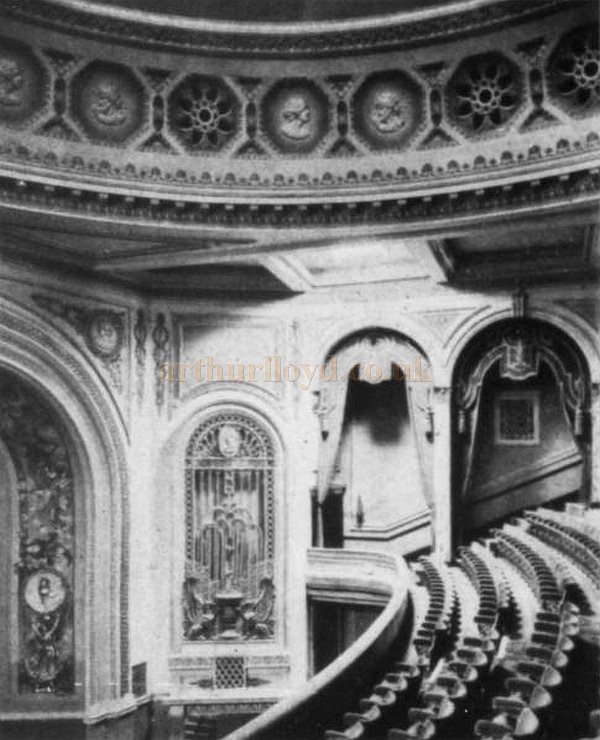 The theatre has a seating capacity of 2,100, and by means of wide spaces at the back standing room is provided for another 300 persons. In addition, the spacious crush halls in the building give accommodation for 1,000 persons, who can wait in comfort. Thus queues have been eliminated. The whole of the seating consists of tip-up armchairs, upholstered in rose pink, which, with the carpets, have been supplied by W. W. Turner and Co., Ltd., Birmingham.
Left - The Auditorium of the Regent Theatre, Bristol - From an Advertisement for H. H. Martin & Co. Ltd., decorators of the Theatre.
The scheme of decoration is one of warmth and brilliancy, the general tone being ivory and titian reds, which are blended harmoniously with soft greens and gold. The most striking feature of the auditorium is the handsome dome with its sunburst and cloudy blue effect, which is enhanced by the reflected lighting.
Another feature has been made of the large grills at the side of the proscenium, which have been painted in varying tones of green, gold and silver, the result of this treatment being to give the effect of fountains. The theatre is decorated generally on Roman lines, but liberty has been taken with the style to suit the requirements of the structure. The vestibule, staircase, halls and balcony lounge wall surfaces have been treated with stuco.
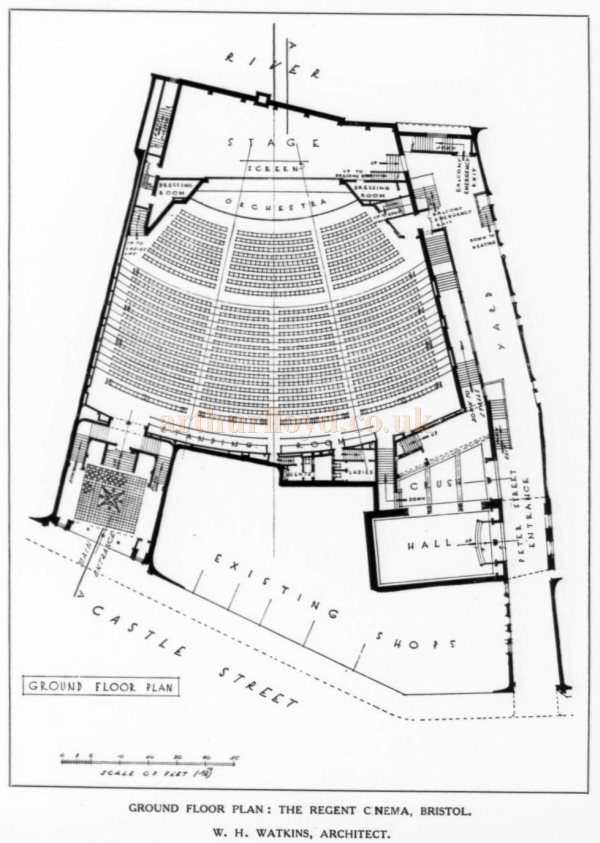 The proscenium is a freely proportioned arch, whose simple splayed reveal is delightfully decorated with a procession of carnival figures in various rich colours upon a background of purple. Lighting is amber in colour and of the concealed type. The proscenium arch opening is 32 ft. high and 48 ft. wide.
Right - W. H. Watkins' Ground Floor Plan of the Regent Theatre, Bristol - From the Academy Architecture and Architectural Review of 1929.
The balcony is one of the finest to be found in any theatre, and is supported by a main girder 112 ft. long, 8 ft. 3 in. deep, and weighing 57 tons.
The stage is 80 ft., with a depth of 40 ft., and a floor space of 2,000 sq. ft., and has an equipment which will permit of any class of entertainment to be put on, and is provided with ample dressing-room accommodation.
The lighting is by four-colour battens and footlights. The system of house lighting is concealed three-colour, and the building contains between 500 and 600 lamps. The secondary lighting system consists of a full battery set which enables all lamps in the house to be lit at full brilliancy.
The house has a Wurlitzer organ, which can be raised above the level of the orchestra on a rise and fall lift; the two organ chambers are over the proscenium area, the music entering the hall through the two ornamental grilles.
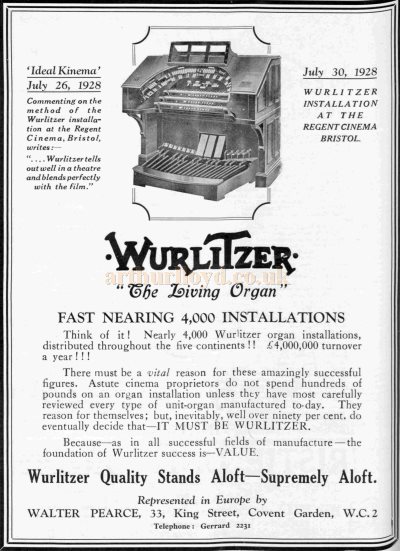 The model selected by P.C.T. is the popular Model F. Wurlitzer, which although by no means a large instrument, has ample volume for any picture theatre, some perhaps the largest in this country. The console is of the two-manual type, but by means of the "double-touch," i.e., the use of extra pressure keys, the organist can bring into play many additional stops. This "double-touch" in effect, of course, gives the organist a third manual.
Left - An Advertisement for Wurlitzer Theatre Organs as installed at the Regent Theatre, Bristol - From The Bioscope, 1st of August 1928.
The most recent improvements are embodied in the Regent Wurlitzer, which represents the maker's latest efforts to give the public a perfect instrument.
In addition to having the full range and volume of the church organ, the instrument is capable of producing the tones of every musical instrument, and in addition numerous touch effects for turning the screen story into music.
The thrills of fire can be realistically portrayed, aeroplanes, trains, horses galloping, the tom-tom of the native, and many other incidental effects are available to the instrumentalist. The wind pressure for the organ is supplied by a five horse-power motor.
 The total weight of the organ including the blower is nearly five tons, and its pipes range from 16 ft. in length, with a diameter of about a foot, down to a tiny pipe a few inches long, with a diameter of a fraction of an inch.
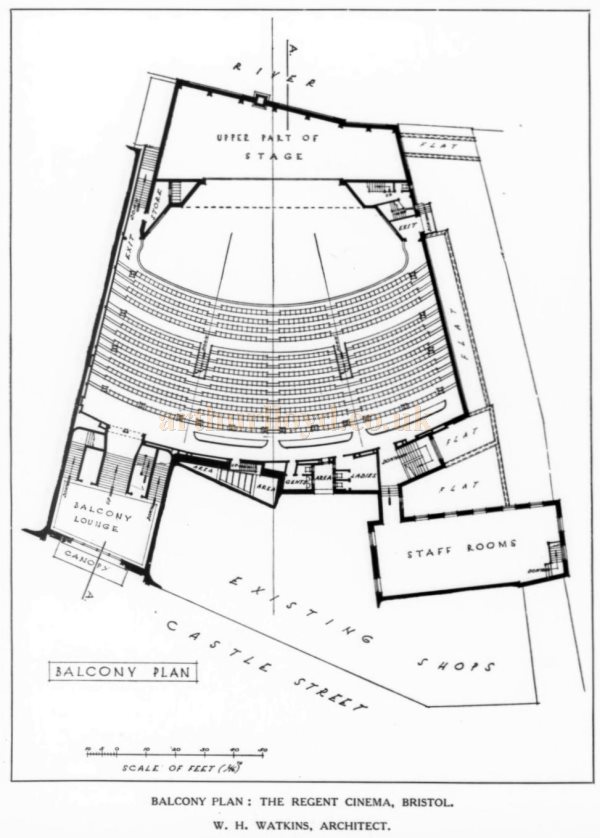
Right - W. H. Watkins' Balcony Plan of the Regent Theatre, Bristol - From the Academy Architecture and Architectural Review of 1929.
Heating and ventilation are carried out on the Plenum system, the plant occupying basements 90 ft. by 25 ft., and consisting of steam boilers having a total evaporation of 5,000 lb. of steam per hour, and fired with oil fuel from storage tanks having a total capacity of 18 tons. Purified and warmed air is delivered through a main duct under the floor and enters the auditorium and cafe at various points through grills in such a manner that there is no suggestion of draught, even to people sitting alongside the grating. Down draughts in the centre of the auditorium are entirely eliminated by means of a special system fixed under the floor, which is automatically controlled to prevent the temperature of the floor rising above the comfort level. The extraction fans in the dome are capable of clearing the air in the building every few minutes, while an automatic arrangement in the dome prevents any possibility of a stagnant atmosphere when the building is closed.
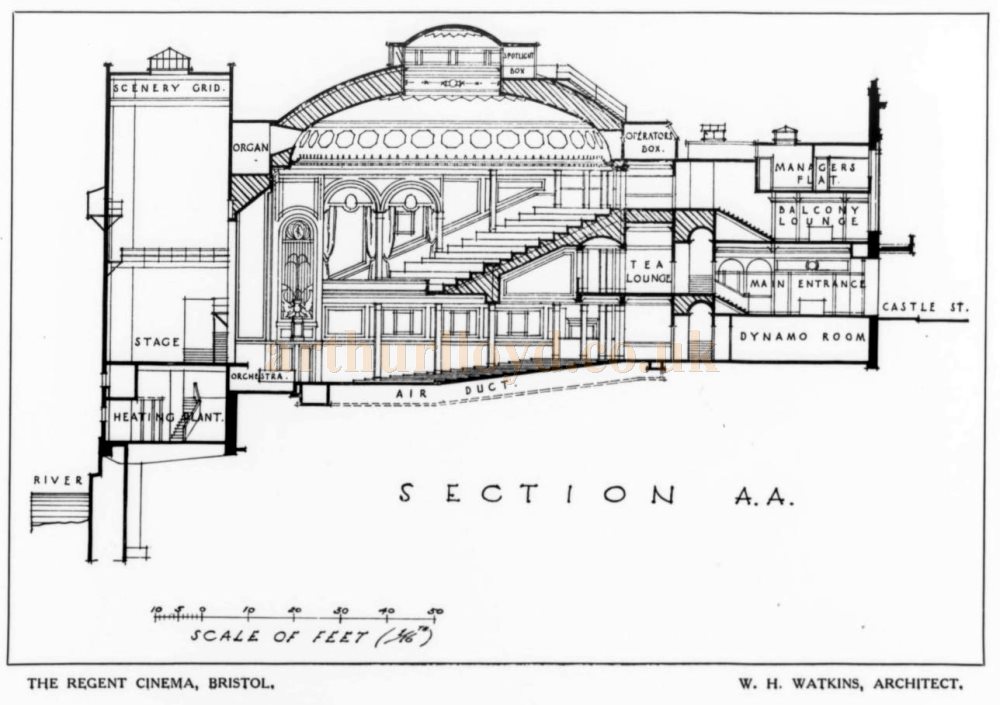
Above - W. H. Watkins' Section Plan of the Regent Theatre, Bristol - From the Academy Architecture and Architectural Review of 1929.
The operating box is well equipped with two of the latest Kalee No. 8 projectors. Each is equipped with high intensity arcs. There are six spotlights, including one of the latest mechanical models. There is a crew of five. The switchboard is of the enclosed type, with push-button control, all resistances being outside the box. It is operated by means of push buttons by the side of the machines. All house lighting is controlled from the box. The secondary lighting system consists of complete battery set, voltage 210, enabling all lamps in the house to be lit at full brilliancy. Current is taken from the Corporation mains; there are two generators, the average load being about 600 amps.
Two screens have been installed, the main screen at the back, with a front screen for use while stage is being set. The main screen is a Jupiter patent seamless silver screen installed by the Bulman Jupiter Screen Co., Ltd.'
The above text in quotes was first published in the Kinematograph Weekly, 26th of July 1928.
The Regent Theatre had first opened on the 30th of July 1928 under the ownership of Provincial Cinematograph Theatres Ltd., and would have quite a short life as it turned out. The Theatre was taken over by Gaumont British Theatres in the early 1930's but was destroyed by bombing in the Second World War on the 24th of November 1940 and was never rebuilt.
What was left of the Theatre was demolished in 1963.
If you have any more information or Images for this Theatre that you are willing to share please Contact me.