
Theatres in Carlisle, Cumbria
Her Majesty's Theatre - Palace Theatre - The Carlisle Theatre - Theatre Royal
See Also - Theatres in Barrow in Furness, Cumbria - Theatres in Ulverston, Cumbria
The Palace Theatre, 120 Botchergate, Carlisle
Later - The New Palace Theatre / Studio Cinema / Studios 1-4 / United Services Club

Above - A Google StreetView Image of the site of the former Palace Theatre, Carlisle - Click to Interact.
 The Palace Theatre Carlisle was situated in Botchergate. Built behind an arcade of shops designed by architect W. P. Gibbings which had been constructed in 1902. The Theatre was built in 1905 behind this arcade, using the arcade as the main entrance via a covered verandah into the Theatre. The building covered an area of 1,500 square yards and cost £10,000 to construct and was built for the Carlisle Palace Theatre Co Ltd. The architects were Messrs Owen and Ward of Birmingham and the contracts for the construction and equipment used were placed with local companies. The Theatre opened on Monday the 5th of March 1906.
Signor Rino Pepi, the Barrow entrepreneur ran the Palace in conjunction with his Halls in Barrow in Furness, Middlesbrough, and the Hippodrome in Blackpool. Mr A. E. Nicholls of Blackpool was appointed acting Manager. Mr J. D. Askew was the Stage Manager, and Mr Henry Hinchcliffe I. R. A. M. conductor of the orchestra.
The Theatre was a three tiered house consisting of Stalls, seating 100 people, behind which was the Pit area, seating 600 people, above was the Circle, seating 300 people, and above that the Gallery, seating 400 people. The Stalls/Pit area had a raked floor giving everyone a clear view of the stage. There were 4 exits provided at each area of the Theatre for fast exit should the need arise. Staircases were fireproof, with plenty of hydrants present throughout the Theatre. The latest ventilation and heating arrangements were installed with electric light throughout supplied by two separate cables. There were 8 miles of wires used in the fitting and lighting equal to 1,500 8 candle power lamps.
The interior decorations and ornamentation were described as rich, elegant and tasteful. The ceiling, boxes, circle and gallery fronts all decorated in fibrous plaster work, the colour scheme being Gold, Cream and Pale Blue.
The proscenium opening was 30 feet wide flanked by two private boxes. The stage was 60 feet wide by 30 feet deep, and the Theatre had an Act Drop depicting Maypole Dancers. Eight dressing rooms were provided, described as comfortable, conveniently fitted and well lit, in a separate two storey building adjacent to the stage.
Tip up seats were fitted in the stalls and grand circle supplied by Messrs Brookfields of Stafford, who also seated the Pit area.
At the grand opening crowds gathered early and the doors opened at 7.00pm, soon every part of the new Theatre was packed. The curtain rose to reveal various Directors and Officials present on stage. Miss Georgina Leonard advanced to the footlights and sang the verses of the National Anthem with all the audience upstanding and joining in with the refrain, at the end of which there was loud cheering. Mr Councillor Long (a director) 'wished to extend to them a hearty welcome to the building which he hoped they would consider a credit to the city.' He then introduced Signor Pepi the Managing Director, who thanked the audience for their patronage and was pleased that so many ladies were present. Next Mr Ward, the architect spoke, thanking the local contractors.
After this the programme of Variety commenced with Marion Scott who sang 'Put a little bit away for a rainy day,' to which there was hearty applause as she was presented with a bouquet. Next Mr Barney Fox delighted the audience with his clever and amusing ventriloquial entertainment. This was followed by Ike Scott and son in a nautical sketch, which they supplemented with an equally sunny representation of a policeman's 'daily day.' Next up was Mr Tom Stuart with an artistic and dramatic character sketch of 'Wilfred Denver and Gaspard,' then Miss Georgina Leonard sang a couple of songs to everyone's satisfaction. Next on the bill was Lieut Albini's 'Mysterious Lady' act which proved 'interesting and entertaining.' His amusing patter with his 'Committee of inspection' created roars of laughter. This was followed by The Brothers Redmond who were acrobatic comedians. Finally, top of the bill were the ever popular Bella and Bijou who gave 3 clever sketches. The proceedings ended with films shown on Vernon's Bioscope.
The Theatre ran a two houses per night policy.
In 1908 the Theatre was losing money, and Signor Pepi's services were dispensed with, resulting in the Theatre closing down. It was then leased to Frank MacNaghten, who immediately spent a considerable amount of money in alterations and decorations. The Theatre re-opening as the New Palace Theatre on Easter Bank Holiday Monday 1909, with a large bill topped by the Will Douglas's Troupe of Five Jolly Bakers. A late tram was put on to take passengers and patrons back to Newton after the last performance. Mr Julius Simpson, from West Hartlepool, was the new manager. Arrangements were made with the Gaumont Company to regularly supply 'Palace Pictures' which became an important part of future programmes.
Under Frank MacNaghten's control the Palace Theatre began to flourish. Ten years later in 1919, Frank MacNaghten took over the lease from the company and the Carlisle Palace passed into control of the MacNaghten Vaudeville Circuit.
In June 1932 the building was altered to become a full time Cinema. The original interior was stripped out and replaced with a new plainer style of decoration. It re-opened in 1933.
By 1950 the Cinema was advertised as now proudly having a Cafe.
In 1957 the McNaughten Vaudeville Circuit closed the Cinema and it was then operated by an independent cinema company until 30th March 1960, when the Leeds based Star Cinema's chain took it over and renamed it the 'Studio Cinema.' By July 1970 the Cinema had been twinned, with seating for 576 in the largest screen, and 350 seats in the smaller cinema. However, soon afterwards it was altered again now being subdivided into four smaller cinema's, seating 336 – 238 – 109 – 114 seats. Now renamed Studios 1- 4. Star Cinema's were taken over by the Cannon Group in 1985. Films carried on being shown until it closed on the 1st of March 1987. It's Cinema days were now over and it was then converted into the 'United Services Club' which finally closed in 1999.
 The building was then boarded up and finally demolished in approximately 2004.
In 2020 the arcade of shops still remained forming the entrance to an open air car park and block of flats built on the site of the Theatre.
Right - A Google StreetView Image of the site of the former Palace Theatre, Carlisle - Click to Interact.
The above article was researched and written for this site by David Garratt in September 2020.
If you have any more information or Images for this Theatre that you are willing to share please Contact me.
Her Majesty's Theatre, Lowther Street, Carlisle
Formerly - The Victoria Hall - Later - The Municipal Theatre / The Regal Bingo Club

Above - A photograph of Her Majesty's Theatre, Carlisle - Original image source unknown, please Contact me.

 This Theatre was originally constructed as the Victoria Hall and was situated on Lowther Street, Carlisle, opening on Monday the 26th of October 1874 with a performance of the 'Messiah. The Victoria Hall was advertised at the time as being able to seat 2,000 people and was available as a Theatre or a Circus. It was used for various purposes until being converted into a proper Theatre in 1879. The new Theatre opened with the new name of Her Majesty's Theatre on Monday the 7th of June 1879 with a larger stage and a reduced seating capacity in Stalls and Pit, Dress Circle, and Gallery combined of 1,600.
Right - An early advertisement for Her Majesty's Theatre, Carlisle - From the Carlisle Express and Examiner, 26th January 1884.
In 1882 the Carlisle Express and Examiner lists the Lessee as Mr Charles Bernard with the Acting Manager being Mr J. E. Miller, and advertising the week commencing 29th April 1882 for performances of 'The Colonel' by Edgar Bruce.
The pantomime at Christmas 1889 was 'Little Red Riding Hood.' being Messrs Imeson's third Grand Pantomime, playing to crowded audiences and featuring Magnificent stage pictures, a Palace Grand Procession, and Wonderful Acrobats. Special trains were laid on for Friday 8th February 1890 leaving Maryport at 6.05pm and on Saturday 9th February 1890 leaving Langholm at 6.0pm, calling at intermediate stations. Evening performances commenced at 7.45pm (doors opened at & 7.15pm) and Saturday matinees commenced at 2.0pm, (doors opened at 1.30pm).
The Carlisle Patriot newspaper of Friday August 16th 1889 reports on the grand re-opening of the Theatre after extensive alterations, including decorating and re-seating the Theatre, with a 'Grand Fashionable Night.' The following week commencing 26th August there was a visit by the Dacre Comedy company in the 'greatest farcical comedy' 'Betsy' re-produced as at the Criterion Theatre for the 3rd time.
Also there was the 'Grand Attraction' for 6 nights of Miss Glady's Heathcoats Comic Opera in the celebrated Opera Comique 'La Mascotte'. 'Powerful Company and Chorus.' Prices were advertised as: Dress Circle 3/- (15 pence today); Side Boxes and Orchestral Stalls 2/- (10 pence today); Pit 1/- (5pence today); and Gallery sixpence (2 and half pence today).
The Christmas attraction for 1889 which commenced on December 23rd was Wilson Barrett's celebrated Drama 'The Golden Ladder' with original scenery and effects, and later 'A Man's Shadow'.
On Monday the 4th of August 1890 the Theatre re-opened after its summer recess with Mr Balsir Chatterton's company performing the drama 'In the Queens Name', Monday through to Thursday, with 'Captain Swift' being performed on the Friday evening.
Early films were screened in the Theatre in 1897.

Above - The auditorium of Her Majesty's Theatre, Carlisle with a packed audience for a performance of the Moody Manners Opera Company production of 'Maritana' in 1907 - Original image source unknown, please Contact me.
 There was a serious fire on the morning of the 15th of September 1904, destroying much of the Theatre's stage area and the auditorium, with damages estimated at £6,000. The previous evening 'The Country Girl' had been playing to a packed house at the Theatre, some of the scenery and dresses for the production were said to have been saved but the Theatre was totally gutted.
Right - An article from the Stage Newspaper of the 21st of September 1905 on the reopening of Her Majesty's Theatre, Carlisle.
After the fire the interior was rebuilt to the designs of Newcastle architects Bendle and Hope. The alterations consisted of a new brick wall proscenium to the designs of Mr Boekbinder, the well known decorator, built by Messrs Gordon and Logan, and fitted with a fireproof curtain made by Messrs Oldroyd and Co, of Leeds. This curtain, which worked automatically, could be lowered instantaneously, and was lowered and raised at each performance during one of the intervals.
The stage roof was also raised during the rebuild, which allowed scenery to be fully flown above the stage, thus enabling the Theatre to stage the largest scenic productions. New dressing rooms were also built and a new fireproof band room incorporated. Fireproof automatic closing doors were also fitted to the stage area.
The auditorium now consisted of orchestral stalls behind which originally was the pit area. Above this was the dress circle and above that, the Gallery. On each side of the proscenium were stage boxes.
The newly rebuilt Her Majesty's Theatre was formally reopened by the Mayor on the 14th of September 1905, but the opening season began on the following Monday with a production of 'San Toy' by George Edward's Company.
Other opening season productions were:- 'The Moneymakers,' which played the Theatre during the tennis tournament week. 'Monsieur Beauclaire'; Mr George Edwards 'Country Girl' company; 'La Poupee'; The Turner opera Company; Mr Edward Terry; Messrs D'Oyly Carte's Opera Company; 'Kitty Grey'; the Philharmonic Society in 'Haddon Hall'; and the 'Belle of New York' company.
For the week commencing the 23rd of October 1905, George Dance's principal company appeared in 'The Girl from Kays,' the entire production direct from London's Apollo Theatre. The Libretto was by Owen Hall with music by Ivan Caryll. Miss Poppy Poole played the title role, Mr Legai Robinson was Hon Percy Fitzthistle, Tom Seymour was the Hall Porter, Miss Emily Taylor was the bride, and Miss Lily Beaumont played the mother in law, along with George Blunt - comedian, and Mabel Dent – soubrette.
It was also noted in the The Carlisle Journal of 24th October 1905 that the orchestral floor had been raised by 9 inches due to previous complaints by performers that they could not see, nor hear the orchestra, which had led to various problems since the reopening of the Theatre.
 The following week, commencing 30th October 1905, there was a return visit of Mr Edward Terry and his entire company from Terry's Theatre London.
Films were being screened by 1912, but by 1919 the Theatre had adopted a programme of live stage productions including Plays, Musicals, Variety and Pantomime.
Left - An advertisement for Her Majesty's Theatre, Carlilse - From the Penrith Observer, 28th September 1937.
In 1933, commencing on the 27th of December, Mr Lionel Lightfoot's company presented 'Diplomacy' by Victorien Sardon. Prices were: Dress Circle 4/9d (23 pence today), Upper Circle 3/6d (17 pence today), stalls 3 shillings (15 pence today), rear stalls 2 shillings (10 pence today), pit 1/3d (8 pence today), and Gallery 6d (2.5 pence today).
 On the week commencing the 30th of September 1935 Mr Lionel Lightfoot presented 'Secrets' by Rudolf Besier and Mary Edgington. On Monday October the 7th 1935 there was a Variety show starring Reginald Bolton (Blackpool's Favourite) called 'Footlight Frolics.' The Christmas pantomime for 1935, which began on the 23rd of December, was 'Dick Whittington.' In February 1936 a Variety programme was broadcast from the stage of Her Majesty's on the Radio at 9.15pm till 10.00pm.
In November 1955 the Theatre advertised the Carlisle & District Boy Scouts Associations production of 'The Gang Show of 1955, commencing at 7.15pm with a Saturday matinee at 2.15pm. 'The terrific all Scout Revue by Ralph Reader, produced by John Sullivan with a cast of 150 Boy Scouts.'
Right - An article from the Stage Newspaper of the 3rd of March 1980 on the demolition of Her Majesty's Theatre, Carlisle.
Her Majesty's Theatre was renamed the Municipal Theatre in the early 1960's, however, in 1963 the Theatre was converted into a 'Regal Bingo Club'. This was later run by EMI from September 1976 who spent some £45,000 on the building, but this only lasted up until December 1978 when it was closed for good. After this the Theatre stood empty and unused before it was finally demolished in 1980, the site of the Theatre is still empty today and is currently being used as a car park, see image below.

Above - A Google StreetView Image of the site of the former Her Majesty's Theatre, Carlisle - Click to Interact.
The above article was originally researched and written for this site by David Garratt in May 2020, and was updated by M.L. in November 2021.
If you have any more information or Images for this Theatre that you are willing to share please Contact me.
The Carlisle Theatre, Blackfriars Street, Carlisle

Above - A Google StreetView Image showing the former Carlisle Theatre, Blackfriars Street in August 2018 - Click to Interact.
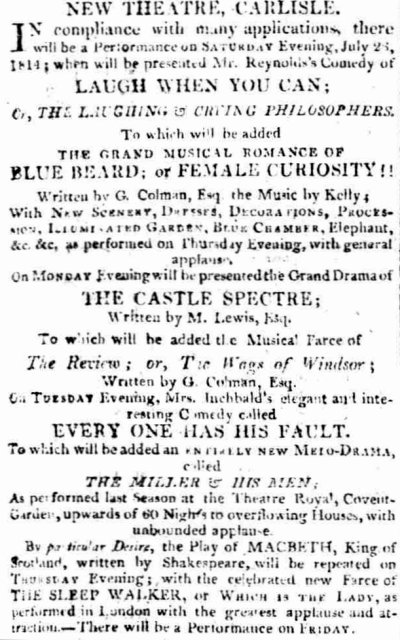 The Carlisle Theatre was situated on Blackfriars Street and first opened in July 1814. It was the first Theatre to be built in the City and was run on its opening by the Dublin born Actor Manager William Macready, whose son William Charles Macready would go on to become one of the most famous actors of the Victorian stage.
It is said in various places that the Carlisle Theatre opened on the 11th of July 1814 although I've been unable to find a mention of this in contemporary newspapers of the period, but it was certainly being advertised as being open on the 23rd of July 1814 in the Carlisle Journal, see advertisement shown right.
Right - An Advertisement for the new Carlisle Theatre - From the Carlisle Journal, 23rd of July 1814.
The Theatre appears to have been open for summer seasons only and was operated by William Macready for several years. In June 1817 when the Theatre closed for the season Macready took a Benefit and made a nice speech thanking the audience for their patronage. Although the Macready season ended in June the Theatre put on various other productions into August that year.
In August 1823 the Theatre was being managed by the actor William Alexander who would perform at the Theatre for many years although in 1826 whilst performing the part of Rob Roy in the play of the same name he was shot in the face by a prop musket and lost his sight temporarily.
Also in 1826 the well known actor Charles Kemble performed at the Carlisle Theatre, and in 1829 Macready was back performing in the tragedy 'Virginius' for two nights. In 1831 William Alexander was back, performing in a short season from September.
In July 1832 an accident happened at the Theatre when workmen were digging underneath the stage and undermined a partition wall which brought down the roof of the Theatre, luckily no one was killed in the collapse. How long it took to repair the Theatre is not documented but William Alexander was back for its reopening in October 1834 with a 'respectable company from Glasgow'.
In November 1835 however, William Alexander, who had managed the Carlisle Theatre off and on for 20 years retired from acting and managing the Theatre saying in his farewell address that theatricals in the city were on the wane, and he attributed this to the 'upper classes' being taught to avoid theatricals as being 'pernicious to their morals'. Within a couple of weeks Alexander had taken up the Theatre Royal, Glasgow and reopened that Theatre with a production of Shakespeare's 'Macbeth'.
 The following year the Lease of the Carlisle Theatre was taken for a short season by a Mr. Martin, reopening it in Whitsun week but attendances were poor. He reopened the Theatre again in November 1836 but he doesn't appear to have much success then either and the following year the Theatre was taken over by a Mr. Connor, followed by a Mr. Burroughs in October 1838.
Left - A 'To Let' Advertisement for the Carlisle Theatre in 1843 - From the Carlisle Journal, 5th of August 1843.
The Carlisle Theatre went on to have a succession of different Managers for the next decade culminating in Daly's management in 1845 and its final closure in June 1848.
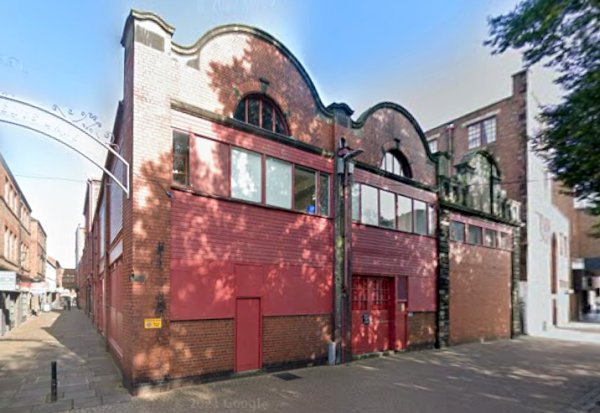 After the Theatre's closure in June 1848 the press of the time were speculating that the Theatre was to be converted into small houses but instead it was converted for warehouse use by the Barton Family. In 1903, the site was absorbed into a Robinson Brothers' department store, later becoming part of Binns and eventually a House of Fraser store.
Right - A Google StreetView Image showing the former Carlisle Theatre, Blackfriars Street in September 2020 - Click to Interact.
Today part of the current building is in use as a Cafe Nero and Tesco store but the back of the building on Blackfriars Street, which was originally the Theatre and later a warehouse, is currently to let. A Plaque on the building placed by the Carlisle and District Civic Trust reads:- 'Here stood the Theatre built by William Macready 1813'.
Some of the information for this Theatre was kindly sent in by Jack Dunn.
If you have any more information or Images for this Theatre that you are willing to share please Contact me.
The Theatre Royal, Carlisle
 The Theatre Royal, Carlisle appears to have opened in July 1840, or at least that's the first advertisement I can find for it in the Newspapers of the time.
In 1866 and 1867 the actor John Wylsone had been the lessee of the Theatre Royal, Kilmarnock but then went on to manage the Theatre Royal, Carlisle whilst also having his own touring company, the London Dramatic Star Company.
The Theatre Royal, Carlisle was destroyed by fire on the 15th of September 1904.
Right - A Poster for the Theatre Royal, Carlisle for the 6th of April 1946 - Courtesy Jason Williamson.
If you have any more information or Images for this Theatre that you are willing to share please Contact me.