
The Crouch End Hippodrome, Tottenham Lane, Crouch End, London
Formerly - The Proposed Athenaeum / The Queen's Opera House
Early History - Destruction by Fire in 1904 and Reopening in 1905 - The Crouch End Hippodrome 1906 - Destruction by Fire in 1942
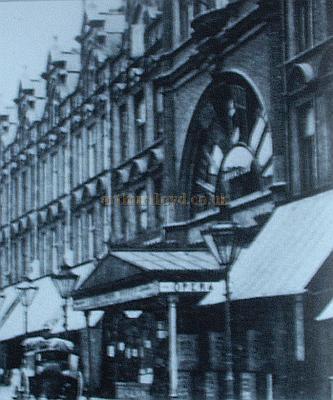

Above - The Queen's Opera House, Crouch End, later the Hippodrome, from the book 'Images of Hornsey and Crouch End' by Ken Gay. And The building in 2004 M.L., at the time called 'Holmes Place.

 The
Crouch End Hippodrome was situated on Tottenham Lane in Crouch End, and originally opened as the Queen's Opera House on
Tuesday the 27th of July 1897 with a production of 'The Geisha', see advertisement shown right.
The
Crouch End Hippodrome was situated on Tottenham Lane in Crouch End, and originally opened as the Queen's Opera House on
Tuesday the 27th of July 1897 with a production of 'The Geisha', see advertisement shown right.
The Theatre was the result of an alteration to the original plans for a Public Hall called the Athenaeum on the same site on Tottenham Lane. This was under construction when the plans were changed for the enlargement of the site and the building of a Theatre instead, the Queen's Opera House was the result.
The Queen's Opera House was built for the owners and managers H. H. Morell and Frederick Mouillot who at the time owned another 17 Theatres between them, and was constructed by Edmonson and Son at a cost of £12,000. The Theatre was designed by the architect Tom Woolnough under consultation with the renowned Theatre Architect, Frank Matcham.
Right - An Advertisement for the opening of the Queen's Opera House, Crouch End - From the Islington Gazette, 20th July 1897.
The ERA reported on the new Theatre a few months before it opened in their 8th of May 1897 edition and amongst other things said:- 'The principal entrance to the building is from the block of shops known as Topsfieid-parade, under a vestibule about 22ft. wide, which is continued out to the curb-line by a handsome iron and glass verandah.
The floor of this vestibule is on a level with the stalls. The entrance to the pit is at a slightly higher level, and that to the dress-circle and upper circle is by a handsome flight of marble steps. Each part of the house will be provided with two or more distinct exits. The theatre can also be approached from an entrance in the block of shops known as the Pavement. There is also a third exit in Elder-avenue.
The stage has an opening 26ft. square, fitted with a fireproof curtain; the size of the stage being 54ft. by 40ft., the height to the grid being about 50ft. There are a number of conveniently arranged dressing rooms on the stage floor level, and a large chorus dressing-room under the stage.
Smoking and lounge rooms are also provided, and suitable refreshment accommodation on both floors. The total seating capacity will be about 1,500. The seats of the orchestra stalls and pit stalls and dress-circle will be tip-up chairs, upholstered in Utrecht velvet, the remaining portion of the auditorium being fitted with chairs, so that each person will have a comfortable seat. The building will be heated by hot-water radiators, supplied with fresh-air inlets.'
The above (edited) text in quotes was first published in the ERA, 8th May 1897.
The Daily News reported on the opening of the Theatre in their 27th of July 1897 edition saying:- 'A Fine theatre has been built at Crouch-end. It is situated not very far from the spot where a year or two back occurred the pretty fish pond in the long garden of an old mansion. Pond, garden, and mansion are no more, and a line of large shops have taken the place of the trees. They represent an extension of the Broadway, and the conspicuous exterior of the Queen's Opera House is a feature of the new frontage.
This place of entertainment is as notable inside as out. Lobbies, corridors, and staircases—all are of generous dimensions. Just over one-third of an acre is covered by the building.
 The auditorium is 100 feet by
54, and the stage 54 feet by 30. There is accommodation for 1,500 persons,
including 100 in the orchestra. stalls (5s.), 236 in the pit stalls
(3s.), and 436 in the pit (1s.). Above there is a large balcony (2s).
Four boxes add to the appearance of the house, which has been beautifully
decorated by Messrs. Dean, of Birmingham.
Mr. Tom Woolnough is the architect, and Mr. Frank
Matcham, the consulting architect.
The auditorium is 100 feet by
54, and the stage 54 feet by 30. There is accommodation for 1,500 persons,
including 100 in the orchestra. stalls (5s.), 236 in the pit stalls
(3s.), and 436 in the pit (1s.). Above there is a large balcony (2s).
Four boxes add to the appearance of the house, which has been beautifully
decorated by Messrs. Dean, of Birmingham.
Mr. Tom Woolnough is the architect, and Mr. Frank
Matcham, the consulting architect.
Left - A sketch of the auditorium of the Queen's Opera House, Crouch End - From Lloyds Weekly, 1st August 1897.
The saloon and lounge is 50 feet by 27, and thereby hangs a tale. Originally the building was to have been an Athenaeum, with a stage at one end of the hall and a platform at the other. One day the property came under the notice of Mr. H. H. Morell, who saw how by a modification of the plans the structure might be made into a fine theatre. One result of the modification is that what was to have been a lecture hall has become a saloon and lounge...
It is intended that the Queen's Opera House should meet the requirements not only of the people of Hornsey and Crouch-end, but of those in more rural districts traversed by the Great Northern and Midland Railways. The theatre will open to-day with "The Geisha," which will be followed by "The Sign of the Gross," "Jim the Penman," "My Friend the Prince," "The Private Secretary," and "The School Girl."'
The above (edited) text in quotes was first published in the Daily News, 27th of July 1897.
Destruction by Fire in 1904 and Reopening in 1905
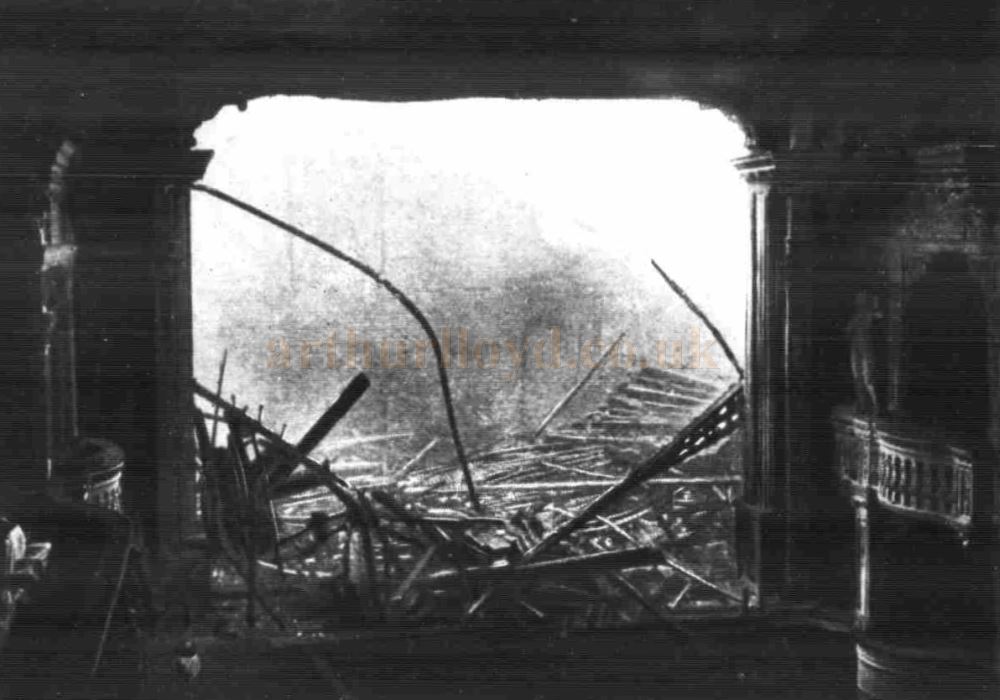
Above - The aftermath of a fire which destroyed the stage and scenery for a production of the Pantomime 'Sinbad the Sailor' at the Queen's Opera House, Crouch End on Christmas Eve, 24th of December 1904. Part of the rear wall of the stage collapsed and the stage roof fell in as a result of the fire - From The Graphic, 31st December 1904.
 On December the 24th 1904 a serious fire occurred at the Theatre when the scenery for a production of the Pantomime 'Sinbad the Sailor' caught fire after a rehearsal at around 10pm. The fire caused the back wall of the stage to partly collapse, and the stage roof then fell in destroying the scenery completely, see image above. Luckily no injuries were caused and the fire was eventually put out by the London Fire Brigade before more of the Theatre could be destroyed. The Company later managed to put on their production of 'Sinbad the Sailor' with new scenery at the Dalston Theatre in January 1905.
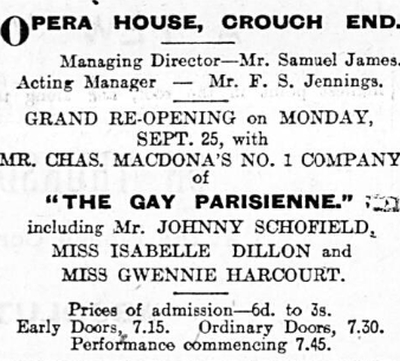
Right - An Advertisement for the reopening of the Opera House, Crouch End in 1905 - From the North Middlesex Chronicle, 23rd of September 1905.
The Architectural Record reported on the fire in their 18th of January 1905 edition along with the photograph shown below, saying:- 'We present a photograph of the stage of the Crouch End Opera House, which was destroyed by fire on Christmas Eve last, after rehearsal. The entire stage portion was gutted, but a considerable portion of the front of the house remains intact. We hope to be able to refer to some technical features in this fire at a later date, more particularly on the protection of the proscenium opening. In the meantime we would, however, mention that the fire-resisting curtain which existed at this theatre was apparently not an asbestos cloth curtain, but a curtain of two thicknesses of canvas painted with a coat of asbestos paint, and the manner in which it was hung and the way in which the runners were fixed did not accord with the usual practice in the London County Council area.' - The Architectural Record, 18th of January 1905.
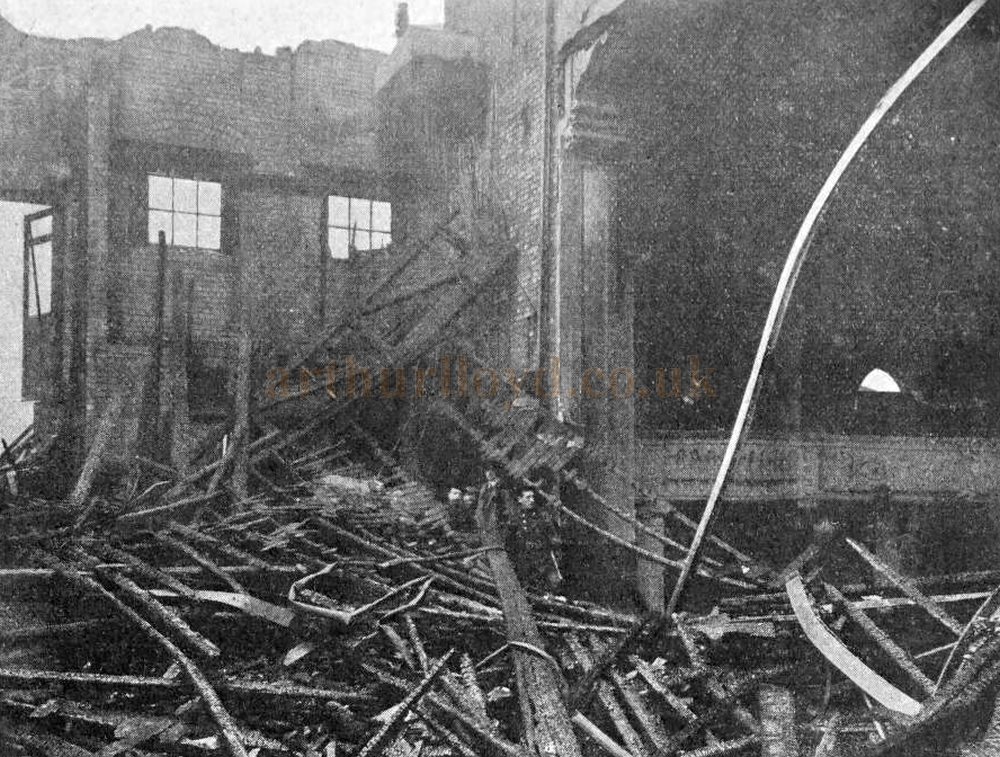
Above- The Stage House and Auditorium of the Crouch End Opera House after the Fire on the 24th of December 1904 - From the Architectural Record, 18th of January 1905.
After nine months of closure and rebuilding and redecorating, only beginning in June 1905 due to insurance investigations into the fire, the Theatre finally reopened, still as the Crouch End Opera House, on Monday the 25th of September 1905 with a production of 'The Gay Parisienne'. A Review of the Theatre and its reopening from the Holloway Press of Friday the 29th of September 1905 can be read here.

The Crouch End Hippodrome 1906
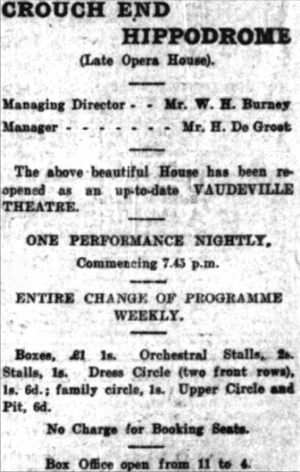 Having only reopened in September 1905, after the fire in December 1904, the
Theatre was again altered the following year and renamed the Crouch End Hippodrome for a reopening as a Variety Theatre on Christmas Eve, the 24th of December 1906.
Having only reopened in September 1905, after the fire in December 1904, the
Theatre was again altered the following year and renamed the Crouch End Hippodrome for a reopening as a Variety Theatre on Christmas Eve, the 24th of December 1906.
The Referee reported on the changes in their 6th of January 1907 edition saying:- 'It is really remarkable how handsome and commodious a variety theatre has been made out of the remains of the some-time-ago burnt-out Crouch End Opera House.
Right - An Advertisement for the Opening of the Crouch End Hippodrome - From the Hornsey & Finsbury Park Journal, 4th of January 1907.
This Northern Hippodrome, directed by Mr. W. H. Burney (of the London and Collins's Syndicate), and managed by Mr. H. De Groot (nephew of Mr. Henri Groot), has a finer and yet much more cosy auditorium than ever the somewhat ambitiously-entitled Opera House had. Therefore, and, of course, chiefly because the entertainment provided is of a lavish as well as varied kind, the Crouch End Hippodrome ought to receive plenty of support from Crouch Enders, Finsbury Parkers, and other neighbouring friendly nations.
More especially should this be the case since these Finsbury Parkers who are not bigoted Anti-Varietarians have, for a year, at least, been deprived by local Chadbands of the fine new Empire which Mr. Oswald Stoll had been preparing for them.'
The above text in quotes was first published in the Referee, 6th January 1907.


 The Crouch End Hippodrome had opened on Christmas Eve 1906 under the Directorship of W. H. Burney who was also at the time the Director of Collin's Music Hall in Islington. The Theatre had seating for 1,600 people.
Right - Posters for the Arthur Lloyd Trio performing 'The Twin Sisters' at the Crouch End Hippodrome in 1907. Also see the review below.
 In 1907, 3
years after his death in 1904, Arthur Lloyd's children, Lillie,
Arthur, and Dulcie had appeared at the Crouch End Hippodrome as The Arthur
Lloyd Trio in the Drawing Room Entertainment 'Little Charlie or The
Twin Sisters' written by their father, see posters above and the review shown left.
In 1907, 3
years after his death in 1904, Arthur Lloyd's children, Lillie,
Arthur, and Dulcie had appeared at the Crouch End Hippodrome as The Arthur
Lloyd Trio in the Drawing Room Entertainment 'Little Charlie or The
Twin Sisters' written by their father, see posters above and the review shown left.
Left - A Review for the Arthur Lloyd Trio performing 'The Twin Sisters' in Sheffield in 1906.
After its opening in 1906 the Crouch End Hippodrome went on to be a successful variety house for several years, firstly on the once nightly principle but later in 1910 it went over to twice nightly variety. This continued until it was eventually turned over to full time Cinema use in 1913, although it was occasionally still used by amateurs for their live theatre productions. One such production was 'Floradora' in 1930, see the illustrated article below.
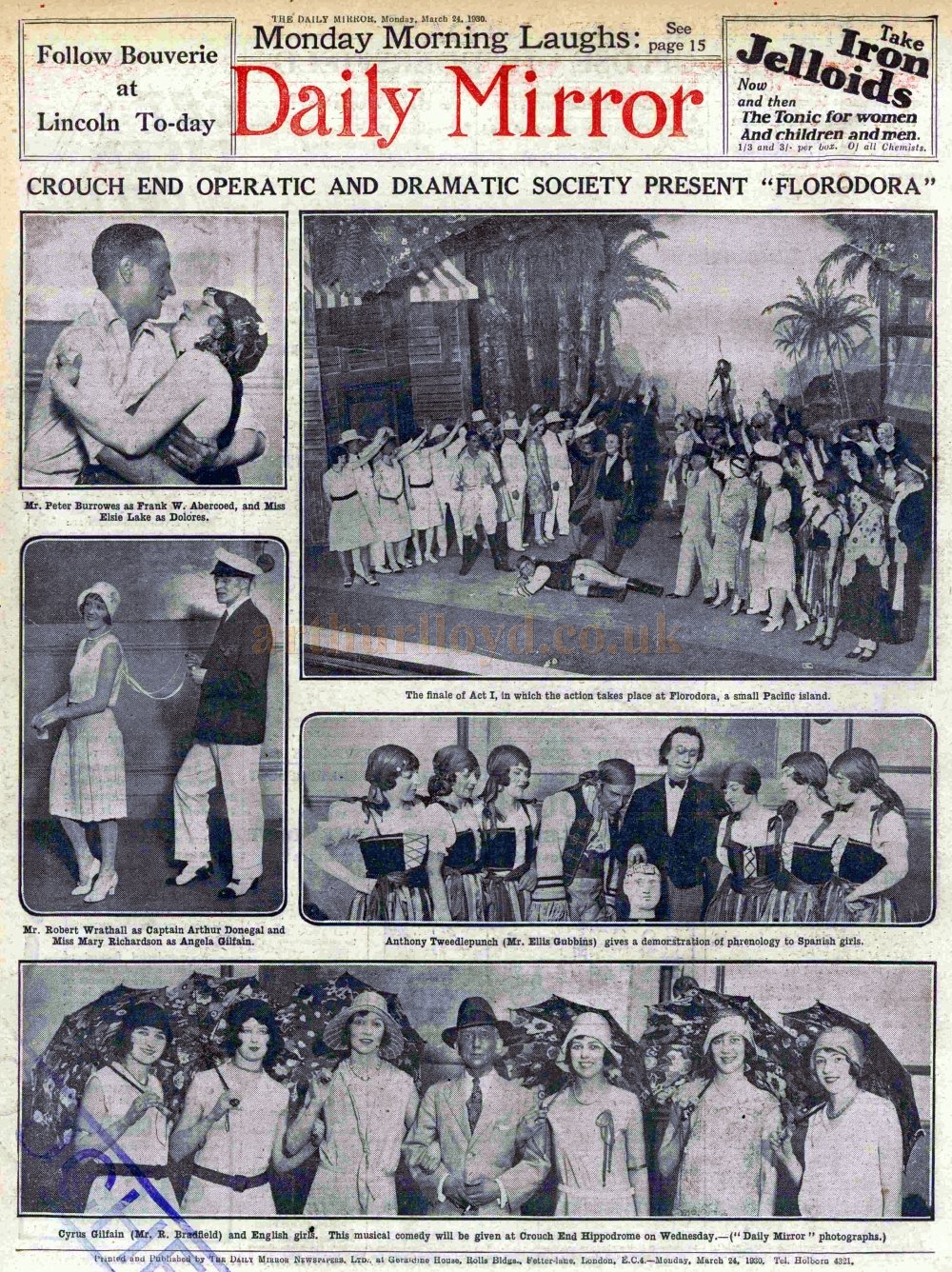
Above - A Full Page Feature on the Crouch End Operatic and Dramatic Society's production of 'Floradora' at the Crouch End Hippodrome in March 1930 - From the Daily Mirror, 24th of March 1930.
Mostly in use as a Cinema from 1913 the Crouch End Hippodrome eventually had Sound Equipment installed for the showing of 'Talking Pictures' in 1929.
The Theatre was altered in 1939 and the Kinematograph Weekly reported briefly on the changes in their 31st of August 1939 edition saying:- 'Construction at Crouch End - Originally built as an opera house, the Crouch End Hippodrome has, like many such buildings, a long entrance passage from the street to the auditorium and over this are two storeys which until the latter part of last year had been leased for 21 years to "The Welcome Club," which used them as a billiards hall and a ballroom.
Since termination of the lease W. E. Trent, Gaumont-British architect, has been planning complete redecoration of these premises, which were last in the decorators' hands in 1897, and the workmen are now busy papering, painting, installing new light fittings and central-heating equipment.
The stairs leading to these upper apartments ended in the vestibule of the Hippodrome and bricklayers are now building a wall to divide the entrance of the modernised rooms from that of the kinema. The work of modernisation is expected in be completed by the end of September.
Manager W. Jackson took advantage of the presence of workmen and a temporary barrier in the corridor leading to the pay box of the Hippodrome to work an astute advertising stunt in connection with a M-G-M feature he was screening. On the barrier he hung enlarged cut-out heads of Graham Moffat, Will Hay and Moore Marriott above a wide linen banner on which was printed the message: "If you want to know what's going on here ask a policeman."'
The above text in quotes was first published in the Kinematograph Weekly, 31st of August 1939.
Destruction by Fire in 1942
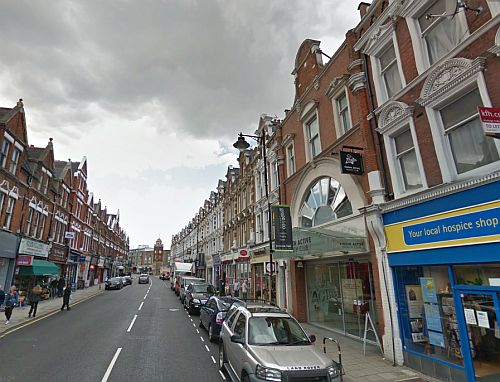 Sadly the Theatre was seriously damaged by fire again during the war in the first week of May 1942. The fire started in the stalls and quickly spread to the roof. The building was patched up but never used as a Theatre or Cinema again, instead it was used for storage and later by Grattan's mail order Company as a distribution centre, at this time all the remaining decorative features were removed and the facade was covered in black tiles.
Right - A Google StreetView Image of the former Crouch End Hippodrome today - Click to Interact.
After Grattan's left the building the auditorium was demolished leaving only the facade and foyer still standing. In 2000 a local conservationist group succeeded in having the black tiles removed from the facade revealing its original semi circular glass window which was then restored and modernised. Today the building is in use as a gym.
If you have any more information or images for this Theatre that you are willing to share please Contact me.
Some archive newspaper reports on this page were collated and kindly sent in for inclusion by B.F.