
Theatres and Halls in Dover, Kent
The Tivoli Theatre - The Granada Theatre / ABC
The Granada Theatre, 62, Castle Street, Dover
Later - ABC / Images Nightclub
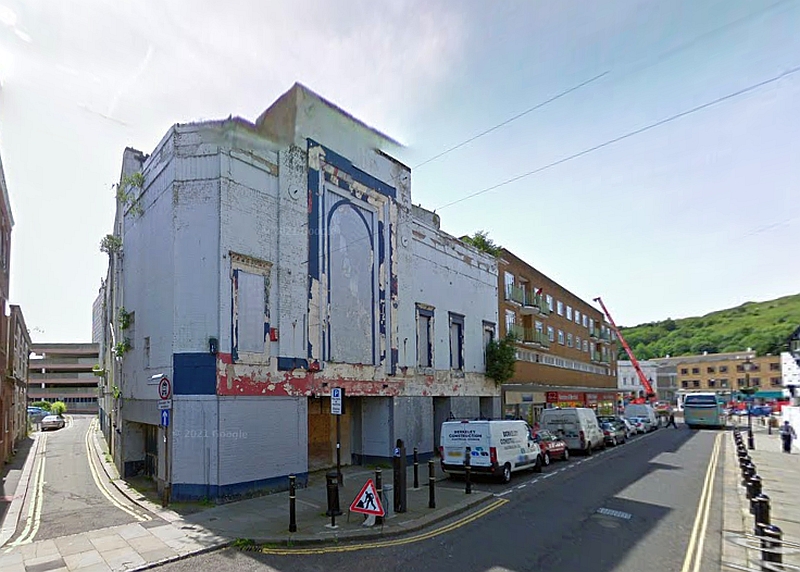
Above - A Google StreetView Image showing the former Granada Theatre, Dover, closed and boarded up in June 2009 - Click to Interact.
 The Granada Theatre was situated on Castle Street in Dover and was the first Theatre to be built and operated by the Granada Theatres Chain. It was designed by Cecil Masey, with interior decorations by Theodore Komisarjevsky, and opened on the 8th of January 1930 with a seating capacity of 1,717 people. The Theatre, though built primarily as a Cinema, did have a large fully equipped stage with a 35 foot proscenium opening, and dressing rooms for artistes. The Theatre also had a Christie Theatre Organ which rose from the orchestra pit in front of the stage on an electric lift.
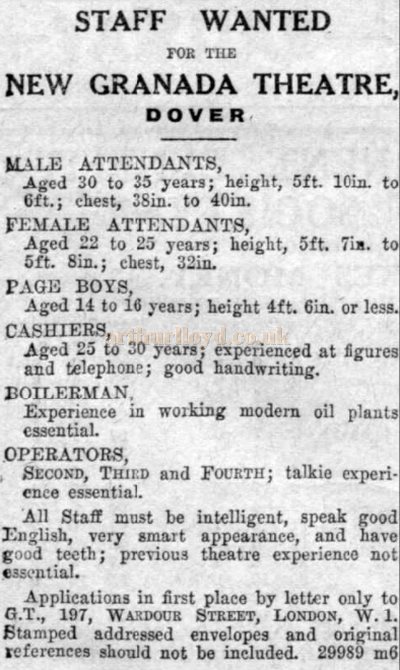
Right - An Advertisement for Staff Wanted for the new Granada Theatre, Dover - From the Dover Express, 6th of December 1929.
The Bioscope reported gushingly on the opening of the magnificent new Theatre in their 15th of January 1930 edition saying:- 'In enumerating the charms of Dover, the guide books mention her castle, her fine harbour and several interesting churches. They will now have to add - if they do their duty - the Granada Luxury Theatre.
The Granada is due to the imaginative enterprise of Sidney Berstein, who proved himself, by this distinctive creation, an artist-exhibitor of fine taste and bold originality, as well as an exceedingly clever showman. Designed by Cecil Masey, F.R.I.B.A., and decorated internally by Theodore Komisarjevsky, the celebrated stage producer and former Director of the Moscow Art Theatre, the Granada strikes an entirely new note among houses of film entertainment. It is essentially gay without any gaudiness of the Plush-and-Gilt-Mirror School; it has magnificence without ponderosity; it is lively and amusing, yet it is always elegant and never vulgar or freakish.
Russian Enchantments
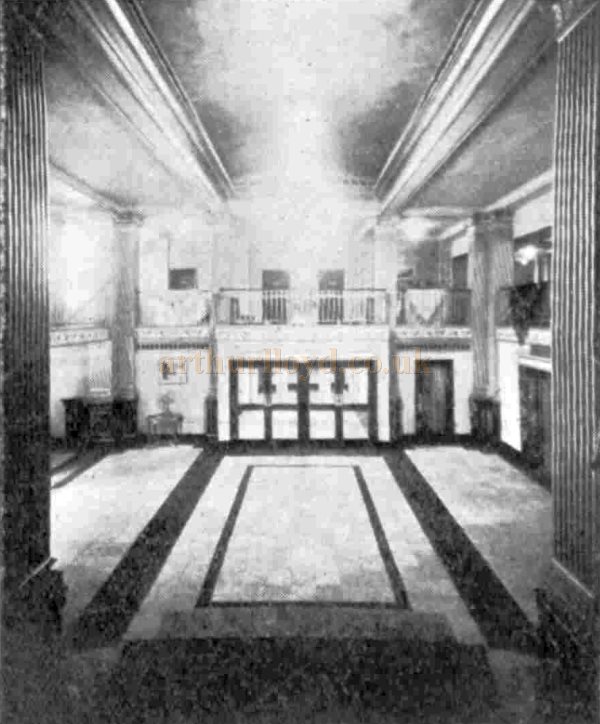 The Inspiration of the theatre was the Moorish Palace at Granada, but no effort has been made to transcribe the Alhambra. In the quadrangle form of the auditorium and in some details of the colouring and decoration and, especially, in the enchanting Patio-like vestibule, there is a suggestion of the Alhambra; but as a whole, the theatre is a Russian Ballet dream of Granada rather than an attempted reproduction.
Right - The Vestibule of the Granada Theatre, Dover when it first opened in 1930 - From The Bioscope, 15th of January 1930.
The masterpiece of the theatre (so it seemed on Wednesday with limited opportunities of inspection) is the square inner vestibule, surrounded on three sides by wide galleries, over the balustrades of which hang tasselled Spanish shawls. On the fourth side a wide staircase leads primly up to a tall formal mirror and thence, right and left, to the galleries. From the centre of the ceiling depends an immense cut-glass chandelier, a dozen "baby" chandeliers being set round the galleries. Here and there, in corners, flourish property lemon trees and flowering shrubs. On the walls are placed etchings and photographs of the real Alhambra.
Gay and Exciting

Above - The Gallery above the Vestibule of the Granada Theatre, Dover - From The Bioscope, 15th of January 1930.
With its pretty decorative fancies, its dainty airs and stately graces, this charming vestibule seems, indeed, more like a stage scene than a cinema entrance. Even the cold realism of Automaticket is bowered in a discreet little booth. in the visitor, the place creates a sense, as he enters, that he is already in Playland. The theatre really becomes - as so few theatres do - the House Where the Actors Live. The play is commencing as one mounts the stairs. The atmosphere is not only gay; it is exciting.
The auditorium, also, is entirely different in its decorative scheme from any other theatre that we know. In its square loftiness it resembles and enclosed courtyard. The heavily patterned walls glow with bright colours. Blue and purple curtains veil the proscenium opening, making in an enclosure of mystery. In its general aspect, the place might be the Palace of a Magician in a Russian fairy tale. Less skillfully executed, the decoration would have been excessive; but every detail is so perfectly balanced that the intricate, crowded designs hang together in satisfying unity, ultimately composing a scheme of gay yet noble splendour.
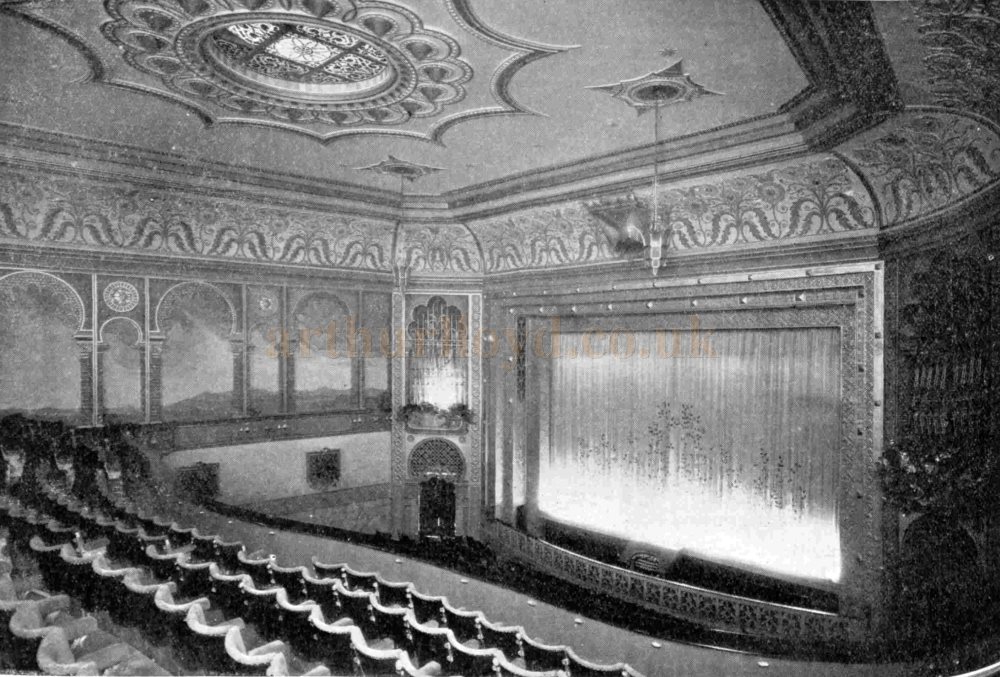
Above - The Auditorium of the Granada Theatre, Dover, as seen from the circle - From The Bioscope, 15th of January 1930.
As in the foyer so in the auditorium, the novel and fanciful beauty of the decorative scheme is allied with up-to-the-minute modernity in equipment. Two thousand cosy, well spaced, carefully positioned seats permit the audience to watch the entertainment in the comfort of fireside armchairs. With its almost human Plenum breathing apparatus, the theatre has the perfect climate which is nowadays characteristic of all leading cinemas. The lighting system represents the last word in electrical ingenuity. And the screen entertainment is supported by a majestic-toned Christie unit organ, a Western Electric sound installation, Ross projectors and an orchestra of 20 instrumentalists, who would do credit to any theatre in the West End of London.
For the opening ceremony (which was as clever in its way as the theatre), a film trade party travelled from London by a special "Granada" Pullman, with Percy Phillipson as their admirable host, those present including George Smith, of P.D.C.; F. S. Fisher, of Western Electric; Sutton Dawes, of Fox; and representatives of the trade and lay Press. Punctually at the advertised hour, Knightsmith, the celebrated London toastmaster, appeared on the stage before a packed house and announced, following a blast of trumpets, that he would introduce some of the leading people responsible for the erection of the theatre. Then the curtains parted to disclose the Architect, Cecil Masey, F.R.I.B.A.; the Decorator, Theodore Komisarjevsky; the Clerk of the Works, E. H. Swann; the Musical Conductor, Leonardi; and others feverishly engaged with vast quill pens at a couple of bare tables on final details of the plans. Above them loomed a large blackboard, threateningly inscribed, "The Granada must be opened by January 8th." This amusing introduction not only succeeded in giving an entertaining twist to what is often a laboured ceremony, but also underlined the fact that the theatre had been completed, despite unusual constructional difficulties, in the remarkably short time of six and a half months.
Achievement of Showmanship
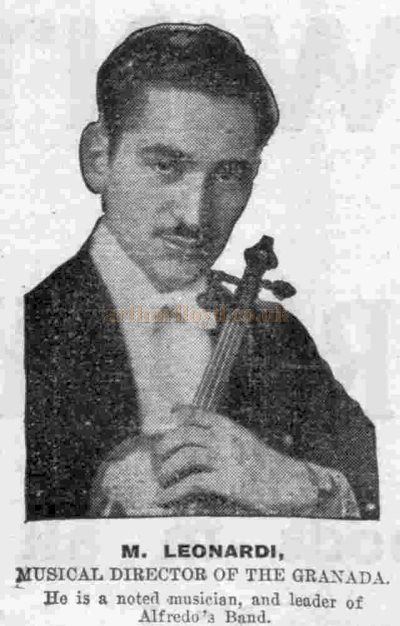 Following a brief opening speech by the Mayor of Dover, a first-rate programme, featuring "The Last of Mrs. Cheney," a spectacular organ recital and an interlude by Leonardi and his band, was carried through with the utmost precision and effectiveness.
Right - M. Leonardi, Musical Director of the Granada Theatre, Dover - From the Dover Express and East Kent News, 3rd of January 1930.
Concerning the interlude, which also introduced the Terry Girls, Kathleen Lafla, Leon and Lucette and the Two Eccentrics, it should be said that no finer musical-dancing-singing turn could be witnessed at any London music hall. If the Granada can maintain the standard of its opening performance, Londoners will soon be visiting Dover for the best "talkies" cum-variety entertainment. The enterprise as a whole must be regarded as unique, even in these days of wonderful exhibiting achievements. It is certainly a notable tribute to Sidney and Cecil Bernstein and their collaborators.
The Christie Unit Organ
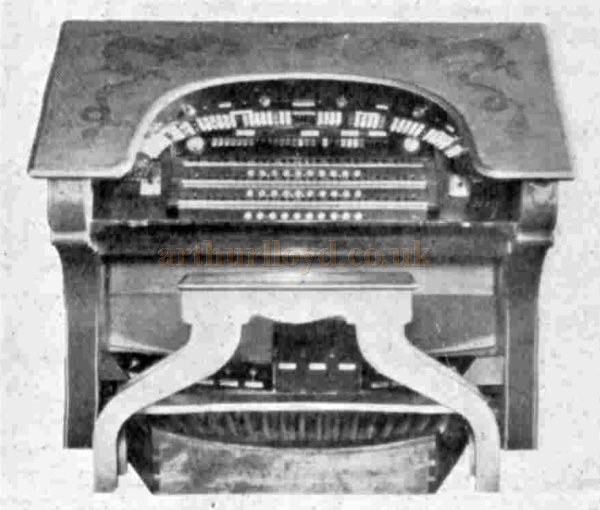 A word should be added concerning the Christie Unit Organ at the Granada. The work of Hill, Norman &. Beard, it is the first modern unit organ erected in any theatre in Dover. Hedley Morton, who has had considerable experience in playing these intricate instruments, has been appointed resident solo organist.
Right - The Console of the Three Manual Christie Unit Organ at the Granada Theatre, Dover when it first opened in 1930 - From The Bioscope, 15th of January 1930.
The three-manual console controlling the organ is placed in the centre of the orchestral enclosure on an electric lift, and is beautifully decorated in Japanese lacquer, a design by Keeble, Ltd., the Art Decorators. If patrons could see behind the sound grilles on the right-hand side of the proscenium whilst the organist is playing, they would be rewarded by a truly wonderful sight. Thousands of electric wires leading from the console to the organ chambers instantly transmit the thoughts of the organist to sensitive electric relays and switches, not unlike a modern telephone exchange in their complicated appearance. This wonder of modern electrical engineering is the nerve centre that calls to life the voices of a symphony or dance orchestra hidden in the hundreds of pipes, percussions, traps, etc. The numerous organ controls involve the use of 5,000 silver wire contacts, between 7,000 and 8,000 contacts of phosphor bronze and 40 miles of copper wire. Many different species of timber from various parts of the globe are used, from English oak and beech to the giant Californian sequoia, Idaho sugar pine, yellow pine from Canada, mahogany from Honduras, tulip tree or whitewood from Western Canada, Oregon pine, maple, teak, walnut, spruce, rosewood and many others.
In the Organ Chambers
 The organ chambers have been specially designed, and are situated on the right-hand side of the proscenium, the lower chamber being at balcony level. The two front chambers contain the pipe work, percussions, etc., and the two at the rear house the organ action and blowing plant. Screen effects and certain percussions are enclosed as a separate unit, and placed on a platform in front of the lower organ chamber. The voicing and tonal balance of the instrument leave nothing to be desired, whilst the workmanship is of the usual high standard associated with the name of Hill, Norman & Beard.
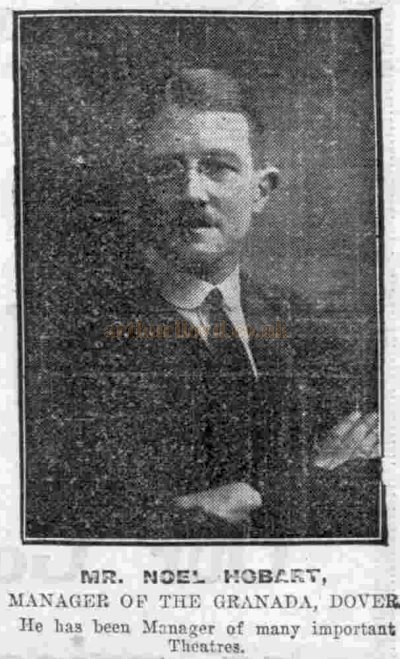
Left - Noel Hobart, Manager of the Granada Theatre, Dover - From the Dover Express and East Kent News, 3rd of January 1930.
Leading members of the personnel of the Granada, which is owned by County Theatre, Dover, Ltd., are Noel Hobart, Manager; F. Fryer, Assistant Manager; S. Williams, Stage Manager; E. J. Barber, Musical Adviser; Leonardi, Conductor; H. Morton, Organist; W. M. Pope, Consulting Engineer; and G. Short, Chief Projectionist.
Continuous performances, including stage presentations, are given on week-days from 2 to 10.30 p.m., and on Sundays from 5 to 9 p.m., at prices which range from 8d. to 2s. 4d. in the evenings, and from 6d. to 1s. in the afternoon.
Creators of the Granada
Following is a list of the individuals and firms responsible for the Granada: Architect, Cecil Masey, F.R.I.B.A., 15, Caroline Street, W.C.1; interior decorator, M. Theodore Komisarjevsky, 18, Gordon Square, W.C.1; contractors, Bovis, Ltd., 41-44, Upper Berkeley Street, W.1; steel works, Wilfred Robbins, Ltd., Great Bridge, Staffs; consulting steel work engineers, S. H. White & Son, 9, Victoria Street, SM.1; marble work, Carter & Co., Ltd., Poole, Dorset; electrical installation, Grierson, Ltd., 4, Bloomsbury Place, W.C.1; ventilating plant, Sulzer Bros., 31, Bedford Square, W.C. 1; vacuum cleaning plant, British Vacuum Cleaner and Engineering Company, Ltd., Parsons Green Lane, S.W.6; oil engine, Petters, Ltd., Yeovil; lifts, Jenson & Co., Ship Yard, Warlour Street, W.1; decorations, Campbell Bros., Ltd., 28, Albert Embankment, S.E.11; seating and furnishings, Kinematograph Equipment Company, Ltd., 87, Wardour Street, W.1; sound apparatus, Western Electric Company, Ltd., Bush House, Aldwych, W.C.2; projection equipment, Kinematograph Equipment Company, Ltd., 87, Wardour Street, W.1; organ, Wm. Hill & Sons, and Norman & Beard, Ltd., 372, York Road, N.7.'
The above article in quotes was first published in The Bioscope, 15th of January 1930.
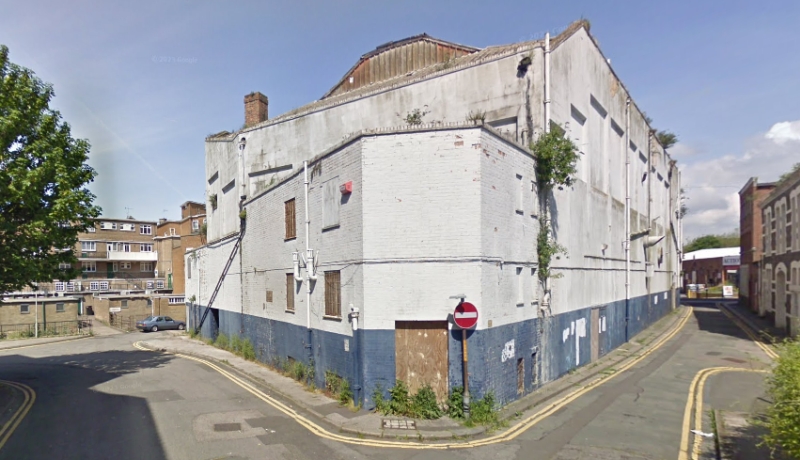
Above - A Google StreetView Image showing the rear and side elevations of the former Granada Theatre, Dover, closed and boarded up in June 2009 - Click to Interact.
 The Granada Theatre, Dover had first opened on the 8th of January 1930 but only 5 years later it was sold to Associated British Cinemas on the 19th of June 1935. However, they wouldn't rename the Theatre to ABC until April 1960 when, coincidentally, the Theatre's Organ was removed.
Right - A Google StreetView Image showing the site of the former Granada Theatre, Dover in April 2023 - Click to Interact.
In 1970 the Theatre was modernised and reopened as a 'Luxury Lounge' Cinema, just using the Stalls of the Theatre, with 610 seats, on the 6th of July. ABC then closed the Theatre completely on the 30th of October 1982 and it was then converted for Nightclub use as 'Images Nightclub'.
The Nightclub closed in 2007 when the Theatre was bought by the Wetherspoon's chain who intended to convert it into one of their public houses but this never came to pass in the end and sadly this once magnificent Theatre, the first to be built by the Granada Chain, was demolished in late 2014. At the time of writing in December 2023 the site has yet to be redeveloped.
If you have any more information or images for this Theatre that you are willing to share please Contact me.
The Tivoli Theatre, Snargate Street, Dover
Formerly - The Clarence Theatre - Later - The Theatre Royal / Hippodrome

Above - The Tivoli Theatre, Dover - From the Dover Observer of 1898.

The Tivoli Theatre in Snargate Street, Dover was built on the site of the former 1790 Clarence Theatre and was designed by the eminent Theatre Architect C. J. Phipps, with A. Blomfield Jackson, of London, and was built by H. Richardson, of Dover. Phipps had just completed London's Her Majesty's Theatre and was returning from supervising the construction of the Tivoli Theatre on Saturday the 22nd of May 1897 when he took ill on the return journey to London and died the following Tuesday, sadly he would never see the Tivoli Theatre completed.
The Tivoli Theatre opened on Monday the 14th of June 1897 with an auditorium consisting of stalls, dress circle, pit, gallery and boxes, and a capacity of around 1,200 people. The ERA reported on the new Theatre in their 8th of May 1897 edition saying: 'The new Tivoli Theatre, advertised to open on Monday, June 14th, occupies the site of the old Clarence Theatre in Snargate-street, with the addition of the adjoining licensed premises the Princess Alice. It has an important frontage in Snargate-street, running right through to Northampton-street, with entrances and exits in both thoroughfares.
The auditorium consists of private boxes, stalls, dress circle, pit and gallery. The stalls are above the level of Snargate-street, and are furnished with plush upholstered chairs of the latest and best patterns of the same style as in Her Majesty's Theatre. The dress circle is provided with chairs of the same style as those in the stalls, and there is a spacious promenade behind. The pit, most excellently seated, is entered from the west side of the frontage, and the large and spacious gallery by an entrance next to the buffet.
The building has a holding accommodation for upwards of 1,200 persons. Between Snargate-street and Northampton-street there are a series of rooms, storage and cellarage. In Snargate-street there is a handsome and commodious saloon, luxuriously furnished and fitted. This saloon will be used, not only in connection with the theatre, but will be open during the daytime, and will supply a want that has always been felt in this busy part of the town. Provision has been made for fitting up a grill in this saloon. There are refreshment rooms to each tier, with every convenience for ladies and gentlemen.
The stage is divided from the auditorium by a brick proscenium wall, carried up through the roof, the opening being 25ft. wide. The width of the stage is 47ft., by a depth from the footlights to the back wall of 22ft., with the fullest possible dressing-room accommodation, provided with every up-to-date improvement. From curtain line to the front of the dress circle is 29ft., and from the curtain-line to the front of the galley 35ft (sic). There are two private boxes on either side of the dress-circle level.
The whole of the construction, from foundation to roof, is of iron and concrete. The interior decorations are of the highest order, and superbly furnished, fitted, and appointed, making the Dover-Tivoli one of the most elegant and commodious theatres in the provinces. The theatre has been erected from the designs of Mr C. J. Phipps, F.S.A., the eminent architect, and Mr A. Blomfield Jackson, of London, and has been built by Mr H. Richardson, of Dover. Messrs Jackson and Son have supplied the plaster decorations, Mr Edwd. Bell the painting and gilding, and Messrs Wadman are supplying the chairs. All these three firms, and also the architects, having been connected with the work at Her Majesty's Theatre in the Haymarket, London.
The new and handsome act drop and scenery have been specially designed by one of our leading artists, and executed in the most perfect manner by the well known scene painter Mr Julian Hicks, in his own studio. The fire hydrants and appliances are by Messrs Merry-weather and Co., and the constructional iron and steel work has been manufactured and executed by Messrs Walter Jones and Son, of London.
The directors have secured the services of Mr Amand A. Mascard as manager, late of the Strand Theatre and Trocadero, London, and who has already booked most of the London successes, amongst others being The Sign of the Cross, Gay Parisienne, Horace Lingard, A Night Out, Shop Girl, His Little Dodge, Artist's Model, Miss Fortescue, Monte Carlo, D'Oyly Carte, Rosemary, Pink Dominos, Betsy, &c.'
The above text in quotes was first published in the ERA, 8th of May 1897.
In September 1898, just a year after the Theatre opened, the facade was altered so that the popular saloon bar could be more easily entered from the street and the Theatre was renamed the Theatre Royal at the same time.
In march 1910 the Theatre was renamed The Royal Hippodrome, a name it would retain until the building was destroyed by enemy action in September 1944. The shell of the building then stood empty for many years until it was eventually demolished in 1951.
If you have any more information or images for this Theatre that you are willing to share please Contact me.