
The Gaumont Theatre, Holloway Road, Islington
Later - Odeon / Odeon Luxe
See also in this area - The Holloway Empire - The Malborough Theatre - The Parkhurst Theatre - St. Georges Theatre
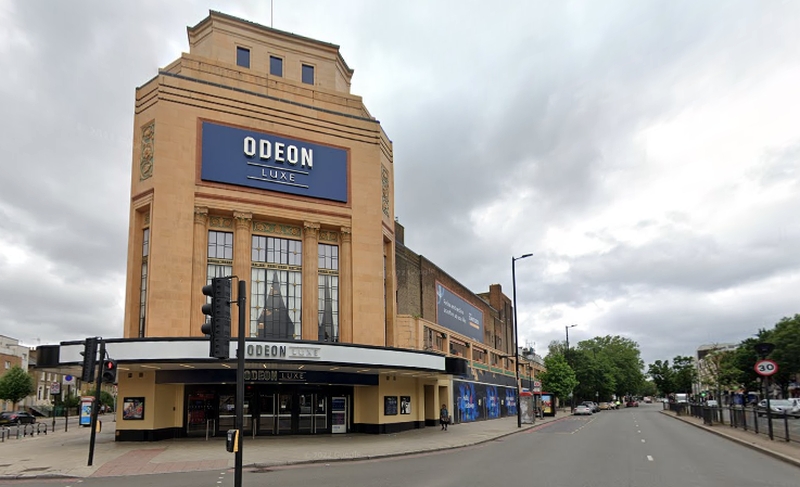
Above - A Google StreetView Image of the Odeon Luxe, Holloway Road in June 2021, formerly the Gaumont Theatre - Click to Interact.

 The Present Day Odeon Luxe on the corner of the Holloway Road and Tufnel Park Road, Islington, pictured above, originally opened as the Gaumont Theatre on the 5th of September 1938 with seating for just over 3,000 people. Originally built for Hyams & Gale it was sold to Gaumont British Theatres during construction. The Theatre was designed by the Detroit Architect Charles Howard Crane.
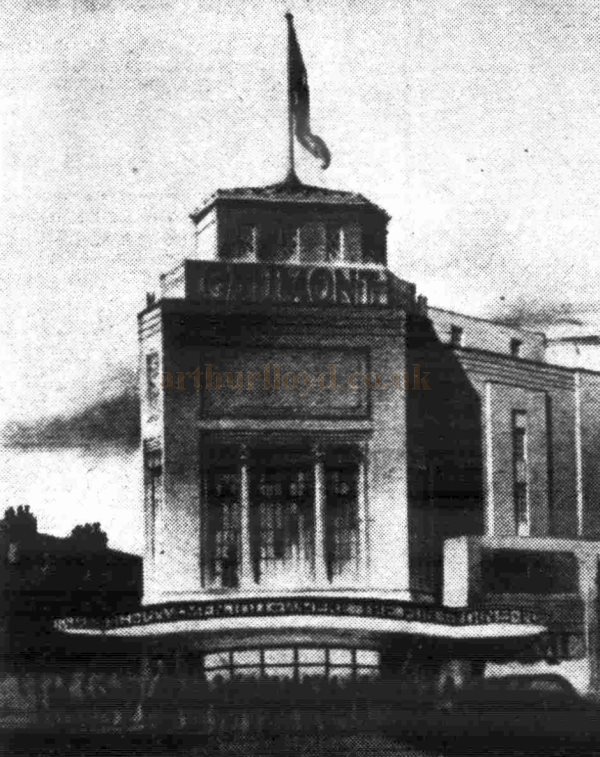
Right - The exterior of the Gaumont Theatre, Holloway Road when it first opened in 1938 - From an Advertisement for G. B. Equipments Ltd., in the ERA of September 8th 1938.
When first opened the Theatre had a massive foyer with a large 220 seat restaurant above with views over the Holloway Road and included outdoor seating. There was also fitted into the imposing tower over the foyer a Broadcasting Studio which was used by the BBC on its opening to broadcast live segments of the opening to its radio listeners.
The Theatre's Foyers and Auditorium were designed in the French Renaissance style with landscape paintings occupying the rear and side walls of the auditorium under the balcony. There was a large fully equipped stage for variety performances 54 foot wide and 30 foot deep which could be extended to 50 feet when the Orchestra Pit was raised to stage level. Included in the design were dressing rooms, two rehearsal rooms, a Music Room and Organist's Room. The Organ itself was a Wurlitzer Theatre Organ which was situated on a revolving lift in the Orchestra Pit. The Theatre also included a waiting room in the basement for 3,000 people and a large car park.
 Before the Theatre's opening the ERA reported on the kind of programming the new Gaumont was designed for in their 25th of August 1938 edition saying:- 'New Policy at New Cinema - Holloway Gaumont Opening - A new kind of entertainment policy will inaugurate the latest addition to the G.B. Circuit, the Gaumont, Holloway, when it opens on Monday, September 5. The programme will consist of 50 per cent. films and 50 per cent variety. The usual cine-variety will not be part of the entertainment, for arrangements have been made with George Black to control the stage of the theatre, so that the Gaumont, Holloway, is assured of the same class of act as the Palladium and the Holborn Empire, a policy which has never before been tried by a cinema theatre.
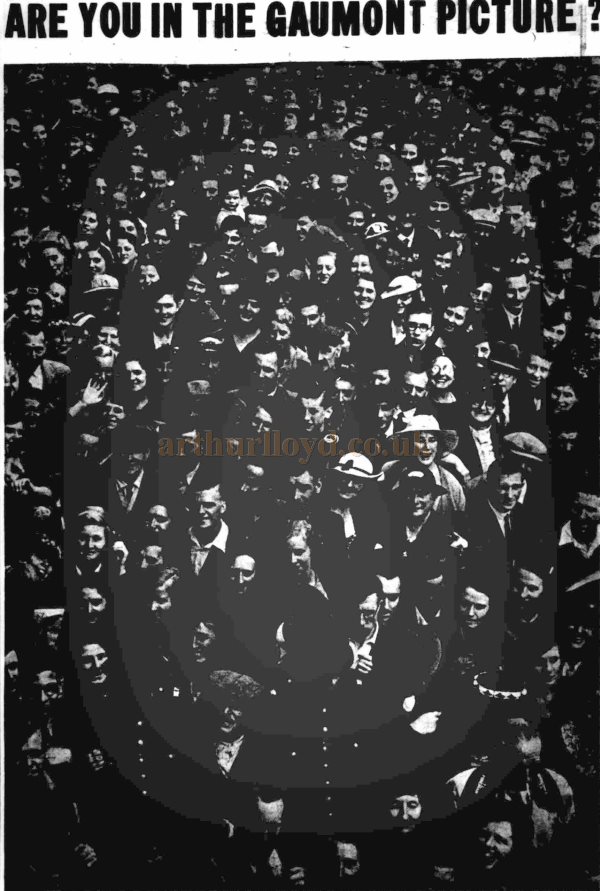
Left - A Photograph showing the crowds of people trying to get tickets for the opening of the Gaumont Theatre, Holloway Road in 1938 - From The Islington and Holloway Press, 3rd of September 1938.
The opening variety programme for the first week will include Marie Burke, the Two Leslies (Leslie Sarony and Leslie Holmes), Teddy Brown, The Maurice Colleano Family. The following stars have accepted the directors' invitation to honour the occasion by appearing personally on the stage for the opening performance, and will give selections from their repertoire, which will be broadcast from 8.30 to 9.15 p.m. Jessie Matthews; Will Hay, supported by Graham Moffatt and Moore Marriott, who will give a comedy excerpt from their new picture "Old Bones of the River," now in production at Gainsborough; Will Fyffe; Louis Levy and his Broadcasting Orchestra, with Eve Becke, Gerry Fitzgerald and the Six Georgettes. The broadcast will be compered by Brian Michie (by courtesy of Jack Hylton), and the whole show will be staged and produced by Jack Swinburne in conjunction with George Black.' - The ERA, 25th of August 1938.
 The ERA also reported on the new Gaumont Theatre just after its opening in their 8th of September 1938 edition saying:- 'A new wonder of the cinema world is the Holloway Gaumont, which was opened this week. This wonderful theatre, the latest addition to the General Theatres Corporation circuit, not only looks different from any other place of amusement that I have seen in any country, but it is going to give a kind of entertainment that is not quite the same as any other. An altogether new theatre for a new type of programme is something to make a song about.
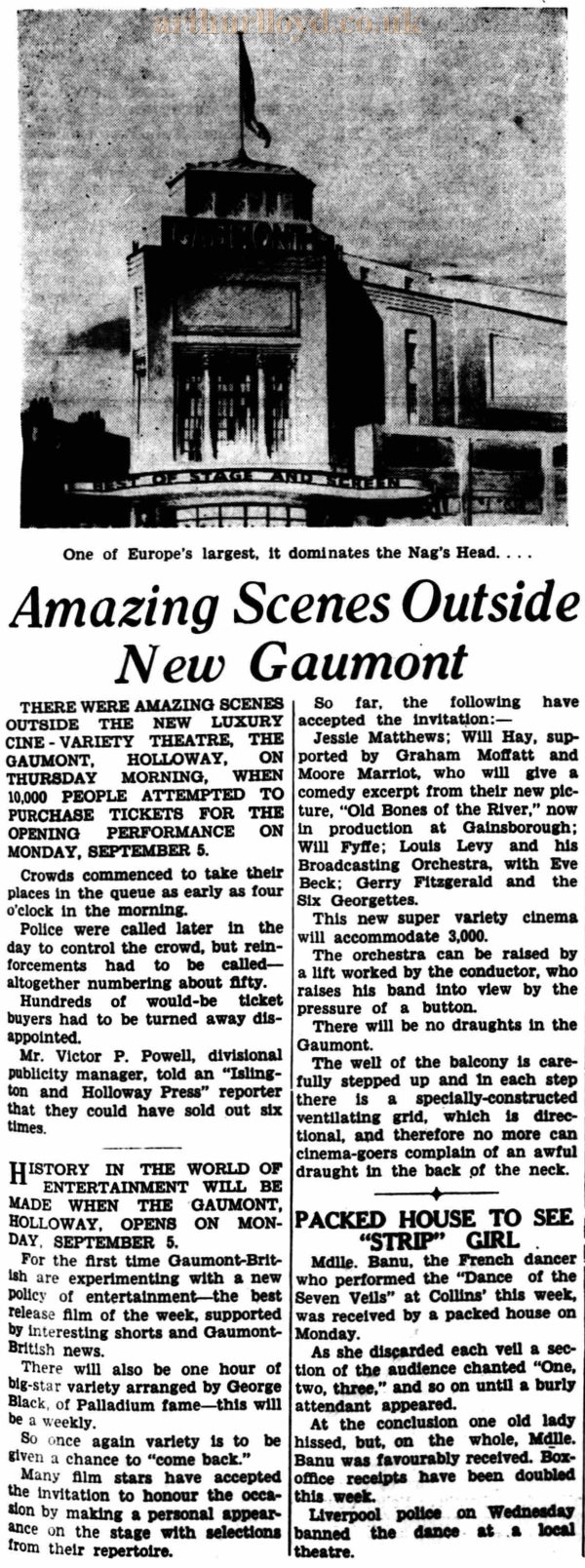
Right - An Article and Image on the crowds of people trying to get tickets for the opening of the Gaumont Theatre, Holloway Road in 1938 - From The Islington and Holloway Press, 27th of August 1938.
Though it occupies a commanding position near that familiar landmark, the Nag's Head, and holds more than 3,000 people, the building is so finely proportioned that its size is the last thing you notice about it. What first commands attention and admiration is the square tower — something unique in cinema architecture. Here again you are impressed with its perfect proportions. There is an air of honest solidity about it without the least suspicion of heaviness.
Once inside the doors - and the entrance was not easy on Monday, with 2,000 people besieging the place to get glimpses of the arriving stars - there was more to engage one's admiration. The foyer is exceptionally large and lofty, with an imposing staircase on each side leading to the circle and restaurant, with an open-air cafe beyond. The seats - and each of the 3,000 tip-up chairs is of similar pattern - are as comfortable as they look, and the colour scheme is nicely unassertive.
There is a full-size stage to fit in with the new policy here of providing a programme consisting of equal portions of produced variety and of films. This involves a permanent orchestra - Cecil Charles Mitchell is in charge of this - and, of course, an organ. The new Holloway Wurlitzer, which not only rises like most of its kind, but has the additional accomplishment of being able to revolve, is played by Terence Casey.
The variety bill this week includes Maurice Colleano with his clever dancing and acrobatic partners, Marie Burke, sweet-voiced songstress of "Show Boat" and "Waltzes from Vienna" fame, Teddy Brown, and the Two Leslies, who were supplemented on Monday by Louis Levy and his broadcasting orchestra, Jessie Matthews (who prefaced her turn by a pretty little speech wishing prosperity to the new theatre), Will Fyffe, Will Hay, with Moore Marriott and Graham Moffatt in an excerpt (on the stage) from his new film "Bones of the River," and Brian Michie, who compered the part of the show that was broadcast. The picture section of the programme included the Gaumont British review of 1937, which had taken the prize for the best news reel at Venice, and Sam Goldwyn's "The Hurricane," which very effectively tested the sound reproduction capabilities of the new theatre and its equipment. And so out once more into Holloway-road - and a last glance back at that challenging tower. E. W. B.'
The above text in quotes was first published in the ERA, 8th of September 1938.
The 1958 Reconstruction of the Gaumont Theatre
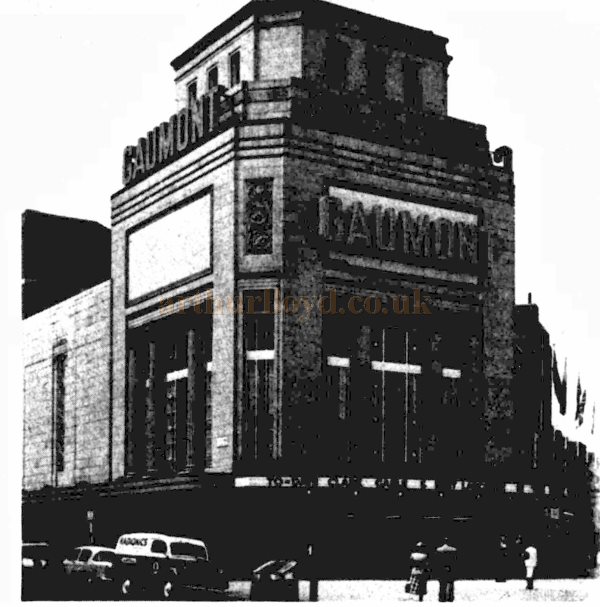 The Gaumont Theatre had first opened on the 5th of September 1938 but of course the War soon intervened and indeed the new Theatre was to become a casualty of this as it was hit by a German V1 Rocket bomb on the 8th of November 1944 which completely destroyed the Auditorium. Amazingly the Foyer and exterior walls survived the blast so it would be possible to reconstruct the Theatre although this wasn't finally achieved until 1958.
Right - The Exterior of the Rebuilt Gaumont Theatre, Holloway Road in 1958 - From The Ideal Kinema, 14th of August 1958.
The newly reconstructed Theatre was finally opened on the 21st of July 1958 with the film 'Run Silent, Run Deep' with Clark Gable. The Theatre's rebuilt auditorium was designed by T. P. Bennett & Sons in a modern style.
The Ideal Kinema reported on the newly reopened Theatre in their 14th of August 1958 edition saying:- 'An ingenious blending of period and modern styles of interior decoration has been achieved in the rebuilding of CMA's Gaumont, Holloway Road, North London.
The combination of styles was, to an extent, conditioned by the amount of rebuilding that was necessary. The Theatre was opened in 1938 as a "Cine-music hall." It suffered from numerous bombing incidents during the early part of the last war and received a direct hit from a flying bomb in August, 1944. The cinema was closed for the duration, but, in January, 1945, what remained of it was hit by a V.2 rocket.
The asbestos roof over the auditorium was completely destroyed and the roofs over the projection room and stage were severely damaged, and all the brickwork above the proscenium opening had collapsed into the orchestra pit. The elaborate plaster work on the foyer ceilings and in the auditorium was destroyed and the heating and ventilation system was put out of action.
Permission to rebuild was first sought in October, 1949, but a licence was not granted until 1956. In the reconstruction of the cinema several of its chief structural and decorative features have been retained. The front of the theatre is the same, as are the spacious lower foyer, the circle foyer and the marbled front entrance lobby.
The exterior has been cleaned down and the faience repaired and replaced where necessary: the original large electric changing sign facing Holloway Road has been replaced with a floodlit poster panel:existing poster panels at street level have been reinstated, and a cigarette machine has been installed to the right of the entrance. The canopy has been changed slightly, but the interchangeable letter-sign has been retained, and the underside is brilliantly lit with 10ft. fluorescent fittings at approximately 10ft. centres.
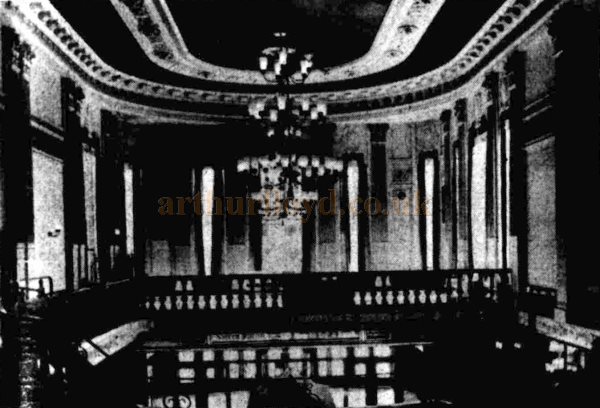 The marbled entrance lobby has been reinstated except that an island pay-box has taken the place of the old side pay-boxes.
Left - The Foyer of the Rebuilt Gaumont Theatre, Holloway Road in 1958 - From The Ideal Kinema, 14th of August 1958.
The entrance to the grand foyer is via five mahogany-framed doors, with handles of contemporary design. In the foyer the mahogany paneling and staircase and bronze handrail has been reinstated; the coloured decoration has been dealt with in a contemporary manner to enhance to some extent, the effect of the rather elaborate plasterwork. Centre of the ceiling is now in deep red, and the main ceiling band in warm taste, with some of the enrichments in gilt; colours are in pale grey; and the approach to the balcony foyer in deep green.
The three chandeliers, 16ft. long in satin brass have arms supporting white opal shades of contemporary design. The floor is covered with large areas of marble-rained lino; stair-treads are in red marbled lino.
A brilliantly-lit sales kiosk has an off-white canopy decked out in gilt. Below the counter, the face is decked out in deep blue Lionide, a colour designed to match the decor of the foyer. The window curtains of the old cafe level are in contrasting colours of deep green, grey and red.
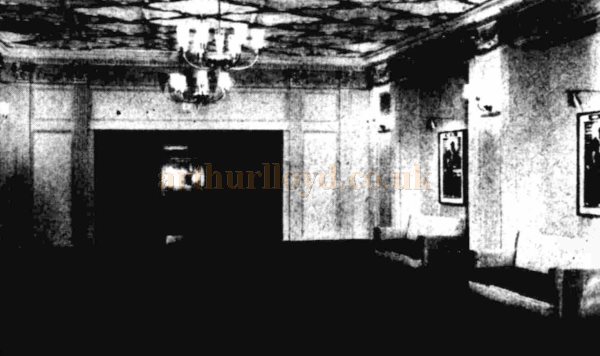 The circle foyer, plaster panelling and Adam type ceiling have also been reinstated. The ceiling has been painted off-white, with the narrow flat sections picked out in gilt.
Right - The Circle Foyer of the Rebuilt Gaumont Theatre, Holloway Road in 1958 - From The Ideal Kinema, 14th of August 1958.
The walls here are in a restful pale green, with enrichments picked out here and there in gilt. The floor is carpeted in red and black design, and lighting is by three contemporary chandelier fittings and eight wall brackets. Furnishing consists of long settees, upholstered in black, with golden yellow cushions.
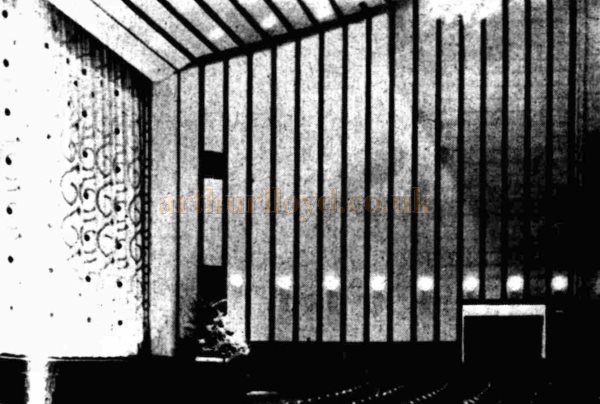 It was felt desirable to change the decoration in the auditorium to a more simple treatment in modern style, and to have the ceiling lowered and stepped, thereby helping acoustics. It was also found necessary to cover the side walls with Paxtiles 20ft. beyond the front of the balcony.
Left - The Auditorium of the Rebuilt Gaumont Theatre, Holloway Road in 1958 - From The Ideal Kinema, 14th of August 1958.
The back wall of the stalls and the rear of the balcony were similarly treated. A screen wall has been erected about half-way up the balcony, reducing the seating by approximately 600. but leaving the remaining seats with excellent sight-lines. It is claimed, however, that this screen wall could be removed and the extra seating made available overnight if required.
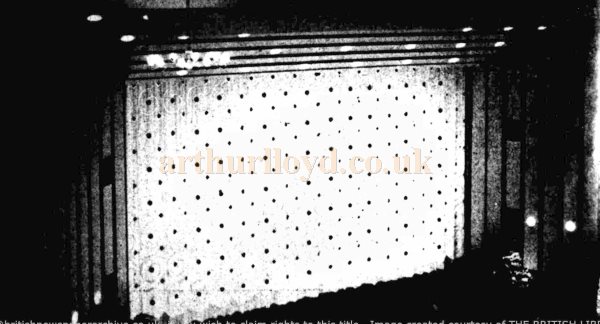 The new Perlux screen provides for wide-screen at 35ft. 6in. x 20ft. 3in.; VistaVision at 36ft. 4in. x 22ft.; and CinemaScope at 48ft. x 20ft. 6in. This involved adjustments to the stage and a complete redrawing of the sight-lines.
Right - The Screen and Auditorium of the Rebuilt Gaumont Theatre, Holloway Road in 1958 - From The Ideal Kinema, 14th of August 1958.
The whole of the ground floor seating was rearranged. Spacing between rows has been so generously treated that there is genuinely no need for anyone seated to get up to allow another person to pass down the row. Total seating is now 1,987.
The orchestra lift well has been floored over giving ample space for an orchestra, and a full stage has been retained, as it is the intention to give occasional live shows at the theatre.
Auditorium decoration was conceived with the object of making the audience aware of long, vertical flutes to the side walls up to the balcony front, which continue across the ceiling immediately in front of the proscenium. The ceiling, itself, is ingeniously stepped and broken at the margins to give added interest and to cope with the centre spotlight chamber, which had to be reinstated.
The fluting is in dark red to tone with the light orange-red that follows over the ceiling. This is broken by a deep blue dado and black skirting. The vertical side-wall fluting also gives added contrast to the white tabs of velour velvet. These have an appliqué pattern in shot satin, with black velvet circle and square motifs, connected with S-shaped curves, and finished at stage level with a deep red fringe.
Back stalls treatment is in a deeper red than the remainder, this colouring being continued in the carpet, but contrast is provided by the bright electric blue moquette covering of the seats.
 Lighting in the auditorium is by six satin brass chandeliers, each having ten arms, with pale champagne flashed opal shades. The under balcony is lit by 14 star fittings in champagne flashed opal.
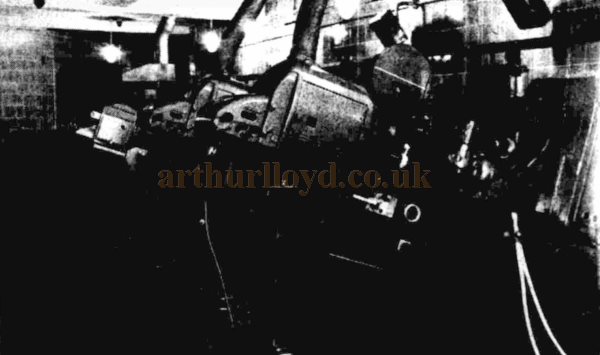
Left - The Projection Room of the Rebuilt Gaumont Theatre, Holloway Road in 1958 - From The Ideal Kinema, 14th of August 1958.
Spaciousness is a feature of the projection suite. Two GK21 projectors have been installed, with Mole-Richardson arc lamps, using Morganite carbons. Slide presentation, stage spotting and lighting effects are dealt with by two Stelmar HI lanterns supplied by J. Frank Brockliss. A roomy rewind department contains all the necessary Premier equipment. The sound installation includes the provision of hearing aids in selected seats.'
The above text in quotes was first published in the Ideal Kinema, 14th of August 1958.
The former Gaumont Theatre Today
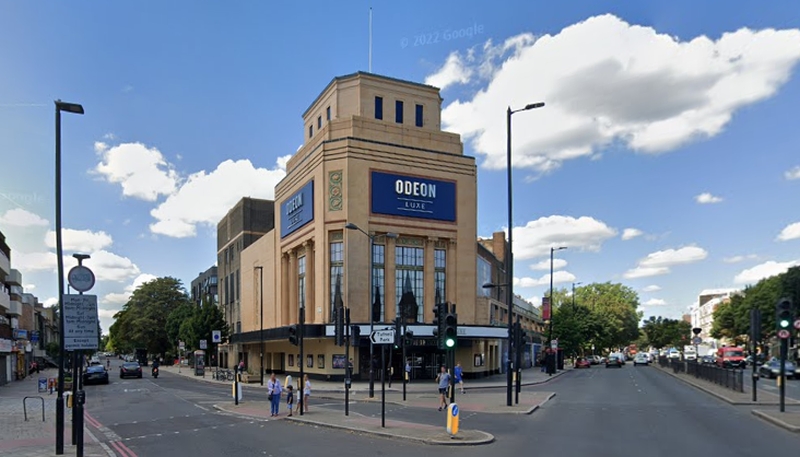
Above - A Google StreetView Image of the Odeon Luxe, Holloway Road in April 2022, formerly the Gaumont Theatre - Click to Interact.
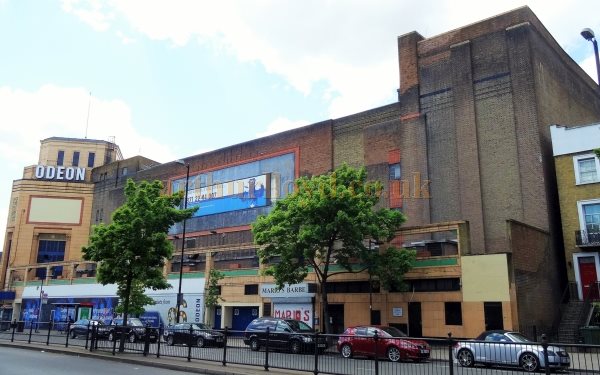 The rebuilt Gaumont Theatre opened on the 21st of July 1958 but would be renamed Odeon a few years later in November 1962. Odeon tripled the Theatre in 1973. I often visited the Cinema in the early 80s myself when I was living nearby. It was quite weird in that the two smaller screens were situated under the balcony and the large screen was seen from the balcony itself where you could look down on a now deserted and unused front stalls area.
Right - The Odeon, Holloway Road in a photograph taken in the 1990s showing the Stage House and side elevation of what was once the Gaumont Theatre - Courtesy Brian Evans.
This was changed later however, when it was converted for eight screens with nothing visible of the former auditorium and only the Foyers remaining in something like their original 1938 grandeur.
The Holloway Odeon Luxe today has seven screens with a lounge situated in the original Gaumont Theatre Restaurant over the foyer. The building's facade and foyers are Grade II Listed.
Some of the information for this Theatre was gleaned from the excellent Cinema Treasures Website where they have some very nice images of the Theatre in its various guises here.
If you have any more information or Images for this Theatre that you are willing to share please Contact me.