
Theatres in Leamington Spa, Warwickshire
Early Theatres - The Theatre Royal / Opera House / Regent Cinema
The Theatre Royal, 23 Regent Grove, Leamington Spa, Warwickshire
Formerly - The Opera House - Later - The Regent Cinema
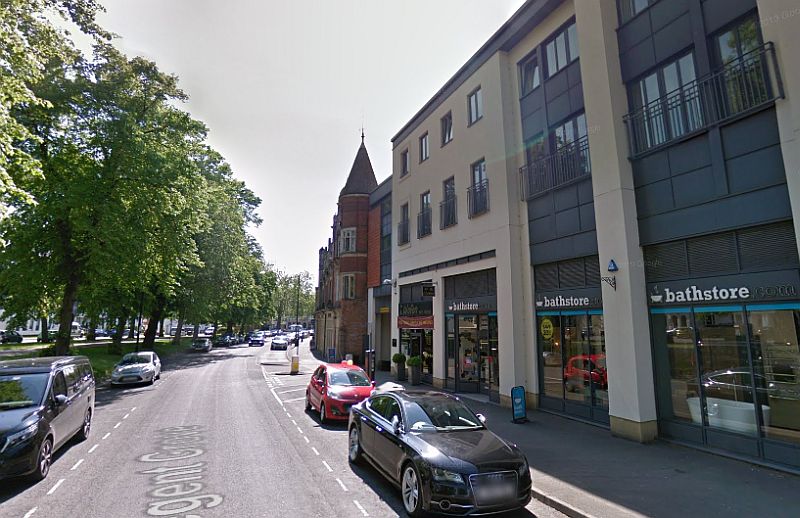
Above - A Google StreetView Image of the site of the former Opera House / Theatre Royal, Leaminton Spa - Click to Interact.

This Theatre was originally opened as 'The Opera House' on the 2nd of October 1882, and was situated at 23, Regent Grove (near the Holly Walk) Leamington Spa. The foundation stone had been laid in May of that year, by Lord Brooke, M.P. The Theatre was owned by a consortium headed by the then Lord Mayor, Mr H. Bright as chairman of the board of directors. Other board members being Lord Brooke. M.P. Lord Riversdale, Messrs G. H. Nelson and Brabzon Campbell. Mr H. C.Passman was secretary to the company.
The architects were Messrs Osborne & Reading, of Bennett's Hill, Birmingham, and the famous London based architect Charles John Phipps, of Mecklenburgh Square, London. The contractor was Mr John Fell, of Bedford Street, Leamington.
The Theatre faced onto the Street in Regents Grove, the frontage containing all the various entrance doors to the various parts of the house. Safety was paramount with 6 feet 6 inch wide staircases for easy entrance and exit of the audience. All doors between the body of the Theatre and the stage were of iron, and two 4 inch hydrants, connected to the town's mains water supply, were situated on each side, at the back of the 'flys'.
The audience capacity was for 1,400 people on three levels. The pit contained 500 seats including 45 seats in the stalls, immediately in front of the orchestra. The rake of the stalls and pit was half an inch in the foot, in order to facilitate a good view for everyone.
The orchestra had room for 25 musicians and was sunken so that the orchestra did not obstruct the view of the stage.
The stage itself was 36 feet deep and 72 feet wide. The height to the grid inside the fly tower being 50 feet. The stage had the same rake as the auditorium floor, being half an inch to the foot. The stage was fitted with 6 narrow cuts, 3 wide cuts, 2 star traps and one vampire or grave trap. In the back wall of the stage were a large pair of iron doors which could be opened to give entrance to large items for spectacular effects, such as a fire engine in the play 'The Streets of London', a horse and cab for the play 'The Gay City,' or an omnibus and a pair of horses in 'The Flying Scud'.
The Gas lighting system was a 'Strodes Patent Flashing System.' This was a system which enabled all the gas being lit without a naked light at the end of a stick. Also the entire gas installation was managed from one point at the side of the stage and under the control of one man.
The Proscenium was richly ornamented in raised diaper, painted in gold and white. On each side of the orchestra pit were 3 private boxes arranged one on top of the other. The boxes were richly upholstered in plush velvet.
The Dress Circle was approached by a spacious staircase leading into a vestibule and Crush Room. The front of the circle was richly decorated with scroll work in cream and gold. Outside the Dress Circle were cloak rooms and a refreshment bar.
The Gallery sat 450 people and its front was set out with panels also decorated in gold and cream.
The ceiling was decorated in the Italian Renaissance style, fitted with a one of Strodes sun burners containing 153 lights.
The Act drop was of 'Kenilworth Castle in the time of Queen Elizabeth the First,' and was supplied by Mr E. Ryan of Penrose street London. An Entirely new stock of scenery had been supplied and painted by Mr Walter Johnson, also of Penrose Street London.
To the west side of the stage was the dressing rooms block.
A long lease for the Theatre had been taken out by Mr P. Tempany, of Arundel Street, London. The first performance was of the Opera 'Lily of Killarney' by the composer Sir Julius Benedict, who also conducted the orchestra and his appearance was a signal for a hearty outburst of applause. There was great applause also when the lights were turned full up to show the prettiness of the auditorium. After the National Anthem was sung the Opera commenced. There was some disappointment of the inability of Madam Rose Hersee to fulfil her engagement as Eily O'Connor, but her place was taken by Madam Olelland, who proved an excellent substitute. Mr Falkner Leigh played Hardreas Cregan with Mr Aynsley Cook singing the part of Danny Mann. At the conclusion Alderman Bright (Major) had arranged supper for the cast at the Regent Hotel.
By 1908 the Theatre had been re-named 'The Theatre Royal' and was presenting early films on the Bioscope as part of the programme at each performance. Some modernisation and redecoration took place in September 1909, with more improvements in December 1912.
In 1932 the Theatre was still operating as a Repertory and Variety Theatre, but 1934 saw the Theatre closed for an internal auditorium rebuild in the 'Art Deco style,' and a re-opening on the 3rd of August 1935, having been enlarged, and now renamed the 'Regent Cinema,' operated by Paramount Picture Theatre Ltd. The opening film was 'The Gay Divorcee' starring Fred Astaire. A Two Manual/5 Rank Compton organ had also been installed which had an illuminated console and was played by Mr John E.Francis.
In 1936 the Regent changed hands, now owned by Leon Salberg & Sydney Clift, under Stratford on Avon Picture House Co, who were a subsidiary of Cinema Accessories, part of the Clifton Picture Chain. The Regent now operated mostly as a Cinema but also presented live Variety shows on its stage.
The Regent Cinema closed on 15th December 1962 with the film 'The Miracle Worker' starring Anne Bancroft and 'Lamp in Assassin Mews' starring Francis Matthews. It was then converted to a Bingo club opening on 28th December 1962, however, this was not successful and it was soon closed.
The building was then taken over by an adjacent garage but by 1964 it was laying derelict and was eventually demolished.
The above article was written for this site by David Garratt in January 2020.
If you have any more information or Images for this Theatre that you are willing to share please Contact me.
Early Theatres in Leamington Spa
When Leamington Spa was emerging as a Spa town, the need for a small temporary structure to house visiting 'strolling players' was soon envisioned. Thus a small building was constructed on a plot of land at the rear of what is now the Crown Hotel in High Street for the use of theatrical performances.
The first permanent Theatre in Leamington however, was in Bath Street, it had previously been a Chapel but was converted for theatrical use in 1813. The lease was under the management of a Mr W. Simons. The opening production was 'The Earl of Warwick,' together with a farce entitled 'Fortunes Frolic.'
In 1842 the Theatre came under legal scrutiny when a complaint about the building being used as a Theatre was heard in the courts, the following article is from the Leamington Spa Courier, Saturday the 28th of May 1842:-
'The vocal performances of Miss E. LAND, during the present week, have been most successful in maintaining the reputation long since acquired by that lady as an accomplished member of her profession. We regret to add that the attendance at the theatre has been far from numerous; and that the worthy manager must be a serious loser by his spirited exertions to gratify the theatrical taste of our townsmen.
In connection with these amusements, we have to record that, at the Petty Sessions on Wednesday last, an application was made Mr. Wright, Solicitor, for" summons against Mr. Jackman, " to show by what authority he performed theatrical representations, and whether he had license to do so." It was stated that the building in which the performances took place had formerly been used as a chapel, and it was revolting to the feelings of those who formerly worshipped there, that the spot which had been the scene of much religious fervour in days gone by should witness such ungodly doings as were now nightly enacted; and that the lease of the premises recognised the prevention dramatic personations.
The Sitting Magistrate (HENRY BRADLEY, Esq.,) very properly suggested that any interference was unnecessary, so long as the theatre continued to be conducted with due regard to public decency;- that the premises, had been appropriated to the purposes of a show and sale-room, and divested of all semblance of a chapel; but Mr. Wright pressed his application, and a summons was granted, on the information of Mr. Minson, of Bath-street, who, in the course of the inquiry, stated, in answer to a question from the Bench, that he was the same individual who had last summer received public patronage towards some pyrotechnical displays in the Newbold Gardens.
Yesterday, the case was again heard before H. T. CHAMBERLAYNE, AND H. BRADLEY, Esqs., when a contest ensued between Mr. Wright and Mr. Empson, who appeared for the defendant, relative to the service the summons, which was ultimately admitted. Mr. Wright, said, then in that case he should withdraw the information on the ground of informality, and asked Mr. Empson proceed instanter with a new one. This was refused, and another information was laid by Mr. Jones, who formerly carried on business as a druggist in Bath-street.
An application made to the Bench by Mr. Empson, for payment by the informer of the costs of the day, was granted, and £1 11s. 6d paid by his attorney. The hearing of the parties upon the new information, will place next Wednesday. Without quarrelling with the religious scruples of those who seek to suppress the rational amusements of the drama, we would suggest that, as no one ventures to interfere with their scources (sic) of enjoyment, it would be but acting charitably to their neighbours to allow them some public recreation in return. If the result of these proceedings should occasion Mr. Jackman's departure from Leamington, where, as in other places comprised within his circuit, he has conducted his theatrical performances with great spirit and respectability, we trust that ere long a compact and elegant theatre will be erected in this town.'
The above text in quotes was first published in the Leamington Spa Courier, Saturday the 28th of May 1842.
Despite the arguments above the Theatre had always had a checkered career anyway, although when it was taken over by a Mr Elliston things had improved somewhat. Under Elliston's management many leading theatrical stars of the day appeared there. Eventually however, the Theatre was demolished, and Leamington was then without a Theatre for several years.
In 1849 a new Theatre was constructed in Clemens Street. This building, being larger than the previous Theatre, was more adapted to the requirements of the town. It existed until 1866 when ironically, given that the previous Theatre had been converted from a Chapel, it was sold to the Congregationalists, and converted into a Chapel itself. Leamington was then without a Theatre for a long period until the Opera House / Theatre Royal was eventually constructed on Regent Grove in 1882, see details above.
The above article was first written for this site by David Garratt in January 2020 and updated by M.L. in 2024.