
The Paramount Theatre, Corner of Headrow and Briggate, Leeds
Later - Odeon Cinema
Leeds Theatres Index
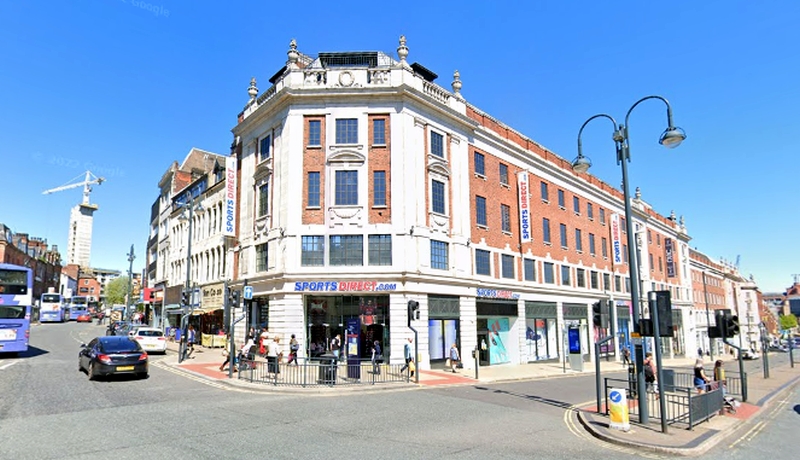
Above - A Google StreetView Image of the former Paramount Theatre / Odeon, Leeds in May 2018 - Click to Interact.

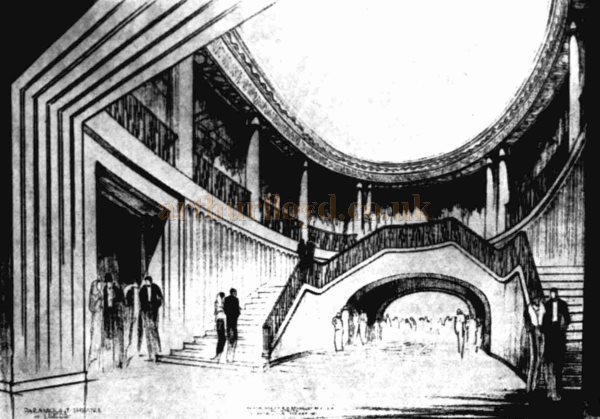 The Paramount Theatre was situated at the corner of The Headrow and New Briggate, Leeds and opened on Monday the 22nd of February 1932 with the 1931 film 'The Smiling Lieutenant'.
Right - The Entrance Hall to Circles and Staircases of the Paramount Theatre, Leeds - From Kinematograph Weekly, February 18th 1932.
The Theatre was designed in the art deco style by Verity & Beverley who designed a number of other Theatres in the UK for Paramount including the Manchester and Newcastle ones. The exterior of the Theatre however, was also designed in collaboration with Sir Reginald Blomfield.
The auditorium of this £250,000 Theatre was constructed on three levels, stalls, grand circle, and balcony with seating for 2,550. The Theatre was equipped with a large stage and fly tower for live productions, and an orchestra pit large enough to house 35 musicians on a platform which could rise, with the Theatre's Wurlitzer Organ, to stage level.
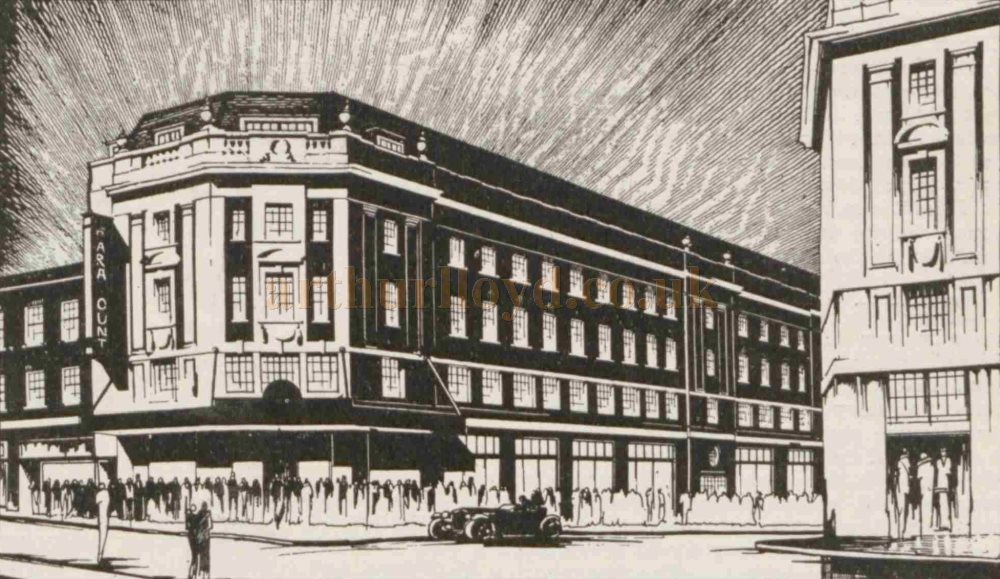
Above - The Paramount Theatre, Leeds - From The Bioscope, 24th February 1932. The caption for this image reads: 'There is a certain austerity about the exterior of the new Paramount Theatre, due to the fact that its architectural form was dictated by a local planning scheme which aims to provide a thoroughfare equalling London's Regent Street in dignity. Frank T. Verity and S. Beverley were the architects, the exterior being designed in collaboration with Sir Reginald Blomfield.
 The Bioscope reported on the new Theatre in their 24th of February 1932 edition saying:- 'Seen from the street, the new Paramount Theatre at the corner of Headrow and Briggate, Leeds, which was opened on Monday, may not, at first glance, seem very impressive, for it conforms architecturally with the rather quiet and sober dignity of the general style of building recommended by Sir Reginald Blomfield for the whole length of the magnificent new thoroughfare in which it stands.
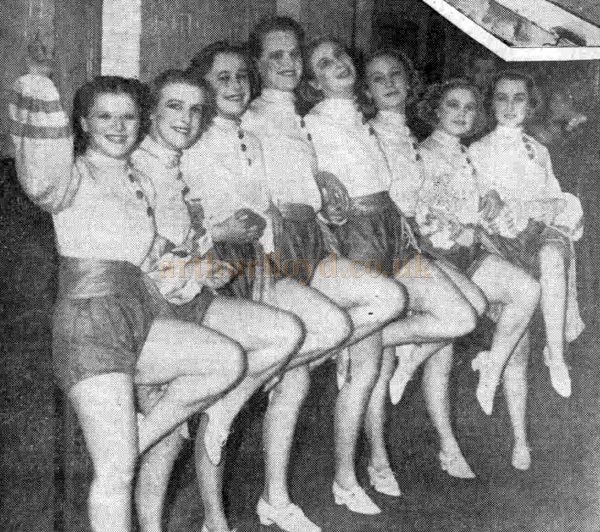
Right - Dancers waiting in the wings during the Leeds University Union's revue 'Televarsity' at the Paramount Theatre, Leeds - From the Leeds Mercury, March 9th 1937.
When the new street is completed, however, the Paramount building will have its place, and will more than hold its own in its dignified surroundings. Meantime, whatever the building looks like outside, the wonders within have already astonished and enthralled the thousands who have visited the theatre and will continue to do so for many a long day.
 Manchester and Newscastle have their Paramount Theatres, but Yorkshire has seen nothing just like this new Paramount Theatre in Leeds.
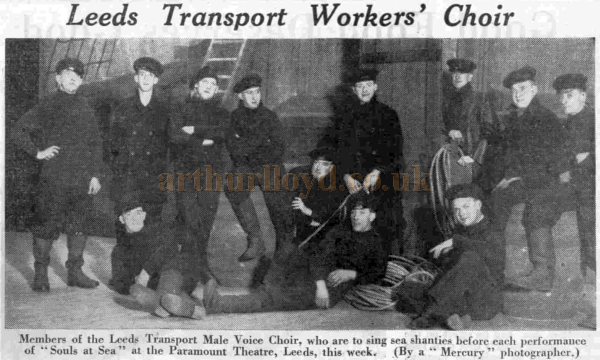
Left - Members of the Leeds Transport Voice Choir who sang shanties before each performance of 'Souls of the Se' at the Paramount Theatre, Leeds in 1937 - From the Leeds Mercury, 29th November 1937.
From the moment you enter the Theatre at the one and only main entrance facing down Briggate, gold - which emblazons the "Paramount" on the front of the verandah outside - is a dominating colour in the general scheme of things. Passing through doors on either side of the paybox, you find yourself in a vestibule, warm or cool (as the weather requires) restful and tastefully decorated. From here you pass through inner doors and uniformed attendants pass you through straight forward and on the level to the stalls, and up a short flight of stairs, first to the royal circle, then the grand circle and then the balcony.
In the spacious promenade and lounges girl ushers, in smart grey trousered uniforms, take charge of you and show you to your seat.
Like a Cloth of Gold
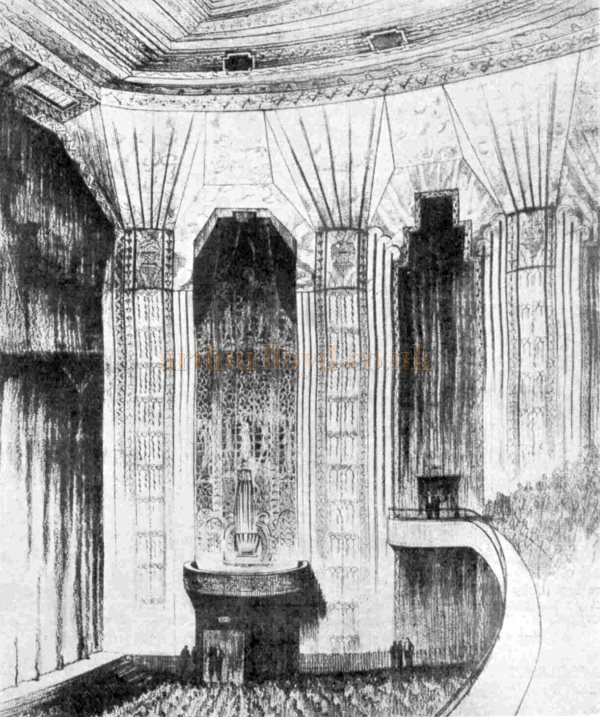 In a general way, the auditorium, with a seating capacity of 2,550, has been designed and decorated on the lines usually followed in Paramount theatres. Walls and ceilings have been treated in a colourful yet delicate manner. The style would be difficult to describe by the casual and inexpert onlooker, but it is both rich and tasteful. At first sight, the rose and green and gold and silver might not appear very striking; you must see the auditorium flooded with amber light to appreciate the exquisite beauty of the colour scheme.
Right - The Auditorium of the Paramount Theatre, Leeds - From The Bioscope, 3rd February 1932.
Silk Panels and tapestries, paintings and stencilings, mostly hand done - these setting off the general scheme of colourings already mentioned - are all enhanced in beauty by the lighting. The proscenium curtain, illuminated by a row of powerful floodlights on the front of the balcony (like so many portholes on a ship, until they burst into coloured light) shines like a cloth of gold.
The seating upholstery, in a delicate shade of green figured in beige, and the carpets in three shades of green and two of beige - the "cushiest " carpet you ever walked on - all help to create an air of quiet restfulness.
The Paramount can make its own weather, for it is claimed that the theatre has some of the finest apparatus in the country for scientifically maintaining the best atmospheric conditions. Every cubic foot of air sucked into the theatre - three million cubic feet of fresh air enter the auditorium every hour - is thoroughly washed and cleansed. Underneath each tip-up chair - in all parts of the theatre, by the way, the seats are alike - there is a ventilator that sucks bad air from the theatre - a very clever gadget.
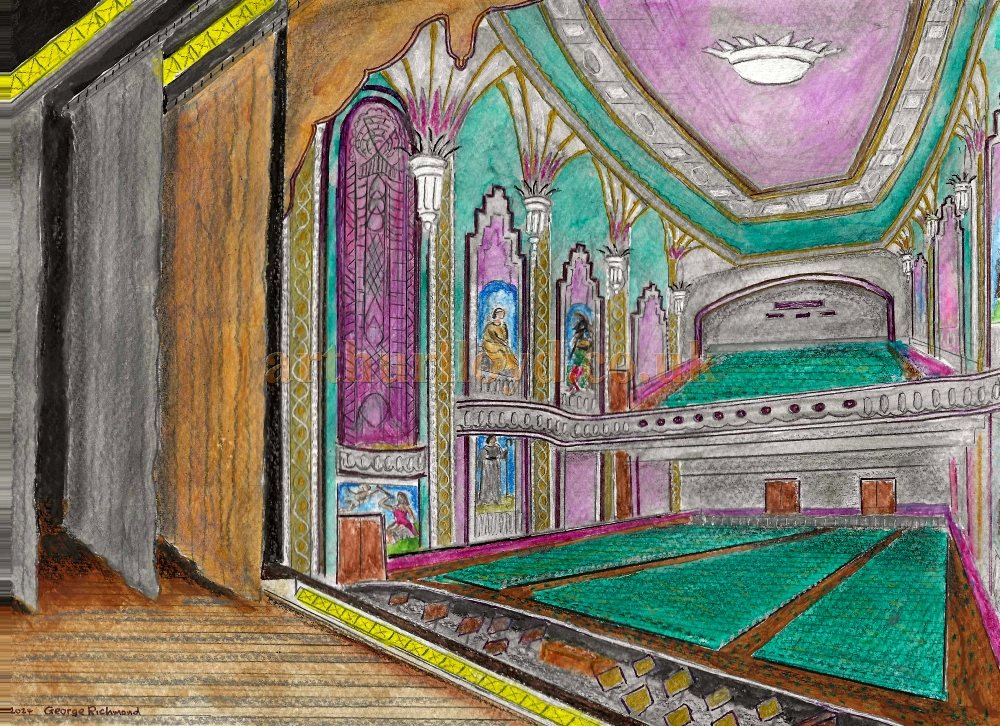
Above - A Painting by George Richmond depicting the Auditorium from the Stage of the Paramount Theatre, Leeds of 1932. George says 'I thought I would show a stark look into the wings in contrast to the rather over the top color scheme taken from the original account on the page. The effect was toned down originally by an amber wash of electric light we are told . Had I attempted this we would have been left with a muddy painting' - Click for an Index to all of George Richmond's Paintings on this site.
The very complete air conditioning equipment was installed by the Carrier Engineering Co., Ltd., and deals with all public parts of the building - auditorium, foyers, ladies' and men's lounges, cosmetic rooms, tea lounge, tea room and the more important administrative offices. The air in these parts is completely changed approximately ten times each hour. During the most extreme days in winter the temperature may be kept up automatically to 67° F., and during the most extreme days of summer down to 72° F. with the correct degree of relative humidity at all times.
Refrigerating equipment has been installed, which gives a cooling effect in summer equivalent to the use of 20 tons of ice during each show of average length. Steam for the ventilating equipment, for the numerous radiators disposed in the various corridors, entrances, etc., and for the hot water services for the lavatories, is provided by two large "Economic" type coal-fired steam boilers.
The seats are both roomy and luxuriously "comfy," with plenty of knee and leg room, and are so placed and tilted that, no matter whether you are in the front row of the stalls or in a remote part of the balcony, you look at stage and screen from the correct angle, and enjoy undistorted vision.
The lighting equipment, both for auditorium and stage, embodies the latest principles known to electrical engineers. At no time anywhere will there be naked lights glaring. Much resort is made to concealed lighting.
Keepalite Emergency Lighting
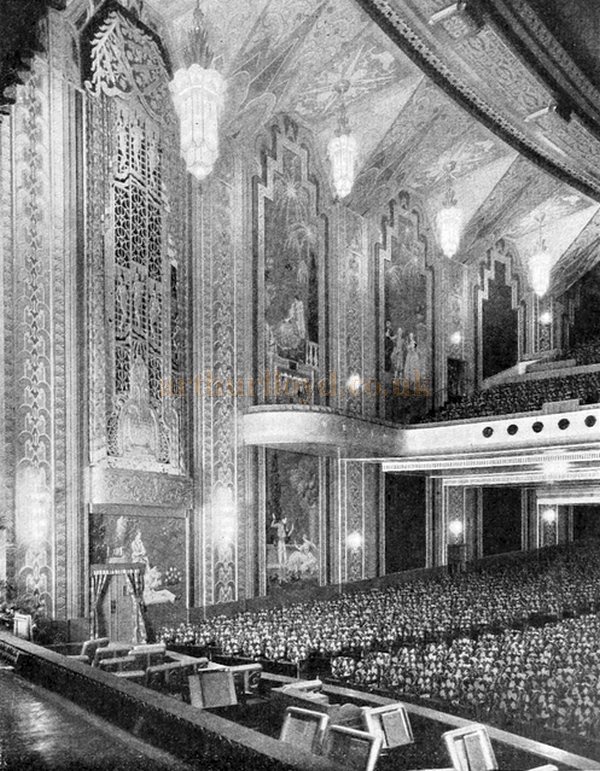 For emergency lighting this theatre is equipped with the Keepalite emergency lighting system. Should the ordinary electric lighting system fail for any reason, the Keepalite immediately and automatically comes into action. The installation derives current from an entirely independent source, consisting of a special set of Chloride batteries, which are at all times kept fully charged and ready instantly to supply current. The electricity from the Chloride batteries is sufficient to light the emergency lamps throughout the theatre and to keep them alight for as long as one hour with the normal lighting system entirely out of action.
Right - The Auditorium of the Paramount Theatre, Leeds - Shown here with a creative commons licence from the Cinema Treasures Website.
It will readily be appreciated that the Keepalite is a valuable precaution in such a public building as the Paramount Theatre. It abolishes the dangers associated with darkness in the event of an accident or otherwise, and ensures that at all times the emergency lighting is available, from whatever cause the normal lighting of the building may fail. The Keepalite equipment is the invention and product of the Chloride Electrical Storage Co., Ltd.
The orchestra of 35 and the Wurlitzer organ are on a platform which can be raised to stage level, and as for the stage itself any setting, either for grand opera or variety, can be produced at a moment's notice. As by a trick of some magician, all trace of talkies can be made to vanish, and the house can be transformed without fuss or commotion into a first-class theatre.
Horns on Counter-weighted Runway
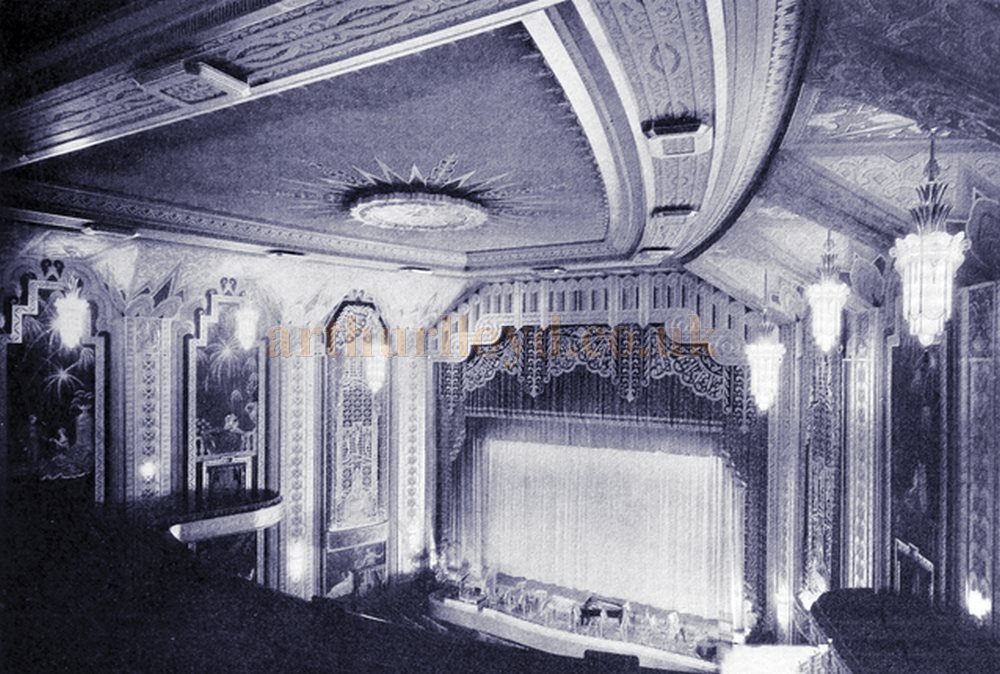
Above - The Auditorium of the Paramount Theatre, Leeds - Shown here with a creative commons licence from the Cinema Treasures Website.
Forty sets of counter-weighting on the 5-line principle have been installed by Gimson & Co. (Leicester), Ltd., the 5-lines being necessary owing to the large dimensions of the proscenium opening. Each set is capable of flying on single purchase a load of 7 cwts. A large size screen frame is also supplied and counter-weighted, while the pelmet on the auditorium side, attached to a steel frame 53 feet long by 13 feet deep, is also counter-weighted. The horns are suspended from a counter-weighted runway, which enables them to be easily drawn off to the side of the stage for stowage under a lighting bridge. This unique arrangement enables additional sets of counter-weighting to be brought into operation for scenic effects.
Gimson's have also supplied two lighting bridges at proscenium arch level spanning, from the front to back of stage, fitted with special handrails to allow the spot lamps to be easily attached to them, as well as all the control gear and secondary suspensions for the 10 auditorium lamps.
A unique feature in regard to the counter weighting is that the weight bars are fitted with special rollers, which ensure silence in operation and, at the same time, dispense with any greasing of the guide bars. All sheaves are fitted with two ball races and the arc of contact of all ropes is so housed that these cannot leave the tread of the sheaves. Any set of counter-weighting is easily operated by one man.
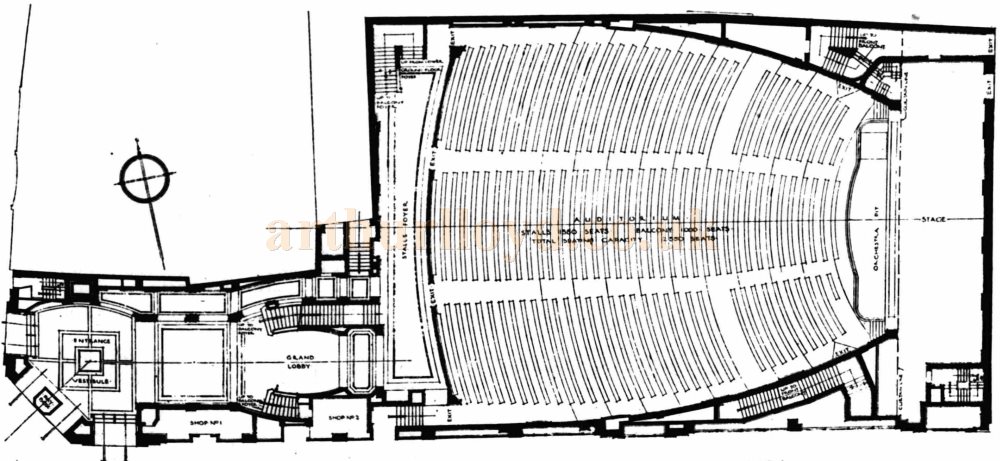
Above - A Stalls Level Plan of the Paramount Theatre, Leeds - From Kinematograph Weekly, February 18th 1932.
Hewittic Rectifiers
A roomy and workmanlike projection booth is equipped with two super Simplex projectors on Western Electric sound bases, Brenograph effects spot, spotlights, etc. To obtain direct current for the projection from the Leeds alternating current supply, Hewittic mercury arc rectifiers are employed.
The theatre has been so planned, and the exits so arranged, that the 2,550 people comprising a full house can be clear of the building in two minutes.
With double-feature programmes, selections by the orchestra, organ interludes and stage presentations arranged by Francis A. M. Mangan, to say nothing of its own magnificence, this new £250,000 Paramount cinema offers Leeds and Yorkshire generally something new and pretentious in cinema entertainment. It opens up a new era in entertainment generally in these parts.
The theatre has been designed by Frank T. Verity and S. Beverley, F.R.I.B.A., - architects for the other Paramount Theatres - with the collaboration of Major C. H. Bell, O.B.E., of the Paramount Company, on the electrical and mechanical side, and S. W. Budd, A.M.Inst.C.E., in respect of the steelwork.'
The above text in quotes was first published in The Bioscope on the 24th of February 1932.
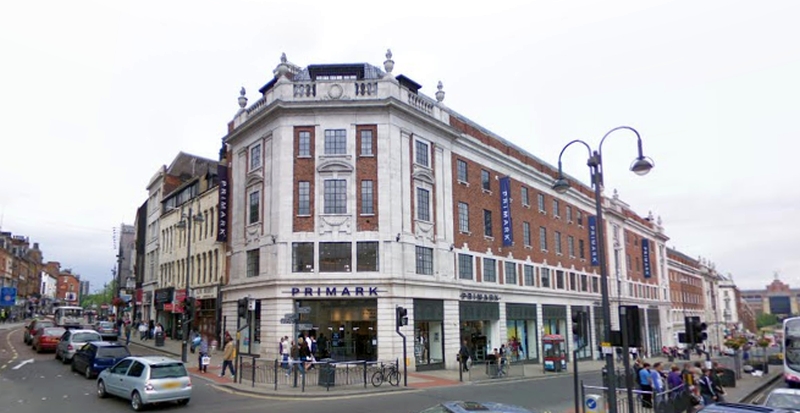
Above - A Google StreetView Image of the former Paramount Theatre / Odeon, Leeds in June 2008 - Click to Interact.
In November 1939 the Theatre was taken over by Odeon Theatres Ltd., who renamed it Odeon the following year in April 1940, and up until its closure in September 1968, for reconstruction into a twin Cinema, it remained open throughout with Films and Live Stage shows and concerts, including, notably, two Beatles Concerts in June and November 1963, the first along with Roy Orbinson.
When the Theatre was twinned in 1968 its Wurlitzer Organ was removed and rehoused in the Norfolk Thursdon Steam Museum where it remains to this day. The twinning of the Theatre involved creating one screen in the former Circle, extended to the stage, seating 978, and another in the former stalls area seating 1,297.
In 1978 a third screen was added in the Theatre's former bar area for 126 people, and the Stalls screen was further split into 3 screens in April 1988 seating 441, 200 and 174 respectively.
Sadly the Theatre was to close down completely in October 2001 so that it could be gutted and reconfigured into housing and shops, although Sir Reginald Blomfield's now Grade II Listed exterior was kept.
Some of the later information for this Theatre was gleaned from the excellent Cinema Treasures Website where a number of very nice photos of the Theatre can be viewed here.
If you have any more information or images for this Theatre that you are willing to share please Contact me.