
The Leeds Playhouse, Playhouse Square, Quarry Hill, Leeds
Formerly - The West Yorkshire Playhouse
The First Leeds Playhouse - The West Yorkshire Playhouse - The Current Leeds Playhouse
Leeds Theatres Index
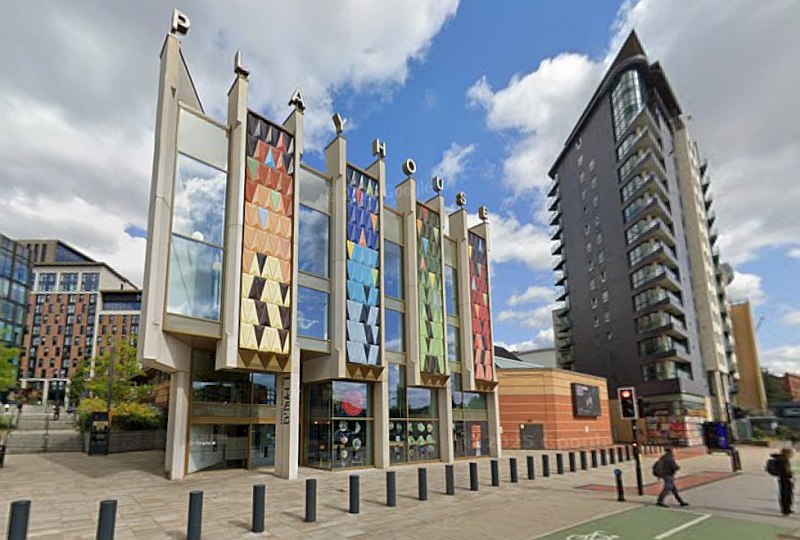
Above - A Google StreetView Image showing the Leeds Playhouse in August 2025 - Click to Interact.
 The first Leeds Playhouse opened on 17th September 1970. However, moves for a repertory theatre in the city had begun six years earlier, with a Campaign Committee stating that:- "We want to see in Leeds a new theatre, architecturally exciting, administered on a non-profit distributing basis, with a residential professional company of the highest quality, and a first-class director. We want to see, the year round, a varied repertory of plays, available at prices that are within the means of all sections of the community."
Right - The Auditorium of the first Leeds Playhouse from 1970 to 1990 - From a Rank Strand Electric Publication.
The Committee successfully organised a public meeting at Leeds Town Hall - a full house in a building which seated 1550 people, with an all-star line-up of speakers including local actor Peter O'Toole. They also organised a petition, which attracted 21,568 signatures.
For the theatre to happen, the Committee members faced two main challenges. First of all, they had to find a site for the theatre. Initially, they looked for a building suitable for conversion – including disused cinemas, religious buildings, factories and warehouses. All this searching came to nothing. The solution was finally found through Leeds University. An agreement was reached whereby the Committee would build a brick structure, in which they would construct a temporary theatre. After ten years the theatre would sell the building to the University, for use as a Sports Hall, and the theatre structure would be moved elsewhere.
The second challenge was finding the estimated cost of £150,000. Leeds City Council were reluctant to contribute, perhaps because they were in the process of buying the Grand Theatre. However, a grant of £25,000 was finally made, alongside £45,000 from the Arts Council. The Committee had therefore to find another £80,000 (£30,000 which was still outstanding when the theatre opened).
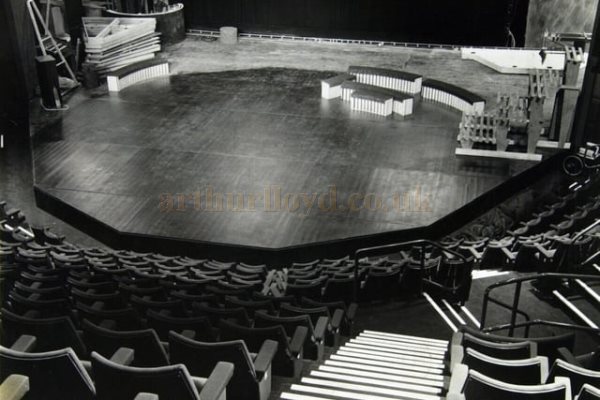 Regarding the theatre structure, the Committee's priority was an open stage:- "The city already has an outstanding example of the traditional stage and auditorium in the Grand Theatre. There is no point in duplicating the Grand on a smaller scale".
Left - The Auditorium and Stage of the first Leeds Playhouse from 1970 to 1990 - From a Rank Strand Electric Publication.
They wanted:- "to combine in a high degree the advantages of an open stage with the possibility of meeting effectively the needs of plays written for a proscenium theatre. We are satisfied that the primary need for good sight lines, good conditions for hearing, and a comfortable seating-space, could be met for an audience of about 650 – 800 people. A good relationship of actors and audience would be assured by the disposition of the seating and by the fact that the furthest seats would be within approximately fifty feet of the stage. Audience and actors would be under a common ceiling... without the disadvantages inherent in an oblong auditorium. There would be no pillars and no balcony".
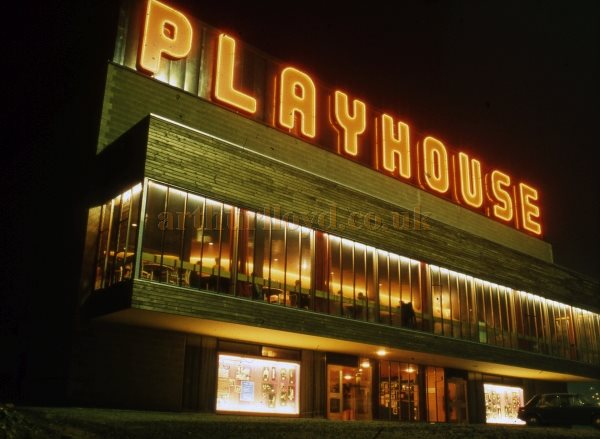 The theatre was located on the edge of the University campus, a mile north of Leeds city centre. The structure was designed by Bill Houghton-Evans, who at the time was a senior lecturer in the University's Department of Civil Engineering. His challenge was a design which would fit into a shell measuring 100ft long by 90ft wide by 40ft. high.
Right - The Leeds Playhouse of 1970 to 1990 - Courtesy David Stannard.
In the event he came up with the following:- "An acting area 30ft in diameter, stands near the centre, 18in above ground level. Behind it stands a scene dock and workshop. Flanking walls enclose backstage stairs to dressing rooms and wardrobe over. Wrapped around the stage on three sides, tiered seating for an audience of 750 rises from ground to roof. Below the rake of the seating tucked in the 'front of house facilities' foyers, bars offices, and cloakrooms. Slung up in the roof trusses are lighting catwalks, control box and 'flies'." - The Yorkshire Post 6 April 1970.
 In the event, it took twenty years for the Leeds Playhouse to find a new home. In those years, there were just two artistic directors. The first was Bill Hays, who had previously worked in television (Z-Cars, The Wednesday Play, etc.) and theatre. He commissioned Alan Plater to write the opening play, Simon Says!, which received hostile responses from both critics and local politicians. Hays was effectively sacked after less than two years, and replaced by John Harrison. John had substantial experience of working at repertory theatres, in Birmingham, Stratford-upon-Avon, and Nottingham.
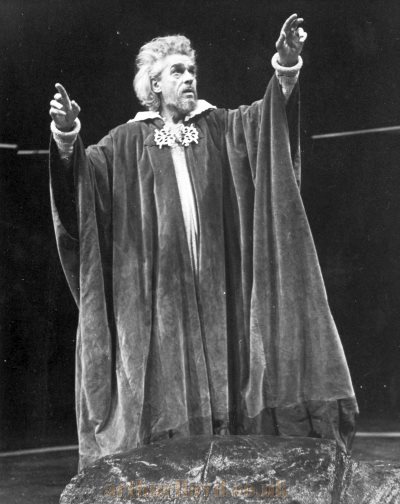
Left - Paul Scofield as Prospero in The Tempest at the Leeds Playhouse - M P H Studios, Leeds.
A highlight of his time at the theatre was a production of The Tempest, with Paul Scofield as Prospero. This played to 94% capacity and was the theatre's first West End transfer (at the Wyndham's Theatre it achieved the record as the longest continuous run of a Shakespeare play in London).
The first Leeds Playhouse often struggled financially, one consequence of which was abandoning plays in repertory after just four years. Nevertheless, the theatre offered much more than plays. It was a very successful venue for films and live music; there was also a ground-breaking Theatre in Education company.
The West Yorkshire Playhouse
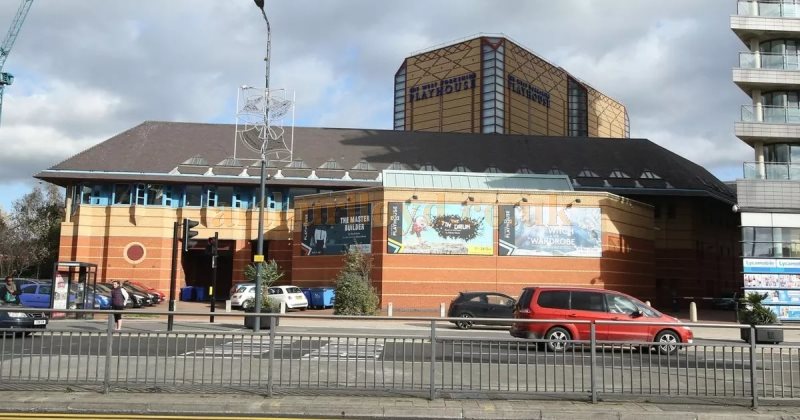
Above - The Exterior of the West Yorkshire Playhouse from 1990 to 2018 - Courtesy David Stannard.
The Leeds Playhouse remained on the University campus for much longer than the planned ten years. Another fruitless struggle for a new venue had included the possibility of becoming part of the Grand Theatre complex, as well as the Gaumont Cinema (now the 02 Academy Leeds). By 1981, the possibility of remaining at the present location was being explored, expanded to allow for a studio theatre and much improved facilities.
However, in 1983 there was the possibility of a new site on Quarry Hill, to the east of the city centre. Here, in 1978, the largest 1930s housing estate in Britain had been demolished. A design competition, organised in partnership with the Royal Institute of British Architects, was held. This was won by The Appleton Partnership, a husband-and-wife team from Edinburgh. One particularly innovative aspect of their design was a second auditorium, much larger than a typical studio theatre, to be seen as of equal importance to the other auditorium.
The original budget for the theatre was £5.8m, with Arts Council funding dependent on other sources, fortunately the soon to be abolished West Yorkshire County Council agreed almost £4m – hence the change of name. The building was completed in time for the official opening, by Diana Rigg, on March 8th 1990, by which time the cost had increased to £13m.
The larger of the two auditoriums, The Quarry Theatre, seated 750 people in a design very similar to the old Playhouse: an open stage with 90 degrees encirclement. There was a steep rake, and the audience entered at the rear of the auditorium.
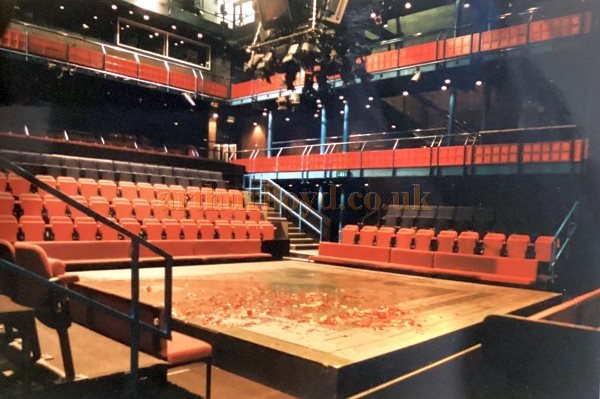 The second space, the Courtyard Theatre, was described by Ian Appleton as "bearing more than a nodding reference to the Georgian Theatre in nearby Richmond. This auditorium does not follow the 'studio' tradition, nor is it a neutral black box. A level of flexibility allows various configurations with a seating capacity of up to 350".
Right - The Auditorium and Stage of the Courtyard Theatre - Courtesy David Stannard.
The first artistic director at the West Yorkshire Playhouse was Jude Kelly. There were many successful productions, and the theatre chose to describe itself as the 'National Theatre of the North'. Many 'stars' were attracted to the theatre, including Sheila Hancock, Warren Mitchell, Alan Rickman, Mark Rylance, Patrick Stewart, David Threlfall, Timothy West – and a very young Jude Law. A particular 'scoop' was a six-month season of three plays - The Seagull, Present Laughter, and The Tempest – with a company of eleven actors including Claire Higgins and Ian McKellen.
Jude Kelly was followed by Ian Brown: his opening production was Hamlet with Christopher Eccleston and Maxine Peake. Other 'stars' appeared, including Tom Courteney, Lenny Henry, and Tim Pigott-Smith.
At both the Leeds Playhouse and the West Yorkshire Playhouse, assistant directors were frequent. John Harrison, in the 1970s, talked of his pride in giving "a bunk up" to younger directors, which included Michael Attenborough, (now Sir) Nick Hytner, and Steven Pimlott. At the West Yorkshire Playhouse, Nicolai Foster and Matthew Warchus, both local to Leeds, began the directing careers at the theatre.
The Current Leeds Playhouse
Including - The Quarry Theatre - The Courtyard Theatre - The Bramwell Rock Void
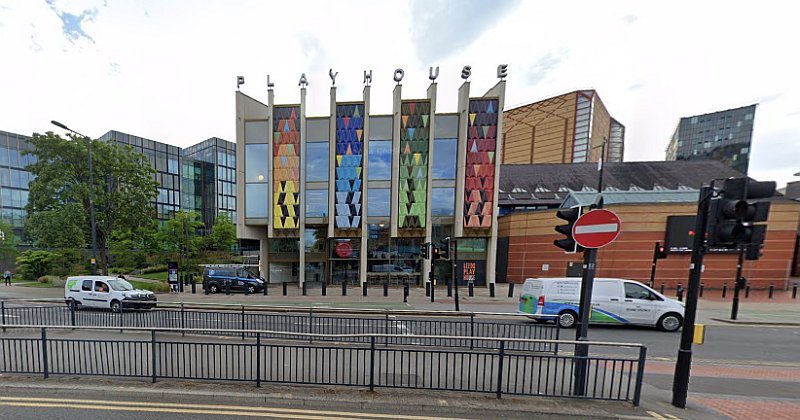
Above - A Google StreetView Image showing the Leeds Playhouse in June 2024 - Click to Interact.
When the West Yorkshire Playhouse opened, the building was often criticised as looking like an overgrown supermarket. Because of other planned developments for Quarry Hill, the theatre's entrance faced away from the city centre, and necessitated climbing a steep flight of steps if arriving by foot. Inside the building, because access to the Quarry Theatre was at the rear, audience members had to descend the dangerously steep rake, and wheelchair access was difficult.
For these and other reasons, the theatre closed for a year in 2018/2019 for a major redevelopment. For the general public, the most obvious development was a new entrance at street level, facing the city centre. Inside the building, the Quarry Theatre was adapted to allow entrance at lower levels and the capacity was increased to 850. The capacity of the Courtyard Theatre was also increased, to 450, but in the process, the possibility of re-configuration was lost. Perhaps the biggest development was the creation of a third auditorium, the Bramwell Rock Void, a flexible space previously a void under the box office – full of Quarry Hill rocks! There is seating for up to 120 people.
At the same time, the theatre's name was changed back to the Leeds Playhouse, arguably because outsiders never know where in West Yorkshire the theatre was located!
Sadly, the re-opening was quickly followed by closure because of Covid-19. So it was only in May 2021 that the theatre's fiftieth anniversary could be celebrated. Six writers, including Simon Armitage and Maxine Peake, were commissioned to write short monologues – one for each of the six decades since the 1970s. They were enjoyed by mask-wearing, socially-distanced audiences!
The size of the Quarry Theatre stage has always made it a difficult space for anything but 'big' productions. Nevertheless, the theatre has always had an excellent reputation for its work on this stage at Christmas. The best example, from 2017, is The Lion, the Witch and the Wardrobe, for which the auditorium was converted into the round, with a vast circular stage. The production attracted several five-star reviews in local and national newspapers. After Leeds, the production transferred to the Bridge Theatre in London; it then toured extensively for six months; it was the Christmas production at the Lowry Centre, Salford in (2021) and the Birmingham Repertory Theatre in (2023); it then returned to London – and was back in Leeds for Christmas 2024!
Recent years have also seen very successful productions of Oliver! (2023) and My Fair Lady (2024). Like most regional producing theatres, the Playhouse has come to depend on co-productions. One of these successes was an adaptation of Animal Farm, co-produced with the Theatre Royal Stratford East. This production won the 2025 UK Theatre Award for Best Play Revival.
The above article on the Leeds Playhouse and West Yorkshire Playhouse was written for this site by Dave Stannard in January 2026. Dave Stannard is the author of Leeds Playhouse: a Tale of Two Theatres, published in 2024 by Naked Eye Publishing.
You may like to visit the Leeds Playhouse's own website here.
If you have any more information or images for this Theatre that you are willing to share please Contact me.