
A Report on the London Coliseum's Construction
From the Builders' Journal and Architectural Record of the 26th October and the 9th of November 1904
Main Page on the London Coliseum
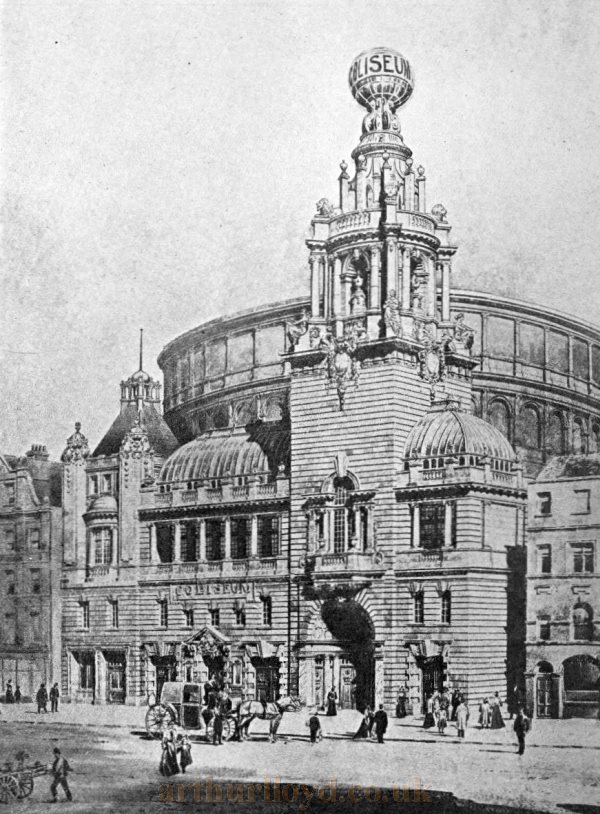 At the London Coliseum now being completed in St. Martin's Lane there is a remarkable circular stage divided into three concentric rings, the outer of which will revolve at 25 miles an hour. The proscenium, 55ft. wide by 40ft. high, is the largest in the United Kingdom; by means of tormentors it can be brought back to the usual 42ft. width, while a sliding proscenium border-frame reduces it to 40ft. by 25ft. The house has three tiers and will seat 3,000 people. Messrs. Frank Matcham & Co., the architects, have employed this patent gridiron construction for the tiers: this consists of a semi-circular main girder with radiating supporting girders, instead of the ordinary cantilevered straight main girder. In this gridiron construction there are 80 tons of steel. The tiers are supported by two solid steel columns, the concrete foundation being reinforced by steel grillage.
Right - An Artist's Sketch of the Front of the London Coliseum - From The Builders' Journal and Architectural Record 26th October 1904. Note that the Circular Roof shown here is not how the Theatre looked when it was finished.
This building, now being completed in St. Martin's Lane, Charing Cross, London, is a work of considerable magnitude, covering 1¼ acres of ground. We publish this week a number of views showing it in course of construction, and in other issues we shall follow with views of numerous other details. Not more than two years will have been spent in erecting this huge theatre. The work was commenced in 1903 by the demolition of the old buildings on the site. This was a difficult task because, with the object of saving time, it is the custom of Messrs. Frank Matcham & Co., the architects, to begin the demolition of the old buildings and the erection of the new several months before all the leases of the properties on the site have expired. By dint of persuasion, however, and monetary inducement, the tenants of this property off St. Martin's Lane were induced to leave, the building operations being suspended when the tenants held out, and the premises shored up. This is very worrying work, but the saving of time and the consequent interest on capital makes it profitable. On the Coliseum site 120 different interests were involved.
 The site is bounded by St. Martin's Lane at the front, Bedfordbury at the back, Taylor's Buildings (a court behind Chandos Street) and May's Buildings. Several historic buildings were destroyed to make way for the new theatre, including Charles Buildings and Turner's Court, but much of the property consisted of slums, there being as many as ten or twelve families in some of the houses.
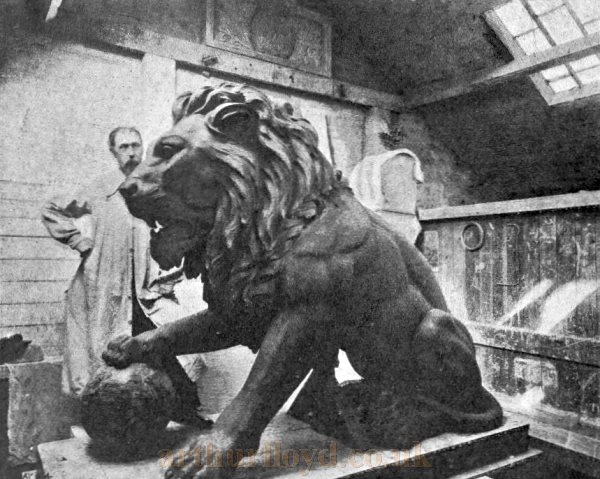
Left - One of the four Lions to be placed above the Tower Balustrade at the London Coliseum - From The Builders' Journal and Architectural Record 26th October 1904.
The Coliseum Co., of which Mr. Oswald Stoll is the managing director, began by employing labour direct, without the intervention of a contractor, under the management of Mr. John F. Revell, the clerk of works, who has now been engaged on theatres under Mr. Frank Matcham for a number of years. Mr. Revell started the laying of bricks in December, 1903, and the work was solely in his hands up till May last, the state of the building at that time being shown by the photograph on p. 216 (shown below).
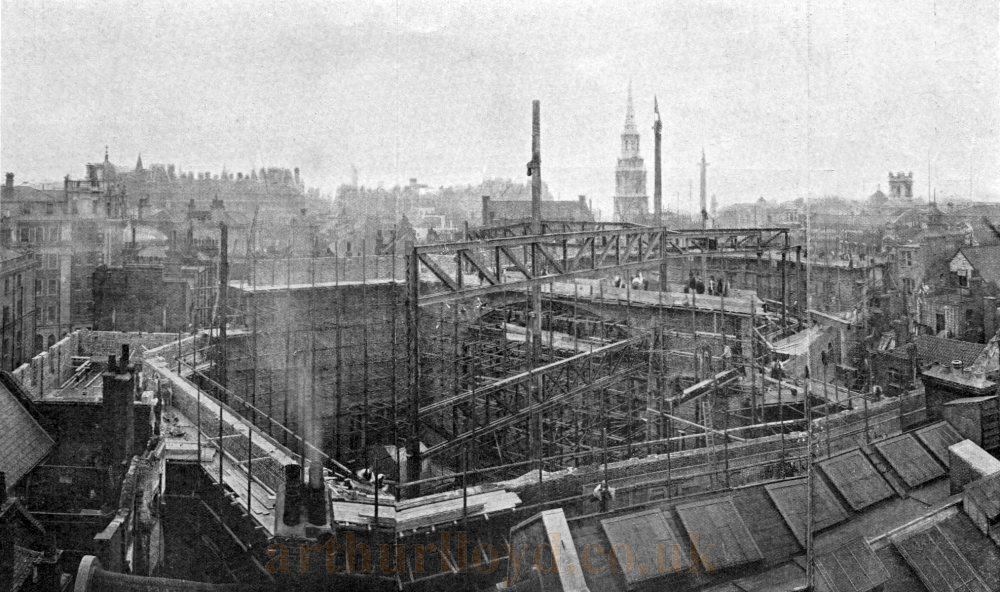
Above - The London Coliseum: Work as executed up to May 5th, 1904. Frank Matcham & Co., Architects. - From The Builders' Journal and Architectural Record 26th October 1904.
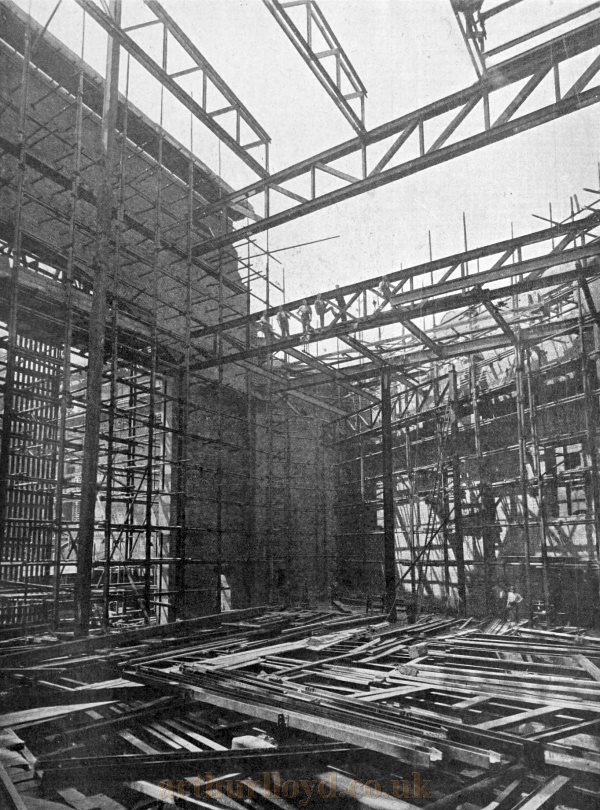 In short, the Company built the foundations and main buildings up to the roof, laying 5,000,000 bricks, when the rest of the work was put up to tender, and the contract secured by Messrs. Patman & Fotheringham, Ltd. (Mr. James F Parker, managing director), the well-known builders of 100 and 102, Theobald's Road, London, W.C., and Park Street, Islington, N., who themselves have laid between 1 and 2 million bricks. These figures show roughly the size of the job. Mr. Revell cleared 28,0000 yds. of material for the stage foundation bed, which is 32ft. below the level of Bedfordbury, and the sinking of the large well (as it may be called) in which the revolving stage is placed.
Right - The London Coliseum: The Stage, looking towards the Scenery Dock and Auditorium. Drew-Bear, Perks & Co., Ltd. Construction Engineers - From The Builders' Journal and Architectural Record 26th October 1904.
The method adopted in carrying out this work is noteworthy. First the ground was trenched for the ring wall, which is 28ft. deep and 6ft. 6ins. at the bottom, tapering to 21 bricks at the top, and concreted for half the depth. Engines were then placed on the ring wall, the earth in the centre being removed by their agency, and the solid concrete bed 9ft. thick by 75ft. diameter constructed. On this bed there are twenty-five different electric motors which will propel the revolving stage. This latter is built in three concentric rings each 25ft. across, which can either revolve independently (the outer one at 25 miles an hour), or be coupled together in any order, or turned as one whole. This stage is to be used for spectacles, horse-racing, &c., and for saving time in setting scenes; while a scene is facing the audience on one-half of the stage another can be set at the back on the other half. This stage will have cost £12,000.
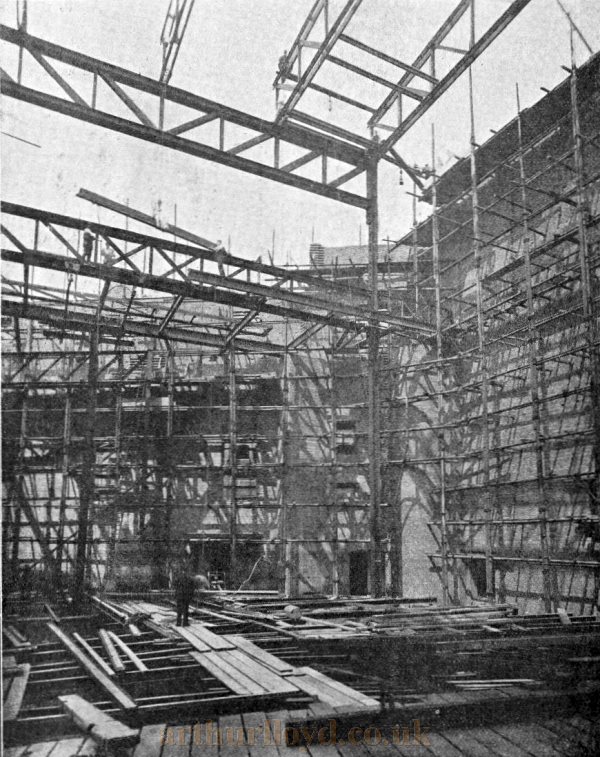 It is covered with 2in. teak and padded with felt to reduce vibration to a minimum. It was designed by Mr. E. Wingfield Bowles, and constructed by Messrs. Ransomes & Rapier, Ltd., of Ipswich and London. Several other arrangements have been adopted for saving time in staging, the main conditions of the design of the theatre being the provision of a two-hours continuous entertainment without the usual waits of up to 15 minutes between the scenes. Thus, over the stage there is a girder on each side on which will run a goliath electric crane capable of picking up a piece of scenery or anything else weighing 10 tons.
Left - London Coliseum: View from the Stage, showing Flies and Back Wall - From The Builders' Journal and Architectural Record 26th October 1904.
All the engineering work of the stage portion, apart from the stage itself, was constructed by Messrs. Drew-Bear, Perks & Co., Ltd., of the Battersea Steel Works, Wellington Road, S.W., and 71A, Queen Victoria Street, E.C. The views we publish show their work in course of construction and give some idea of the immense size of this portion of the building. The impressiveness of the place may be realized if we imagine entering a room 100ft. square and 70ft. high, for there is nothing between the stage and the grid, which is 71ft. - and the roof 81ft. - above the floor. The stage is free from any obstruction with the exception of two stanchions at the back which pick up the flies, grid and roofs over. We shall deal at greater length with Messrs. Drew-Bear, Perks & Co.'s work in a later issue, when detail illustrations of the steelwork will be given. We would mention that it was delivered built up to a large size and that a 90ft. derrick was used in erecting it.
The foundation bed for the revolving stage was intended to be inclined, as it was thought that the wheels would need to run as on a bicycle track, but on being worked out it was found that the centrifugal action of the circular stage was balanced and consequently a flat bed was substituted. Below this foundation is a subway 8ft. 6ins. high, 4ft. wide in the clear, constructed with brown-glazed bricks. It is entered by an iron spiral staircase in a great central hole raft 12ft. in diameter, and leads out of the ring back to the dressing-rooms, so as to allow the artists to get off the stage while the other rings are revolving. Under this foundation bed is also a sump for catching surplus water. Under the stage floor are tanks for aquatic spectacles, and a storage tank 22ft. by 18ft. by 11ft. deep holding 20,000 gallons still further below (35ft. in all below street level). The main walls of the stage had naturally to be carried down to the same level as the foundations of this interior work. They are laid throughout in cement, and grouted up. Fletton bricks were used. The walls go down to the London clay and are 3ft. thick at the base, with a foundation spread of 6ft. 6ins. Not much water was encountered, only hand pumping being necessary.
There are also dressing-rooms at the back with the latest appliances, including a spray-bath for ladies and another for gentlemen, as well as a green-room of course. On the O.P. side is a large triangular scene dock.
The auditorium is designed to seat 3,000 persons, comfort being studied rather than the accommodation of a large number. The main entrances to all parts of the house are in St. Martin's Lane. There are three distinct exits from each floor outside the main walls of the building. There are three tiers - called the grand tier, the dress circle and the amphitheatre. The whole of the ground floor is devoted to stalls and boxes.
The structural engineering to this portion of the building has been executed by Messrs. Richard Moreland & Son, of Old Street, E.C. The tiers are carried by a novel form of construction, the patent of Messrs. Matcham & Co., the architects. This is shown in the photographs on pp. 222 and 223, (shown below).
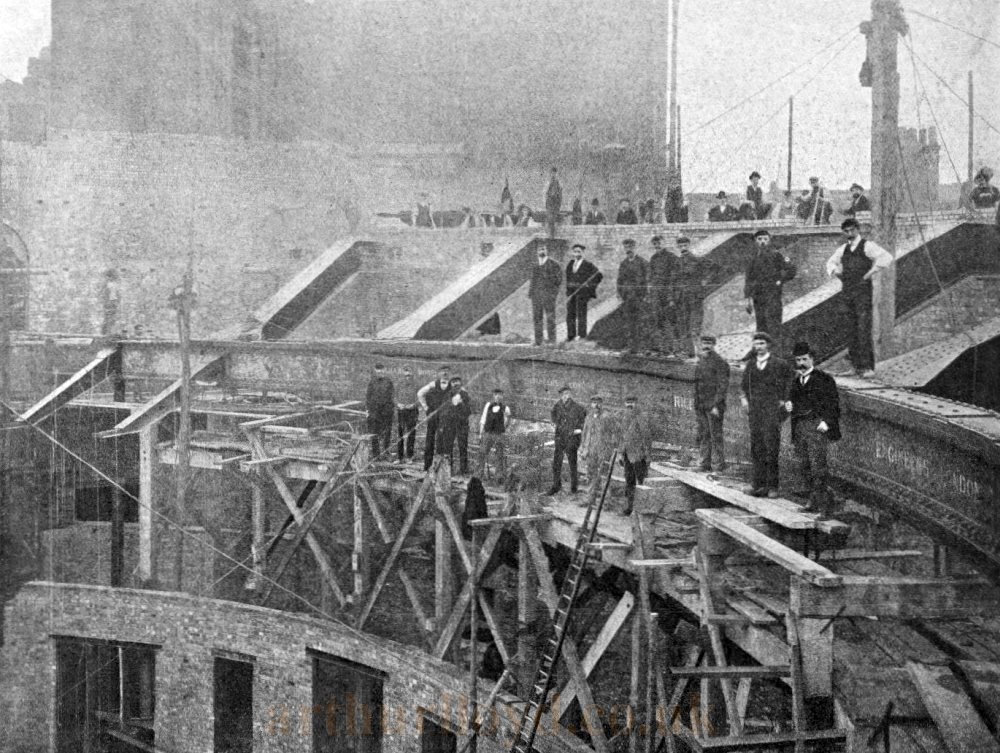
Above - The London Coliseum: Grand Tier Construction. Richard Moreland and son Ltd., Engineers - From The Builders' Journal and Architectural Record 26th October 1904.
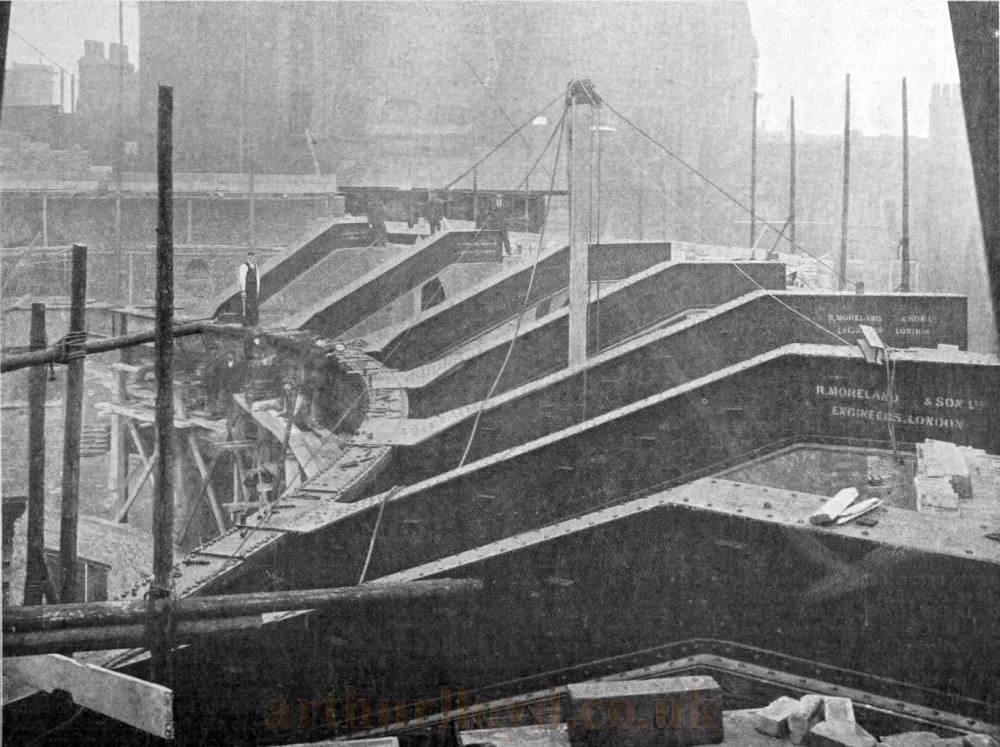
Above - The London Coliseum: Grand Tier Construction - From The Builders' Journal and Architectural Record 26th October 1904.
 It will be seen to consist of a main circular girder, with girders radiating from it. This kind of "gridiron" is not a cantilever construction, the whole stability depending upon the gusset plates (similar to those seen on the top side) riveted under the ends of the radial girders where they join the main girder. Cantilevers are run out beyond the main girders, two of which are shown in the view on p. 222, (shown above) but these are subsidiary. The advantage of this construction is that the ceiling is regular, not being upset as by the usual straight girder. The total length of main girder is 129ft. 6ins.; it has a Clear span, being only supported close to the walls by solid steel columns, 88ft. from centre to centre. The weight of the main grid construction shown is 80 tons.
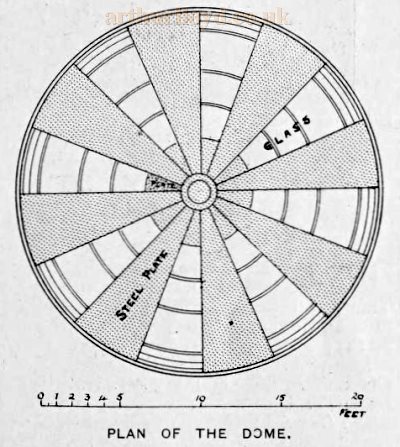
Right - A Plan of the Dome at the London Coliseum - From The Builders' Journal and Architectural Record 26th October 1904.
The solid steel columns referred to are a speciality of Messrs. Moreland, and have obvious advantages over the hollow column, as to the smallness of their diameter and resistance to fire. The diameters of the columns here used are 10ins. on the ground floor, 9ins. on tier above, 8ins. above that, and 7ins. at the top. The cap to each column is 4ins. solid steel. The foundation to each column is a concrete-steel grillage 120ft. super, in extent; consisting of four 23in. by 6in. joists, held in place by two plates riveted over, and on top of this three joists crossing. The concrete is 9ft. thick. On the grillage is a 6ft. by 6ft. by plate, and then a solid steel plate 4ins. thick. Messrs. Moreland used derricks (to be seen in the views on pp. 222 and 223) (shown above) and pneumatic riveters, the compressor being driven by an electric motor.
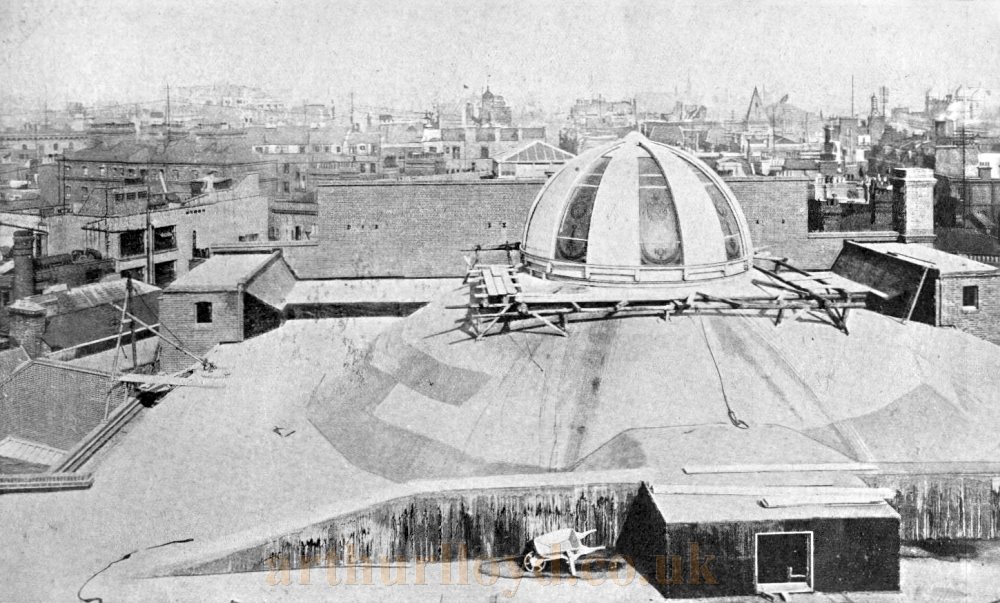
Above - The London Coliseum: Roof and Dome over the Auditorium - From The Builders' Journal and Architectural Record 26th October 1904.
 The dome over the centre of the auditorium is a special steel structure of novel design. It is 22ft. in diameter and nearly 70ft. in circumference, constructed on the principle of the "hit and miss" ventilator, so that one-half can be opened direct to the outside air, or closed up at will. Its circumference is divided into sixteen parts, eight of which are filled in with painted glass (see p. 221) (shown above). These eight parts are stationary, the remainder being constructed of steel plates of a special make on a light steel frame, made to turn on their axis, and so forming a revolving dome similar to that of an observatory.
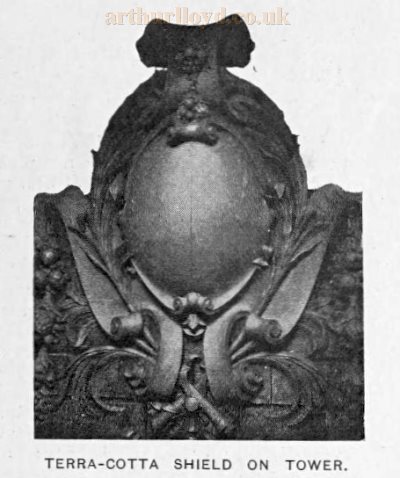
Right - A Terra-Cotta Shield on the Tower of the London Coliseum - From The Builders' Journal and Architectural Record 26th October 1904.
 The glazed fixed portion of the dome has a base ring made up of light angles and plates of steel, the radial ribs, of which there are sixteen in this portion, being firmly, riveted to this ring. They are curved to true radius and intersect at the crown into a specially designed steel head. The ribs are connected together with circumferential ribs of steel tees, arranged to support and form the glazing bars for the ring panels. On the outside of the steel ring supporting the stationary portion of the dome a circular track is formed and firmly riveted in place, acting as a roller path for the base of the steel-plated portion of the dome. This base has a series of wheels working on steel pins in gunmetal bearings socketed to the radial ribs.
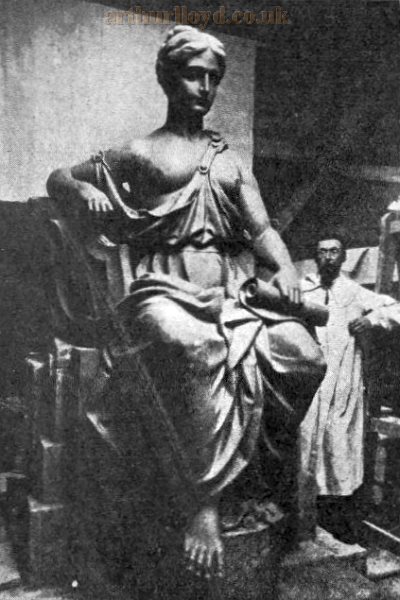
Left - A Figure of Music on the Tower of the London Coliseum - From The Builders' Journal and Architectural Record 26th October 1904.
 The loads are carefully regulated and distributed over the wheels by an adjustable steel pin at the crown in gunmetal bearings, so that friction is reduced to a minimum. The thrust of the radial ribs is taken up by a steel channel ring riveted to their bases. When the dome is properly adjusted two men by pulling on this ring can easily revolve it: a rack, however, is fixed to the channel ring, having a small pinion working in it, so framed and geared that one man with trifling effort can open or close the apertures in a few seconds. The working out of the details of this dome and its construction and erection was entrusted by the architects to Messrs. William Whitford & Co., an old-established firm of structural engineers, of the West Ferry Road, Millwall, E.
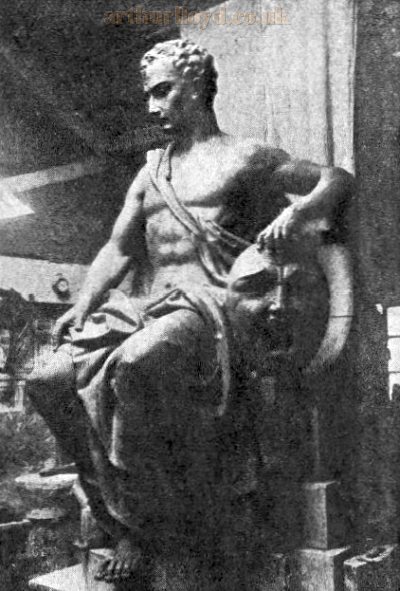
Right - A Figure of Drama on the Tower of the London Coliseum - From The Builders' Journal and Architectural Record 26th October 1904.
We publish photographs of some of the terra-cotta work. The colour is warm drab and the surface dragged rough. It was supplied by the Hathern Station Brick and Terra Cotta Co., Ltd.,of Loughborough. We shall notice it further in another article.
The above Article and its accompanying images was first published in the Builders' Journal and Architectural Record 26th October 1904.
A Continuation of the Report on the London Coliseum's Construction
From the Builders' Journal and Architectural Record of the 9th of November 1904
 In our issue for October 26th we published a number of photographs showing this building in the early stages of its erection, together with certain details of the exterior. We now give some photographs of the interior.
Right - The Arch over the Proscenium Opening of the London Coliseum - From the Builders' Journal and Architectural Record of the 9th of November 1904.
The roof of the stage is no ordinary affair. The regulations governing theatres generally are not drawn up in regard to one of this size, and they came rather awkwardly. Thus the London County Council require one-tenth of the area of the roof over the stage to open automatically in case, of fire and at the Coliseum the opening roof lights are 105ft. by 130ft. Their automatic opening is effected by a weight raised by means of a cord, the lights falling to; when the cord becomes burnt the weight drops and the lights open. This lantern light, with the proscenium wall rising in front, is shown in the view on p. 221 of our issue for October 26th (shown here).
The flies and the grid of the Coliseum are higher than in any other theatre in the United Kingdom. The grid consists of steel bridging covered with timber, acting on the principle that the stage is to be made inflammable, so as to carry the smoke and flames away from the auditorium in case of fire. The roof is covered with lead.
The proscenium opening is the largest in the Kingdom, being 55ft. wide by 40ft. high, which can be brought back to the usual 42ft. width when desired by "tormentors" or side wings. There is also a sliding proscenium border - frame by which the opening can be reduced to 40ft. by 25ft. The fireproof curtain is double-hung, with double asbestos cloth, and sprinklers above. This curtain and the other fire appliances were supplied by Messrs. Merryweather & Sons, Ltd., of Greenwich Road, London, S.E. The exactitude with which the curtain has been constructed will be apparent when we state that it is 42ft wide with a lift of 40ft. which does not vary ½in. Built into the main proscenium wall are two huge stanchions, one on each side, 18ins. by 22ins , which carry the portion of the auditorium roof and the great arch over the proscenium built on the extrados of a bow-string girder 57ft. in the clear and 62ft. long, springing 12ft.; this is shown in the illustrations on p. 245 (shown below)
Above - The London Coliseum: View showing Bowspring Girder and Brick Arch over Proscenium Opening - From the Builders' Journal and Architectural Record of the 9th of November 1904.
As regards general matters, the theatre absorbed four public-houses, but it will not have a licence. Three axes or lines are worked to a datum line, a main centre line and a curtain line. Only one slight accident occurred while the labour was engaged direct by Mr. Revell, the clerk of works. It may be mentioned that the building will contain 3 miles of carpets and 10 miles of electric casing. The time taken with the pneumatic riveters used by Messrs. Moreland averaged three seconds per rivet, 12ins. long and 1½ins. diameter.
The plasterwork and decoration of the auditorium has been entrusted to Messrs. F. de Jong & Co., of 84, Albert Street, Regent's Park, N.W., who have done a great deal of such work for Messrs. Frank Matcham & Co. and other theatre architects. It is all executed in what is known as fibrous plaster, commonly called in the trade "stick and rag," that is to say, there is a basis of coarse canvas and pieces of wood to form a skeleton framework, upon which the plaster is manipulated. Nearly all the work has been executed at Messrs. de Jong's shops, although necessarily there must be a considerable amount of fitting and finishing in situ.
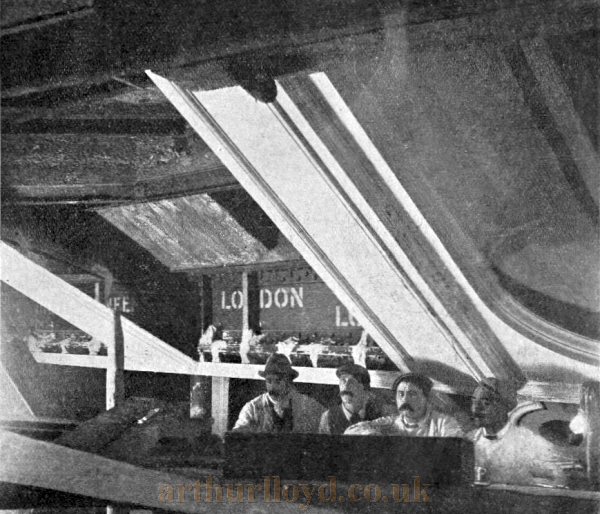 The view on the opposite page (shown right) shows the men working on the ceiling of the grand tier: it will be noticed how the ceiling slabs are hung by stirrups from the girder.
Right - Underside of Grand Tier showing method of fixing Plaster Ceiling - From the Builders' Journal and Architectural Record of the 9th of November 1904.
The difficulty of executing the work complete in the shops will be readily appreciated, and it is only by the co-operation of the other trades concerned that Messrs. de Jong are able to carry it out without extensive alterations. Thus the ironwork drawings have been worked to, to a great extent, probably giving the most help of all and of course the architects' working drawings to ⅛th scale.
The drawings prepared in the draughting and setting-out office of Messrs. de Jong have been to both 1in. and ½in. scales,with full-size details for mouldings.
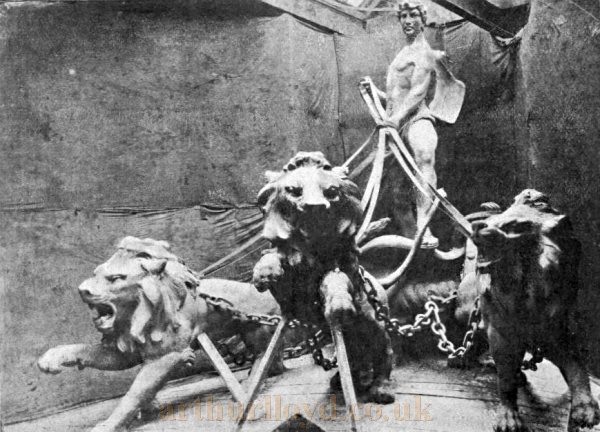 All the decoration is modelled in clay, and moulds cast therefrom in gelatine, which, we need hardly say, allows undercutting to be done and avoids the use of elaborate piece-moulds. In some of the larger work, however, such as the lions and chariot illustrated on this page, piece-moulds have been used.
Left - Plaster Group above Chorus Box at the London Coliseum- From the Builders' Journal and Architectural Record of the 9th of November 1904.
In order to save time in the drying, these are placed in the drying-room in front of coke fires and have a very curious aspect steaming away there. The model of the interior illustrated on the opposite page (shown below right) was prepared at the architects' request in a plastic clay composition this allows any details to be altered if considered necessary without having to keep the clay moist, as usual, to prevent cracks.
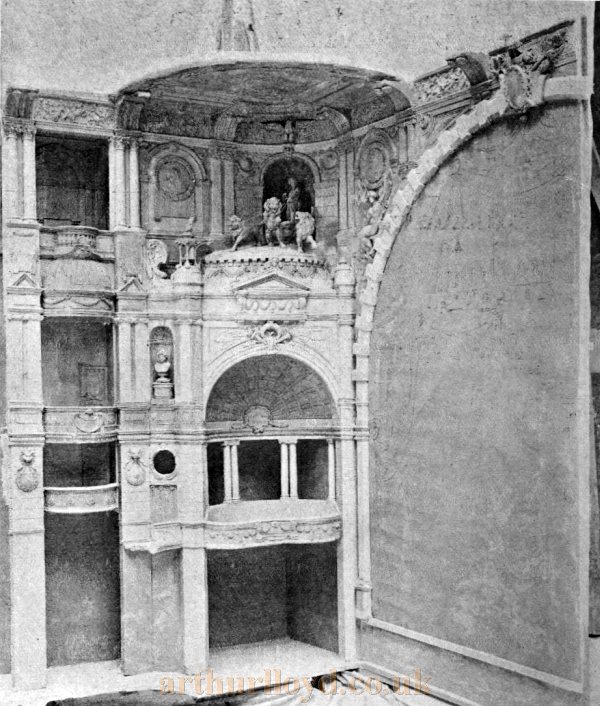 Messrs. de Jong find these models are of very great service in realizing the scale and effect of the design; this one was especially prepared for seeing the effect of the rather peculiarly-shaped chorus box and the group above, about which a doubt existed.
Right - A Model of the Interior of the London Coliseum, showing Boxes and Proscenium Opening, by F. De Jong & Co. - From the Builders' Journal and Architectural Record of the 9th of November 1904.
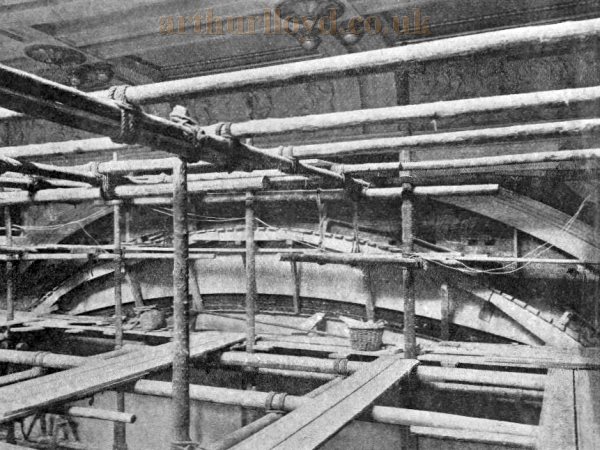
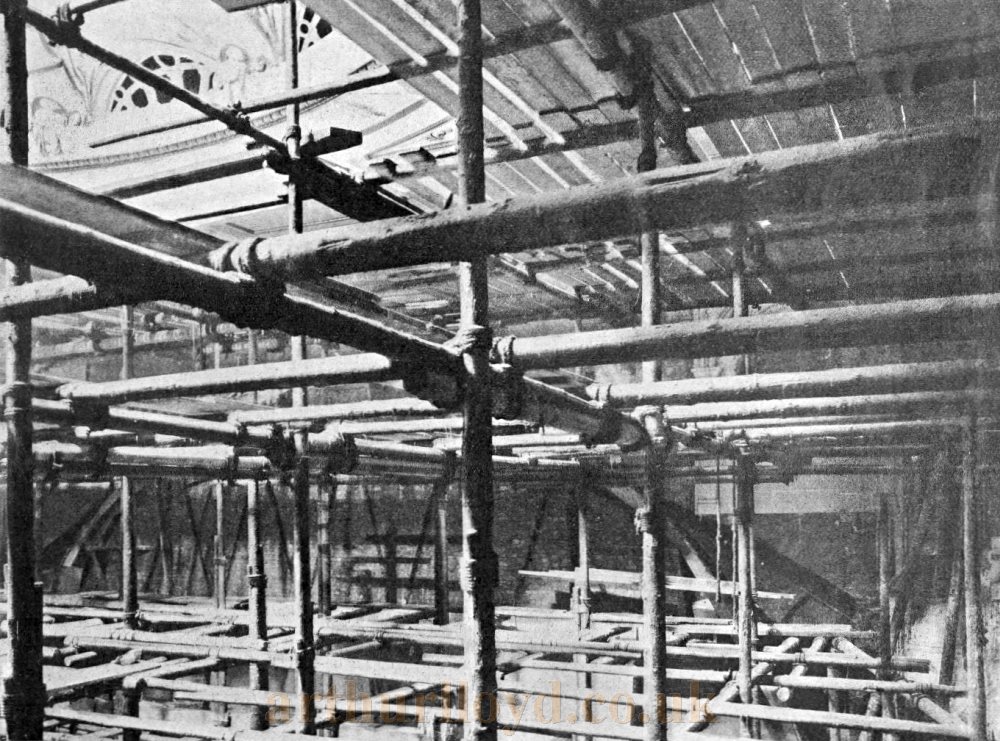
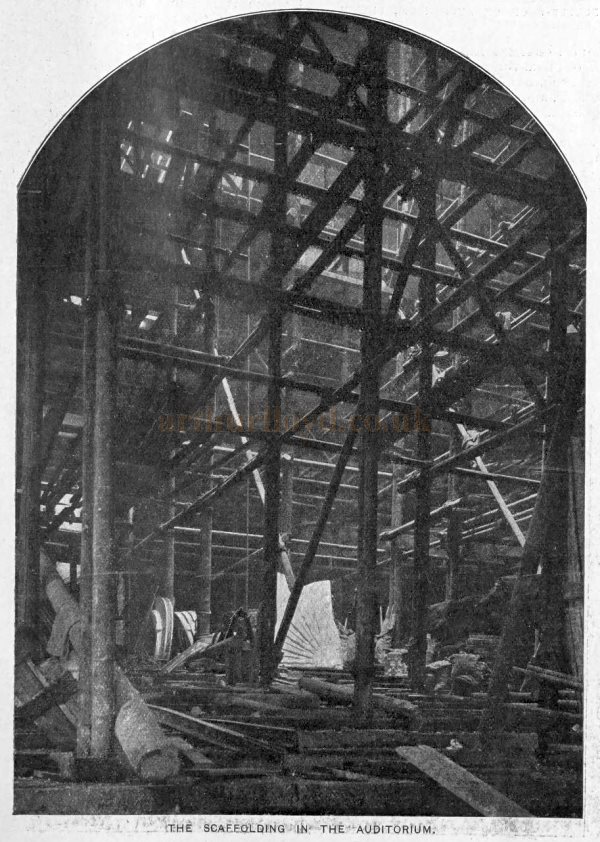
The interior of the Coliseum is decorated in Classic style, the predominant colours being stone and gold. The colouring is done with oil colour, this being preferred to distemper as it does not clog the mouldings, &c. To fix all the fibrous plasterwork and do the colouring, Messrs. de. Jong required an independent scaffold away from the walls, so that it could be demolished as the workmen descended. This scaffold was a remarkably elaborate one, as will be seen from the photograph below. It contained about 3,000 poles.
In addition to the numerous parts which are being carried out in fibrous plaster, a very large portion is being carried out in white and coloured marble by the well-known firm of Messrs. J. Whitehead & Sons, Ltd., of the Imperial Works, Kennington Oval, and late of Westminster, who have lately done so much for beautifying the interior of Westminster Cathedral.
 Alabaster will enrich the main piers of the auditorium which separate the boxes and reach up to the frieze of the dome ceiling. These piers, 3ft. 6ins. wide, are treated differently at the various levels, being in part rusticated and in part fluted and panelled and richly-moulded, with string-courses which will run parallel and continuous with the fibrous plaster mouldings to the fronts of the dress circle, grand tier and balcony.
Left - The Scaffolding in the Auditorium of the London Coliseum erected for F. De Jong & Co. Plasterwork to be fitted - From the Builders' Journal and Architectural Record of the 9th of November 1904.
Each pier will have a moulded pediment at the grand-tier level and a solid double-column treatment at balcony stage, supporting the main frieze referred to above. The three solid columns are 10ft. high and of extremely fine material. The proscenium arch is worked solid in polished alabaster, the splayed piers (over 2ft. wide) being treated with richly-moulded pedestal and super-bases and other string-courses.
To the front of the stage will be an alabaster fascia, and flanking the stage on either side the entablature of the alcoved ceiling of semicircular - shaped chorus boxes will be supported on single and double solid marble columns. Under the chorus boxes the alabaster exits from stalls will be surmounted by richly-moulded pediments, and the curved alabaster walling flanking the exits will abut against massive octagonal piers of alabaster towards the auditorium and similar canted-shaped responds against stage wall. A balustraded and moulded barrier in polished white marble will separate the stalls from the exit gangways, and will span the whole width of the building (over 72ft.). This barrier will have two exit openings leading from the stalls down to a lower level, and the marble walling towards gangways will be fitted with polished louvres for ventilating purposes. Within the barrier towards the auditorium the first of the stalls boxes on either side is to have an alabaster front with moulded string-courses, each being supported on six solid marble legs standing on an alabaster dais. The remainder of the eight stalls boxes, four on either side, have their fibrous plaster arches supported on polished alabaster columns. Behind the stalls boxes and beyond the auditorium the semi-circular foyer will have various marble columns and responds as part decoration. Similar columns and responds will also help to decorate the constructional supports to the ceiling of the dress circle and grand tier. The counter tops to all refreshment stalls will be in rich Paonazzo marble with moulded fronts. Around the walls of the dress circle there will be a dado in three different-coloured marbles extending to the exits, whose lobbies will also have a special marble treatment.
A very conspicuous feature will be the Royal box in a central position immediately facing the stage, and projecting slightly within the auditorium beyond the other stalls boxes, five on each side. The front of this box will be nearly 12ft. wide, and will be carried out in polished white marble with moulded balustrading, plinth and rail and panelled sides. On either side will be continuous panelled and moulded pedestals in the same material for supporting sculptured figures. Over the box will be a canopy in elaborate fibrous plasterwork, with the Royal crown as a terminal, supported on highly polished white marble columns.
The auditorium is constructed entirely in steel and concrete. The stalls occupy the whole of the auditorium floor, which has a 6ft. rake and is stepped in 12in. steppings (an unusual thing as will be seen in the view on the preceding page.
One feature which is a distinct improvement in a theatre has been adopted at the Coliseum, namely, the corridor at the back of the stalls has been sunk so as to prevent the sight of the stage being blocked. In front of the Royal box, by means of steps, all possibility of interruption of view by people standing up. is avoided. Gangways lead down the side with the object also of preventing obstruction. There is a spacious orchestra.
In the front of the house are the staircases to every part of the building and the main entrance, together with crush-rooms, refreshment bars (especially noticeable being a large tea-room), press-rooms, managerial offices, &c. There are three fireproof floors in this portion, constructed on the Hennebique reinforced concrete system by Messrs. Cubitt & Co. from designs by Mr. I,. G. Mouchel. Over the entrance is a large mosaic dome executed by Messrs. Diespeker, Ltd., of 57 to 60, Holborn Viaduct, London.
The marble work for the entrance hall, foyer, vestibule and staircase has been entrusted to Messrs. Anselm Odling & Sons, Ltd., of Poole Street, 132, New North Road, N. The combinations are of a varied character, and embrace Swedish, Italian and Belgian marbles of the finest quality. In the hall and staircase the walls have a skirting in Verde di Prato (a rich deep green from near Florence), with a dado filling of alternate strips or panels of Swedish green and Bianco Chiaro. The dado rail is of dark Swedish green. The surface is broken up at intervals by pilasters and architraves to doors of Breccia Serravezza. The treads and risers of the staircase are of the finest Sicilian marble, the balusters of English alabaster, and the handrail of Verde di Prato, terminating in carved newels representing griffins, dolphins, &c. The staircase columns are of Swedish green. The vestibule has the skirting and dado rail in Rouge Griotte, the dado filling in brown Brocatello, with alternate courses of brown Brocatello and Bianco Chiaro above the dado: the whole surrounded by a Navy cornice in Bianco Chiaro. Part of this work was executed in Messrs. Odling's studios at Carrara and part in their London workshops.
 The inside of the dome over the auditorium has been decorated as a valarium - the covering of light material suspended over the theatre in Greek and Roman days to give shade from the sun and make it possible for the spectators to hear the actors.
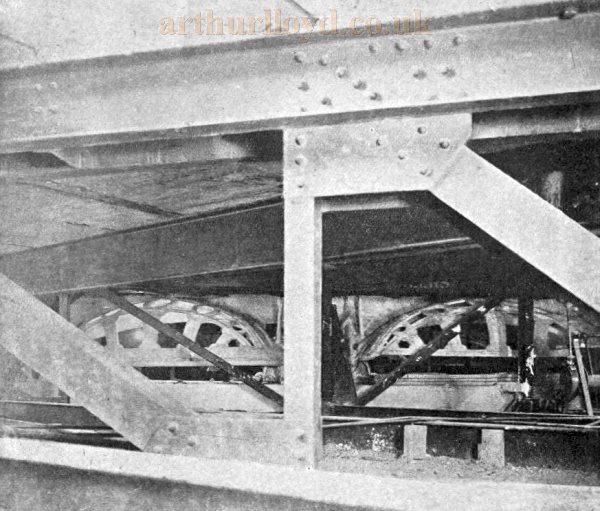
Right - View from the Chamber, looking between Double-Roof of Auditorium, showing Ventilation Openings - From the Builders' Journal and Architectural Record of the 9th of November 1904.
The engineering work in connection with the warming and ventilation and hot-water domestic service has been carried out by Messrs. Ashwell & Nesbit, Ltd. It is divided into two sections, the first consisting of a complete plenum system for the auditorium, and the second the warming of the stage, artists' rooms, offices, &c., which are supplied with direct heating service. Steam for the heating is generated in one Lancashire boiler 24ft. long by 7ft. diameter, fixed in the basement. Two large heating batteries are fixed in prepared chambers in the roof (shown on either side of the proscenium wall in the photograph on p. 221 of our issue for October 26th) (shown here), through which are passed 3,500,000 cub. ft. of air per hour by large pressure-fans driven by electric motors of 200 volts, 8-b.h.p. and 1,000 speed, made by Messrs. Newtons, Ltd., of Taunton.
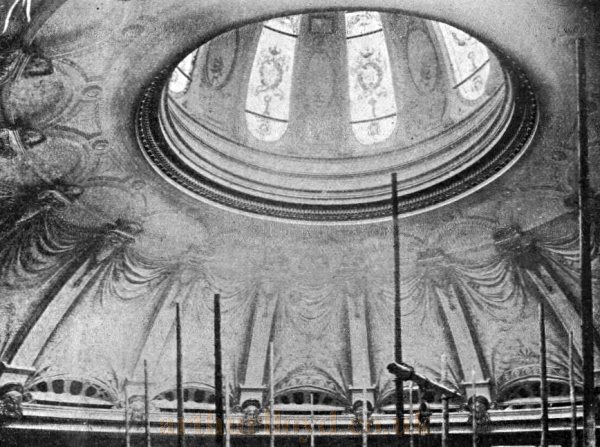 The incoming air is cleansed by being passed through filtering screens, and will be warmed in the winter by being drawn over the steam batteries, after which it is forced along horizontal ducts formed in the roof space (see illustration above) (shown above right), and a quantity of fresh air then discharged into the auditorium at the ceiling level (see illustration below) (shown left), the remainder being carried down in vertical flues and discharged immediately below the ceiling of each gallery.
Left - The Interior of the Dome over the Auditorium of the London Coliseum - From the Builders' Journal and Architectural Record of the 9th of November 1904.
It will be noticed that the auditorium ceiling is a double concrete one, the air being forced in between. The vitiated air is extracted through openings arranged under the various private boxes and in the riser between the orchestra and the stalls, thence through ducts formed in the basement to one large exhausting fan driven by an electric motor which delivers vitiated air vertically into an area, finally discharging into the atmosphere at a high level. The stage is warmed by four wrought-iron pipe-coils specially designed to occupy a minimum amount of space, and all other parts of the building are warmed by direct heating-radiators of a neat pattern. Owing to the large number of people who will be congregated in this building every day for an extended length of time, it has been most necessary to arrange that the ventilation shall be adequate; and in spite of the controversies which have lately taken place on this subject, there is no possible doubt that the only way to keep the air in this building sweet and fresh is to arrange for a large supply of it to be mechanically brought in and removed when vitiated.
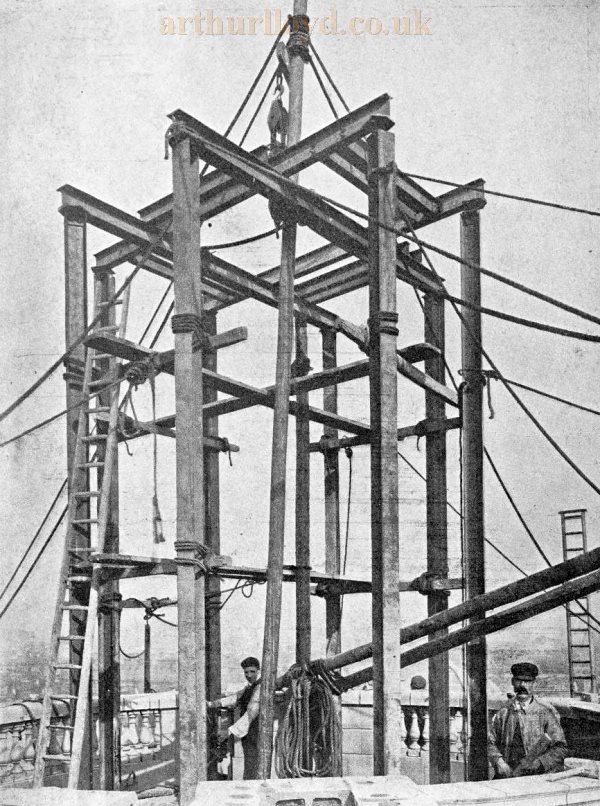 The illustration on the next page (shown right) shows the steel framework constructed by Messrs W. Jones & Son. Ltd., of Magnet Wharf, Bow Bridge, Stratford, E., to support the summit and revolving globe on top of the tower, which, in all, will be 145ft. high. This has been encased in terra-cotta by the Hathern Station Brick and Terra-Cotta Co., Ltd., Loughborough, to whom we briefly referred in the first article, when illustrations of some of the terra-cotta figures on the tower were given.
Right - The London Coliseum: Steel Framework Summit of Tower - From the Builders' Journal and Architectural Record of the 9th of November 1904.
The terra-cotta work has been carefully set out by the firm's staff of experienced draughtsmen. Key drawings made to 1in. scale were supplied to the contractors for erecting, showing the exact position of each piece in the building, and identifying numbers were stamped into each block before burning to correspond with the numbers shown on the key drawing. Owing to the small space available on the job for stacking, the work was all carefully assembled after coming from the kilns and despatched in proper order for erection.
The above Article and its accompanying images was first published in the Builders' Journal and Architectural Record 9th of November 1904.