
The Capitol Theatre, School Lane and Parrs Wood Road, Didsbury, Greater Manchester
Later - ABC TV Studio / Manchester Polytechnic Studio
Manchester Theatres Index
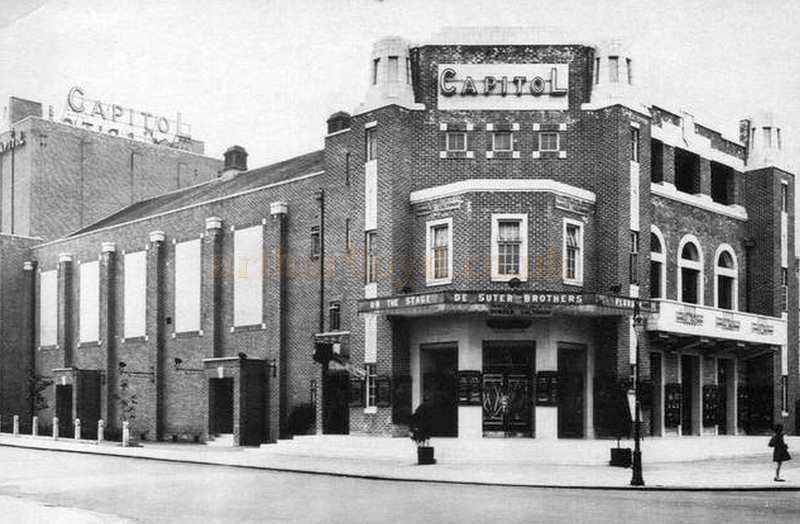
Above - An Early Postcard View of the Capitol Theatre, Didsbury.

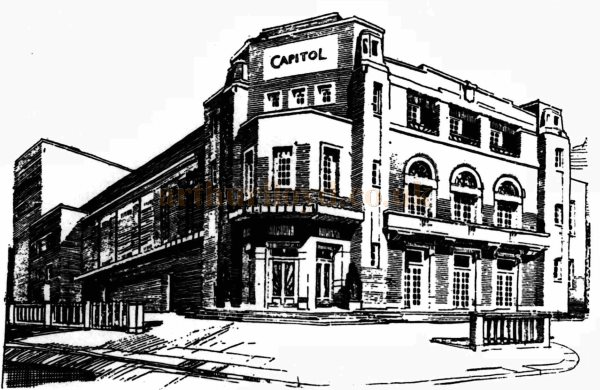 The Capitol Theatre was situated at the corner of School Lane and Parrs Wood Road, Didsbury in Greater Manchester and was first opened on Thursday the 21st of May 1931.
Right - Architect Peter Cumming's Sketch of the Capitol Theatre, Didsbury - From the Kinematograph Weekly, 14th of May 1931.
The Theatre was designed by the architect Peter Cummings and decorated with the new Holophane Colour Lighting System in mind, created by Holophane Ltd. It was said in the press of the time that the lighting system could create five thousand and forty four different combinations of coloured lighting, and that the result was 'Beautiful beyond description'.
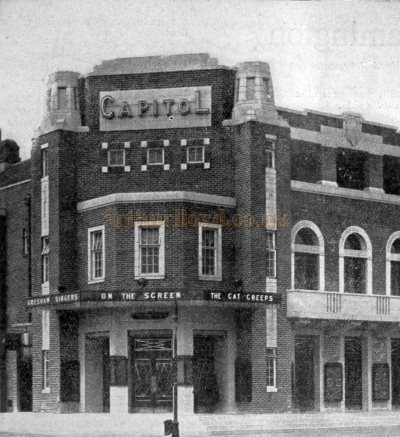 The Capitol was designed as a Super Cinema with Full Stage Facilities and accommodation for 2,000 patrons, all seated in opulent surroundings and comfortable seats by the George Pixton Company. The Theatre's Entrance Hall was Walnut Panelled and led to the Theatre's Stalls and Balcony which were decorated with fibrous plasterwork by Lenegan Humphreys and Co., with cornices carrying the Holophane lighting which illuminated the ceiling from below and the auditorium walls from above.
Left - The Main Entrance to the Capitol Theatre, Didsbury when it first opened in 1931 - From a Chloride Storage Batteries Advertisement in The Bioscope, 16th of September 1931.
The Stage Proscenium opening was surrounded by cove lighting and the Theatre's Cinema Screen, which was 40 feet wide, could be flown out with the Gimson and Co., counterweight flying system which was also used for Stage Scenery and effects. The Theatre's 15 piece Orchestra were situated on a 40 foot lift in front of the stage so that they and the Theatre's Christie Organ could be raised to stage level when required. The Theatre's Projection room was large and originally fitted with two Ernemann III Projectors with Zeiss Artisol high intensity lamps and Taylor Hobson magnascope lenses.
The Capitol Theatre also contained its own Restaurant and Cafe on the first floor with Walnut Paneled doors and fittings, and seating for over a hundred people to have lunch or for five hundred people to have coffee. The cafe could also be used as a Dance Hall and had revolving mirrors and provision for lighting with spots and projection equipment.
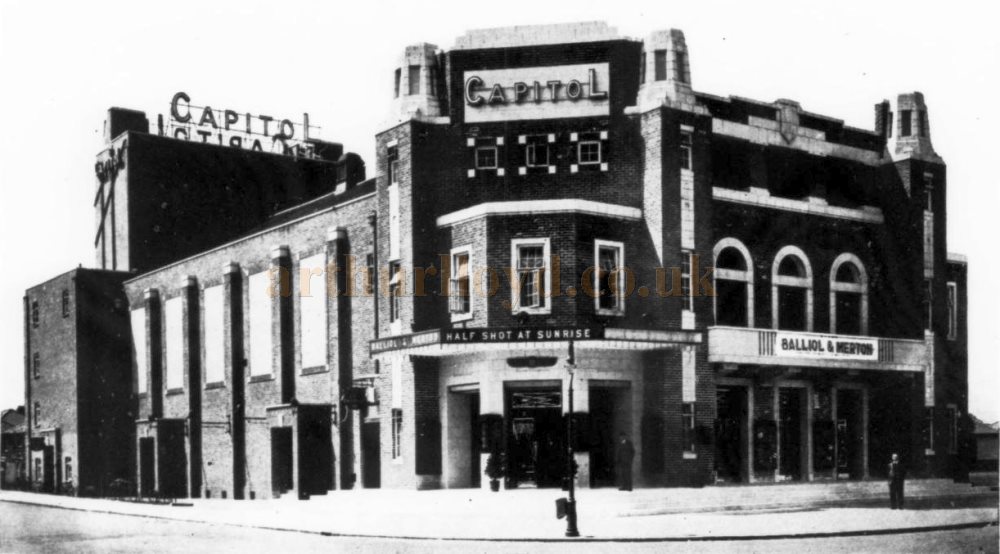
Above - The Capitol Theatre, Didsbury when it first opened in 1931 - From The Architects' Journal, 24th of June 1931.
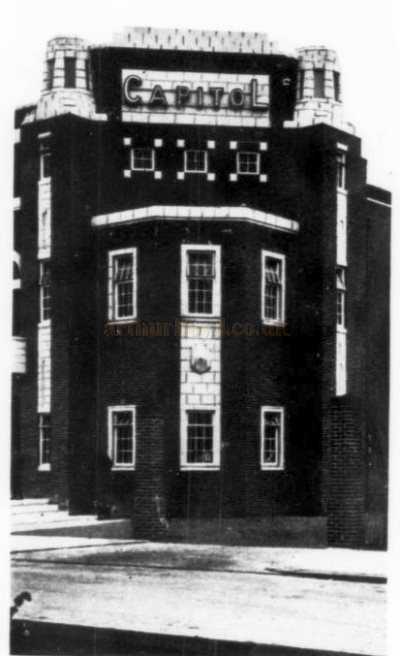 The Architects' Journal reported on the new Capitol Theatre in their 24th of June 1931 edition, along with some of the images shown here, saying:- 'In designing a building for a purpose still so comparatively young, yet so vigorous and well grown, as the presentation of cinema films, it is tempting to an architect to indulge in some degree of freakish or bizarre extravagance in form or in decoration.
It is therefore pleasant to perceive the restraint which characterizes the general scheme of the Capitol Cinema, erected on a corner site between Parrs Wood Road South, and School Lane, Didsbury, Manchester.
Right - The Secondary Corner Facade of the Capitol Theatre, Didsbury containing the Manager's Office and a Landing with the Motor Generating Room above - From The Architects' Journal, 24th of June 1931.
Both exterior and interior have a character and quality of their own, combining successfully straightforward modern lines and masses with effects reflecting traditional ideas. At the same time full opportunity is given for the exercise of the various contributory and accessory contrivances which it is desired to "feature."
Owing to the fact that the management of this new theatre does not limit its projects to picture entertainment or even to sound films, a considerable proportion of the back of the building is occupied with very up-to-date mechanism for transforming the stage and its accessories in a short space of time to serve dramatic or musical programmes. Moreover, organ chambers, organ-blower room, and organ-action room were necessitated by the installation of a modern organ with its 1,000 pipes.
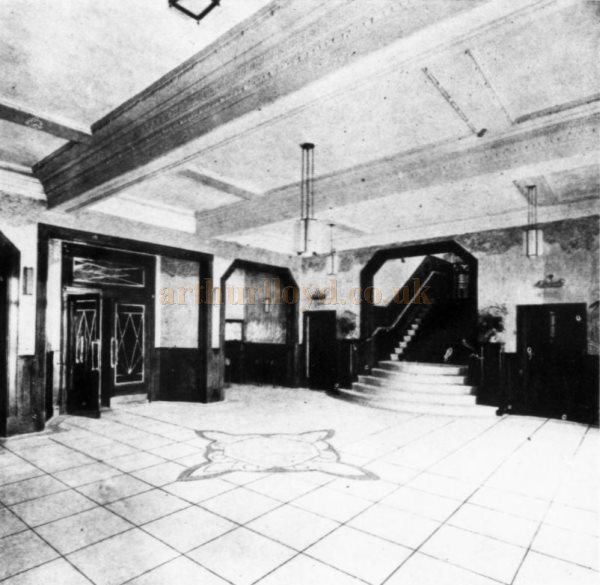 A number of dressing-rooms for artistes were required, besides accommodation for musicians when not actually performing. In connection with this intention to vary the type of performance, an ingenious arrangement of lifts makes it possible for the organ console and the orchestra itself to be lowered, each independently of the other, into a space provided in the basement floor.
Left - The Foyer of the Capitol Theatre, Didsbury when it first opened in 1931 - From The Architects' Journal, 24th of June 1931.
On the other hand, the film screen and the loud speaker can be cleared out of sight into the flies as occasion requires, the screen being replaced by appropriate stage settings, for which a complete and interchangeable set of scene pieces are provided, with a variety of curtains and the necessary counterweighted scenic lines. The large cyclorama gives the illusion of great depth in the stage. The exceptionally large size of the proscenium opening and the screen foreshadows the possibility of future development in wider screens and films, but the large screen is capable of reduction to normal size by means of an electrical device. Above the balcony are installed projectors of the latest type in a spacious operating box, with battery room and motor generating room, respectively, situated at the two angles of the building. Staff rooms, both for men and women employees, are provided close by.
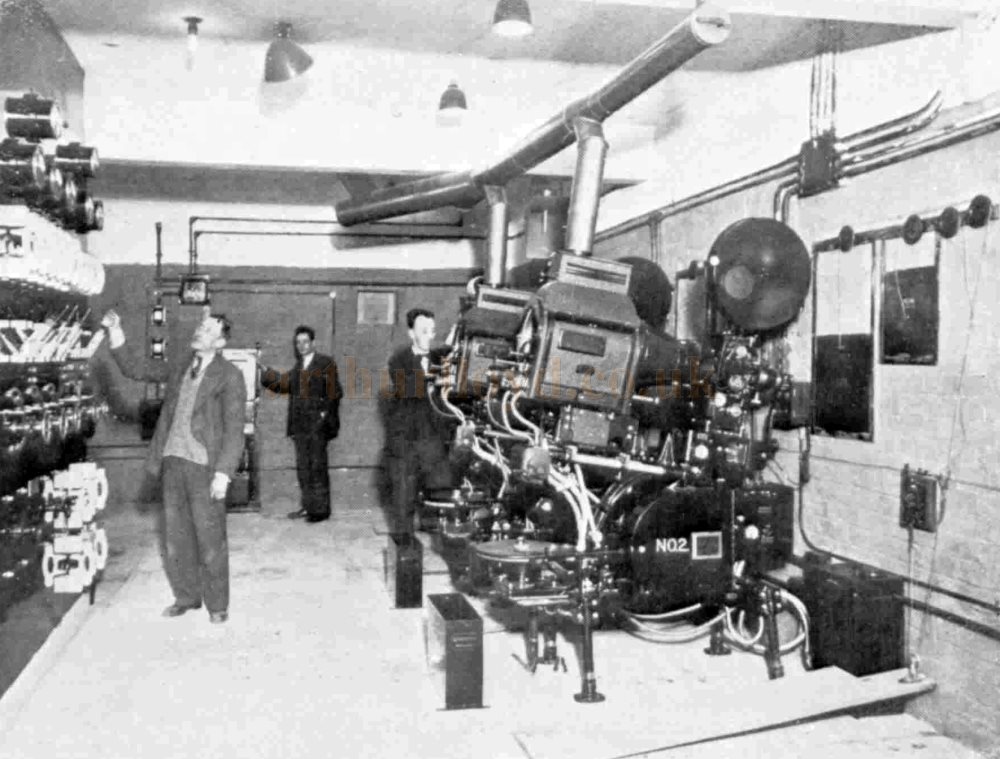
Above - The Projection Room at the Capitol Theatre, Didsbury when it first opened in 1931 - From The Bioscope, 17th of June 1931.
The nature of the lighting arrangements for the stage and for the house have had considerable influence upon the actual design and decoration. For instance, the main walls of the auditorium are plain white, but with a broken rough-cast finish, and the ceiling surface is broken up into decorative compartments with a special view to enhancing the effect of colour-lighting. For the same reason, moulded plaster enrichments are sparingly used, where they are most appropriate; as at the proscenium arch. In contrast to the plain plaster work, the walnut panelling in foyer and cafe and the simple modern woodwork of the glazed doors and other fittings introduce a warmer tone in those portions of the building where the public desires to enjoy comfort without the more spectacular attractions of the stage and auditorium. Fibrous plaster and plastic paint are used throughout in the attainment of decorative ends, and stainless steel where metal is introduced.
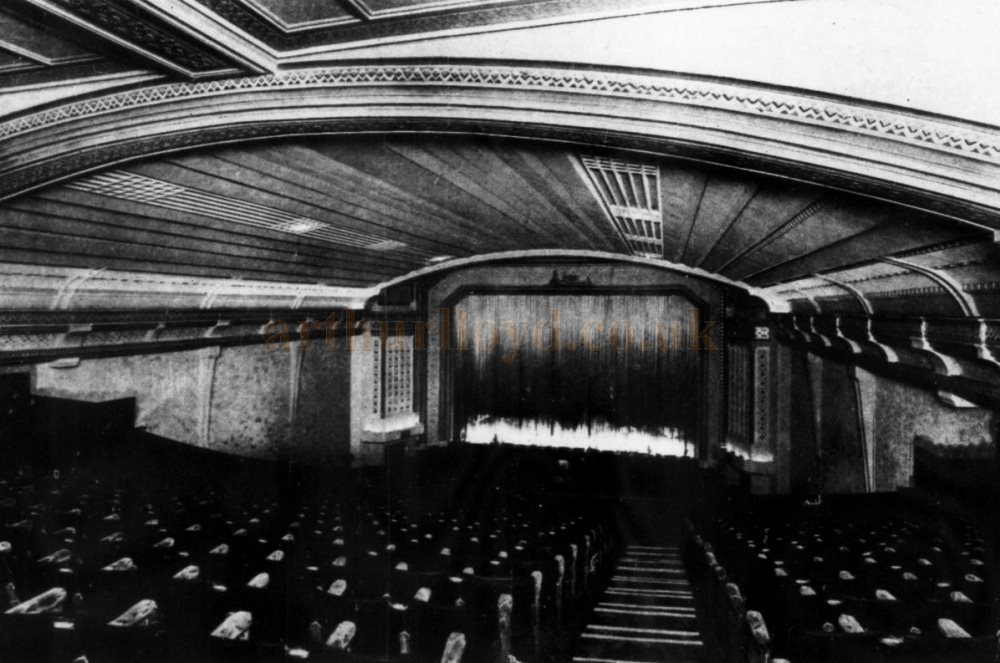
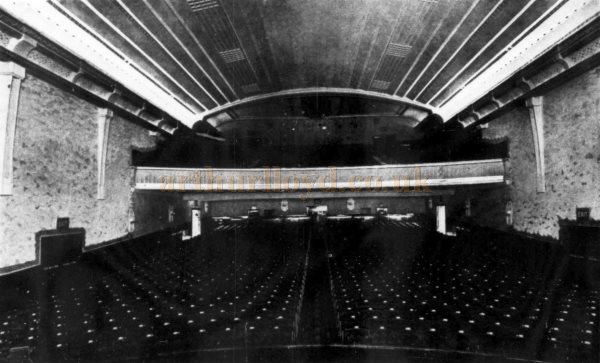
Above - The Auditorium and Stage of the Capitol Theatre, Didsbury when it first opened in 1931 - From The Architects' Journal, 24th of June 1931.
 Up-to-date fire-extinguishing plant and automatic safety devices are provided, and an emergency lighting system. Adequate cloakroom and lavatory accommodation is provided on various floors, and ample staircases and landings.
Right - The Auditorium of the Capitol Theatre, Didsbury when it first opened in 1931 - From The Architects' Journal, 24th of June 1931.
Externally, as well as within, this cinema building relies for its effect upon grouping of masses and well-placed sparse enrichment related to reasonable purpose. In avoiding the ponderous garishness of some picture-houses, it does not lack the requisite gaiety, but produces therewith an impression of tasteful dignity.
The use of hand-made, sand-faced bricks in combination with white cement joints and cream terra-cotta dressings ensures the latter effect, while coloured window glass contributes the lighter quality of the facade. Structurally, one of the points of interest is the fact that the main girder of the balcony, where 500 people can be seated, spans from side to side of the auditorium, so that no intermediate supports encumber the ground-floor seating space. The balcony staircase treads and risers are of monolithic reinforced concrete. The asphalted flat roofs and the floors are of reinforced concrete hollow-tile construction, the latter being paved with terrazzo and the main roof being covered with vitreous mottled roofing tiles. In view of the reliance placed on decorative illumination in modern cinema practice details of the present installation are given [below].
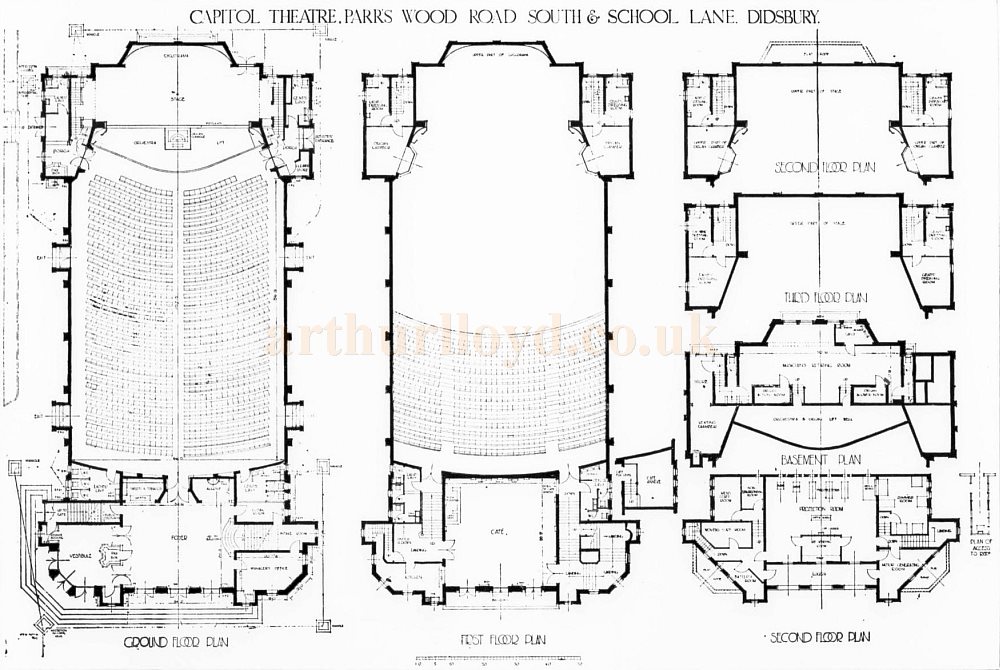
Above - Plans of the Capitol Theatre, Didsbury - From The Architects' Journal, 24th of June 1931.
Sub-contractors Holophane, Ltd., colour lighting; Wm. Hill and Son, and Norman and Beard, Ltd., Christie unit organ; G.. Pixtorr & Co., Ltd., seating and stage draperies; Banister, Walton & Co., Ltd., constructional steelwork; W. J. Furse & Co., Ltd., lifts, curtain control and screen frame; Middleton Fireclay Co., Ltd., terracotta; Saunders and Taylor, Ltd., heating; Henry Hargreaves and Sons, ventilating; Sturtevant Engineering Co., Ltd., cleaning plant; J. Lenegan, fibre plaster; Mather and Platt, fire appliances; Reliance Telephone Co., Ltd., telephones; Williams and Williams, Ltd., steel windows; F. Butterworth, Ltd., joinery; Chloride Electrical Storage Co., Ltd., safety lighting; Rowe Bros., Ltd., Sloan valves; Kershaws, electric wiring; Laidlaw and Thomson, Ltd., door fittings; Charles Lightfoot, Ltd., leaded lights; Baxendales & Co., Ltd., sanitary appliances; Insulite Products Corporation, Insulite; A. and 0. Stefanuttie & Co., Ltd., terrazzo; T. and R. Boote, Ltd., wall tiles; Thos. Firth and John Brown, Ltd., kicking plates; R. H. Lord and Son (Asphalters), Ltd., asphalt; Brilliant Sign Co. (1907), Ltd., signs; G. and T. Earle & Co., Ltd., cement; Grip Steel Bar Co., Ltd., reinforcing bars; Wm. Hayward & Sons, Ltd., area railings.'
The above text in quotes was first publsihed in The Architects' Journal, 24th of June 1931.
 On its opening night the Capitol Theatre's audience were first introduced to R. Gillespie Williams, Sir William Cundiff, and Muriel Angelus who gave introductory speeches from the stage.
This was followed by an orchestral selection during which the Organ and Lifts were demonstrated, the Organ being played by Frank Matthews.
Right - A Programme for the Magician Jasper Maskelyne performing at the Capitol Theatre, Didsbury in July 1949 - Courtesy Simon Moss, stagememories.
And this was followed by a 'Stage spectacle' written and produced by Gillespie Williams, who was Holophane's Colour Expert, and was designed to show off the Holophane lighting system in all its variety, with many stage sets and a large chorus of dancers.
The opening night show also included a performance by the acrobatic dancers Balliol and Merton.
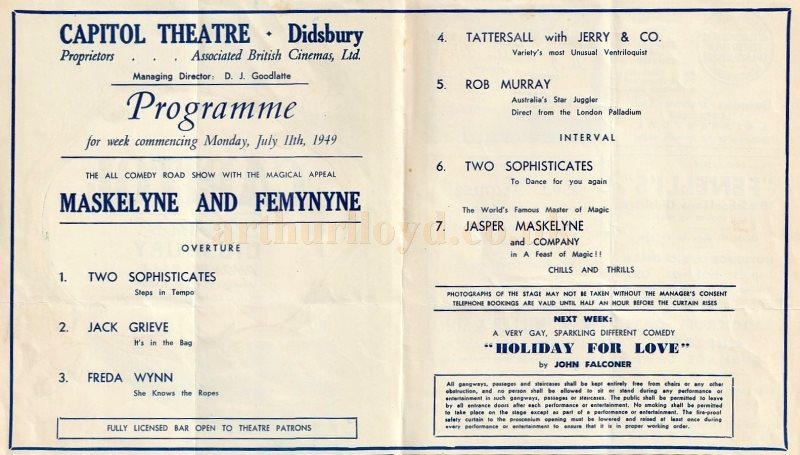
Above - Programme Details for the Magician Jasper Maskelyne performing at the Capitol Theatre, Didsbury in July 1949 - Courtesy Simon Moss, stagememories.
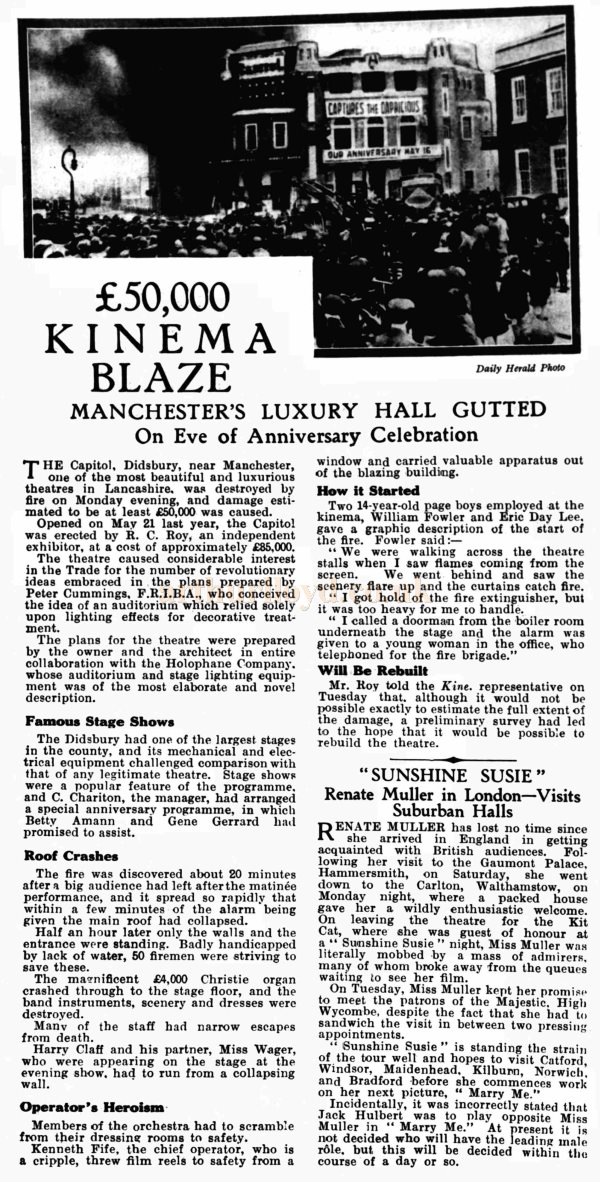 The Capitol, Didsbury had first opened on the 21st of May 1931 and had a successful opening year showing films and variety shows on its large stage but just eleven months after it opened it was seriously damaged by a fire on the 25th of April 1932 which it was said caused £50,000 of damage to the building.
The fire happened after a matinee performance and before the second show so luckily there was no audience in the Theatre. Starting behind the screen the fire destroyed the stage together with the Theatre's scenery, dresses, and band instruments along with its £4,000 Christie Organ. The fire then brought down the roof and destroyed almost the whole of the Theatre's auditorium.
Right - An Article and Image about the Capitol, Didsbury Fire - From the Kinematograph Weekly, 28th of April 1932.
Undeterred the owner of the Theatre H. C. Roy soon had the Theatre rebuilt and its original architect Peter Cummings was brought back in to redesign the Theatre, this time with much better fire resistance.
The Theatre was reequipped with a Four Manual Christie Organ, a new Holophane Lighting System, and a new Fully Equipped Stage House with a revolving stage with automatic raising lifts and platforms for stage effects.
The Theatre reopened on Wednesday the 16th of August 1933 with a programme that started at 7.45 pm and didn't conclude until 11pm.
The Capitol was taken over by ABC in 1937 and they continued to run the Theatre up until the 14th of January 1956 when it was repurposed as an ATV Television Studio. In fact it had three studios, the largest of which was in the Theatre's Stalls area, with a News Studio situated in the former Restaurant, and a small continuity studio was also included. All the editing and telecine work was done in the Theatre's former Projection Room. A film showing the opening night of the TV Studios can bee seen here.
Eventually ABC lost their contract for producing TV for the Northern Region and after they vacated the building it was then taken up by Manchester Polytechnic who used the Theatre as a base for their Theatre Studies and Television Courses. They used the stalls area as a Theatre where students put on many shows over the ensuing years, and the first floor for studio and TV production. The Theatre's Balcony was operated as a separate Cinema.
Sadly when the Manchester Polytechnic left the building in 1998 instead of being repurposed again it was demolished the following year, 1999, and that was the end for this once magnificent Super Cinema and its convoluted history. Today a residential building called Capitol Court stands on its site, see image below.
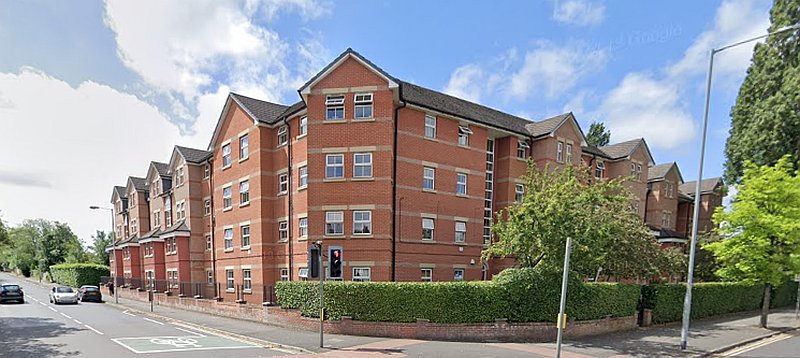
Above - A Google StreetView Image showing Capitol Court in June 2019 which stands on the site of the former Capitol theatre, Didsbury - Click to Interact.
Some of the information for this Theatre was gleaned from the excellent Cinema Treasures Website.
If you have any more information or Images for this Theatre that you are willing to share please Contact me.