
The Orpheum Theatre, Finchley Road, Temple Fortune and Golder's Green, London
Later - The Odeon Cinema
See Also in this Area - The Golder's Green Hippodrome / artsdepot / Gaumont Theatre, North Finchley
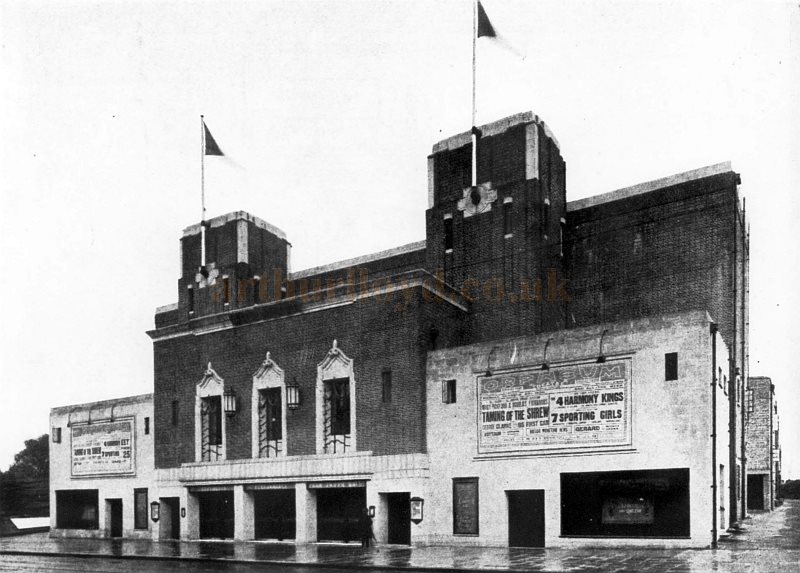
Above - The Orpheum Theatre, Finchley Road, London when it first opened in 1930 - From The Architect's Journal, 10th of December 1930.

 The Orpheum Theatre was situated on the Finchley
Road between Golder's Green and Finchley in the district of Temple Fortune. The Theatre was designed by
the architects Yates, Cooke and Darbyshire and opened on the 11th of
October 1930 with a showing of the film 'Condemned'.
The Orpheum Theatre was situated on the Finchley
Road between Golder's Green and Finchley in the district of Temple Fortune. The Theatre was designed by
the architects Yates, Cooke and Darbyshire and opened on the 11th of
October 1930 with a showing of the film 'Condemned'.
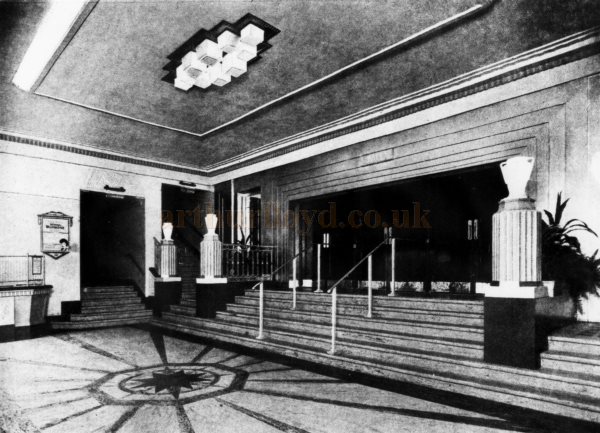
Right - The Entrance Foyer of The Orpheum Theatre, Finchley Road when it first opened in 1930 - From The Architect's Journal, 10th of December 1930.
Built for an Independent Operator as a Cine / Variety Theatre it had a large stage, 40 feet deep by 35 feet wide at the proscenium, and was equipped with ten dressing rooms for artists. The Theatre, which could seat 2,400 people, also had a Tea Room and Cafe for its patrons and was equipped with a Compton 3Manual Theatre Organ which was played by Lewis Gerrard on its opening.
 The Archtect's Journal reported on the building in their 10th of December 1930 edition, along with several of the images shown here, saying:- ' The Orpheum Theatre, erected upon an open site in the Finchley Road, at Temple Fortune, Golder's Green, has seating capacity for no fewer than 2,400 persons.
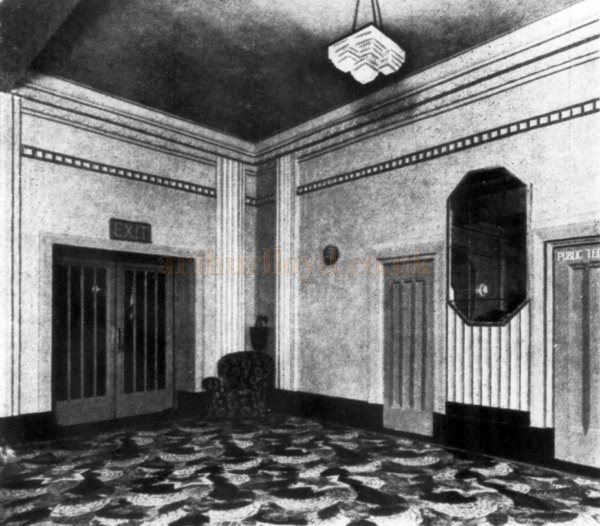
Left - A Corner of the Tea Room at The Orpheum Theatre, Finchley Road when it first opened in 1930 - From The Architect's Journal, 10th of December 1930.
Londoners whose usual beats lie within or well clear of what used to be known as "the three-mile circle" are apt to remain oblivious of what is going on around the outskirts of this colossal city, and may well feel some surprise at the magnitude of the public presupposed; not so those who have kept an eye on the rapid growth of what is fast becoming in itself a subsidiary metropolis.
 In a cinema enterprise of this size considerable space has to be devoted to accessory accommodation; accordingly there is a spacious foyer, and a cafe and tea-room at balcony level afford accommodation for 300, while large waiting-spaces have been provided on the ground floor.
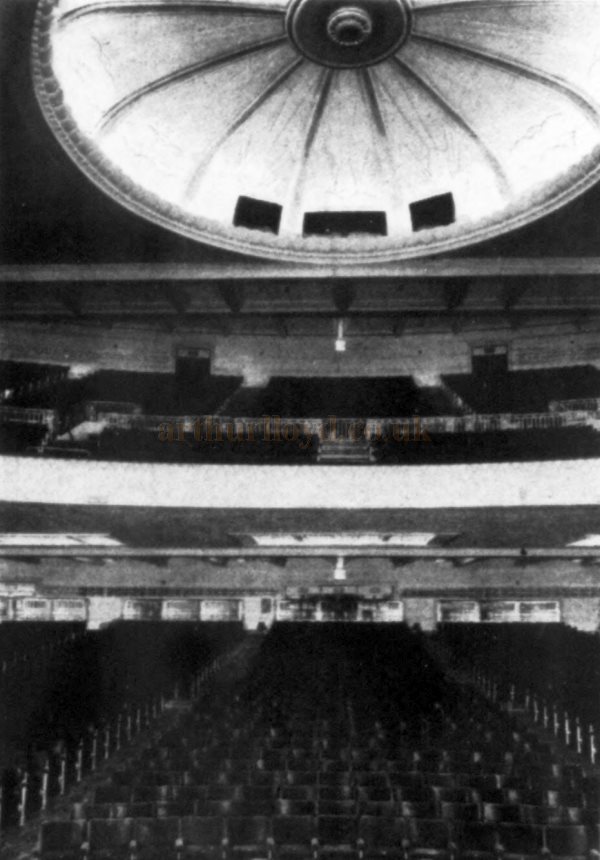
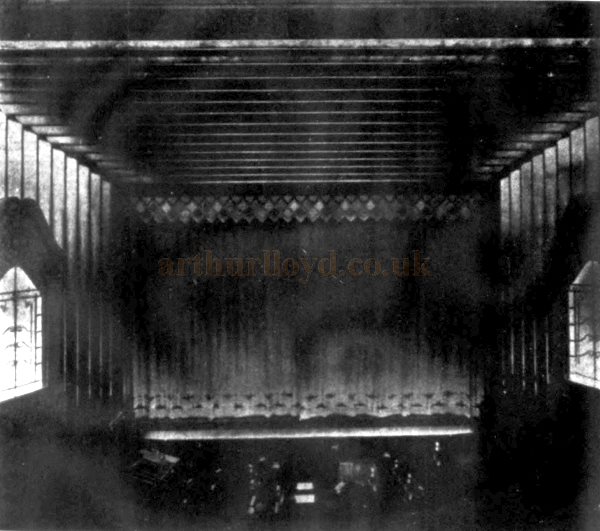
Right - The Auditorium of the Orpheum Theatre, Finchley Road when it first opened in 1930 - From The Architect's Journal, 10th of December 1930.
The main elevation is symmetrical, and, with its two dominating towers, flood-lit by night, is constructed in purple-brown Gloucester bricks, with cornices and facings of Bath stone. Large poster spaces have been expressly designed.
Within, the scheme of decoration, not only of the auditorium but of the foyer, tea-lounge and cafe, is carried out on modern French lines, but is kept of a very simple character. Tones of beige predominate, with enrichments in blue. For example, the panels at the base of the dome in the centre of the auditorium ceiling are in blue, but gold has been sparingly used in the dome itself; the proscenium arch is also in dull gold.
A glance at the plans (shown below) will reveal the manner in which the very complete service of amenities demanded by the modern picture-house public has been disposed. The problem of rapid exit will be found to have received special attention; and here it takes place in the most favourable circumstances, a lateral road running either side of the front.'
The above text in quotes was first published in the Architect's Journal, 10th of December 1930.
 The Bioscope also reported on the Orpheum Theatre in their November the 12th
1930 edition saying:- 'One of the major attractions at the Orpheum,
Golder's Green's new 3,000-seater, is the elaborate stage show incorporated
in each week's programme. General manager Wilson Speakman has at his
disposal one of the finest stages in London, complete with a one-man
counter-weighting system of 38 lines, a very fine lighting installation
and an orchestra 24 strong.
The Bioscope also reported on the Orpheum Theatre in their November the 12th
1930 edition saying:- 'One of the major attractions at the Orpheum,
Golder's Green's new 3,000-seater, is the elaborate stage show incorporated
in each week's programme. General manager Wilson Speakman has at his
disposal one of the finest stages in London, complete with a one-man
counter-weighting system of 38 lines, a very fine lighting installation
and an orchestra 24 strong.
Right - The Auditorium and Stage of the Orpheum Theatre, Finchley Road when it first opened in 1930 - From The Architect's Journal, 10th of December 1930.
With these and a number of extraneous first-class vaudeville attractions he is able to build up a presentation lasting about three-quarters of an hour, and he has succeeded in inducing patrons to flock to his house from a very wide area...
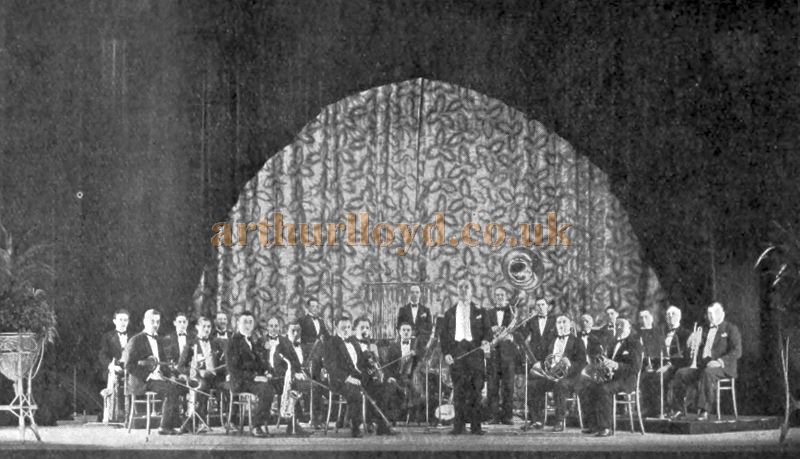
Above - One of the stage attractions at the Orpheum, Golder's Green, is the house orchestra, directed by Kottaun. The elegant draperies form an effective background for this popular 'turn' - From The Bioscope November the 12th 1930.
...A typical Wilson Speakman show was that given on Monday last. First of all he put his orchestra on to the stage, and for ten minutes the audience was regaled with tuneful selections, the music being backed up by clever play with the lighting effects and draperies. This part of the programme was elaborately and very effectively put over, and the various items were enthusiastically received. The orchestra was followed by several clever turns, which gave an opportunity to demonstrate the facile manner in which flies and curtains could be handled. The presentation was concluded by further selections from the orchestra, playing this time from the well, play with the lighting on the closed tableau curtains giving a happy finishing touch.'
The above text in quotes was first published in The Bioscope, November the 12th 1930.
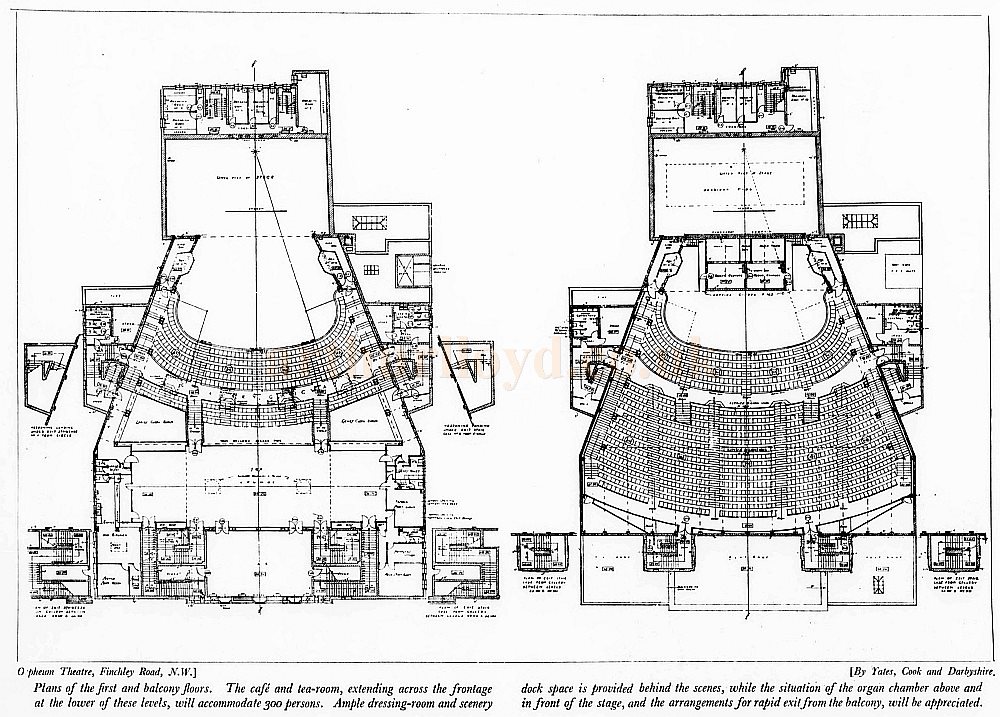
Above - Plans of the Orpheum Theatre, Finchley Road - From The Architect's Journal, 10th of December 1930.

Above - A Google StreetView Image showing Birnbeck Court, Finchley Road in September 2024, which was built on the site of the former Orpheum Theatre in 1982 - Click to Interact.
 The Orpheum Theatre had first opened as an Independent Cine / Variety Theatre on the 11th October 1930 but was taken over by ABC in 1932, and
then acquired by County Cinemas two years later in March 1934, who would
themselves be taken over by Odeon Theatres in 1937, although the Theatre
was not renamed as an Odeon Cinema until 1945.
The Orpheum Theatre had first opened as an Independent Cine / Variety Theatre on the 11th October 1930 but was taken over by ABC in 1932, and
then acquired by County Cinemas two years later in March 1934, who would
themselves be taken over by Odeon Theatres in 1937, although the Theatre
was not renamed as an Odeon Cinema until 1945.
Right - A Ground Floor Plan of the Orpheum Theatre, Finchley Road - From The Architect's Journal, 10th of December 1930.
The Orpheum Theatre was used primarily as a Cinema from the beginning but it did also stage a large variety of live stage shows including regular productions of Ralph Reader's 'Gang Shows', touring productions, and annual pantomimes. The Theatre was even graced by a Royal visit when the Queen attended one of the Gang Shows there in 1972, and the Theatre was redecorated for the occasion.
Considered too large and too far away from anywhere by the 1970s, Odeon eventually closed the Theatre on the 27th of April 1974. The building then remained empty and derelict for many years until it was eventually demolished in May 1982. A photograph of the Theatre being demolished can be seen here. The site was then used for the construction of an apartment building called Birnbeck Court, see image above.
Some of the later information for this Theatre was gleaned from the excellent Cinema Treasures Website.
If you have any more information or images for this Theatre that you are willing to share please Contact me.