
The Palace Theatre, Appletongate, Newark on Trent, Nottinghamshire
See also- Nottingham Theatres
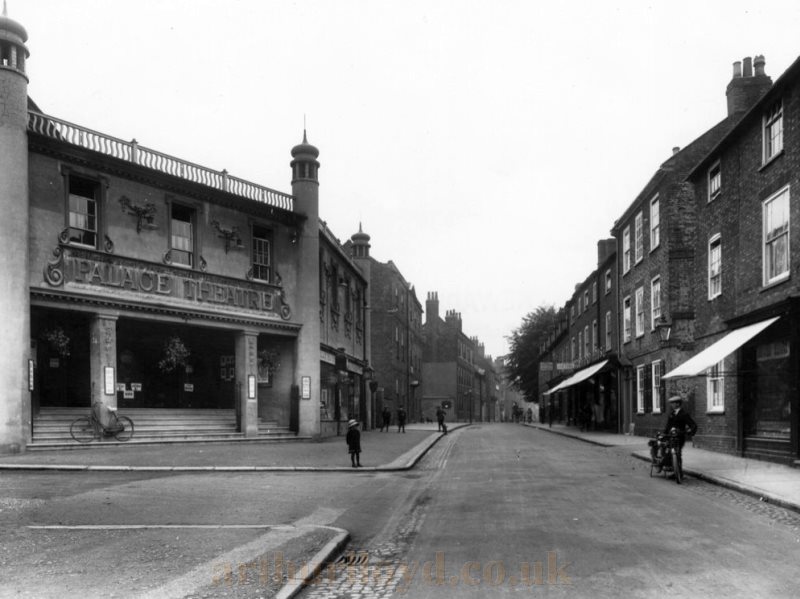
Above - An Early Photograph of the Palace Theatre Newark Circa 1923 - Courtesy David Piper.

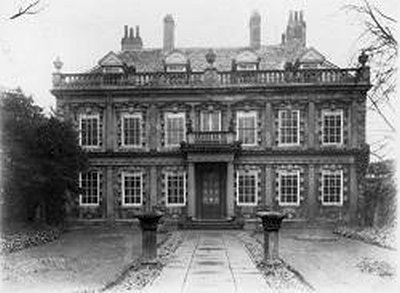 The Palace Theatre opened its doors on the 5th July 1920. Built on the site of Chauntry House, a Queen Anne style mansion, this was to be the jewel in the crown as far as Newark entertainment was concerned. The New Theatre and the Kinema already existed and the Savoy followed later. Designed and built by local business woman Emily Blagg who also owned a brick company and built a number of houses in the town. Ironically some of the remnants from Chauntry House were incorporated in the new build.
Right - Chauntry House, Newark, the Palace Theatre was built on its site - Courtesy David Piper.
The building is in the Byzantine style with its imposing facade to Appletongate. A feature of the structure are the minarets which give it an Oriental touch and are quite unique. The general opinion at its opening was that there was a spacious foyer giving entrance to the auditorium and the grand staircase for the balcony. This entrance prepared the visitor for the charm and beauty of the interior decorations. Imposing as the Theatre was in its dimensions as viewed from the outside, the impression from the inside was even more pleasing.
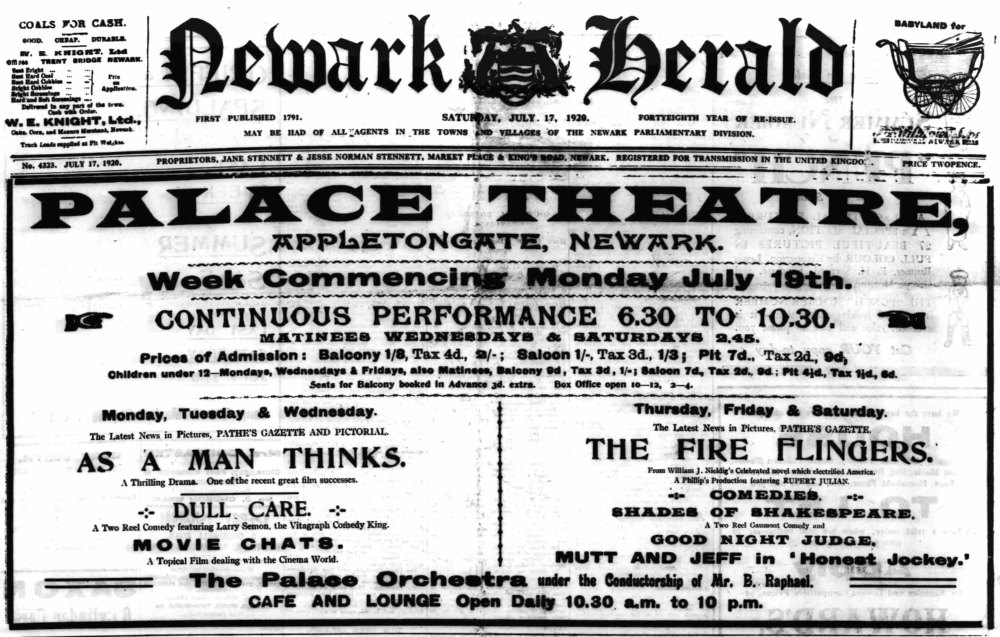
Above - An Advertisement for the Palace Theatre, Newark in July 1920 - From the Newark Herald, 17th of July 1920.
The original capacity was 1,100 with stalls, balcony and side slips. The ceiling was slightly cambered and in the style of Louis XIV with ornamental floral designs showing up in bold relief. The decorations on the proscenium arch in white and the balcony front in dresden blue tints was considered to be 'strikingly beautiful'. On the walls the panelling was bold, filled in with tapestry designs and electrical light fittings. There was a blue painted Dado around the walls and the trellised ceiling and borders highlighted in light primrose tints. The seats were upholstered in peacock blue plush and "arranged in alternate rows in order for patrons to have an uninterrupted view of the stage by looking between the seats instead of the usual method of viewing with discomfort over one another's heads" was the opinion of a local reviewer. As the decorations blended with the upholstery, luxurious carpets were fitted in the stalls, gangways and into the first floor lounge where 'teas would be served'.
The balcony promenade or slips proved to be very popular among cinemagoers. Theatre patrons preferred to sit in the stalls. There were two emergency exits from the balcony and the main stairway with eight exits was located downstairs.
According to reports of the day special attention had been paid to the ventilation system so that the interior may be cool in summer and warm in winter. Fresh air was circulated into the building during the summer months, but in the winter it was warmed first. There were three large extractors to carry out the impure air.
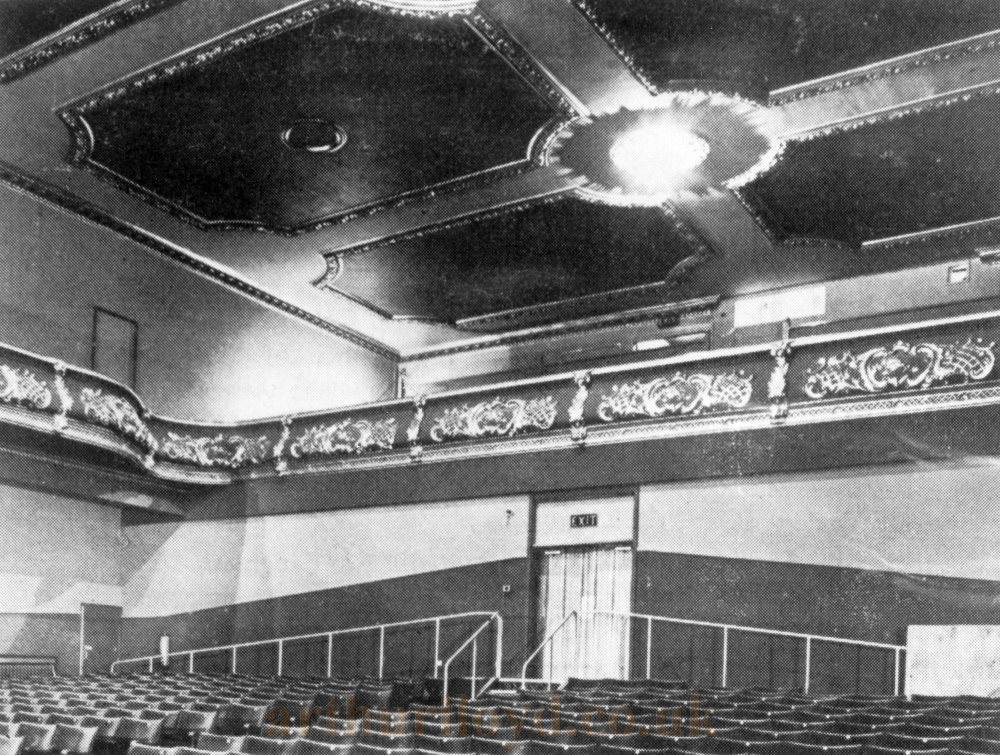
Above - The Palace Theatre Rear Stalls prior to the 1988 refurbishment showing the original positions of the chandeliers - Courtesy David Piper.
 The projection room, situated at the rear of the balcony, was fireproofed, had a steel roof and was lined with concrete. The automatic shutters over the apertures made it impossible for fire to spread. Provision was made for three machines – two films and one lantern. Electricity was supplied by two 45 h.p. Crossley engines, two dynamos and storage battery. A secondary lighting system, powered by gas, was provided by the town supply. This room is still in use as the lighting control room and follow spot location and until recently the projection room for films.
Right - An Advertisement for 'Peg O' My Heart' at the Palace Theatre, Newark in 1921 - From the Newark Herald, 15th of January 1921.
Looking from the stage out into the stalls, performers had to be aware of the six foot drop from stage level to the auditorium floor. The distance from the front of the stage to row A was approximately twelve feet, enough space to accommodate an orchestra. Eight dressing rooms were situated under the stage. This was reduced to six when a green room and stage manager's office was incorporated. A lighting gantry was situated above the prompt corner on stage right and hemp flying system with wooden grid installed.
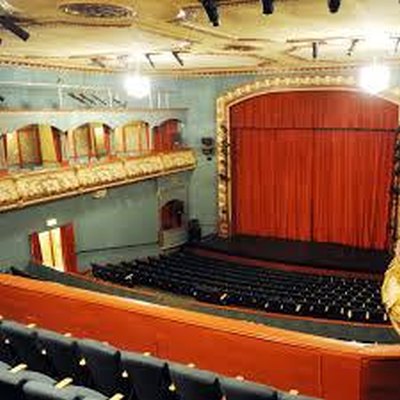 The opening presentation was a screening of 'King Solomon's Mines' with music provided by a seven piece orchestra. Variety acts were to provide the majority of the entertainment as a fully equipped stage was available. Talkies were introduced in 1930 when the projection equipment was upgraded.
Left - The Auditorium of the Palace Theatre, Newark looking from the Circle - Courtesy David Piper.
Although considered to be 'a wonder' locally, Newark was never a number one date for touring purposes. In fact due to its geographical location most well known artistes of the day opted to play more established venues in Nottingham, just over twenty miles away. However there were a few highlights in the programming. George Robey, Cicely Courtneidge, Anna Pavlova and the celebrated locally born actor Donald Wolfit*, and in later years Margaret Rutherford and even Cliff Richard, who arrived in an ice cream van in order to evade the screaming crowds.
*Wolfit gained amateur experience at the nearby Robin Hood Theatre Averham. His first professional engagement was with the Charles Doran Shakespearean Company.
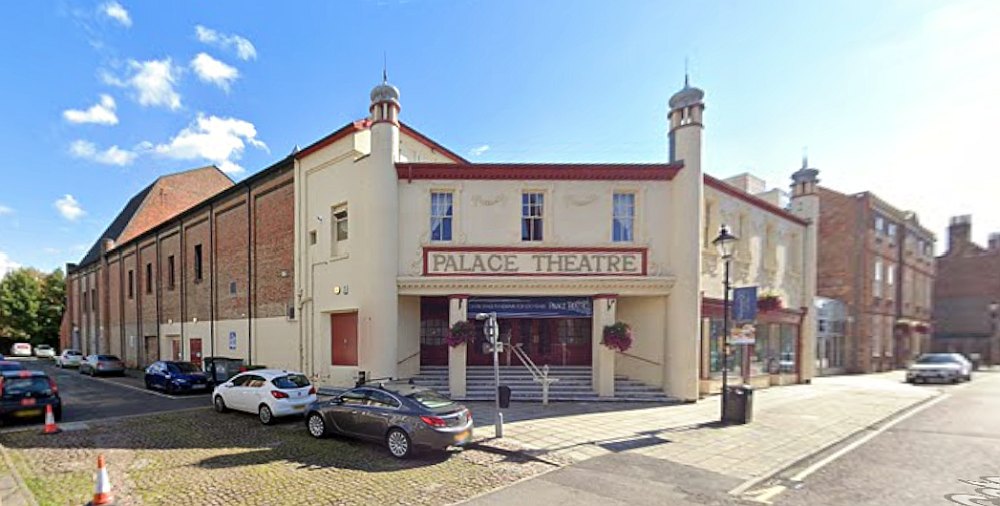
Above - A Google StreetView Image showing the Palace Theatre, Newark in September 2020 - Click to Interact.
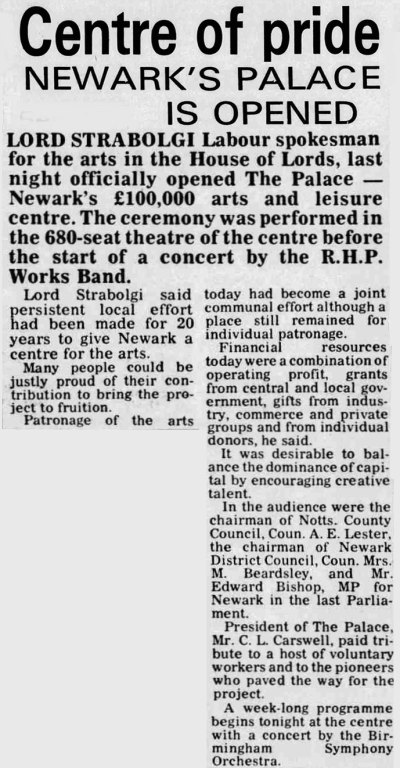 For the next forty years the Palace Theatre played a significant role in Newark's nightlife. However as was common everywhere trends altered and the live performance role declined leaving cinema screenings and bingo to entertain. Even Wrestling bouts were included when cinema audiences declined. With low footfall, the venue itself deteriorated eventually culminating in the sale from the then owners, Star Cinemas, to the local authority following pressure from local townspeople and the local Operatic Society who for several years had nowhere to perform.
Right - A Report on the Palace Theatre, Newark Opening as an Arts Centre in 1974 - From the Nottingham Evening Post, 30th of September 1974.
With the intention of creating an Arts Centre, a number of structural alterations were made. With the belief that an 1,100 seat capacity venue was too large, the area underneath the balcony created a new lounge bar and multi purpose room. Approximately 400 seats were removed and now the entrance to the stalls was immediately underneath the front of what was the balcony. A new box office area was created in the foyer and the colour scheme in the auditorium changed to a grey / brown with purple embellishments with matching carpets. Also in the auditorium six new chandeliers were installed but the side slips remained unaltered. Minor alterations occurred on stage namely the lighting gantry on stage right prompt corner was removed.
For the next fifteen years the capacity was 703. However during this next period a lack of investment and financial difficulties meant the Palace relied heavily on local support once again. In the early 1980's the Theatre was jointly administered by the town and district councils. Therefore a period of stability but the venue still had to pay its way.
Hindered by lack of funding a new approach was required. In 1987 Brien Chitty was appointed General Manager to oversee the way forward. Brien was Manager of the Vaudeville Theatre WC2, prior to this he was an actor and the Manager of St Georges Theatre, Tufnell Park. He was also a founder member of the Irving Society and The Donald Wolfit Charitable Trust. Brien then took the Palace through the next phase of its journey.
In 1988 the local council decided to invest in a facility more worthy of a market town now connected to commuting to and from London due to improved rail links. £250,000 was spent drastically renovating the auditorium reducing the seating further to just over 600, just over half the original capacity. A new colour scheme of pale gold and copper beech replaced the 70's grey/brown and purple and the original seating was re-upholstered. No improvements were made to the stage and only minor amendments in the front of house. The number of auditorium chandeliers was reduced to four when one fell to the floor during building works. A faulty winch was responsible. Soon after all the winches were replaced with fail safe mechanisms.
One episode which went unreported at the time was the discovery of remains of the original Chauntry House when digging the foundations for supporting walls. Due to the tight timescale involved the archaeological artefacts were quickly covered over. The promenade or slips in the auditorium enabled the creation of private boxes. With access from the balcony these boxes generated income on a long lease basis but the revenue was never included in box office returns much to the annoyance of some promoters.
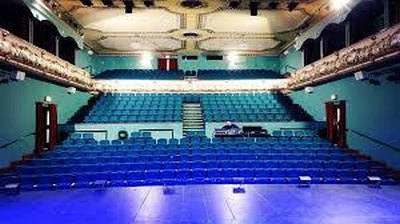 In 1993 the Theatre was given a Grade II* Listed Status.
Left - The Auditorium of the Palace Theatre, Newark looking from the Stage - Courtesy David Piper.
A pleasing entry in the Guide to British Theatres in 2000 stated 'the fortunes of this delightful house would appear to be in the ascendant with a varied menu of popular artists visiting the town'. In 2016 The National Civil War Centre opened in Newark immediately adjacent to the Theatre with funding from the National Lottery. The Palace was improved further as a result. Oh to have had that level of funding fifty years ago.
You may like to visit the Theatre's own Website here.
The above article on the Palace Theatre, Newark on Trent was kindly written and sent in for inclusion on the site by David Piper in January 2026, David worked at the Theatre for 22 years.
Sources: The Palace Years 1920 –1972 – Tony Lloyd.
First Interval – The autobiography of Donald Wolfit.
Sir Donald Wolfit – His life and work in the unfashionable theatre – Ronald Harwood.
Guide to British Theatres 1750 -1950 – The Theatres Trust.
If you have any more information or Images for this Theatre that you are willing to share please Contact me.