
The Paris Cinema, Lower Regent Street, London
Later - The BBC's Paris Studios
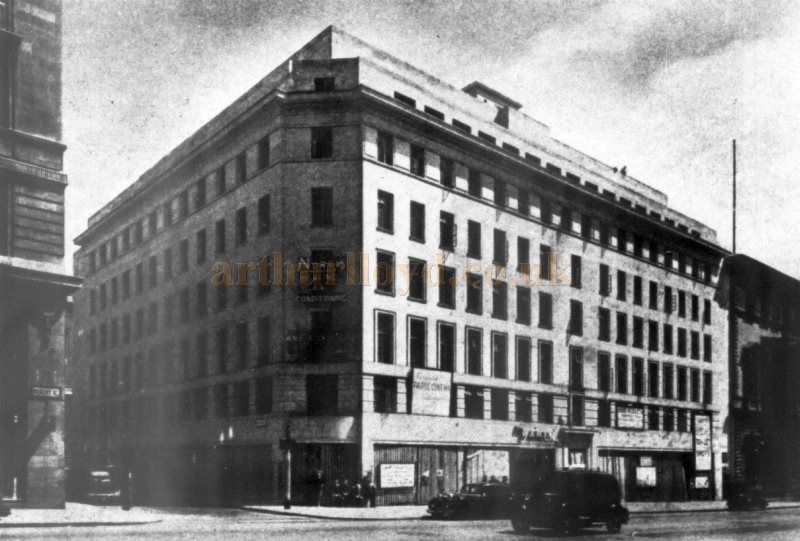
Above - Rex House and the Paris Cinema, Lower Regent Street - From The Architects' Journal, 18th of May 1939.

 The Paris Cinema was situated on Lower Regent Street in London's West End, just off Piccadilly Circus, and down the street from the former Plaza Theatre. The Cinema was housed in the basement of Rex House, shown above, an office building designed by the well known Theatre Architect Robert Cromie who also designed the Cinema.
The Paris Cinema, which was equipped with a small stage, was opened on the 20th of April 1939 with the film 'La Bete Humaine'. The Cinema was originally constructed for the showing of foreign language films, however, it soon went over to English Speaking films too, and its stage would later find a new use when the Cinema was converted by the BBC as the Paris Studios, details below.
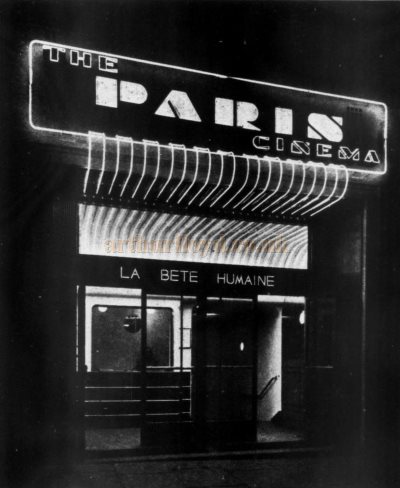
Right - The Paris Cinema, Lower Regent Street, at night - From The Architects' Journal, 18th of May 1939.
 The Cinema's main entrance was next door to the main entrance for Rex House and was quite small and fairly unremarkable, this led on to a small foyer which then led down stairs to the main auditorium which was decorated in the Art Moderne style. The ceiling of the auditorium however, was ribbed with concealed lighting, which also ran down both sides of the proscenium.
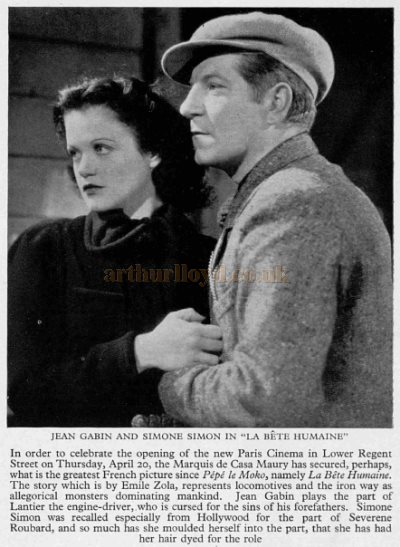
Left - A Photograph of Jean Gabin and Simone Simon in 'La Bete Humaine' the Film which opened the Paris Cinema in 1939 - From The Tatler, 5th of April 1939.
The Architects' Journal reported briefly on Rex House and the new Paris Cinema, along with some of the images shown here, saying:- 'The building is a commercial block allowing at ground floor level for the whole of the space, excepting entrances, exits and staircases, for use as shops or showrooms.
In the basement the "Paris Cinema" is incorporated, and is virtually a building within a building, being entirely self-contained. There is also a large restaurant planned here, which again has its own separate entrances and exits.
 From the first floor upwards the whole of the floor is available for office purposes, but on the seventh floor a portion of the space is allocated for ventilation plant. The structure is steel-framed with R.C. retaining walls all the way round on the road frontages to Lower Regent Street, Carlton Street, and St. Alban's Street.
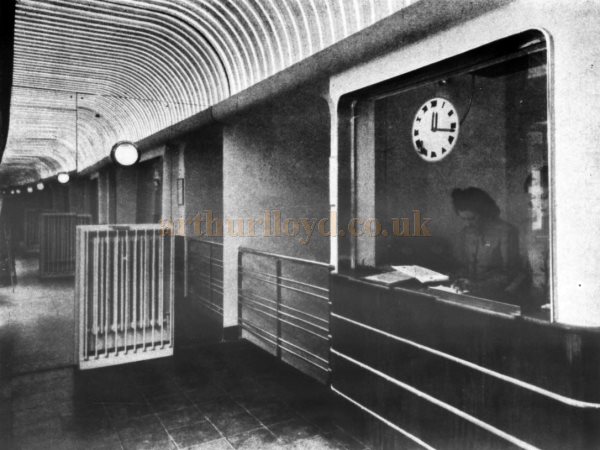
Right - The Paris Cinema's Foyer and Box Office when it first opened in 1939 - From The Architects' Journal, 18th of May 1939.
The main elevation to Regent Street and the majority of the Carlton Street elevation are faced in Portland stone, the remaining portion in reconstructed Portland stone. The walls round areas, etc., are built in sand lime bricks. The roofs generally are flat, covered with asphalt. Internal walls are brick. Floors are hollow tile.'
On the Paris Cinema itself the Architects' Journal said:- 'The walls, including those to the stage, and the ceiling in the auditorium and to the stage were treated with special acoustic plaster sprayed with plastic material.
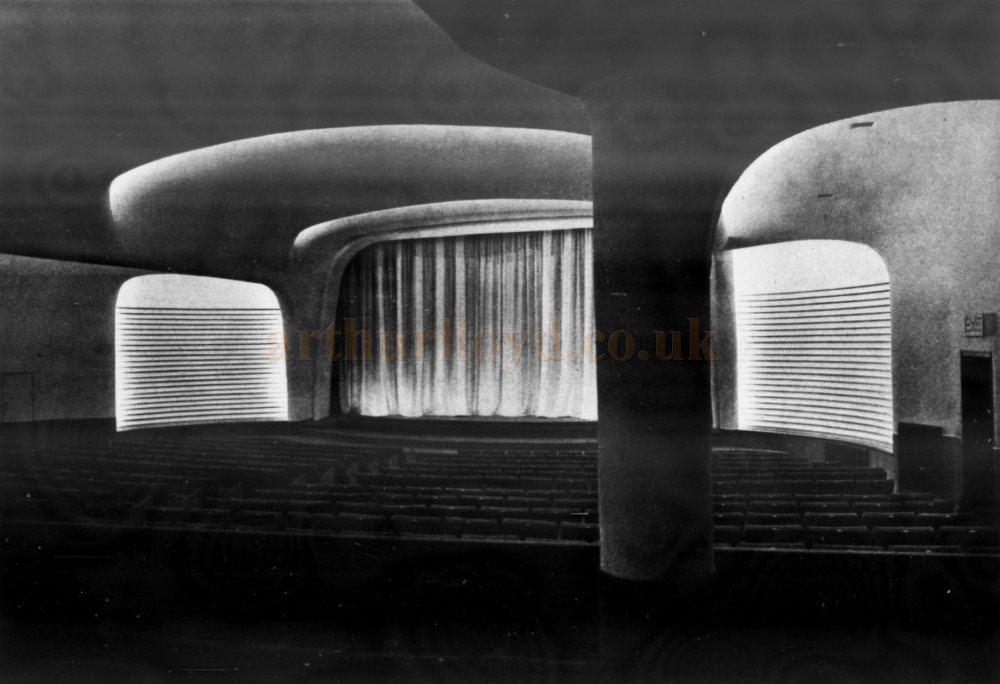
Above - The Auditorium of the Paris Cinema when it first opened in 1939 - From The Architects' Journal, 18th of May 1939.
 No decorations have been carried out and the whole of the interior, including corridors and foyers, etc., is left in white to conform with the requirements of the client. The cinema entrance is similarly treated, but the side walls are faced entirely with mirrors. The main entrance doors are to special design in bronze.
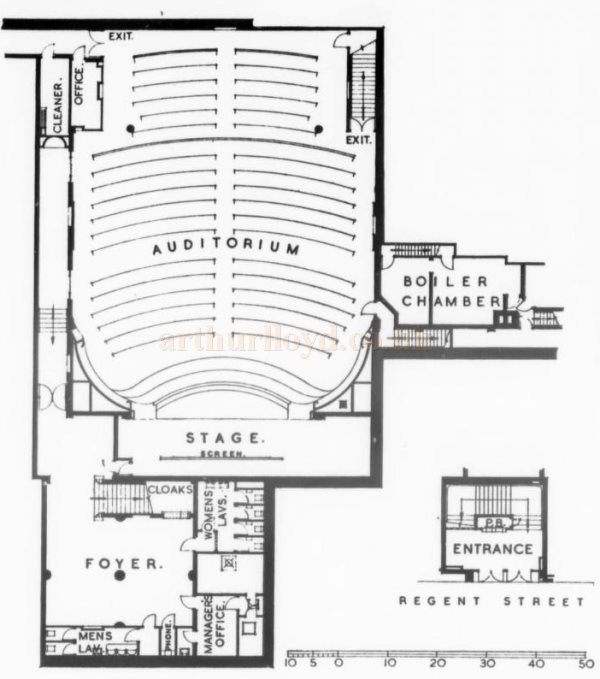
Right - A Plan showing the Paris Cinema in the Basement of Rex House and its Ground Floor Entrance from Lower Regent Street - From The Architects' Journal, 18th of May 1939.
The main pay-box is mahogany faced, with specially designed pay-box glazing with the clock dial engraved on the glass. In the cinema foyer mirrors are applied to the piers, the principal illumination being by porthole type of electric fittings let into the walls.
Heating and ventilation throughout the whole building is in three separate units. The cinema has its own boiler-house, and complete ventilation plant, and is quite distinct from the rest of the building. The restaurant portion of the building and the office portion have their own boiler-houses for heating purposes. Boiler-houses are all grouped together, as well as the fan chambers on the top floor.
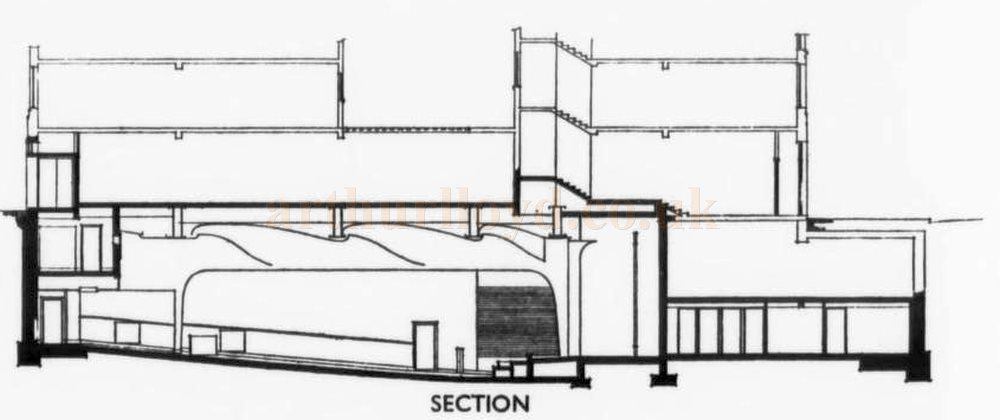
Above - A Section Plan of the Paris Cinema, Lower Regent Street - From The Architects' Journal, 18th of May 1939.
The general contractors were Lane, Fox & Co., Ltd., who were also responsible for the demolition, excavation, foundations and reinforced concrete. Consulting structural engineer: S. W. Budd, M.INST.C.E. Consulting electrical engineer Basil Davis, M.I.E.E. Sub-contractors and suppliers included Ragusa Asphalt Co., Ltd., asphalt; Sydney A. Hunter, Ltd., facing bricks; F. J. Barnes, Ltd., stone (natural); Girlings Ferro-Concrete Co., artificial Portland stone; Heenan, Beddow and Sturmey, Ltd., structlural steel; Hoffmann Sprinkler Co., Ltd., fireproof construction ; Helical Bar and Engineering Co., Ltd., special roofings, flooring (hollow tile); Faulkner, Greene & Co., Ltd., glass; Norris Warming Co., Ltd., central heating, boilers and ventilation; Gas Light and Coke Co., gasfitting Electrical Installations, Ltd., electric 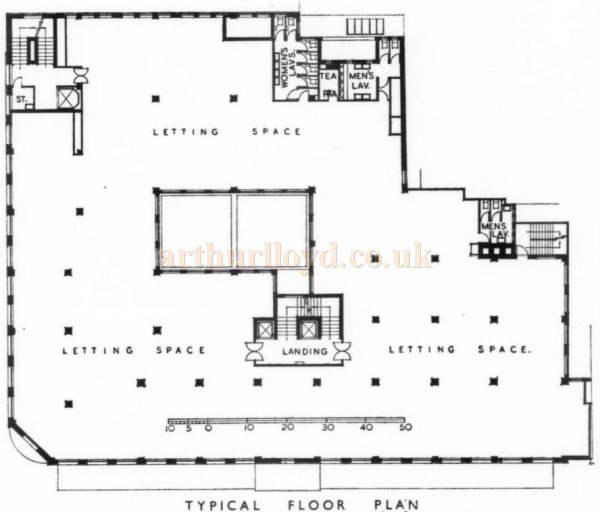 wiring and electrical installations; F. H. Pride, Ltd., electric light fixtures and clocks; Beer and Warren, Ltd., plumbing; Adamsez, Ltd., sanitary fittings; Davies and Johnston, stair-treads and furniture; Walter Cassey, Ltd., door furniture, ironmongery and furniture; Middlesbrough Casements, Ltd., casements and metal windows; G.P.O., telephones; Haskins, rolling shutters and iron staircases; W. Miller, Ltd., solid plaster; Stucco, Ltd., acoustic plaster; W. J. Wilson and Son, decorative plaster and fibrous plaster;
Right - A Typical Floor Plan of Rex House Offices - From The Architects' Journal, 18th of May 1939.
Swanser and Son, main entrance doors to cinema and surround and radiator grilles, bronze front; Allensor, Ltd., joinery; Thomas Cook, Ltd., marble; Protheroe and MacNab, tiling; Marion Dorn, Ltd., textiles; Express Lift Co., Ltd., lifts; Le Grand, Sutcliff and Gell, Ltd., water supply Ionlite, Ltd., signs; Garton and Thorne, metalwork, internal hand-rails, balustrades, etc., and pay-box front; Wilfred Langton, Ltd., decorations; British Vacuum Cleaner and Engineering Co., Ltd., vacuum plant; Sound Equipment, Ltd., sound; Hall Manufacturing Co., Ltd., stage equipment; Walturdaw Cinema Supply Co., Ltd., stage curtains; Pixtons, Ltd., seating, carpets and floor coverings; William Mason and Son, Ltd., kiosk; St. James' Tile Co., Ltd., terrazzo; Bull Super Silent Motors, by Bull Motors (Branch of E. R. & F. Turner, Ltd.)'
The above text in quotes (Edited) was first published in the Architects' Journal, 18th of May 1939.
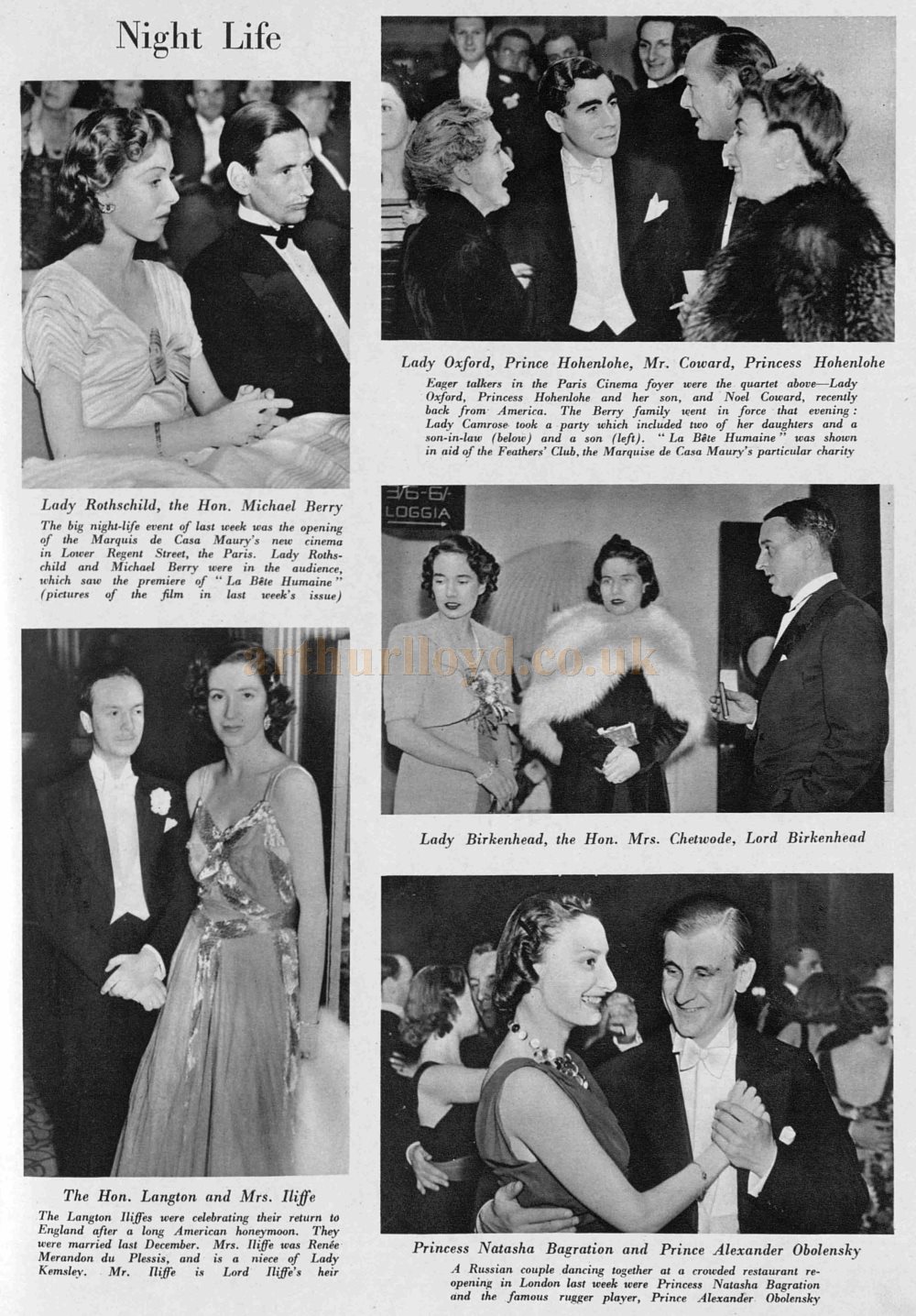
Above - An Illustrated Article on the Opening of the Short Lived Paris Cinema in 1939 - From The Bystander, 26th of April 1939.
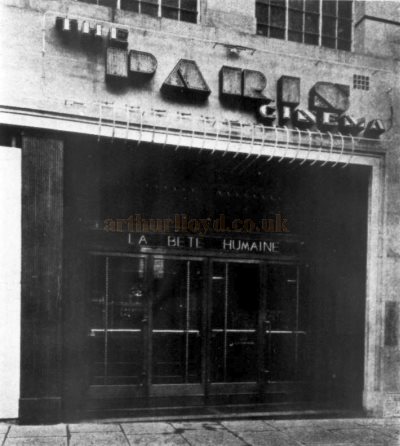 The Paris Cinema had first opened on the 20th of April 1939 with the film 'La Bete Humaine' as it was originally constructed for the showing of foreign language films, however, it soon went over to English Speaking films too in order to get the maximum footfall.
The Paris Cinema had a short life in this form however, as it was forced to close in late 1939 because of the outbreak of the Second World War.
Right - The Entrance to the The Paris Cinema, Lower Regent Street when it first opened in 1939 - From The Architects' Journal, 18th of May 1939.
When the Cinema reopened in February 1940 it was only for the occasional film, and then by the summer of 1940 it went over to being a home for trade shows and the like. Following this it was requisitioned by the Government for the War effort.
After the war the Cinema was taken over by the BBC and converted for use by them as a radio studio called the Paris Studios, details below.
The BBC's Paris Studios
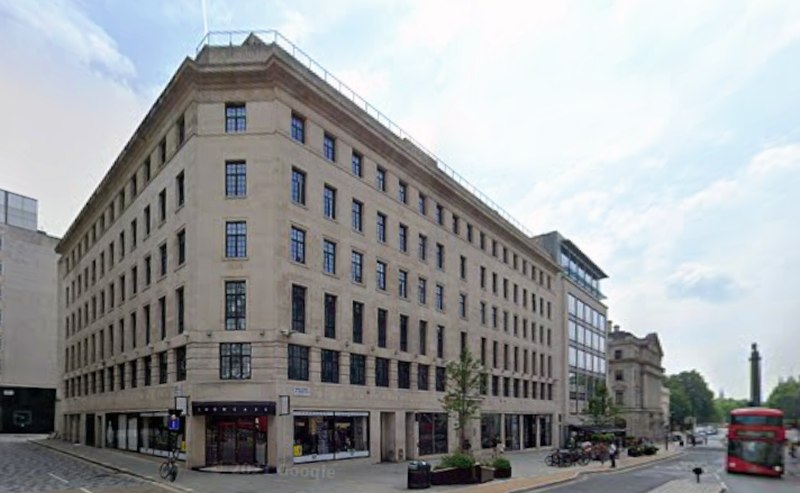
Above - A Google StreetView Image showing Rex House, Lower Regent Street, London in 2021, which formerly also housed the Paris Cinema / the BBC's Paris Studios - Click to Interact.
 After the war the venue was to have its most illustrious career when it was taken over by the BBC and converted for use by them as a radio studio called the Paris Studios.
Many well know comedy radio shows of the time were recorded at the Paris Studios in front of a live audience. 'I'm Sorry I Haven't a Clue', the radio version of 'Dad's Army', 'The Hitchhiker's Guide to the Galaxy', 'It's That Man Again', 'Much Binding in the Marsh', and many other well known Radio Shows were all recorded there.
Right - Princess Elizabeth and the Duke of Edinburgh at the Paris Studios for a recording of 'Much Binding in the Marsh' in 1949 - From The Tatler, 12th of January 1949.
The Paris Studios was also home to live performances by some famous rock and pop bands over the years including The Beatles, Joni Mitchell, Queen, and Pink Floyd amongst others.
I went there sometimes myself in the late 1970s and 80s to see radio programmes being recorded there, it had a lovely atmosphere and I was sorry to see it go when it eventually came to an end in 1995.
After the BBC left, the former Cinema and BBC Studio lay empty for many years before being reconfigured as an LA Fitness Gym around 2005. Today it is still in use as a Gym although under another name, and the front entrance and former auditorium are sadly unrecognisable from its Paris Cinema and BBC Paris Studio days.
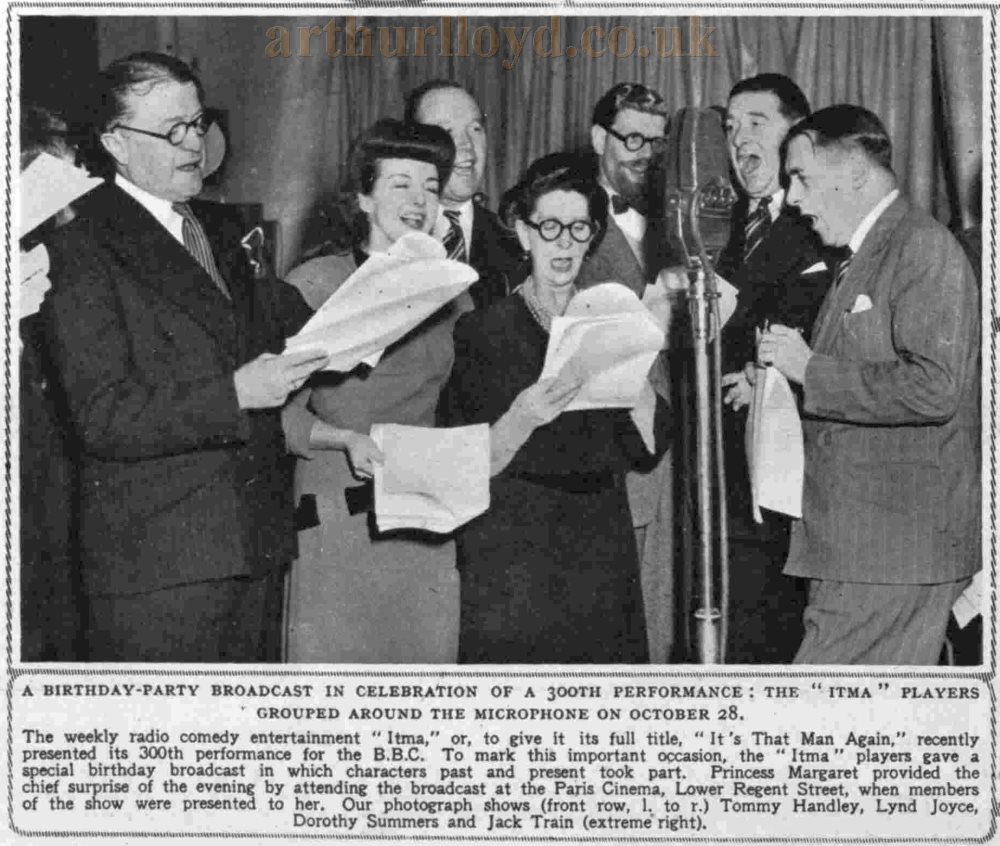
Above - Tommy Handley, Lynd Joyce, Dorothy Summers, Jack Train and others recording a Birthday Broadcast Celebrating the 300th performance of the BBC's 'It's That Man Again' at the Paris Studios in 1948 - From the ILN, 6th of November 1948.
Some of the information for this Theatre was gleaned from the excellent Cinema Treasures website where they also have some very nice photographs of the Paris Cinema here.
If you have any more information or Images for this Theatre that you are willing to share please Contact me.