
Theatres in Rugby, Warwickshire
The Palace Theatre - Vint's Electric Palace of Varieties - The Rugby Theatre / Empire / Scala Cinema - The Plaza Cinema / Granada - The Theatre Royal
The Palace Theatre, 136 Railway Terrace, Rugby
Later - The Prince of Wales Theatre / Vint's Hippodrome Theatre / The Regal Cinema
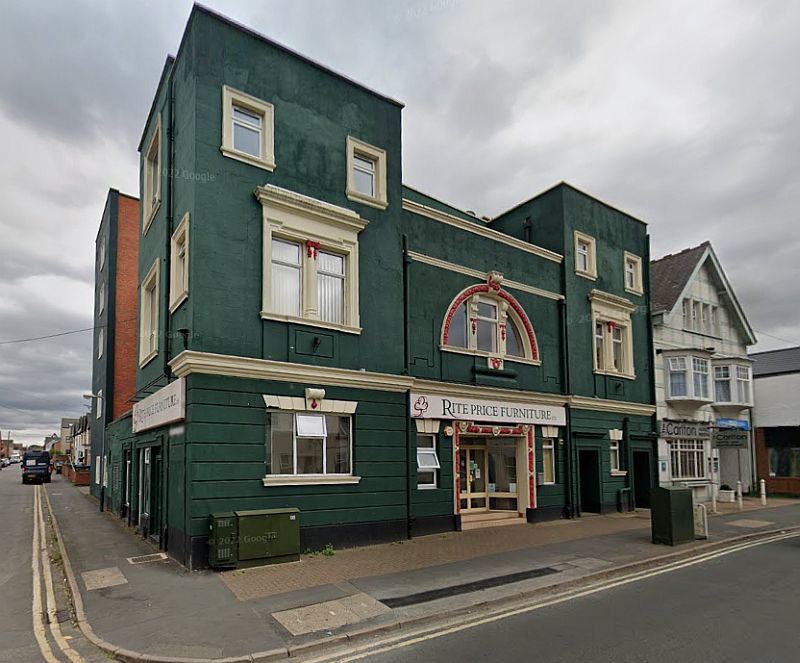
Above - A Google StreetView Image of the former Palace Theatre, Rugby in August 2022 - Click to Interact.

 The former Palace Theatre, Rugby, today partly in use as a furniture store, originally opened on Boxing Day the 26th of December 1910 with a production of the Pantomime 'Aladdin'. The Theatre was built on the site of the former Theatre Royal for Frank Langley and designed by Franklin & Newman with an elegant facade and an Auditorium capable of seating 800 people in its Stalls, Circle, Gallery, and two boxes. The Theatre's large stage was 50 foot wide with a 26 foot wide proscenium opening, and was 36 foot deep, fitted at the start with a revolve and traps. There were seven dressing rooms for artists.
Right - An Advertisement for the Pantomime 'Aladdin' which opened the Palace Theatre Rugby on the 26th of December 1910 - From The Rugby Advertiser, 24th of December 1910.
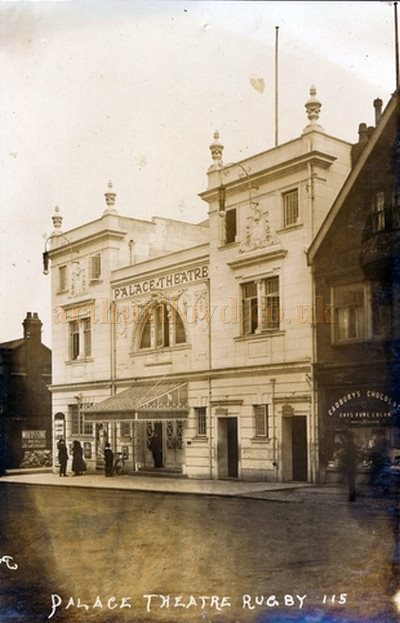 The ERA reported on the imminent opening of the Theatre in their 26th of November 1910 edition saying:- 'The New Palace Theatre Rugby will be substantially built of brick, with stone dressings. It will have a handsome frontage of 61ft. to Railway-terrace, and will be carried back along Market-street to a depth of 98ft. Accommodation will be provided for about 800 people. There will be two boxes, with foyer, orchestra stalls, pit stalls, and pit, above which is a circle and behind that a gallery. Five exits will be provided. The staircases will be constructed of fire resisting materials, and the auditorium floor will be sloping, so that all patrons may get a good view of the performance.
Left - An early postcard showing the Palace Theatre, Rugby - Courtesy Roger Fox.
The stage will be larger than some of those in the London theatres, the measurements being 36ft. by 50ft. The curtain will be fire-resisting, and the fittings will include iron contact doors. The flys and grids are to be constructed on the most modern principles, and there will be seven dressing-rooms.
The pit and gallery entrances will be in Market-street, also the stage entrance, and at the main entrance in Railway-terrace there will be provided a crush hall, in addition to managers' and box offices, stores, &c. Internally, the theatre will be treated with fibrous plaster and suitably decorated. The electric light will be installed, and it will be heated with water on the low-pressure system. When completed, no doubt the theatre will be a creditable addition to the buildings of Rugby. The architects are Messrs. Franklin and Newman, L.R.I.B.A., of Rugby.'
The above text in quotes (edited) was first published in the ERA, 26th of November 1910.
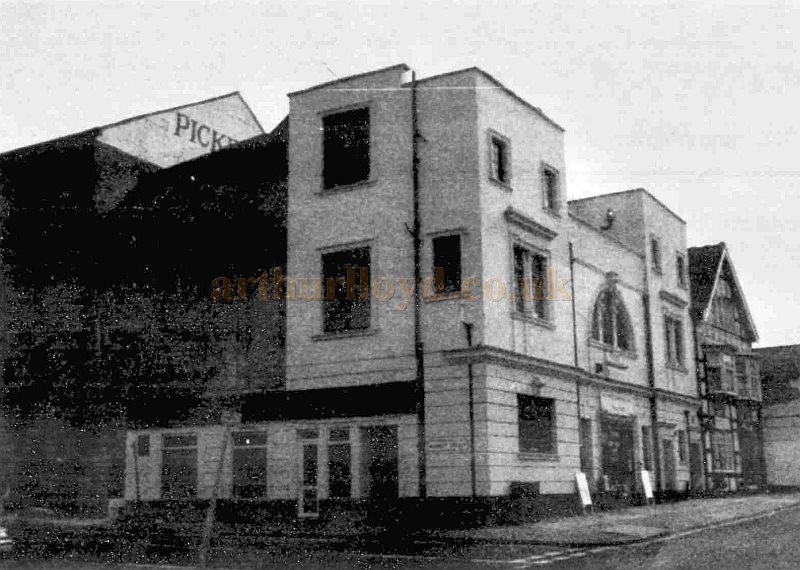
Above - The Regal Cinema, Rugby, formerly the Palace Theatre / Prince of Wales Theatre, whilst in use as a Pickfords Furniture Store in 1988 - From the Rugby Advertiser, 6th of October 1988.
 The Palace Theatre had first opened for its owner Frank Langley on the 26th of December 1910 but in 1912 it was taken over by the Leon Vint Organisation and was renamed Vint's Hippodrome Theatre showing Films and Variety shows. The Leon Vint Organisation also operated Vint's Electric Palace in Rugby at the time, which had been a conversion of the upper part of the Town Hall.
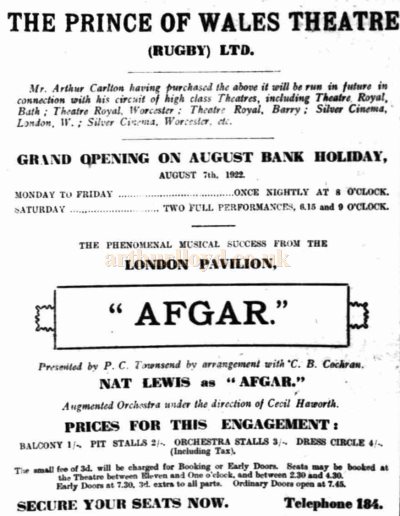
Right - An Advertisement for the Opening of the Prince of Wales Theatre, Rugby in 1922 - From the Rugby Advertiser, 4th of August 1922.
Ten years later, in 1922, the Hippodrome Theatre, formerly the Palace Theatre, was sold to Arthur Carlton, who had a small circuit of several other Theatres. He redecorated the Theatre and renamed it the Prince of Wales Theatre for its 'Grand Opening' on the 7th of August 1922 with a musical production from the London Pavilion called 'Afgar'.
However, the Theatre was to have a fairly short life in this guise too and it was closed again on the 11th of May 1929, sadly for the last time as a live Theatre. Arthur Carlton died just two years later.
After its closure the Theatre was substantially altered by its new owners the Charles Orr Circuit. They set about removing the Gallery and shortening the Stage depth to just 14 feet, and widening the proscenium opening to 35 feet for the better showing of films. The auditorium was repainted with pastoral murals for its reopening as the Regal Cinema on the 23rd of September 1931.
The Bioscope reported on the new Regal Cinema, along with the photograph shown below, in their 28th of October 1931 edition saying:- 'The Regal Cinema, recently acquired by the Charles Orr Circuit of Coventry, was formerly a legitimate theatre under the title of the Prince of Wales. It is the first cinema in the Midlands to provide a 50-50 programme.
Extensive reconstruction has been carried out. The proscenium opening has been widened to 35 ft. and the stage - which was one of the largest in the Midlands - has been considerably reduced, and now has a depth of 14 ft.
Entering the foyer, which is decorated in futuristic style, the pay-box is on the right with a stairway to the mezzanine lounge -and balcony at the rear. The manager's office is on the left, with switch-rooms and store-rooms on either side. The same style of decoration is employed in the mezzanine lounge, which contains a well-equipped café and is furnished with Lloyd Loom furniture.
Atmospheric Decorations
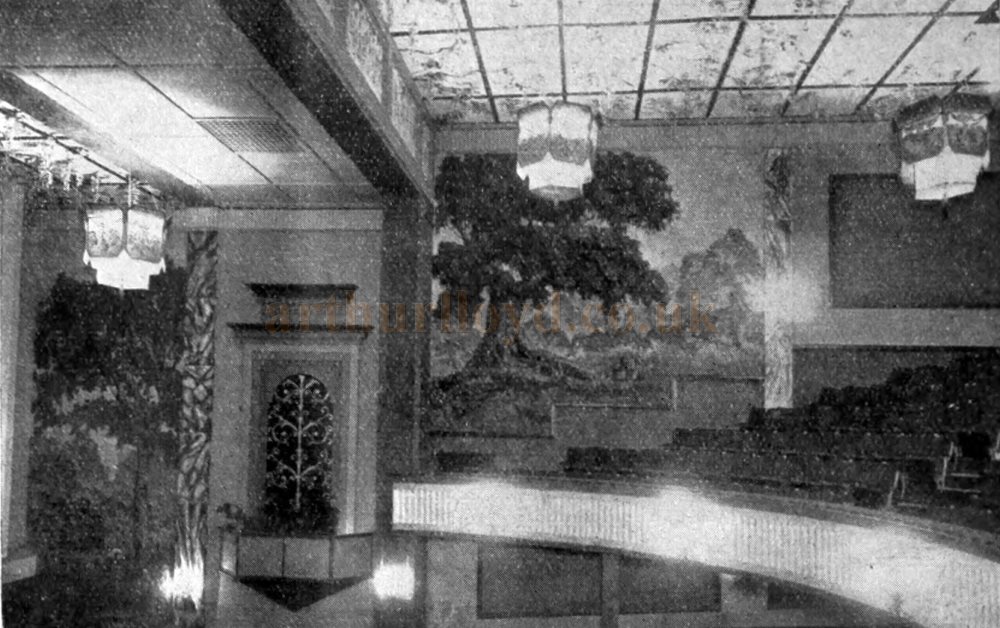
Above - The Auditorium of the Regal Cinema, Rugby, formerly the Palace Theatre / Prince of Wales Theatre, when it reopened as the Regal Cinema in 1931 - From The Bioscope, 28th of October 1931.
The decoration in the auditorium is in a fawn tone, whilst on each side of the proscenium opening are panels in decorative relief plasterwork. The well-known cinema decorative specialist, Fred A. Foster, of Nottingham, has adapted the panels to represent pastoral scenes; that on the right an English oak in a woodland scene; that on the left is a similar vista having a weeping willow as the principal feature.
The decorative treatment is atmospheric, following closely that at the Regal, Marble Arch, London, with the exception that the ceiling decoration employs hanging wisteria in place of the grape vine. The seats are upholstered in a multi-coloured moquette to produce a jazz effect. The proscenium curtains and pelmet are in crimson.
The projection chamber at the Regal is built as a separate unit, and is equipped with Western Electric sound in conjunction with Ernemann projectors, supplied by Walturdaw, and a Transvox screen. The seating capacity of the Regal is 990, of which number the balcony accommodates 250.'
The above text in quotes was first published in the Bioscope, 28th of October 1931.
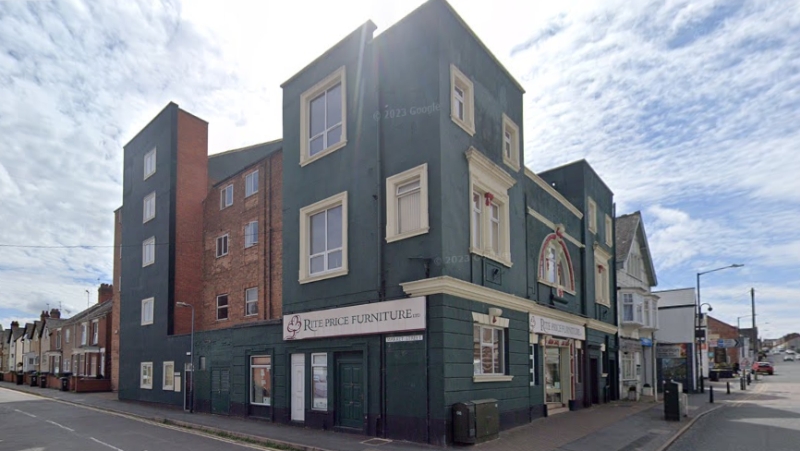
Above - A Google StreetView Image of the former Palace Theatre, Rugby in August 2023 - Click to Interact. Note the new Apartment Building on Market Street occupying the space where the Stage House and part of the Auditorium once stood.
In 1944 the Regal Cinema was taken over by the Granada Cinema chain but just nine years later it was closed by them on the 5th of January 1953 and this was to be the end of its entertainment career. The former Theatre was then altered for use as a Pickfords Furniture Store. In the 1990s further alterations were carried out when the interior of the former Theatre was gutted for use as a Price Rite Furniture Store. The Theatre's former Stage House and part of the Auditorium space were reconstructed at the same time for use as an apartment building, only the frontage to Railway Terrace remains as originally built today.
Some of the later information for this Theatre was gleaned from the excellent Cinema Treasures Website.
If you have any more information or Images for this Theatre that you are willing to share please Contact me.
Vint's Electric Palace of Varieties, High Street, Rugby
Formerly - The Town Hall - Later - The Electric Palace / The Rugby Palace Cinema
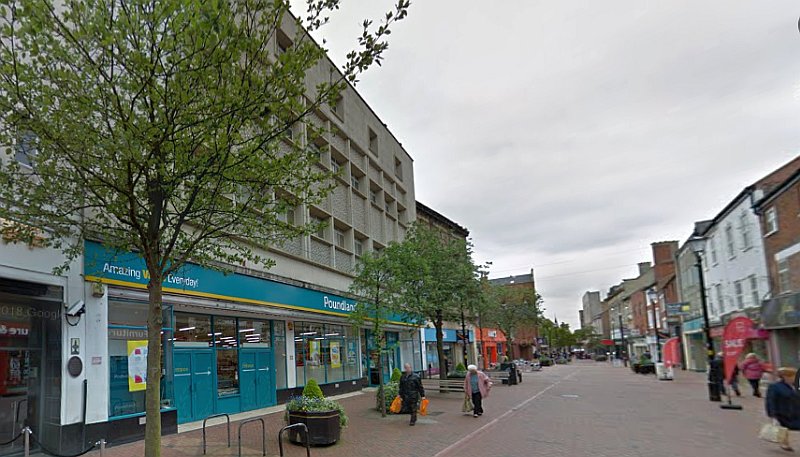
Above - A Google StreetView Image of the site of the former Town Hall and Vint's Electric Palace of Varieties, High Street, Rugby in May 2017 whilst in use as a Poundland Store - Click to Interact.
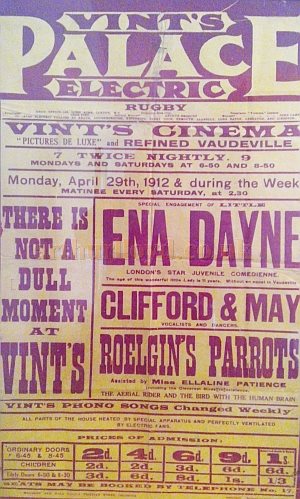 Vint's Electric Palace of Varieties was situated in Rugby's former Town Hall building on the High Street. The Town Hall itself had been constructed in 1858 on the site of several former Alms houses. The new Town Hall quickly became home to many local societies and its Assembly Room was used for all manor of entertainments including a regular Hunt Ball. Arthur Lloyd and his Comic Company performed there in November 1879. Various alterations to the building were carried out over the following years and it was enlarged several times by the purchase of adjoining buildings.
Right - A Poster for Vint's Electric Palace, Rugby - Courtesy Colin Charman.
In 1906 arrangements were made to sell the building to a theatre company but the negotiations fell through so the upper part of the building was instead let out to several entertainment companies and was often used for the showing of early cinema films.
In 1910 Leon Vint took over the upper floor and opened it as Vint's Electric Palace of Varieties where he screened films and put on variety acts, see poster right. Leon Vint would also run the nearby Palace Theatre by 1912.
The Hall was renamed The Electric Palace in 1914 but the following year Leon Vint was declared bankrupt and it was then taken over by other operators who renovated the Hall and reopened it as the Rugby Palace Cinema.
Plans were later put in place to refurbish the Cinema portion of the building by creating new separate entrances for it with vestibules and pay boxes in Sheep Street to the rear of the building and to the front in High Street. A new polished floor was also planned to be incorporated in the lower part of the former Town Hall for its use as a Dance Hall, and a new cafe was also proposed for its patrons.
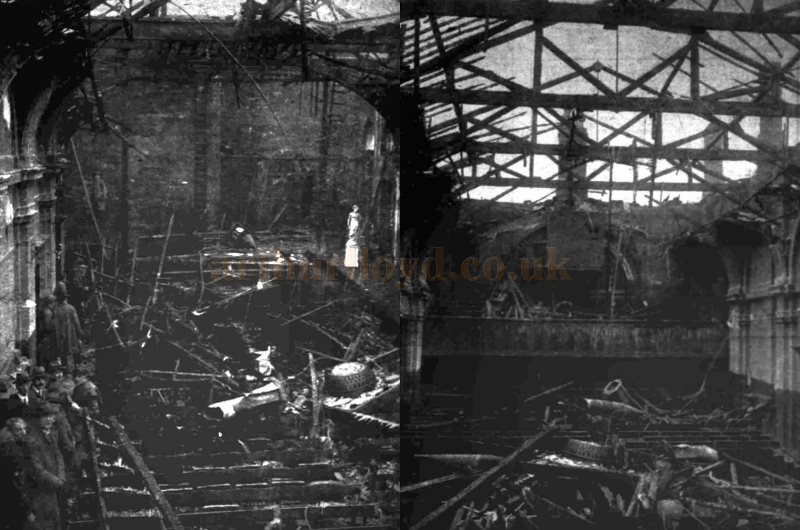
Above - The Palace Cinema, Rugby after the fire in January 1921 - From The Rugby Advertiser, 4th February 1921.
However, all these plans were lost when a major fire engulfed and destroyed the building on the 30th of January 1921. It was never reconstructed or reopened and the site was instead used for a new Woolworth's Store, so ending this particular site's entertainment history.
If you have any more information or Images for this Theatre that you are willing to share please Contact me.
The Rugby Theatre, Henry Street, Rugby
Formerly - The Empire Cinema De Luxe / Empire Cinema / Scala Cinema
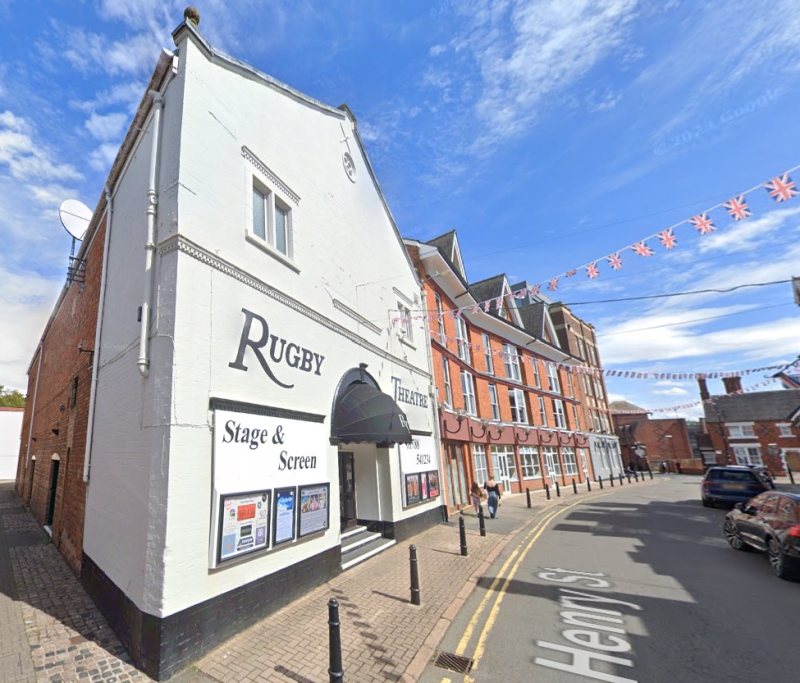
Above - A Google StreetView Image showing the Rugby Theatre in August 2023 - Click to Interact.
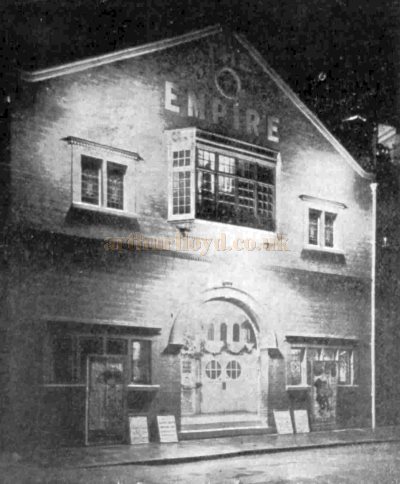 The Rugby Theatre is situated on Henry Street and was first built as an early Cinema called the Empire Cinema De Luxe which opened on the 6th of September 1913, it was reported on briefly in the Kinematograph Weekly on the 18th of September 1913 where they said:- 'The Empire, Rugby's new place of entertainment, was opened last week. It is a handsome building, with a picturesque interior, giving seating for 520 on the ground floor and 230 in the balcony, all of the tip-up variety. An efficient system of ventilation has been installed, and for the winter the hall will be heated on the accelerated hot water system. The B.T.H. Co.'s "eye-rest" system of lighting has been put in. The proprietor of the hall is Mr. B. Morris, and the manager is his nephew. Mr. J. Morris, for five years in charge of a picture theatre at Darwen. Two performances will be given each evening.' - The Kinematograph Weekly, 18th of September 1913.
Right - The Empire Cinema, Rugby in 1914 - From The Bioscope, 25th of June 1914.
Renamed the Empire Cinema in 1914 the Cinema also had a small stage for variety acts to perform between the films and also sometimes for complete stage shows. It had been built at a cost of £5,000 and had an auditorium decorated with plaster casts of artistic designs.
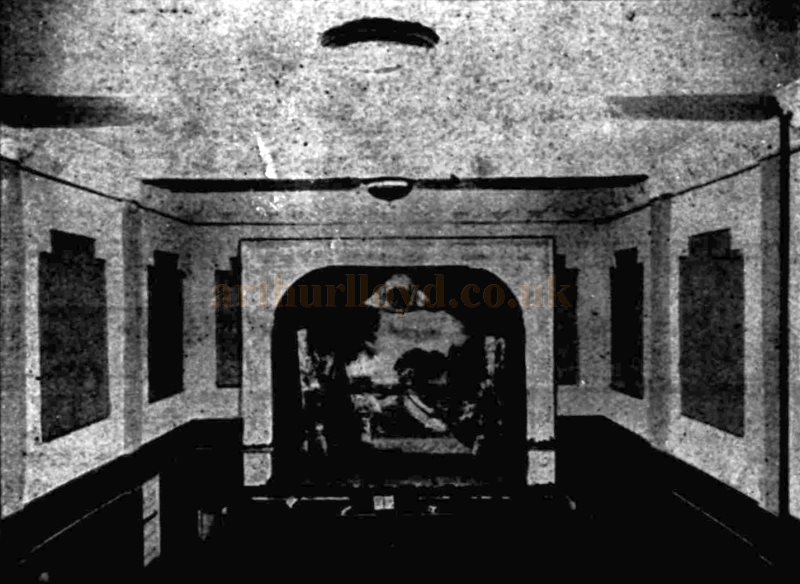
Above - The Auditorium of the Empire Cinema, Rugby in 1914 - From The Kinematograph Weekly, 2nd of July 1914.
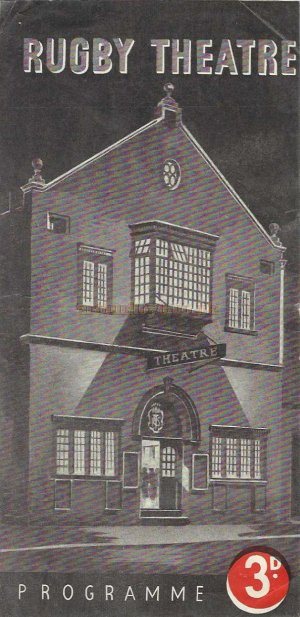 In 1923 the Empire was taken over by new operators and renamed the Scala Cinema for its reopening on the 5th of March that year but was closed after a fire in the projection box in June 1946. After this it was taken over by the Granada Cinema Chain but was never reopened by them and was instead sold on and then reopened as the Rugby Theatre on the 5th of December 1949.
Right - A Programme for the Rugby Theatre Society's Amateur Production of 'Quality Street' by J. M. Barrie at the Rugby Theatre in April 1954 - Courtesy Simon Moss, stagememories.
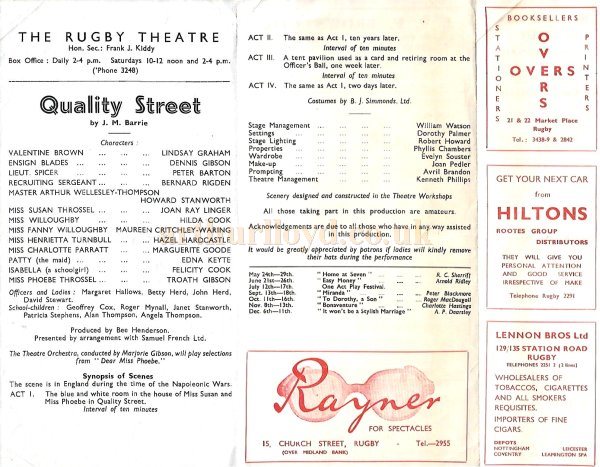 By 1976 the Rugby Theatre was showing films occasionally as part of its programming as there were no other Cinemas in the town by then, the last one being the Granada Cinema, which had gone over to Bingo that year.
Left - A Programme for the Rugby Theatre Society's Amateur Production of 'Quality Street' by J. M. Barrie at the Rugby Theatre in April 1954 - Courtesy Simon Moss, stagememories.
And this is how the Rugby Theatre is still run today, with amateur theatre productions on its stage most of the time and the occasional film being presented at other times.
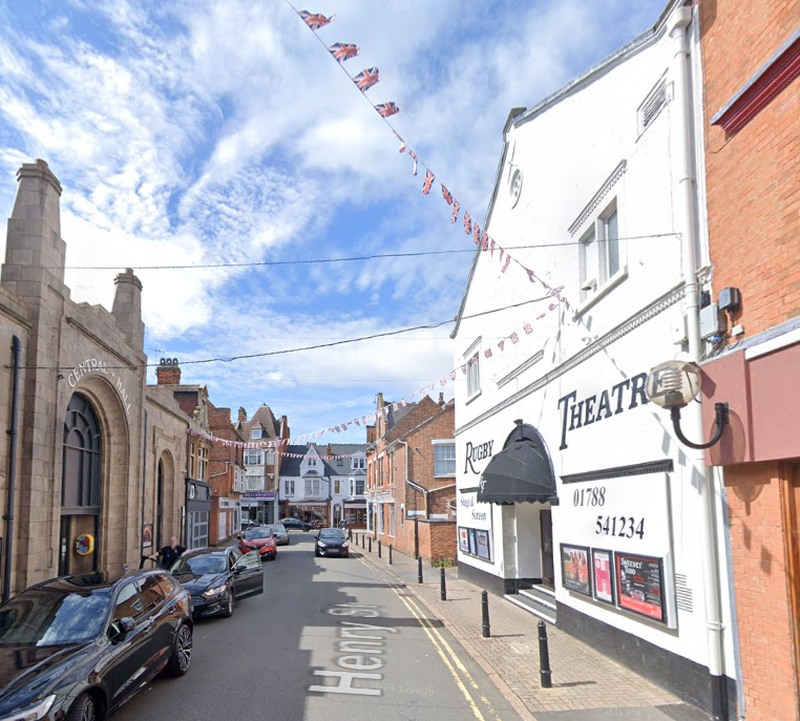
Above - A Google StreetView Image showing the Rugby Theatre in August 2023 - Click to Interact.
You may like to visit the Rugby Theatre's own Website here.
If you have any more information or Images for this Theatre that you are willing to share please Contact me.
The Plaza Cinema, North Street, Rugby
Later - The Granada Cinema / Granada Bingo Club / Gala Bingo
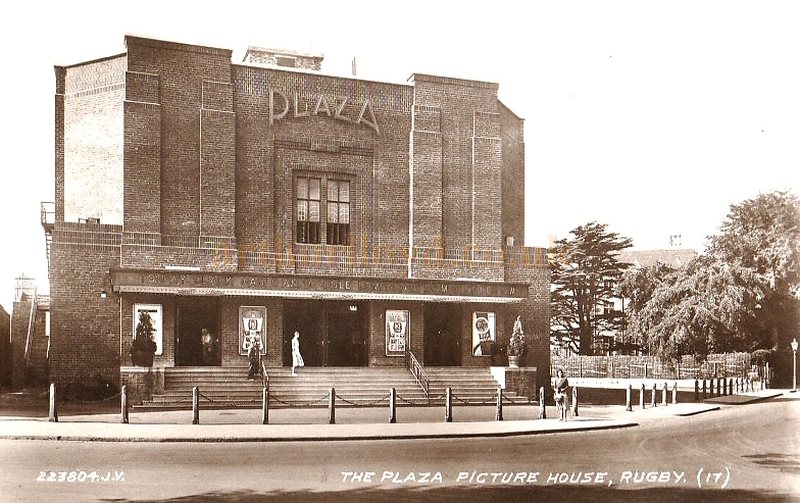
Above - A Postcard View of the Plaza Picture House, Rugby when it was Screening the 1932 film 'No Man of her Own' with Clark Gable and Carole Lombard in September 1933 - Courtesy Simon Moss, stagememories.
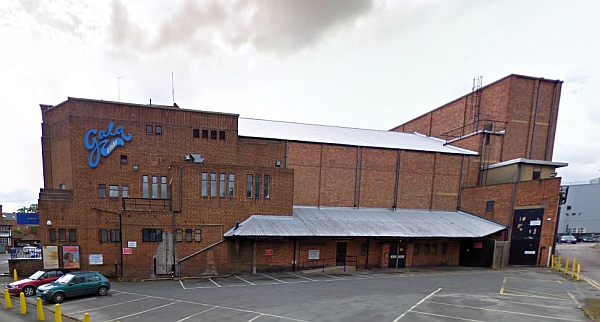 The Plaza Cinema was situated on North Street, Rugby and opened by the Mayor of Rugby on the 30th of January 1933. It was built as a Super Cinema for the J. F. Emery Circuit at a cost of £60,000 and designed by J. H. and R. B. Lyddington in association with the architectural firm Leathart & Granger.
Right - A Google StreetView Image showing the Side Elevation of the former Plaza Theatre, Rugby in June 2009, here in use as a Gala Bingo Club. Note the large Stage House to the rear of the building - Click to Interact.
The Theatre had a large fully equipped stage which was 32 feet deep with a proscenium width of 40 feet. There were also four dressing rooms for artists and a Christie Theatre Organ on a lift which could rise up from the orchestra pit, played by Reginald Foort and Frank Newman on the Theatre's opening.
The Plaza could seat 2,000 people in its large auditorium consisting of Stalls and one Circle and was said to be one of the 'most luxuriously furnished in the Midlands.' The Theatre had a spacious crush hall which lead to the stalls and a large balcony foyer and cafe. It was also equipped with a Holophane Lighting system which could bathe the Auditorium in different colours depending on the style of the feature being presented. There was a large car park attached to the Theatre with provision for 500 cars, and remarkably for the time the Balcony was provided with some seats for the hard of hearing equipped with Headphones so they could better enjoy the programme of films and stage shows.
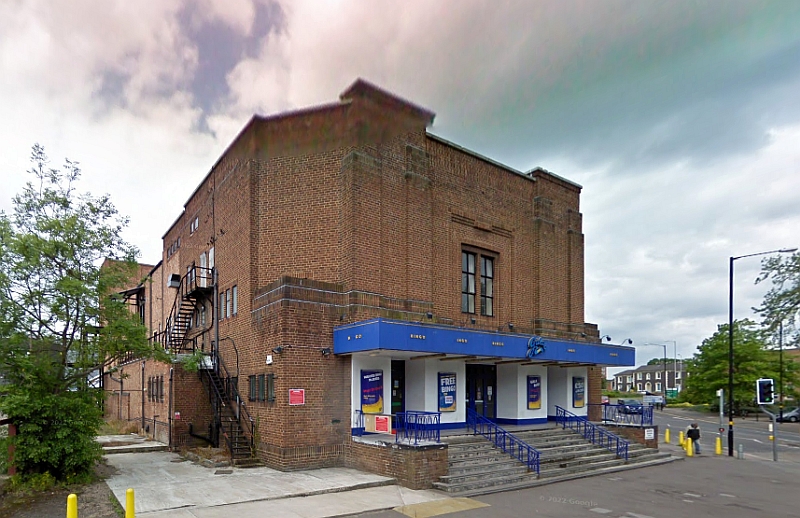
Above - A Google StreetView Image showing the former Plaza / Granada Cinema, Rugby in June 2009 - Click to Interact.
In September 1944 the Cinema was taken over by the Granada Chain and was renamed the Granada Cinema from the 26th of May 1946. The Theatre's stage was still regularly used for variety shows and music concerts however, and by the 1960s it was often staging pop concerts along with Organ concerts on Sundays.
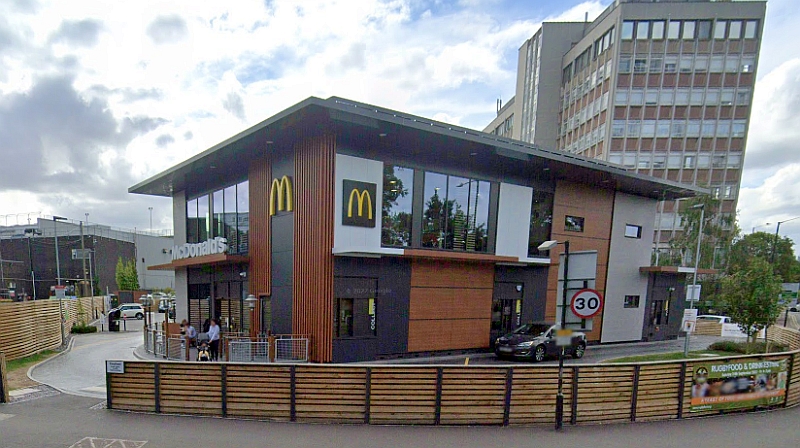
Above - A Google StreetView Image showing the site of the former Plaza / Granada Cinema, Rugby in August 2022 - Click to Interact.
The Granada Cinema was closed on the 28th of February 1976 and was then converted into a Granada Bingo Club which was taken over by Gala Bingo in 1991. Sadly even this ended in 2010 and the building was demolished the following year in November 2011. Today the site is in use as a Drive in McDonald's Restaurant.
Some of the information for this Theatre was gleaned from the excellent Cinema Treasures Website.
If you have any more information or Images for this Theatre that you are willing to share please Contact me.
The Theatre Royal, Railway Terrace, Rugby
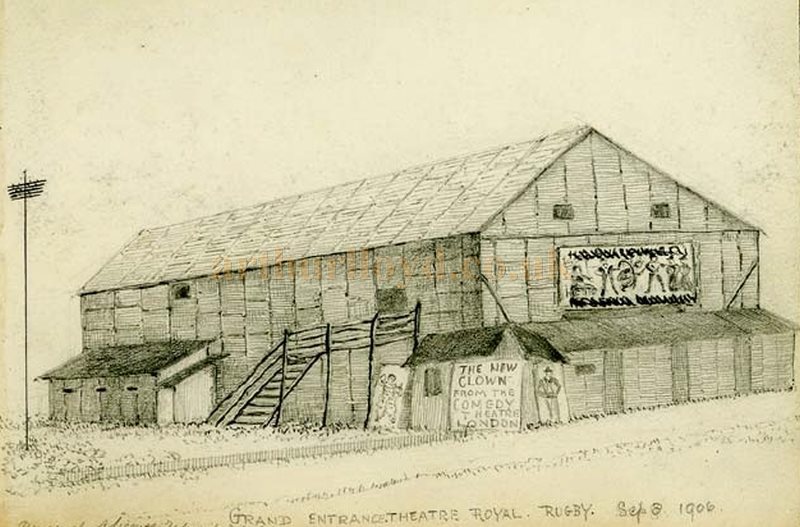
Above - The Theatre Royal, Rugby in 1906 - From the book 'Manuscripts, Drawings & Ephemera, Thomas Fairfax to Richard Nixon, 1647 - 1974'.
The Theatre Royal, Rugby was situated in a field on Railway Terrace where the Palace Theatre would be built in 1910. The Theatre was a small temporary structure erected in 1890 and run by George Henry and Walter Howard, referred to rather disparagingly in parliament over a licence application in 1895 as being like a shed or booth constructed entirely of wood, although judging by the image shown above this was a fair description. The Theatre was, perhaps surprisingly, said to have been able to seat up to 1,200 people and was reported as being 104 feet long by 42 feet wide, with a stage depth of 36 feet, and several dressing rooms.

Above - An Advertisement for the Theatre Royal, Rugby - From The Stage Newspaper, 14th of February 1890.
George Henry Howard was declared Bankrupt in January 1891 and the Theatre was put up for sale although plays and pantomimes continued to be put on there and George Howard still seemed to own the building, however, it was often let out to other temporary lessees. One such Lessee was a Mrs. Dalmaine who had the Theatre substantially altered and redecorated for a reopening season in December 1893.
In September 1894 the Theatre's Gallery was sold for reconstruction as a Stand at the Rugby Football Ground, the Theatre continued in operation however, so one can only assume that they either didn't need the space any more or the Gallery was rebuilt.
The following year in 1895 an application for a Licence to continue running the Theatre was objected to by many people and even ended up in the House of Commons, objectors to the Licence said that the building was unsafe, a fire risk, and unsanitary, but the Licence was eventually granted and the Theatre continued in operation. I imagine that its patrons must have wondered whether it was still safe to visit the Theatre, but performances continued.
On May 7th 1895 the D'Oyly Carte Opera E-Company performed the latest Gilbert & Sullivan opera 'Utopia, Limited' at the Theatre Royal, Rugby for one night only. Prices for the performance were 4s, 3s, 2s, and 1s, with doors opening at 7.30 for an 8pm performance and this was quite a coup for the little wooden Theatre situated in a field in Rugby. E-Company toured the smaller towns of Britain with a very simple set, much less elaborate than their sister companies which produced carbon copies of the Savoy Theatre London production in the larger houses.
The Theatre was replaced by a new Theatre in 1901 and under the new ownership of the Rugby and Entertainments Company Limited who opened it at Easter on April the 8th 1901. The new Theatre had a larger stage, 52 feet wide with a 27 foot proscenium opening, and a stage depth of 36 feet. Its auditorium was capable of seating 1,600 people. The Theatre was actually the former Pavilion Theatre, a Wooden and Corrugated Iron building which had been running in Nuneaton for several years previously and was rebuilt in Rugby for its 1901 reopening.
The Rugby and Entertainments Company Limited continued to run the Theatre Royal successfully, for several years, even including early film showings occasionally as part of the entertainments there. Later managers put on plays, concerts, and variety shows along with occasional Cinematograph Film showings, and the place was always very popular and rarely closed.
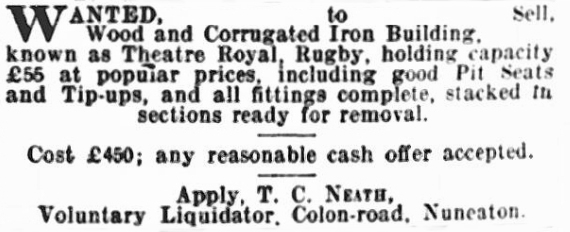 However, in November 1907 the Theatre and it's fixtures and fittings were put up for sale by a Liquidator for £450. The sale included the building itself, advertised as a wooden and corrugated iron structure, and its tip up seats, stacked and ready for removal. And that was the end for the Theatre Royal, Rugby.
Right - An Advertisement for the sale of the Theatre Royal, Rugby and its fixtures and fittings in 1907 - From the ERA, 23rd of November 1907.
During all this time Rugby had become more and more populated, the Midland Railway had put Rugby on the map by 1839 and Railway Terrace was laid out in 1840, the town just grew and grew from there. The site of the old Theatre Royal, which had been just a field when it was first erected, later became the site of a new permanent and substantial Theatre called the Palace Theatre which was erected there in 1910.
If you have any more information or Images for this Theatre that you are willing to share please Contact me.