
Theatres in Skegness, Lincolnshire
The Embassy Theatre - The Arcadia Theatre - The Tower Theatre / Cinema - The Lawn Theatre - The King's Theatre / King's Hall - The Parade Cinema - Fred Clements
The Embassy Centre and Embassy Theatre, Grand Parade, Skegness
Formerly - The Embassy Ballroom
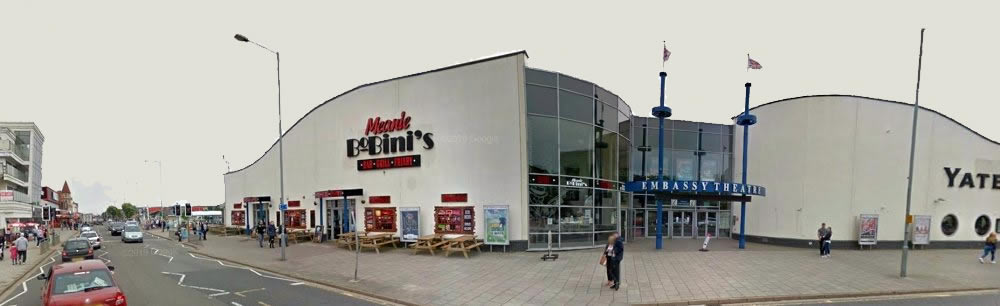
Above - A Google StreetView Image showing the Embassy Centre and Embassy Theatre Entrance, Skegness in July 2016 - Click to Interact.

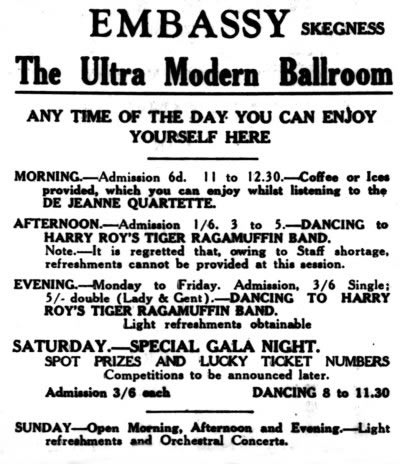 The Embassy Centre is situated on Grand Parade, on the Skegness Seafront, and has been operating for a hundred years, first opening as the Embassy Ballroom in 1926.
Right - An Advertisement for the Embassy Ballroom, Skegness in 1946 - From Skegness News, 3rd of July 1946.
Originally built as a Ballroom at street level with a restuarant below, it was often used for Concerts and Variety Performances along with being a venue for Dancing and other Events.
In 1982 the venue was altered and a new Theatre was added behind it and on part of the site of a former sea water swiming baths, at a cost of £1 million.
The Embassy Theatre has a large octagonal shaped auditorium, which was capable of seating 1,200 people when it first opened, and is comprised of Stalls and one Circle which surounds five sides of the octagon.
With no fly tower and no orchestra pit, and dressing rooms situated in the basement front of house, it is not the easiest Theatre to run but has been very successful over the years running regular summer seasons since it opened.
You may like to visit the Embassy Theatre's own Website here.
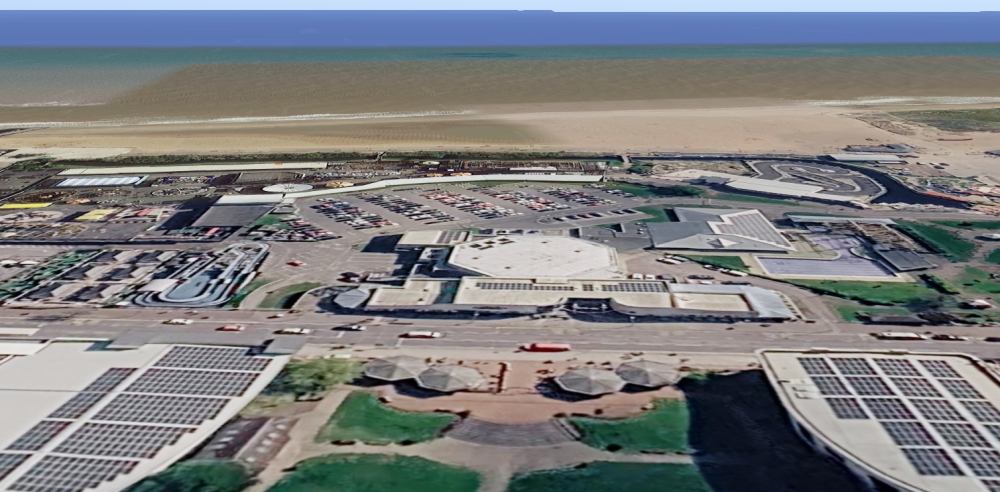
Above - A Google Earth Image showing the Embassy Centre, Skegness and its octagonal Theatre from above - Click to Interact.
If you have any more information or Images for this Theatre that you are willing to share please Contact me.
The Arcadia Theatre, Drummond Road, Skegness
Later - The Arcadia Centre
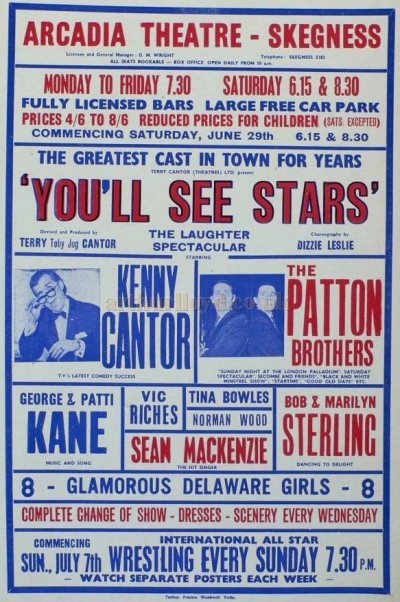 The Arcadia Theatre was situated on Drummond Road in Skegness and opened in 1911. The Theatre was constructed by J. T. Turner & Son who would be on hand over 70 years later to repitch the roof shortly before it was closed and demolished.
Right - A Poster for the Arcadia Theatre, Skegness with Kenny Cantor on the Bill in the 1970s - Courtesy Maurice Poole.
The Arcadia Theatre presented live shows for most of its life despite being fitted for Cinema use in the 1950s. It was operated by Fred Clements from its opening until 1935 when he sold it, and the nearby Tower Theatre, to the Parade Cinema Company, Skegness Entertainments Ltd., and took on the lease of the Central Cinema in the Town instead, formerly the Central Hall.
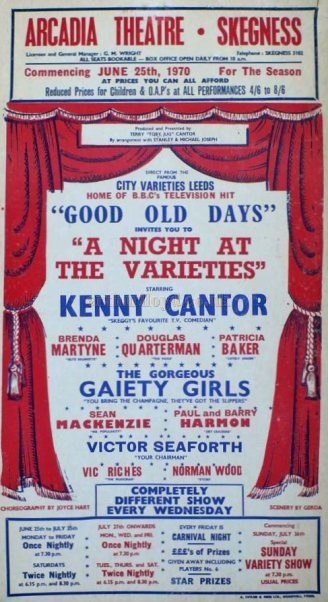 When East Lincolnshire Arts took over the Theatre in 1972 they returned it to live theatre use along with film showings by dividing the Balcony to create a small 560 seat cinema called Studio One whilst using the rest of the auditorium for theatre use, it was renamed The Arcadia Centre at the same time, and its official opening was on Wednesday the 13th of December 1972 with a performance of 'Don Giovanni' by The London Opera Group.
Left - A Poster for the Arcadia Theatre, Skegness with Kenny Cantor on the Bill in the 1970s - Courtesy Maurice Poole.
In 1973 the original Dressing Rooms of the Theatre were demolished and a new Block of modern Dressing Rooms was constructed in its place at a cost of £10,000. Along with the new Dressing Rooms a new Wardrobe Room, Backstage Canteen, Orchestra Room, Stores, Toilets, and Showers were also fitted into the new Block making the Theatre fit for modern productions.
In October 1984 the Arcadia Theatre was closed after several years of poor attendances and structural issues with the building. The last performance I can find for the Theatre was The Midlands Dance Company in a production called 'Leaps and Bounds' in September 1984. The Arcadia Centre was put up for sale the following year in 1985.
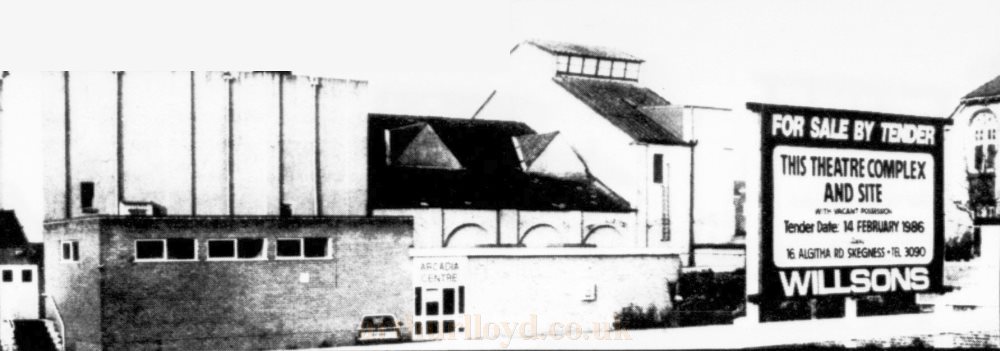
Above - The Arcadia Centre, Skegness closed and awaiting a new owner in 1985 - From the Skegness Standard, 6th of December 1985.
Despite the Theatre being closed the Cinema continued in operation, and a new roof was installed by the original contractors of the building in July 1986. However, the Arcadia was sold to Alf Jackson for £100,020 later in 1986 and this proved to be beginning of the end for the Arcadia. The building was demolished in 1988 and its site became The Arcadia Car Park.
If you have any more information or Images for this Theatre that you are willing to share please Contact me.
The Tower Theatre, Lumley Road, Skegness
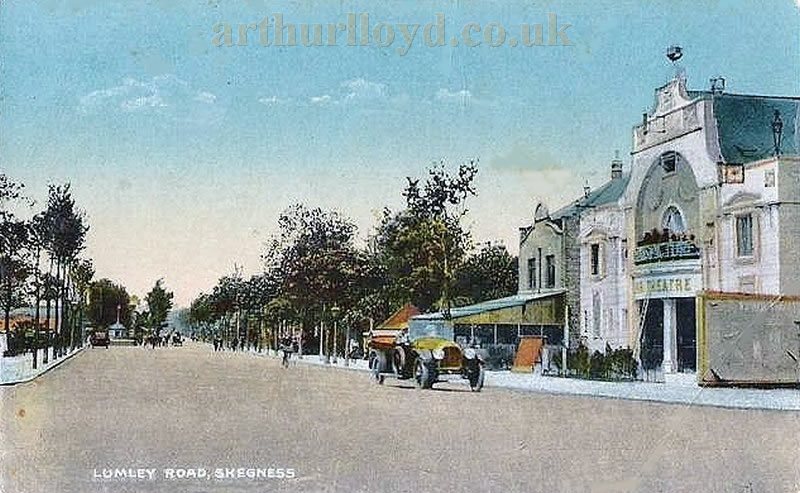
Above - An Early Postcard showing Lumley Road and the Original Tower Theatre, Skegness of 1921 - Postcard reproduced here with a Creative Commons Licence from Mike Blakemore at the Cinema Treasures Website.
 The Tower Theatre was situated on Lumley Road in Skegness and first opened on Monday the 25th of July 1921. The Theatre was built for Fred Clements who also operated the nearby Arcadia Theatre in the town, he would sell both Theatres in 1935 however, to the Parade Cinema Company, Skegness Entertainments Ltd., when he took on the lease of the Central Cinema in the Town, formerly the Central Hall.
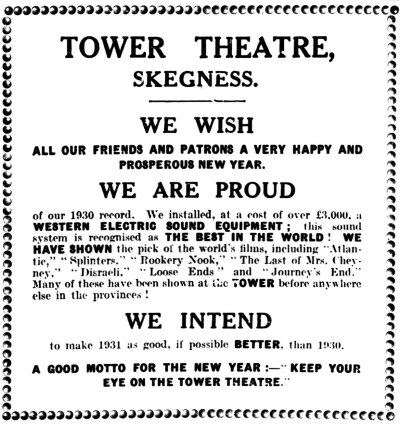
Right - An Advertisement for the new Western Electric Sound Installation at the Tower Theatre, Skegness in 1930 - From the Skegness Standard, 31st of December 1930.
On its opening the Tower Theatre was Managed by Arthur Gadsby of Lincoln. The Theatre is Situated close to the well known Clock Tower in Skegness, hence the name, and was built for both live theatre and cinema use, having a small stage and a capacity of around 950 people.
In 1930 the Theatre was equipped for sound to accompany the new talking pictures, an advertisement in the local press shows just how proud the Management were of this achievement, see image right. The Sound Equipment installed was a Western Electric, billed in the advertisement as being 'The Best in the World!'.
Sadly the original building was badly damaged during the war in January 1941 when it was hit by a bomb which destroyed the roof and the front of the Theatre. It never reopened but was instead rebuilt in 1949 to the designs of the Nottingham Architect Alfred John Thraves.

Above - Alfred John Thraves Sketch of the Tower Theatre, Skegness - From the Skegness News, 28th of December 1949.
The Skegness News reported on the soon to be completed new Tower Theatre in their 28th of December 1949 edition saying:- 'When the reconstruction of the Tower Theatre, work on which commenced a month ago, is completed during the coming year, Skegness will possess one of the most up-to-date theatres, from the standpoints of both design and equipment, in the whole of eastern England. At this particular season, when large numbers of workmen are busily engaged in dismantling the bomb-shattered parts of the old cinema, it seems appropriate to reproduce an architect's sketch showing the ultimate appearance of the Lumley Road facade of the new theatre, together with a few notes on the special features which it will present. But before doing so, a word about the existing building will not be out of place.
Occupying one of the most ideal sites in the town, the Tower Theatre was built to the order of the late Fred Clements in the winter of 1920-21, and opened as a cinema during the 1921 summer season.
OLD TOWER WAS BOMBED
Although on the small side by modern standards, being just under a thousand-seater, the Tower at the time of its erection was one of the most comfortable and completely equipped houses in the county. In so many respects, it was "just right" for its purpose, and it was also discovered, when sound equipment was installed in 1930, that its acoustics were almost perfect, this happy state resulting from what might almost be termed an accident in design. When Mr. Clements relinquished his entertainment connections in the late 'thirties, the Tower was acquired by Mr. R. L. Kemp for Skegness Entertainments Ltd., which also owned the more recently constructed Parade Cinema.
It maintained its role during the first eighteen months of the late war, but on the afternoon of January 18th, 1941, it received a direct hit from one of a string of bombs dropped by a low-flying German raider, while a matinee performance was in progress. Fortunately no one was killed, several members of the audience escaping with no more than severe shock. The explosion brought down part of the south-west corner of the building, which was later used as a store for the remainder of the war. Mr. Kemp's United Entertainments, Ltd., which now controls this house, has long been seeking a licence for reconstruction, and work commenced on the licence being granted at the beginning of December.
BID FOR ACOUSTIC PERFECTION
The new building is to the design of Mr. Lionel Thraves, F.R.I.B.A., of the firm of A. J. Thraves, of Nottingham, who are architects for the whole of the circuit of theatres conducted by United Entertainments Ltd. The same firm was responsible for the design of the Parade Cinema, Skegness, which was completed in 1933. As will be seen from the sketch, the new building is of handsome and imposing appearance. The main entrance in Lumley Road gives access to a main foyer, from which two staircases, one on either side, lead to a circle foyer, and to allow for this latter feature the building is being considerably enlarged. Naturally, the circle foyer is being built of fire-resisting materials, and there will be emergency exits from the circle itself. What was achieved accidentally in the case of the old Tower is being sought in the new building through the medium of essentially careful design, and the building will be correced [sic] to comply with really good sound-reproducing standards.
MOST MODERN SOUND SYSTEM
The projection boxes, at the rear of the circle will run the full width of the building, and the equipment, including spotlighting facilities, will be completely up-to-date. Westrex sound-reproducing equipment, the very latest development by Western Electric, is to be utilised, and it is worthy of note that equipment of this type has just been installed in the Empire Theatre, Leicester Square. The stage will be very much enlarged, and will have a depth of approximately 26 feet, and a proscenium opening of 32 feet, the additional space being obtained by taking in the old engine-houses at the rear of the building. It will enable the Tower to be used as a cinema, as a theatre, or as a concert hall, as the policy of United Entertainments Ltd. and the demands of the public may dictate.
READY FOR TELEVISION
In view of current developments, it is of particular interest to note that preparations are being made for the reception of Large Screen Television. The special ducts to accommodate the extra-high-tension cables are being built in, a control room is being provided, and provision for the special projector is being made at the front of the circle. Seating will consist of the very latest type of tub chairs, with ample space between the rows of seating, as the comfort of patrons - rather than the attainment of maximum seating capacity - has been kept in mind throughout the whole design.
"NO-DRAUGHT" VENTILATION
The ventilation system, by Goodacre, Glover and Butler, of Nottingham, will be essentially complete, and will include the latest type of "cool and warm air" inlets, electrically coupled to the exhaust fan system, resulting in a constant air flow and the elimination of all draughts. The whole of the electrical equipment has been designed by United Entertainments Ltd.'s circuit supervisor, Mr. J. M. Wright, whose son, Mr. G. M. Wright. is supervising its installation by the company's own engineers. The building contractors are Messrs. Metcalf Bros., of Doncaster, who built the Parade Cinema, and are main contractors to United Entertainments Ltd. If weather conditions permit the work to proceed at a uniform speed, it is hoped that the Tower will be completed and ready for its official opening during the 1950 season. It will be a building of which Skegness will have every reason to be proud.'
The above text in quotes was first published in the Skegness News, 28th of December 1949.
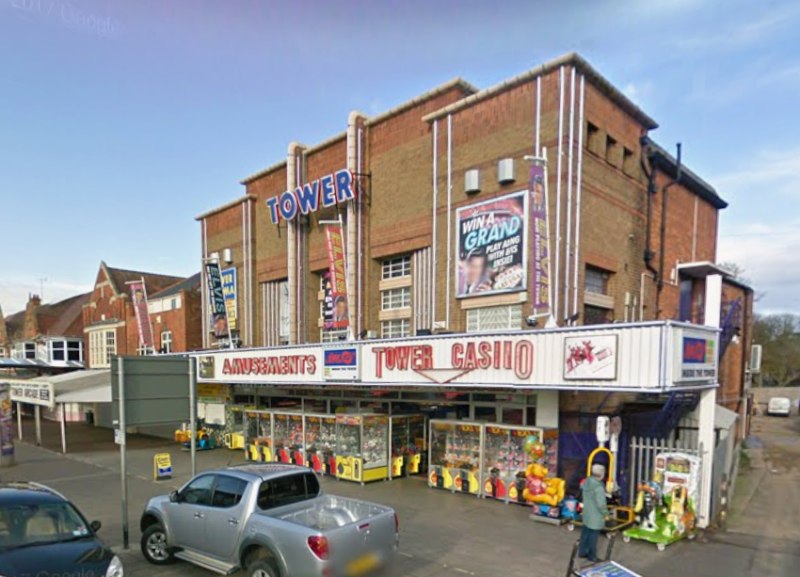
Above - A Google StreetView Image showing the 1951 rebuilt Tower Theatre, Skegness in November 2008 - Click to Interact.
 The new Tower Theatre was larger than the previous one having a seating capacity of 1,200 on two levels, stalls and one circle, and had a larger stage, with a 32 feet wide proscenium opening and a depth of 28 feet, eight dressing rooms for artists were also included in the rebuild.
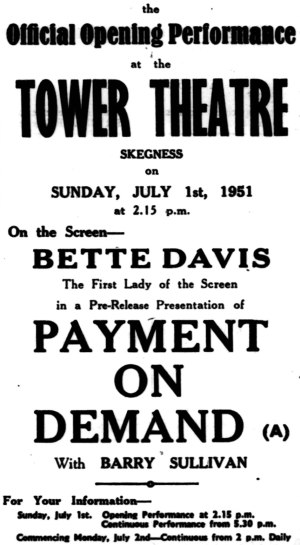
The Theatre officially reopened on the 1st of July 1951 with a Pre-Release Presentation of the Bette Davis Film 'Payment on Demand', see the advertisement shown right
Right - An Advertisement for the Official Opening of the new Tower Theatre, Skegness in 1951 - From the Skegness News, 27th of June 1951.
Perhaps surprisingly after so many decades since its opening the Tower Theatre is still operating today, albeit as Twin Cinema with an Amusement Arcade below.
In 1984 the Theatre's Circle was converted into a 420 seat Cinema and the Theatre's Stalls area was converted into the Amusement Arcade. And in 2003 the Circle Cinema was twinned so that today there are two Cinema Screens above the Amusement Arcade, so despite all the changes over the years its good to see the building still in entertainment use today, over a hundred years since the original Tower Theatre was first built in 1921.
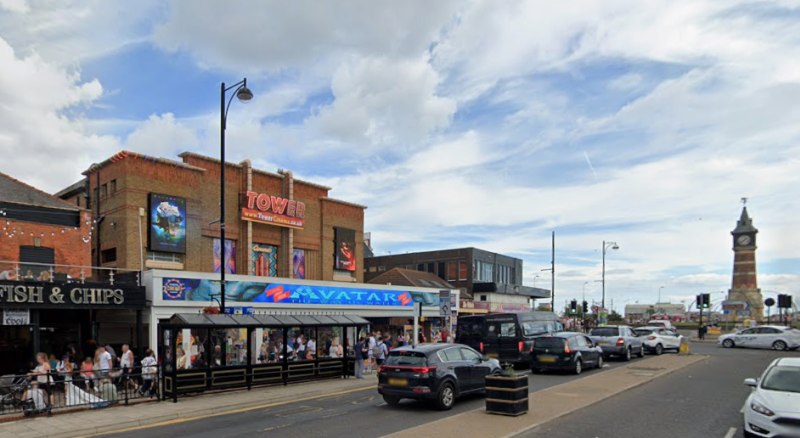
Above - A Google StreetView Image showing the 1951 rebuilt Tower Theatre, Skegness in August 2022 - Click to Interact.
If you have any more information or Images for this Theatre that you are willing to share please Contact me.
The Lawn Theatre, High Street, Skegness
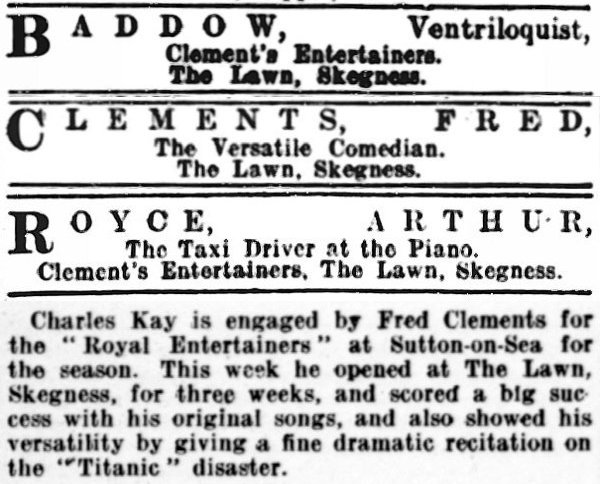 The Lawn Theatre was situated beside the Hildreds Hotel on the High Street in Skegness. It began life as an open air venue on the Lawn of the Hotel, and was run by Fred Clements from 1911 although he had put on performances there from as early as 1906. At that time the venue was lit by Chinese lanterns and fairy lamps. Eventually the venue was roofed over with canvas and Clements put on many concert performances there with a variety of performers, see advertisements shown right.
Right - Four Advertisements from the ERA for events at the Lawn, Skegness in 1906, 1907, 1909 and 1912.
Henry de Mond took over the Lawn Theatre, as it had become known, in 1921, it had been rebuilt in a more substantial form by then, and he put on Cine Variety shows there for many years, but it was to end in 1934 when the Theatre was demolished for the construction of a Ballroom for the Hildreds Hotel on the site instead.
If you have any more information or Images for this Theatre that you are willing to share please Contact me.
The King's Theatre, Scarbrough Avenue, Skegness
Formerly - The King's Hall
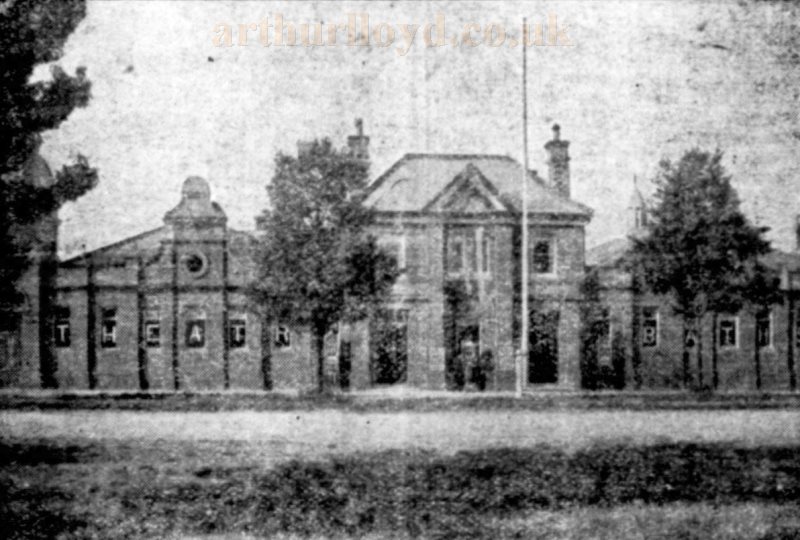
Above - The King's Theatre and Sea Water Baths, Skegness - From the Skegness Herald, 22nd of May 1908.
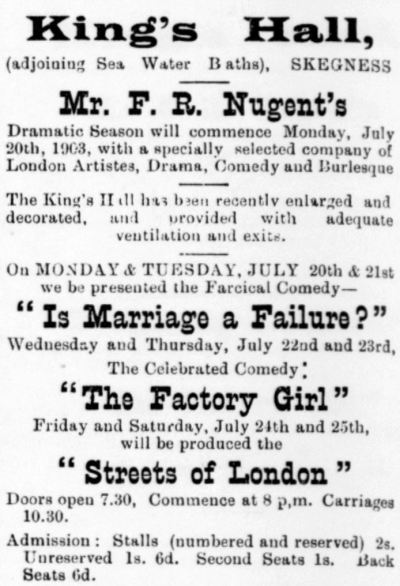 The King's Theatre was situated on Scarbrough Avenue in Skegness, adjoining the Sea Water Baths, and originally opened as the King's Hall, a Concert Venue, in 1902. It was enlarged and redecorated the following year and reopened for the season on the 20th of July, advertising that a Specially selected company of London Artistes would be putting on Drama, Comedy and Burlesque, see advertisement shown right.
Right - An advertisement for the King's Hall, Skegness in 1903 - From the Skegness Herald, 17th of July 1903.
In 1908 H. Rowley redecorated and reopened the building as the King's Theatre with seating for 600 people and a stage 30 feet wide by 23 feet deep, an image showing the Theatre and Baths can be seen above.
The following year the Theatre was repurposed as an early Cinema, reopening as the Skegness Picture Hall with George Francis as Manager and J. Loveday as the Proprietor. The Bioscope reported on the new Picture Hall in their 8th of July 1909 edition saying: -'The King's Hall, Skegness, opened last Thursday, and was crowded. The local Press has a good word for the show, from which we, extract the following :- "There was a good selection of pictures, and if the selections to follow are up to the standard, as it is stated, and no doubt will be, Lovedays should prove one of the most attractive shows among the many excellent entertainments provided for the amusement of the public in Skegness. A most excellent exhibition. The pictures are clear, lifelike, and almost devoid of flicker. The films, too, are obviously new, being devoid of the holes which make some living pictures so trying to see. We have seen similar exhibitions in London, at the Alhambra and elsewhere, no better than this, and a good many not nearly so good. Lovedays' Animated Pictures are really first class, and well worth a visit. The programs will be varied twice weekly." Mr. Francis, the manager, said on Monday last that he was quite satisfied with the results, and that they had received more patronage than they had anticipated.' - The Bioscope 8th of July 1909.
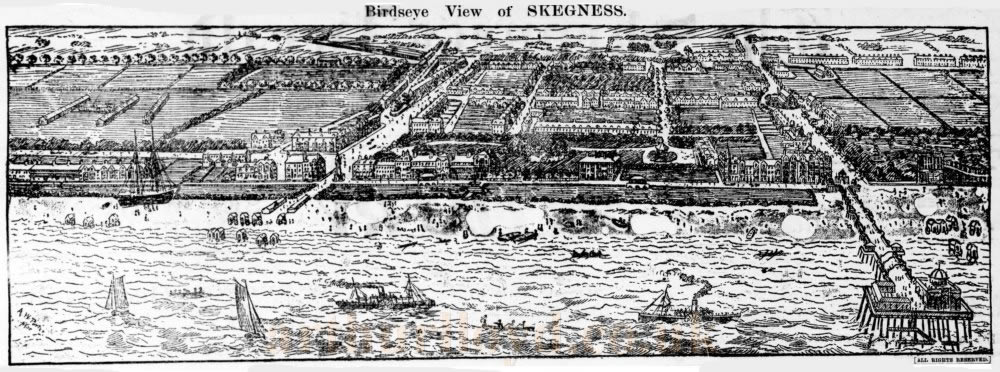
Above - A 'Birdseye' View of the Skegness sea front in 1908 - From the Skegness Herald, 22nd of May 1908.
By 1911 the Theatre was being used for cine variety variously known as the King's Hall or the King's Theatre right up until 1938 when no more notices for either name appeared in the press. I'm told that the building was later damaged during the war and was never reopened but instead was demolished and the site was then used as a car park.
If you have any more information or Images for this Theatre that you are willing to share please Contact me.
The Parade Cinema, Grand Parade, Skegness
Later - The Penny Parade Amusement Arcade / The Plaza Amusement Arcade
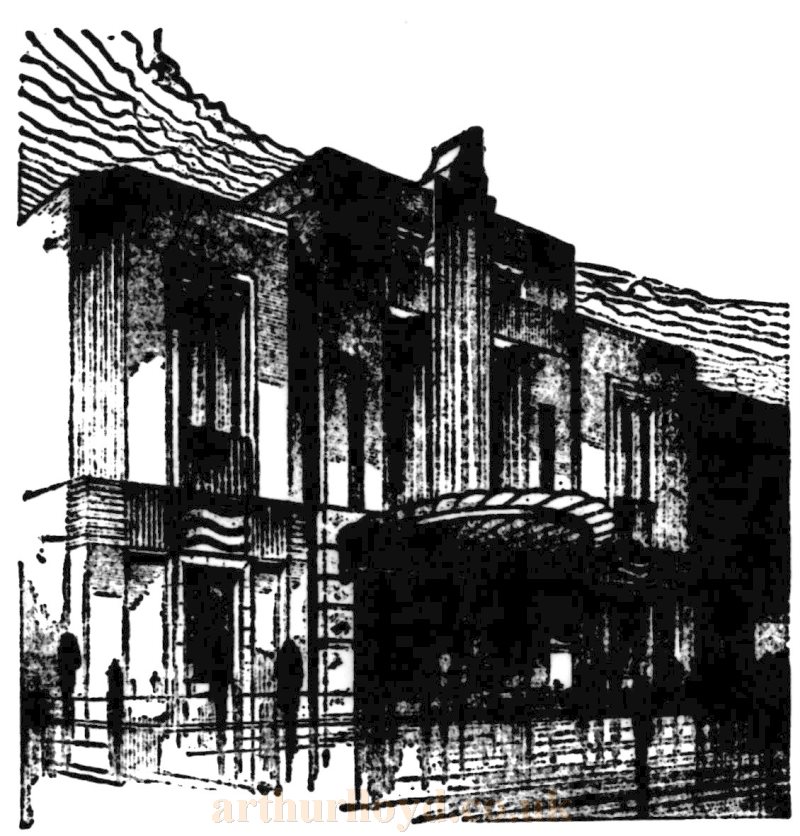
Above - The Original Entrance Facade of the Parade Cinema, Skegness when it first opened in 1933 - From the Skegness Standard, 13th of December 1933.
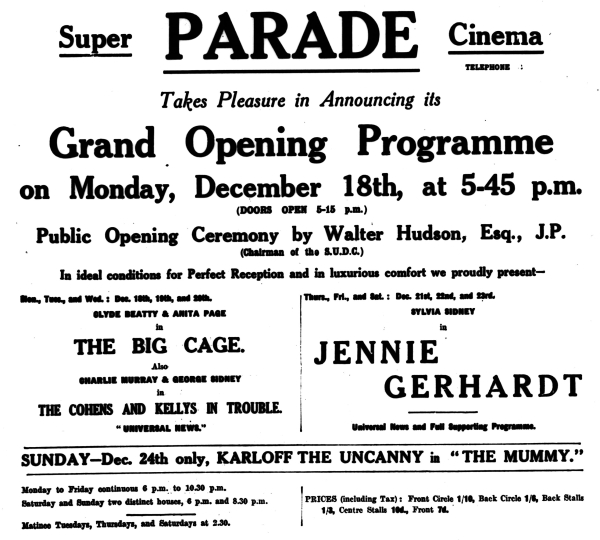 The Parade Cinema was constructed by J. H. Metcalf Brothers of Doncaster in 1933 over a period of 5 months and a cost of £30,000, opening on the 18th of December that year with the showing of the Films 'The Big Game' and 'The Cohens and Kellys in Trouble'. The Parade Cinema was situated just up the road and opposite the Embassy Theatre, on the Skegness Sea Front, which at that time was known as the Embassy Ballroom.
Right - An Advertisement for the 'Grand Opening' of the Parade Cinema, Skegness in 1933 - From the Skegness Standard, 13th of December 1933.
The Parade was billed as a Super Cinema, meaning it had facilities for both Film and Stage Productions, and was designed by the Nottingham Architect Alfred John Thraves, assisted by the local Architect W. F. Wills, L.R.I.B.A. who had helped with many local building projects. The Theatre's Auditorium was built on two levels, Stalls and one Circle, with a Proscenium opening of 42 feet, and a Screen of 24 feet by 16 feet, with a Western Electric Sound installation for 'Talkies'. The Cinema could accommodate 1,100 people in comfort.
The Skegness News reported on the new Cinema in their 20th of December 1933 edition saying, amongst other things, that:- 'The entrance hall, foyer and lounge have a delightfully fresh appearance, with rough carted walls in pleasing shades of green shading into pale green ceilings. The auditorium is treated to harmonise, with the carpets and seating with a background of ivory, the doors and panels at either side picked out with waving lines of blue and silver. The ceiling with its ivory background and beautifully coloured lighting domes in green, red and gold, gives a lofty airiness to the whole hall. The entire scheme gives an impression of tasteful restraint and an artistic blending of colours to bring about a feeling of perfect harmony, making a perfect setting with that sense of warmth and comfort which is so essential to an evening's entertainment... The whole of the decorations were carried out by J. Nixon Hough, Ltd., of Birkenhead.' - Skegness News, 20th of December 1933.
On its opening the Parade Cinema was Managed by Walter J. Fearn who had a long association with theatre and had appeared in a number of stage productions himself, and even in some films.
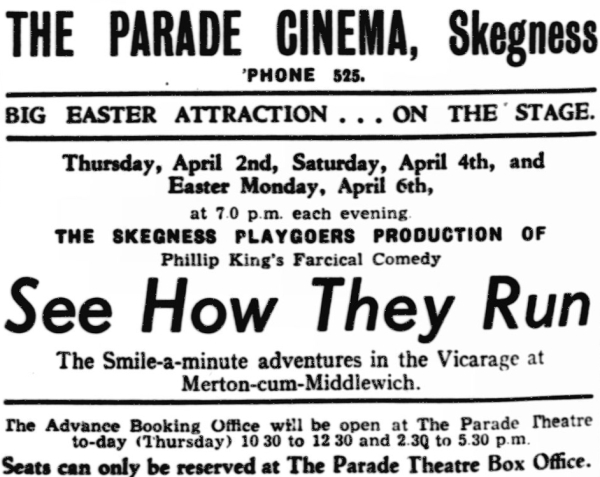 It opened in 1933 but was closed in September 1935 for the Winter, only reopening in the Spring of 1936, and this became a regular occurrence with the Cinema only opening for the summer months, although during the war from 1941 it remained open all year round.
Left - An Advertisement for the Play 'See How They Run' on stage at the Parade Cinema, Skegness in 1953 - From the Lincolnshire Standard and Boston Guardian, 4th of April 1953.
The Cinema's stage which had been rarely used since its opening was put to use more often in the 1950s and was even extended into the auditorium eventually for the construction of an ice rink so that it was able to produce Ice Shows during the Summer Seasons such as 'Carnival on Ice' which was staged there in July 1957. Variety shows and Concerts were also staged there during this period and proved to be very popular, with Films only being shown in the off season.
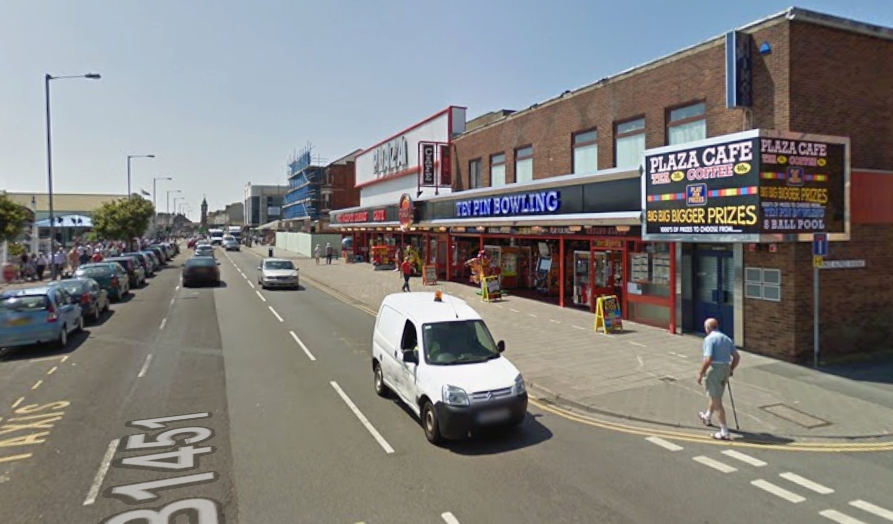
Above - A Google StreetView Image of Grand Parade on the Skegness Sea Front in July 2009 with the Plaza Amusement Arcade, formerly the Parade Cinema, on the right and the Embassy Centre, formerly the Embassy Theatre / Ballroom, far left - Click to Interact.
This all changed in the 1960s however, when the Cinema went back to showing Films in the Summer, and it was closed completely in September 1973, with the final Films shown being 'Mary Poppins' and 'Live and Let Die', with Children's Matinees shown in the mornings; Plans were afoot by the Skegness Pier Company to convert the Cinema into a so called 'Super Show Bar' with a strict Dress Code, dining and dancing, and cabaret style performances around waitress served tables.
 The Show Bar idea sadly never came to fruition though and the Cinema was eventually converted into an Amusement Arcade instead, which opened in March 1976 as the Penny Parade Amusement Arcade, this operated from 10 in the morning till 11.45 at night on weekdays and 12pm to 11pm on Sundays.
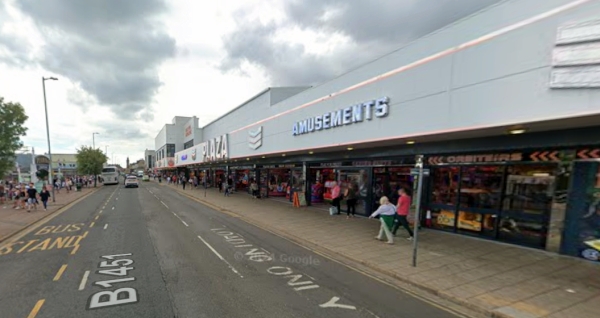
Right - A Google StreetView showing the Plaza Amusement Arcade Skegness, formerly the Parade Cinema, in August 2022 - Click to Interact.
The building was later renamed the Plaza Amusement Arcade which is still in operation today although the building itself is unrecognisable from its original incarnation as the Parade Super Cinema of 1933.
If you have any more information or Images for this Theatre that you are willing to share please Contact me.
About Fred Clements
SKEGNESS CONCERT PARTY PIONEER
SUDDEN DEATH OF MR. FRED CLEMENTS
From the Louth Standard, 29th of November 1941
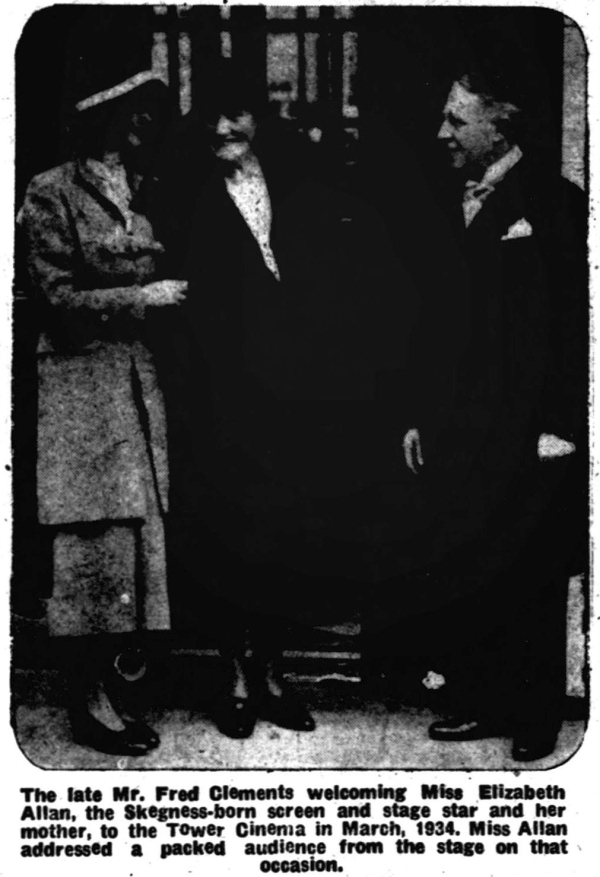 His many Lincolnshire friends received a shock when, on Friday, news reached Skegness that Mr. Frederick George Clements had passed away at 8.45 that morning. He was 66 years of age. His death occurred at Hereford. In which town Mr. and Mrs. Clements - together with other well-known Skegnessians - had made their home since leaving Skegness after the outbreak of war. Mr. Clements had not enjoyed his usual health for some time. In January of this year he had a slight seizure, following which he suffered from periodical heart attacks.
Right - The late Mr. Fred Clements welcoming Miss Elizabeth Allan, the Skegness born screen and stage star and her mother, to the Tower Cinema in March, 1930. Miss Allan addressed a packed audience from the stage on that occasion - From the Louth Standard, 29th of November 1941.
OVER 40 YEARS AT SKEGNESS
Up to his retirement a few years ago the name of "Clements" had been linked with entertainment activities in Skegness for over 40 years; and it is very questionable whether any other individual was better known, both to the local community and the hundreds of thousands of visitors and excursionists who patronised the resort, than was Mr. Clements throughout that long period.
Mr. Clements' father was an official of the old Great Northern Railway Company (now the L.N.E.R.) at King's Cross, and Mr. Fred Clements, who was born in London, commenced his career as a clerk on the railway. His ambition was however, far removed from office routine and visits to Skegness suggested to him the potentialities of achieving his ambition at a place which was than a mere village. Two concert combinations were already in existence, those of Will Marsh's Entertainers and the Davidson-Cowley Trio.
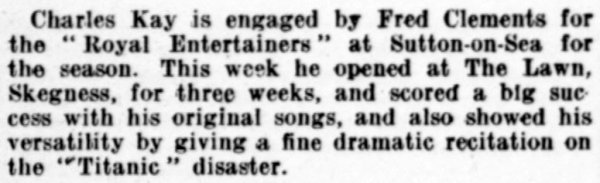 Neither of these actually came within the seaside pierrot category and Mr. Clements was the pioneer of this form of entertainment at the resort.
Left - An Advertisement for Charles Kay at Fred Clements' Lawn, Skegness in which he sang songs and did a recitation on the Titanic disaster - From The ERA, 1st of June 1912.
His party appeared at a "pitch" on the sands for day-time shows and in the evening their location was "The Lawn" on the east side of Hildred's Hotel. At that period the venue was part of the lawn belonging to the hotel, bordered by trees inside a boarded fence. Illumination was mainly supplied by Chinese lanterns and fairy-lamps.
At first the venue was open to the weather but in due course a canvas roof was erected. Subsequently Mr. Clements built the fine Arcadia Theatre on Drummond Road, and the Lawn Theatre was erected on the site of his former pitch.
For many years Clements' Royal Entertainers, as they were then styled, made two appearances daily at the alfresco venue, Happy Valley (where the Sun Castle now stands), and in the evening at Arcadia. During this period Mr. Clements extended his activities to the sister resorts of Sutton-on-Sea and Mablethorpe, where he ran successful concert parties, and in the course of time he erected a cinema at Mablethorpe.
"CLEMENTS" THE MAGNET
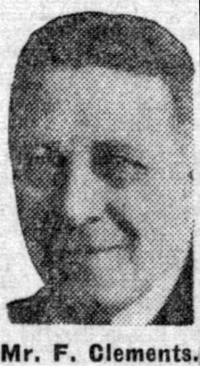 At Skegness "Clements" had been gaining in prestige and popularity with every season that passed. Mr. Clements had a wonderful personality for the job, combined with business acumen, and these, allied to a first-class show, brought him outstanding success. Indeed, so popular was the man and his party that it is no exaggeration to state that Skegness boarding-house keepers and tradespeople owed no little of their prosperity to Mr. Clements. Not one but hundreds of heads of families openly admitted that but for the partiality of then womenfolk and children for "Clements" they would not have continued to visit Skegness year after year.
Right - Fred Clements - From the Nottingham Evening Post, 21st of November 1941.
In the course of time, Mr. Clements extended his activities to pantomime and at one period he was the second largest pantomime producer in Great Britain. In this connection he received valuable co-operation from his brother, Mr. Jack Clements, and also from Mr. Dudley Powell, his musical director, who died very suddenly at Leicester early in 1929.
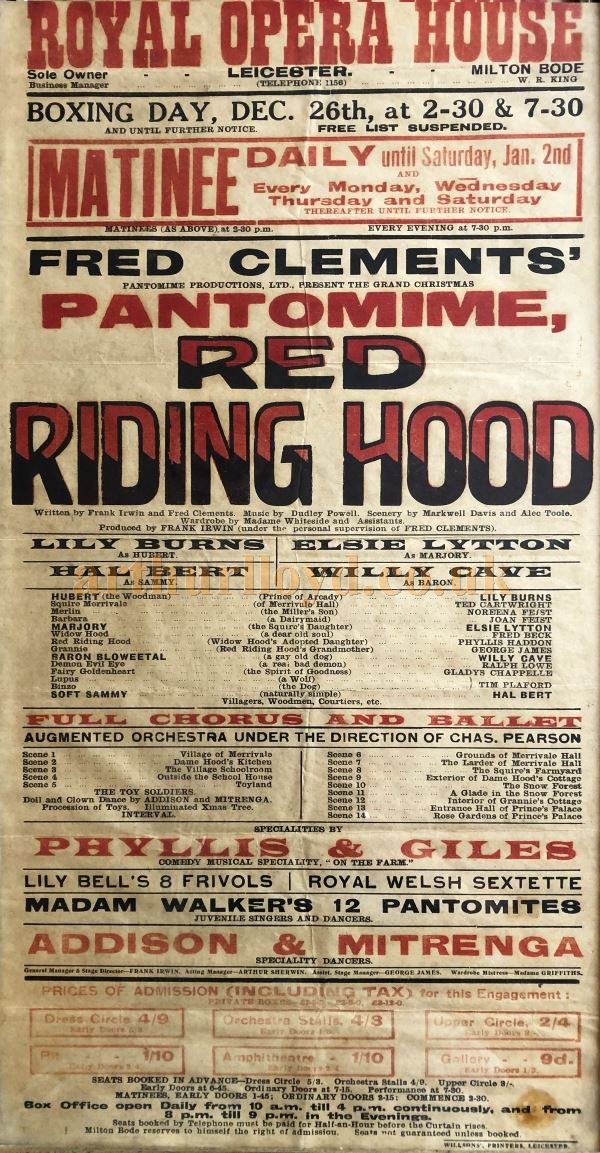 Both Mr. Fred Clements and Mr. Jack Clements were responsible for the "books" of pantomimes which were successfully produced at Plymouth, Sheffield, Leicester and Nottingham, among other Places. The whole of the enormous preparatory work in connection with these annual productions was carried through by Mr. Clements from his Skegness office; and even the costumes were designed and made, and the scenery painted at the resort, under his personal supervision. During these "intensive" periods, Mr. Clements worked as hard as any man in the British Isles, but he never gave any indication of the tremendous strain which he must have undergone.
Left - A poster for Fred Clements' Pantomime 'Red Riding Hood' at the Royal Opera House, Leicester in January 1926 - Courtesy Paul Kemp.
Just as he had visualised the Potentialities of Skegness in respect of flesh and blood entertainment, so Mr. Clements foresaw what "the pictures" would come to mean in the lives of the people. He erected the imposing Tower Cinema, in which he presented the very best of screen fare, supplemented by a fine orchestra; and when the "talkies" arrived he immediately installed the most modern apparatus.
WIFE AND DAUGHTER ARTISTES
Mr. Clements married Miss Mabel Hind, member of a well-known Nottingham family. A talented soubrette, Miss Hind, under that name, was a member of the old "Lawn" party and continued to be associated with her husband's concert party and pantomime productions until he went out of business.
She supplemented her seasonal successes at Arcadia in principal roles in pantomime, including those produced at Sheffield, Leicester and Plymouth.
The only daughter of the couple was also on the stage for a time under the name of "June Merrill." She also made several appearances in Mr. Clements' pantomimes and was principal girl in "Cinderella" at Plymouth and the Opera House, Leicester.
Her marriage, in June, 1932, to Mr. Arthur Smith, member of a well-known Boston family and a Popular young Skegness tradesman, was an outstanding social event. As indicative of the interest aroused it may be recalled that although the ceremony was not timed to commence until noon, sightseers had taken their places in St. Matthew's Church at 10 a.m., and an hour later the whole of the accommodation except that reserved for the guests was taken up!
Mr. Clements was a Freemason, being a member of both the Lumley Lodge and the St. Clement Lodge. He was also a member of the Avenue Club, where he derived keen enjoyment from his favourite indoor pastime, snooker. His favourite outdoor recreation was golf and he was a member of the North Shore Club. Football also claimed his interest, particularly the doings of Grimsby Town, whose home matches he frequently patronised in pre-war seasons.
THE FUNERAL
Members of the Masonic craft lined the entrance to St. Matthew's Church on the occasion of the funeral service on Monday afternoon, and the brethren subsequently dropped sprigs of acacia on the coffin after it had been lowered into the brick-lined grave in St. Clement's Churchyard. Several other old friends also paid a last tribute of respect in the church or at the graveside. The simple service was conducted by the Rector (Rev. W. F. Willson. B.A.) and included the 23rd Psalm and a Scriptural portion from the 15th chapter of St. Paul's Epistle to the Corinthians.
The principal mourners included: Mrs. Clements (widow): Mr. and Mrs. Arthur Smith (son-in-law and daughter): Mr. "Bob" Clements (brother), Peterborough: Mr. and Mrs. W. B. Lambe (friends): Miss Lily Matz (formerly confidential secretary to Mr. Clements for many years): Mr. F. Smith. senr., Boston: Mr. Herbert Smith, Boston. Illness and travelling difficulties prevented the attendance of other of Mr. Clement's brothers and relations.
Also present among the mourners were two former well-known members of Mr. Clements' Entertainers. Mr. Jimmy Loft (Skegness) and Mr. Ted Cartwright (Burgh), and Mr. Tom Liggins, who was stage manager at Arcadia for a long period during Clements regime.
The above article on the death of Fred Clements was first published in the Louth Standard, 29th of November 1941.