
Theatres in Tamworth, Warwickshire
The Theatre, Tamworth - The Palace Theatre - The Grand Theatre - The Assembly Rooms
The Theatre, Church Street, Tamworth
Later - The Malthouse / The Tamworth Baptist Tabernacle / The Arts Centre
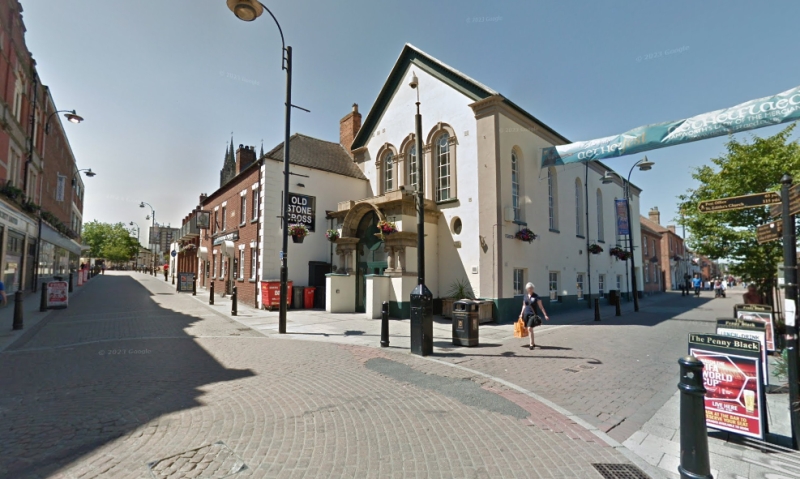
Above - A Google StreetView Image of the former Tamworth Theatre, Church Street in January 2018 - Click to Interact.

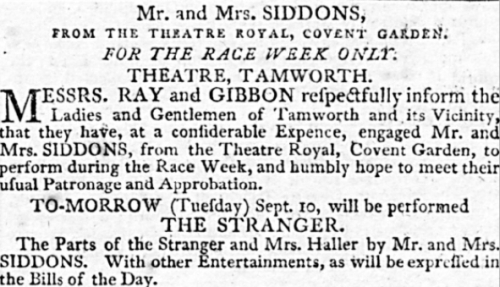 The Theatre, Tamworth was constructed around 1770 on the corner of Church Street and Gungate, today Colehill, and was in operation as a Theatre until the 1830s. Sarah Siddons famously performed there with her husband in September 1805, see cutting right.
Right - A Notice for Mr. and Mrs. Siddons from the Theatre Royal, Covent Garden, playing at the Theatre, Tamworth in 1805 - From Aris's Birmingham Gazette, 9th of September 1805.
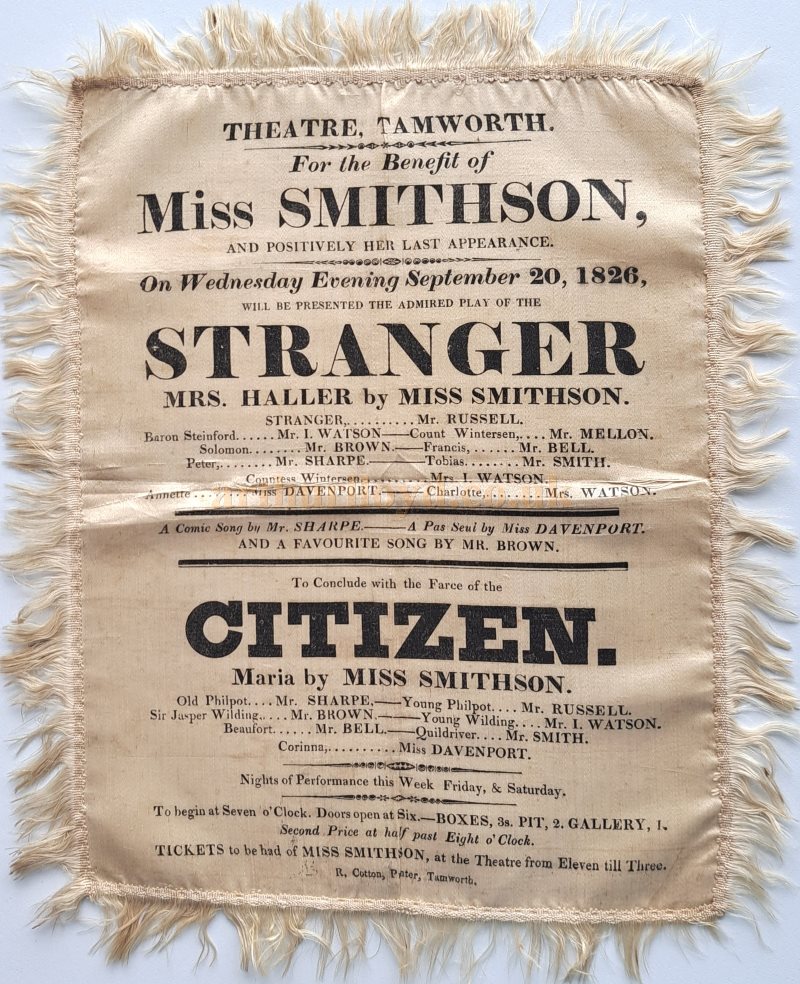 The building, which still stands today, hasn't changed much externally although the front of the Theatre was originally graced with a Corinthian Portico. By the 1830s however, the Theatre was said to have become a 'Shabby ruinous pile of brick' and was closed down, it was later restored for use as a Malthouse.
Left - A Silk Programme for 'Stranger' and 'Citizen' at the Theatre, Tamworth for the 'Benefit' of Miss Smithson on the 20th of September 1826 - Courtesy Simon Moss, stagememories.
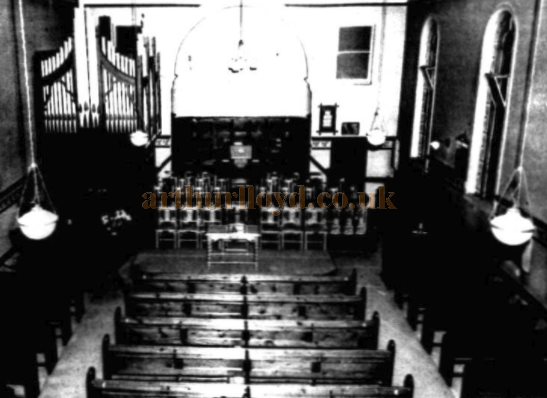 The building, which was later owned by Sir Robert Peel, was given to the Baptist Association in 1869 with a ground rent of £10 a year. At this time the building, known as the Malthouse, was reported as having four stories. The Baptists removed the two upper floors and transformed the room on the ground floor into a schoolroom.
Right - The Interior of the Tamworth Baptist Church in 1970, before it was converted for use as the Tamworth Arts Centre - From the Coleshill Chronicle, 22nd of September 1972.
The Tabernacle was formerly opened on the 19th of October 1870. In 1884 the Tabernacle purchased the Freehold of the building for £270.
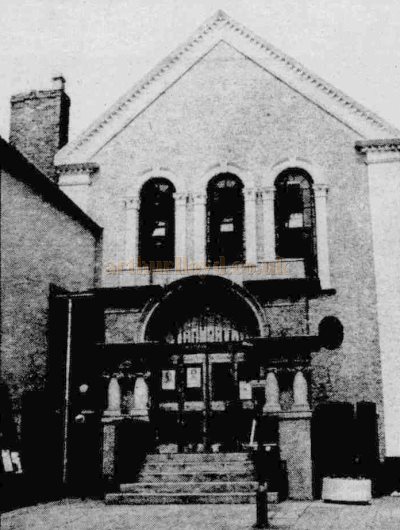 In 1908 the Corinthian Portico at the front of the building was replaced by the porch that is still there today and this gave a new entrance to the Church and the rooms below. At this time a Gallery was also erected in the Church with seating for 54 people, and a new Organ was installed, the alterations and Organ purchase costing around £700.
In November 1975 the building, which was by then owned by the Council, became home to the Tamworth Arts Centre and so returned to its roots as a theatrical performance space, it officially opened on Friday the 21st of November to an invited audience but was opened to the public the next day on Saturday the 22nd of November 1975.
Seating 100 people the Arts Centre put on all sorts of performances, both amateur and professional, including drama and musical concerts, and had its own coffee bar which was open during the day.
Left - The Tamworth Arts Centre in 1996 - From the Tamworth Herald, 16th of August 1996.
Running into the late 1990s the Arts Centre would later be transferred to the Tamworth Assembly Rooms and the former Theatre would be put to other uses. Today the former Tamworth Theatre is a Grade II Listed building but is not in theatrical use anymore.
If you have any more information or Images for this Theatre that you are willing to share please Contact me.
The Palace Theatre, George Street, Tamworth
Formerly - The Palace Electric Theatre / New Palace Theatre
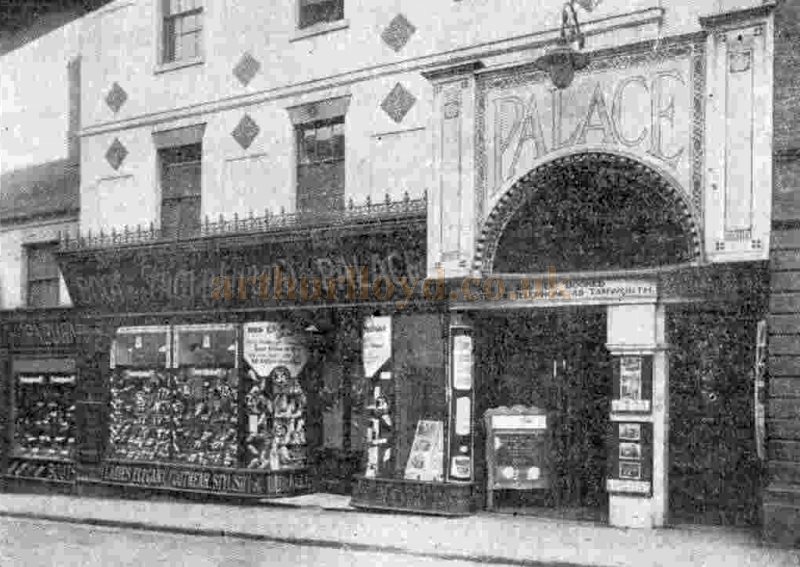
Above - The First Palace Theatre, Tamworth in 1925 - From the Tamworth Herald, 15th of August 1925.
 The Tamworth Palace Theatre was situated on George Street and first opened as the Palace Electric Theatre on the 3rd of November 1910. The Theatre was built primarily as a Cinema but did have a small stage for Music Hall and Variety acts. The Tamworth Herald reported on the new Theatre in their 29th of October 1910 edition and to summerise they remarked that the entrance hall was 'surmounted by a kiosk, studded with numerous electric lamps of various colours' and that it was decorated in 'cream and gold, with large mirrors either side'.
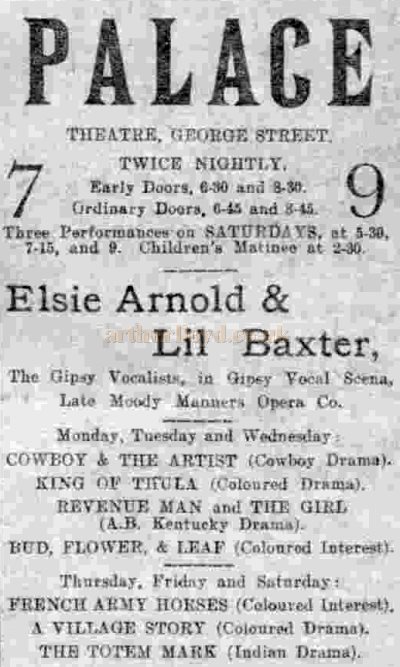
Right - An advertisement for Elsie Arnold & Lil Baxter from the Moody Manners Opera Company, on stage at the Palace Theatre, Tamworth in 1911 - From The Tamworth Herald, December 30th 1911.
The Tamworth Herald also reported that there was a cafe for 'light refreshments' at the 'extreme end' of the entrance hall, and from the entrance hall was a vestibule which led on to the auditorium which was decorated with green panels and designed by Hicklin and Son, Tamworth. The floor of this single level Theatre was gently raked and the seating in the stalls and pit were of the tip up variety whilst the 'cheap part' of the house was just fitted with chairs. The auditorium was 75 feet long by 40 foot wide with a projection box at the rear at about 15 feet above the stalls. The projector was supplied by the London firm Pathe Freres. The Tamworth Herald also mentioned that: 'A novel feature is the electric orchestra, with numerous attachments, whereby the pianist can supply very realistic effects'.
This Palace Electric Theatre had quite a short life and, although it was renovated in 1915, by 1934 its closure was imminent as a new much larger Palace Theatre was being constructed next door. This early Palace closed on the 25th of May 1935 and the new one, which you can read about below, opened on the 10th of June 1935.
The New Palace Theatre, George Street, Tamworth 1935
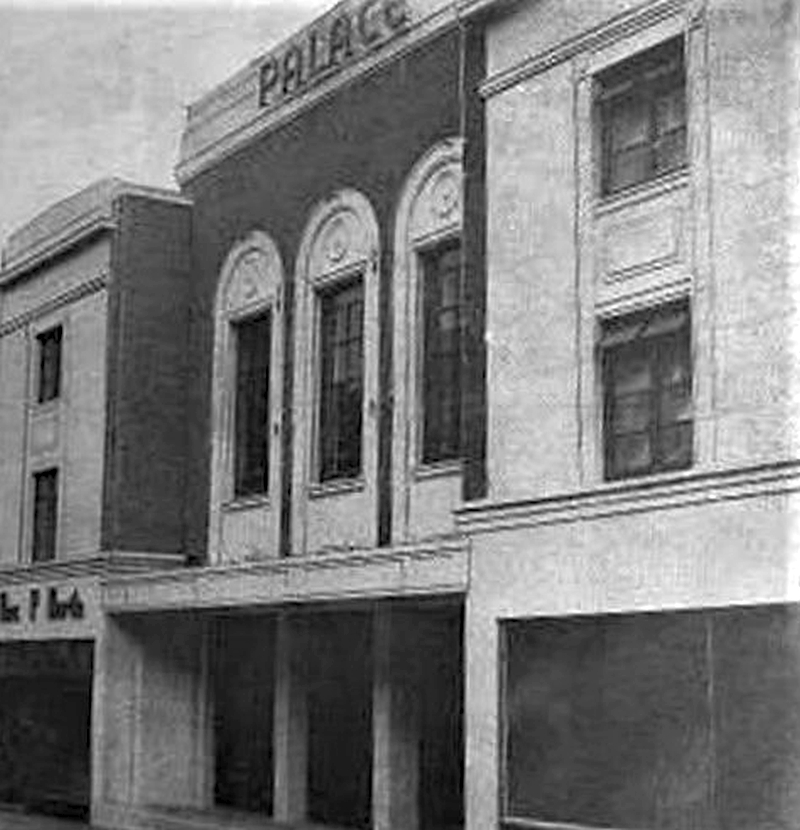
Above - The 1935 Palace Theatre, Tamworth - Reproduced here with a Creative Commons Licence from Mike Blakemore at the Cinema Treasures Website.
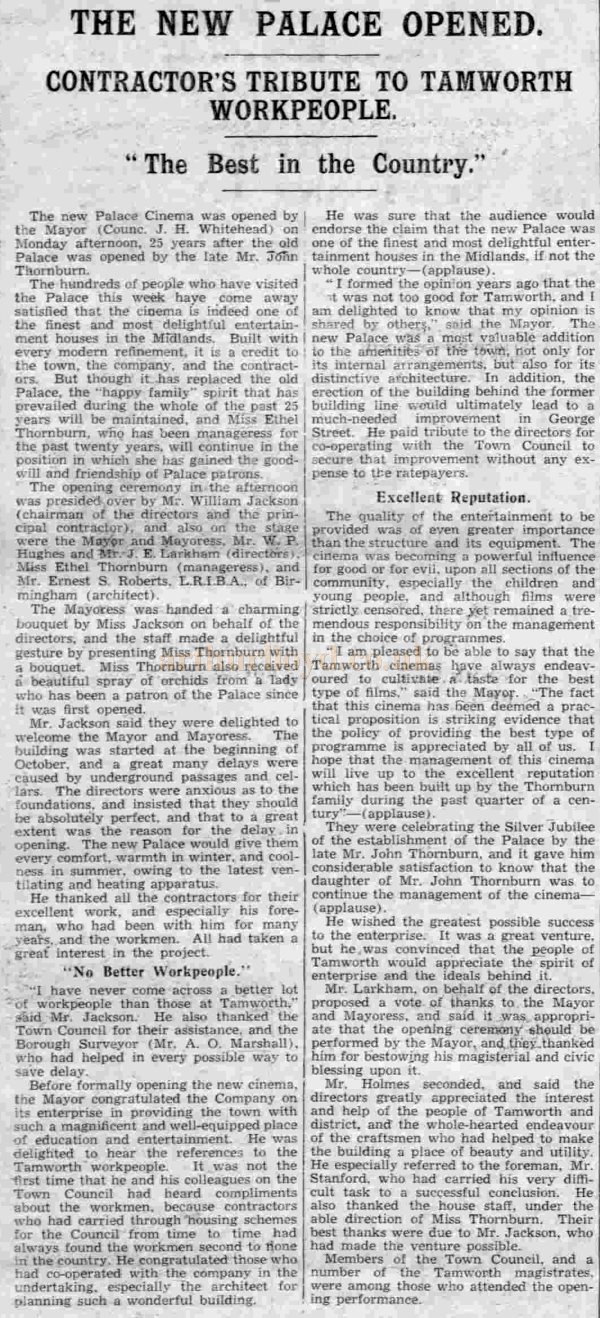 The New Palace Theatre, as it was called for a few years after opening, was built in 1934 and opened by its owners Tamworth Theatres Ltd., on the 25th of May 1935. A report on the opening can be seen right.
Right - A Report on the opening of the new Palace, Tamworth - From the Tamworth Herald, 15th of June 1935.
The Tamworth Herald reported on the new Theatre before it opened in their 11th of May 1935 edition saying:- 'Every modern improvement has been incorporated in the new Palace cinema, and it is claimed that it will be at least the equal of any of a similar size in the Midlands. Judging by what can now be seen of the building, with very little decoration and no furnishing, that is no idle claim. Everything is for the comfort and convenience of patrons. There is ample room for the 1,470 seats, 954 on the ground floor and 456 in the balcony; there is a waiting-room, lounge, and cafe, and heating and ventilation are of the most modern type, giving plenty of fresh air without cold draughts.
An imposing wide staircase leads from the entrance hall and pay box to a mezzanine lounge on a floor between the auditorium and the balcony, and this lounge leads on the one side to the balcony, and on the other to a spacious cafe-lounge, from which can be obtained a view of the entrance hall below.
The balcony is raked sufficiently to give an uninterrupted view of the screen from every seat, and this applies, too, to the ground floor. In accordance with the regulation enforced by the County architect, the front seat on the ground floor is placed no less than thirty feet from the screen, so that there will be a perfect view of the picture from every seat in the building.
In keeping with the rest of the building, the sound system will be brought absolutely up-to-date with the latest Western Electric "Wide Range" equipment, which gives perfect reproduction over the widest possible range of notes. This will be enhanced by the special treatment to the walls, which are acoustically treated.
An ingenious Combined system of heating and ventilation ensures the temperature of the interior being kept at a constant point, while the air is being completely changed every two minutes. No fewer than 46 radiators are thermostatically controlled at a fixed temperature, and through these, fresh air is pumped, so that it is warmed before circulating round the building, after which it is withdrawn by four exhaust fans. There will be no cold floors, for they are boarded over, and will be covered by heavy carpeting.
The stage will be lighted by four rows of differently-coloured lights, concealed, and by a system of dimmers it will be possible to obtain every possible colour and shade, which will merge into each other with an attractive effect. The "house" lighting, too, is concealed and operated by dimmers, so that there will be no sudden "black-outs." The attractive stage curtain and screen will be electrically controlled.
Every precaution, of course, is taken against fire, and there are numerous exits and emergency exits from both balcony and ground floor. The staff has received every consideration, and their quarters are roomy and comfortable, with plenty of exits. A special form of electrical vacuum cleaning, from a number of points in the building, adds the finishing touch to a cinema on which the town will be able to look with pride.'
The above text in quotes was first published in the Tamworth Herald, 11th May 1935.
The Palace Cinema, Lower Gungate, Tamworth 1976
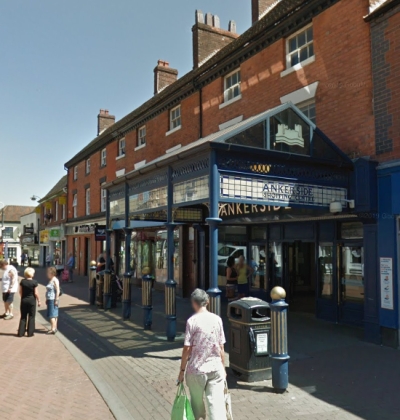 The Palace Theatre had opened on the 25th of May 1935 and had a long life as Tamworth's primary Cinema but after 40 years it was eventually closed, on the 1st of November 1975, and it, and the site of the earlier Palace Electric Theatre next door, was then used for the construction of the Ankerside Shopping Centre, shown right.
Right - A Google StreetView Image of the Ankerside Shopping Centre, Tamworth in June 2018, built on the site of the former Palace Theatre - Click to Interact.
A new Palace Cinema was then constructed on another site on Lower Gungate in Tamworth to replace it, the now much altered building is shown below left in an image from July 2022.
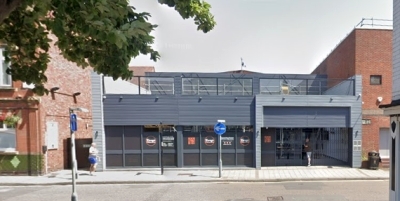 This third Palace Cinema was designed by Elsom, Pack and Roberts, and opened on the 21st of December 1976.
Left - A Google StreetView Image of the former Palace Cinema, Lower Gungate, in July 2022 - Click to Interact.
Closing on the 9th of May 1991 this third incarnation of the Palace Theatre / Cinema was then put to use as a Bar and a new 10 screen multiplex Cinema was then constructed on Bolebridge Street, Tamworth but without the Palace name, today this is known as the Odeon Luxe.
If you have any more information or Images for this Theatre that you are willing to share please Contact me.
The Grand Theatre, 34 George Street, Tamworth
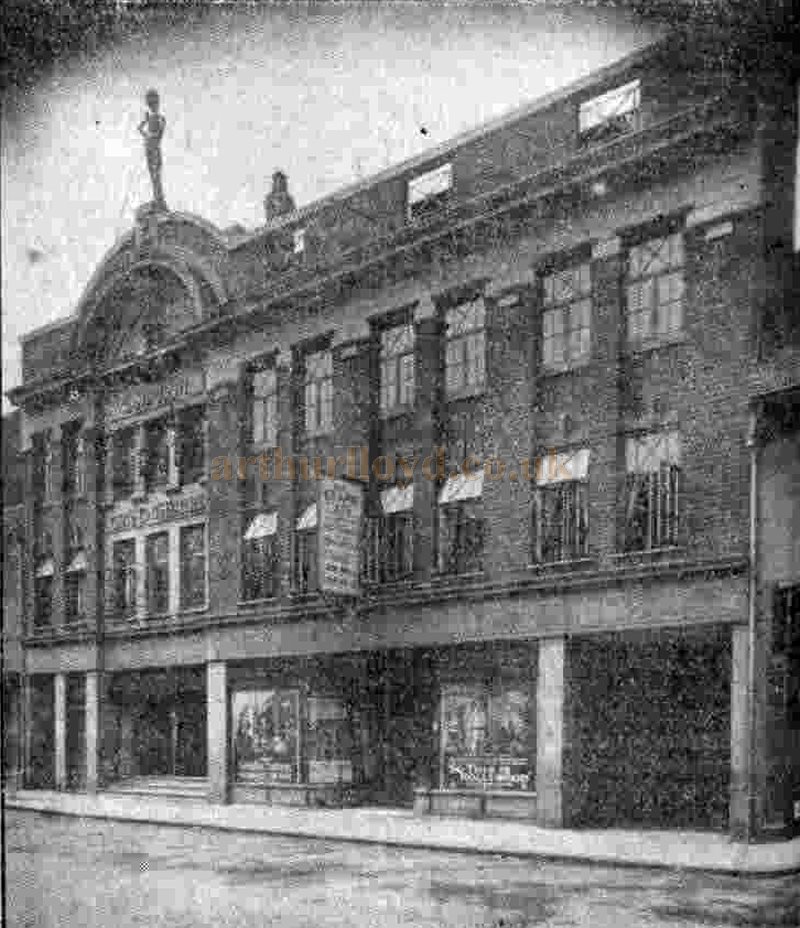
Above - The Tamworth Grand Theatre in 1925 - From The Tamworth Herald, 15th August 1925.
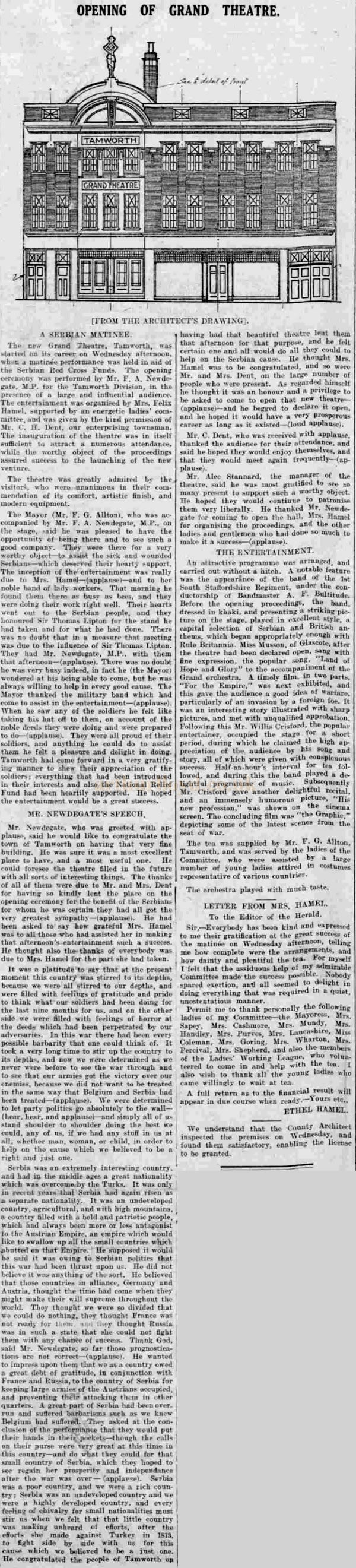 The Grand Theatre was situated on George Street, Tamworth and opened on the 19th of May 1915. The Theatre, which was built as a Cinema and Theatre with Stage facilities, was designed by the Birmingham architect H. G. Bradley for the owner C. H. Dent. The auditorium was built on two levels, Stalls and Balcony, and could seat around 700 people.
Right - A Report on the opening of the Tamworth grand Theatre - From the Tamworth Herald, 22nd of May 1915.
The Tamworth Herald reported on the new Grand Theatre shortly before it opened in their 15th of May 1915 edition saying:- 'The finishing touches are being put to the Tamworth Grand Theatre in readiness for the opening ceremony on Wednesday afternoon next. The building is a gratifying acquisition to the architecture of the town, and occupies a central situation in George street. It is a striking structure, built according to modern ideas and on the most approved methods. The theatre has been erected mainly through the enterprise of Mr. C. H. Dent of Tamworth, who is to be congratulated on his achievement.
The front elevation, in which is included a shop, consists of four storeys and basement and is constructed of pressed red bricks with terra cotta facings. A conspicuous feature is a fine terra cotta statue of Venus, which occupies a position on the top of the building over the main entrance. When the war is over, and the lighting regulations are less rigid, it is proposed that a lamp shall be displayed from the figure. We are informed that part of the roof is to be utilised as a roof garden.
Passing up a few steps, the visitor reaches a spacious vestibule, the floor of which is covered with duros tiles of neat design. Here a ticket office is situated, and access is gained up a staircase to the balcony of the theatre, or to the pit on the level, through swing doors. To the right of the chief entrance there is another entry by which the seats of the pit are reached.
In the front of the building there is a large assembly room, the walls of which are coloured with an uncommon tint of light Wedgewood blue. On the occasion of the matinee next Wednesday, this apartment is proposed to be used as a reception and tea room. The other apartments adjoining include the operating room, re-winding room, manager's and attendant's offices, and lavatories.
The theatre proper is a pretty and commodious place, and includes a balcony of large proportions, capable of seating nearly 200 persons, while the pit has a seating capacity for 500. It may he mentioned that all the seats will be tip-up chairs of a comfortable pattern, upholstered in red plush. The walls are artistically treated, being covered with fibrous plaster decoration, and finished in carmine, white, and pink. The panels have artistically executed borders in relief to correspond with the fancy work of the roof. The proscenium is a large and imposing one, being surmounted with the Tamworth arms. An uninterrupted view is obtainable from all parts of the house. The floor being laid on the slope, while the balcony chairs are fixed in tiers. The balcony, which is a fine example of builders' work, being constructed of re-inforced concrete, and supported without the aid of unsightly girders, is luxuriously carpeted.
The building is heated by the hot water system, and the ventilation is of the most efficient description. All the necessary safety appliances and fire extinguishing apparatus and conveniences are provided. The operating chamber is fitted with up-to-date machinery. There is an ample number of exits in case of emergency to enable the hall to be cleared in a few minutes. The exit doors are fitted with the latest panic type of bolts, and immediately these are released the double doors swing open.
A feature which will undoubtedly strike the public is the fine electric light installation, the current for which is supplied by a dynamo driven by a 27h.p. National gas engine, of the latest design, situated in the basement.
Altogether the building is an excellent and thorough job. The contractors were Messrs. W. Wilkinson, Ld. (Birmingham), the architect being Mr. H. G. Bradley, also of Birmingham. Messrs. Gibbs and Canning. Glascote, supplied the terra cotta, and the electric lighting has been carried out by Messrs Blackburn, Starling. Ld., Nottingham, and the seating and upholstering by Turners. Ld., Birmingham. The bricks and most of the labour has been obtained locally.
At present it is proposed to submit an all picture programme, changed twice-weekly, and some of the finest films obtainable have been booked. Mr. Alec Stannard, from one of the principal London cinemas, has been appointed as manager. A small, but thoroughly competent orchestra has been engaged.
For the opening performance on Wednesday night a sensational two-part drama. "For the Empire," dealing with the present war, is announced. There will be a complete change of programme on Thursday.'
The above text in quotes was first published in the Tamworth Herald, 15th of May 1915.
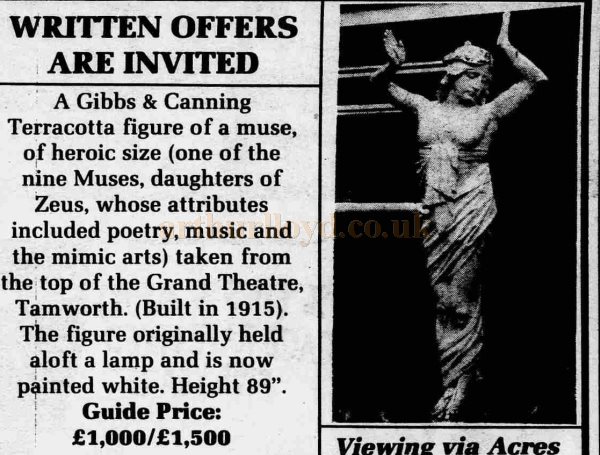 The Grand Theatre had originally opened on the 19th of May 1915 under the ownership of C. H. Dent but in the 1930s it was taken over by Tamworth Theatres Ltd. Used mostly as a Cinema throughout its life it finally closed on the 4th of October 1958 and was subsequently demolished. Offices and shops were then constructed on its site.
Right - An advertisement for the sale by auction of the Grand Theatre's Terracotta statue - From the Tamworth Herald, 16th of October 1992.
In 1992 the Terracotta statue from the roof of the former Grand Theatre came up for auction with a guide price of £1,000 to £1,500, an advertisement for the auction with a nice photo of the Statue from the Tamworth Herald can be seen right.
If you have any more information or Images for this Theatre that you are willing to share please Contact me.
The Assembly Rooms, Corporation Street, Tamworth
Also known as the Tamworth Arts Centre / Tamworth Arts & Events
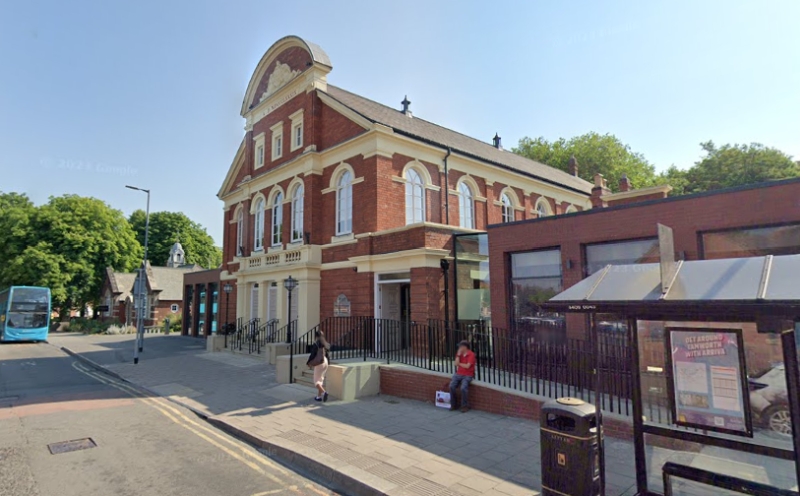
Above - A Google StreetView Image of the Tamworth Assembly Rooms in June 2023 - Click to Interact.
The Tamworth Assembly Rooms were designed by the architect Nicholas Joyce and first opened on October the 8th 1889. Built as a public space, all manner of attractions were soon being put on there including public meetings, balls, fund-raising events, musical concerts and dramatic performances. During the 1960s the venue was often used for popular music concerts and even The Beatles and The Rolling Stones played there during their heyday. Later in the 70s the Assembly Rooms started putting on Wrestling Matches and was often host to the Tamworth Arts Club. Today the Assembly Rooms is host to a great many musical and theatrical events and is also known as the Tamworth Arts Centre, whose first home was the former Tamworth Theatre in 1976.
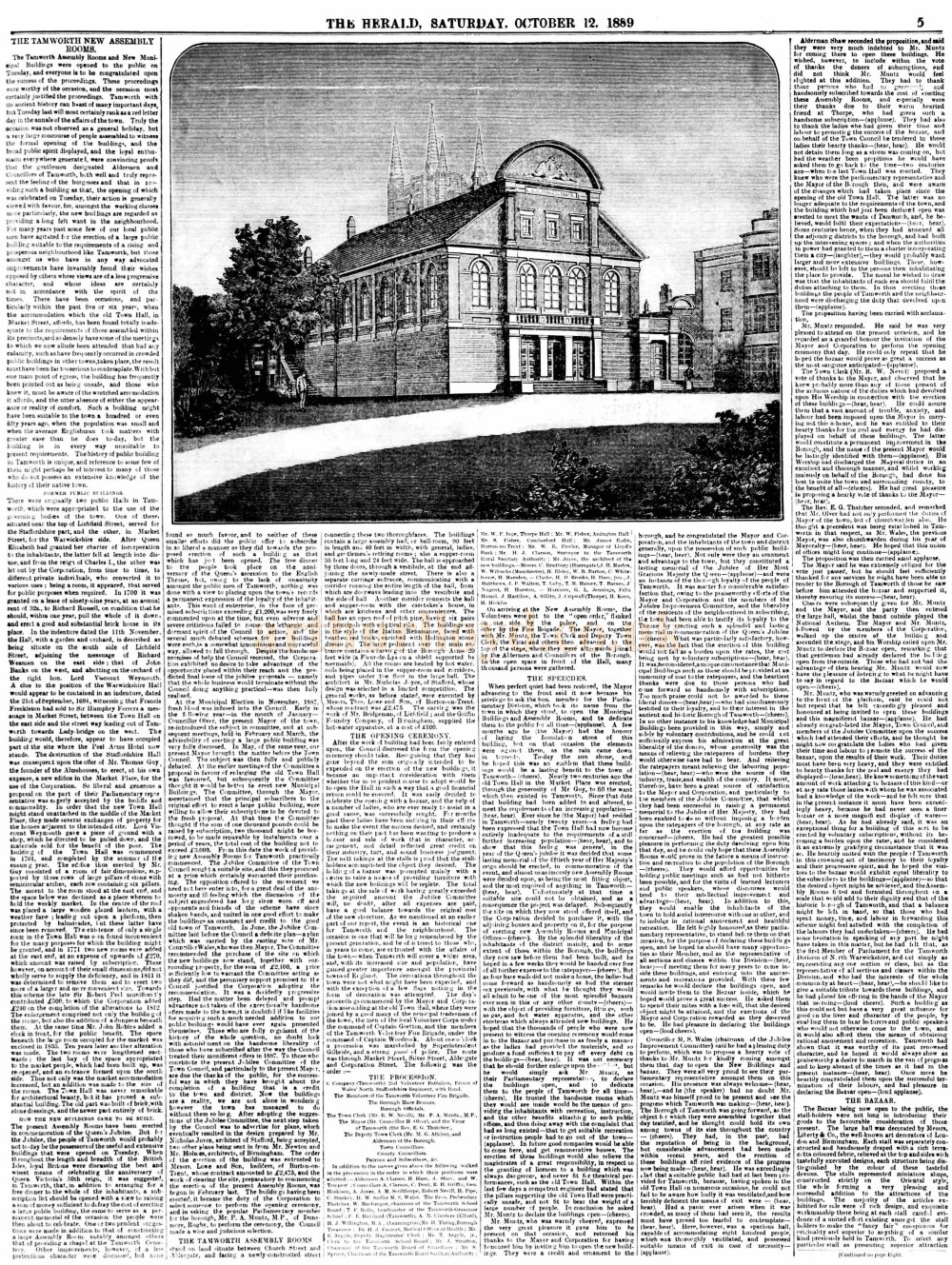
Above - An Article about the newly opened Tamworth Assembly Rooms - From the Tamworth Herald, 12th of October 1889.
At the time of writing in 2023 Tamworth Borough Council are said to be working towards a major redevelopment of the building, supported by the Heritage Lottery Fund.
You may like to visit the Assembly Rooms own Website here.
If you have any more information or Images for this Theatre that you are willing to share please Contact me.