CONCERT-HALLS AND ASSEMBLY-ROOMS
Serialised in The Building News and Engineering
Journal from 1895
CONCERT-HALLS
AND ASSEMBLY-ROOMS.
Chapter 22
Images begin again at Fig 1
The provincial music-hall demands as much attention
as the London theatre of varieties, and some fine examples are to be
found among the wretched places which are scattered broadcast over the
whole of the country towns of Great Britain. The ordinary provincial
music-hall is too dreadful to think about; as a rule it is extremely
dangerous from a fireman's point of view, it is vulgar in treatment,
ill ventilated, badly lighted, and generally a place to be avoided.
I have said that there are some fine examples to be found, and one
of the best is undoubtedly Messrs.
Darbyshire and Smith's building in Manchester,
the Palace
of Varieties. Figs. 1 and 2.


Here the architects were guided by the initial condition of safety - namely, isolation,
and the Palace stands in an open space. On the ground to the left, away
from the hall, are placed the dangerous elements of a hall - the lime-light tanks, electrical plant, carpenters' shop, and workshops. The general
arrangement of the plans is symmetrical, and the simplicity of the arrangement
of exits from each tier shows that the designers were well aware of
the advantage of having both sides of the house arranged alike. There
are no tricks in this plan; it is one that can be taken in by the audience
at a glance, and a building in which they would therefore feel safe.

The general scheme of the plan has been governed by the old Greek form
of the semicircle, which brings the seated audience nearer the stage,
and allows for the addition of a wide promenade behind the seats, a
provision almost essential in this class of building. On examining the
section, Fig. 3, it will be seen that a large foyer extends the entire
length of the back of the auditory. This is slightly raised above the
heads of the promenaders, so that occupants of the foyer have a full
view of the performance.

Fig. 4 is a perspective view of the auditorium. The ceiling is a cove
in form, surmounted by an elliptical dome 60ft. above the area floor.
The auditorium is 90ft. wide and 66ft. deep. The stage is large enough
for the production of the most luxurious spectacle or ballet, being
66ft. by 40ft., with a proscenium opening 36ft. wide by 32ft. 10in.
in height. The highest point the audience can reach from the street
is 33ft. 6in. The cost of the building was a little over £40,000,
and the seating accommodation is for 3,078 persons. The construction
is fire-resisting, the tiers being made of concrete upon steel cantilevers,
so that no columns come between the seated audience and the stage.

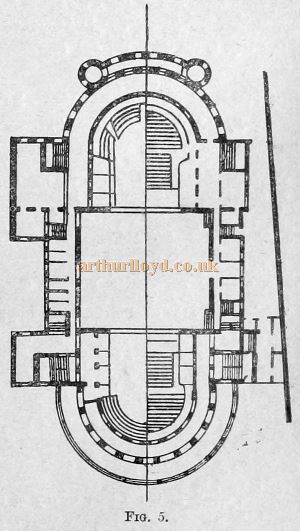
Figs. 5, 6, and 7 are of the Bristol
Empire, a provincial music-hall of a smaller type than the Manchester
Palace, but one none the less important, as representing a class
rapidly increasing provincial
towns to supplant the dangerous structures which have done duty
in the past. Messrs. Wylson
and Long are the architects of his hall, which was originally intended
to include circus, as shown upon the plan, Fig. 5. where the ring is
formed by removing a portion of the stage. This intention was, however,
subsequently abandoned.


There is a large pit or area floor, as being the part most frequented
in places of this kind. The area is 81ft. 3in. deep by 52ft. wide; from
this part there are four exits. Immediately over the pit is the balcony,
consisting of six rows of seats, with promenade and raised buffet in
the rear; above this is the gallery. The
Empire is said to be one of the best music-halls of its class in the provinces,
and the architects have
designed it in an appropriate Free Oriental style, which readily adapts
itself to the internal and external decoration of the building, the
colour scheme of the auditorium being in warm tints, in which red and
blue predominate The size of the stage is 32ft. wide, with a depth of
32ft. The holding capacity of the auditorium is 1,376 persons, seated
as follows : Pit 338, stalls 218, balcony 246, gallery 542, private
boxes 32.
These two examples, I think, will suffice to show the character of
building which is now being erected in the provinces as a music-hall.
They differ in many respects, the one having an auditorium nearly square
on plan, while the other is an oblong. The one may be truly included
in the type of theatres of variety, while
the other is essentially a music-hall of the better class.
My next illustrations, Figs. 8 and 9, are of the Palace
Theatre, London. It might be argued that, being built as an opera-house,
this is not a music-hall. Yet I include this house in my series, to
see what useful lessons we can gather from the fact that a house built
for one purpose has been used for another.

The Palace Theatre stands almost
alone as a place of entertainment where a music-hall performance is
given. In spite of descending from an opera-house to a music-hall through
changes of fortune, it has maintained a character which the beauty of
the building demands. There is nothing vulgar in the surroundings of
the Palace. As a music-hall the building has its defects.
There is not sufficient room to move about, there is unfortunately
no promenade, thanks to the authorities, and the communication between
the tiers is not what one would demand in designing a music-hall on
the same scale. As an opera-house, its one great and fatal defect was
the smallness of the stage, which did not allow the constant change
of scenery demanded in opera-houses. The lack of room meant increased
labour in mounting and unmounting the scenery, and the expenses spelt
ruin to the undertaking. So now we have the palace as an assembly hall
for variety entertainment. I do not agree with some that the Palace
was too good a building to be turned into a music-hall, but in many
respects it is inappropriate because designed for another purpose. Its
excellence in design is not lost, but its lack of accommodation for
a moving audience is manifest, and this is perhaps greatly due to the
licensing authorities. My argument that a beautifully designed building
will influence the class of the audience is confirmed by the example
of the Palace. Here alone a great
lesson can be learned: that it is worth while for both the architect
and the clients to put forth every effort when designing these buildings;
it is time and money well invested.

The licensing laws appertaining to music-halls are, for the most part,
a survival of very old legislation, which is not at all applicable to
the present state of society. Architects practising in this class of
building are at the necessity of studying the laws of licensing and
the ways of the various authorities who issue these licenses.
Music-halls have to be designed in accordance with the requirements
of the licensing bodies, and it is because of the tendency these have
towards faddism that proprietors prefer the licensing being in the hands
of permanent justices whose views on these matters are not likely to
change from year to year.
It is extremely difficult for an architect to design a building to please an authority whose views change with
each triennial election, and even oftener. One year he may find it possible
to build the music-hall with extensive promenades and refreshment bar,
&c., on every tier, while the very next year, if he were to make
the same application, he would be promptly refused. There is great variation
in the rules which govern these demands, as in one place a promenade
will be permitted, while in another it is forbidden.
The obtaining of a music license for a music-hall does not carry with it the Excise license. The proprietor has not only
to obtain the music license, but from another body he has to obtain
the drink license. In the theatre this is different, as the license
granted for the holding of stage plays covers also the right of a license
for the sale of intoxicating liquor for the refreshment of the audience
who come to witness the play during the time the theatre is open. Some
people think that because a theatre has an Excise license liquor can
be sold there at all times in the same manner as in a public-house;
this is not the case , intoxicating liquor can be sold only to people
attending the performances.
In music-halls the license is continuous, as we have seen a public-house
often forming a part of the hall, and perhaps being the original cause
of the erection of the hall. Another point which may interest architects
in reference to licensing matters, which is suggested by the above remarks,
is that when an addition is made to a licensed building it is not necessary
to apply for a new license, but merely to place the plans before the
magistrate, and ask him for an extension of the existing license, a
very much easier thing to obtain than a new one. When the license is
granted it embraces the whole of the building, and when it is enlarged
the license grows with it, and if the plans are satisfactory the justices
cannot refuse to grant the extension.
A curious case came before my notice a short time back, where an extension
was being made to a theatre, and such extension was for workshop and
office for the theatre. In the lease for the land upon which the block
was to be erected was a clause inserted by the ground landlords to the
effect that the land was not to be in any way used for the erection
of a public-house. As the theatre held perforce an Excise license, the
license had to embrace the addition as a natural consequence, and it
was some time before the ground landlords could be made to see that
this extension, although holding an Excise license, could not be used
as a public-house, being part of a theatre. Of course, the lessee was
powerless, as whether he liked it or not the license had to grow with
his building.
Another and very important thing with regard to licensing matters which
the architect should not forget,
that where he is making alterations to a licensed premises, however
small and unimportant the alterations matters not, he must deposit plans
and obtain the consent of all authorities concerned, and he will find
the authorities having a voice in the consent as numerous. Each of them
will want a set of the drawings, and some of them will require duplicate
sets, returning one set marked as approved. In a case which lately came
under my notice, no less than six authorities had to be satisfied before
a small addition could be made to a licensed building. The worst of
it is that the various authorities do not always quite agree in their
requirements. Such is the muddled state of our licensing laws.
CONCERT-HALLS AND ASSEMBLY-ROOMS
By ERNEST A. E. WOODROW, A.R.I.B.A.
Chapter 23
Images begin again at Fig 1
 The
concert-hall and assembly-room, which is commonly called the music-hall,
is to be found all over the world; but it will be found that each country
has its own peculiar class of music-hall. The music-halls of the Continent
are, as we understand them, distinct from theatres, but follow in most
instances the form of the auditorium. In some cases theatres have been
converted into music-halls, notably Ronacher's Variety Theatre, Vienna,
which was formed from the old City Theatre after it was partly burnt
down. The famous Continental theatre architects are Messrs. Feltner
and Helmer, and it was from their designs that the old theatre was converted
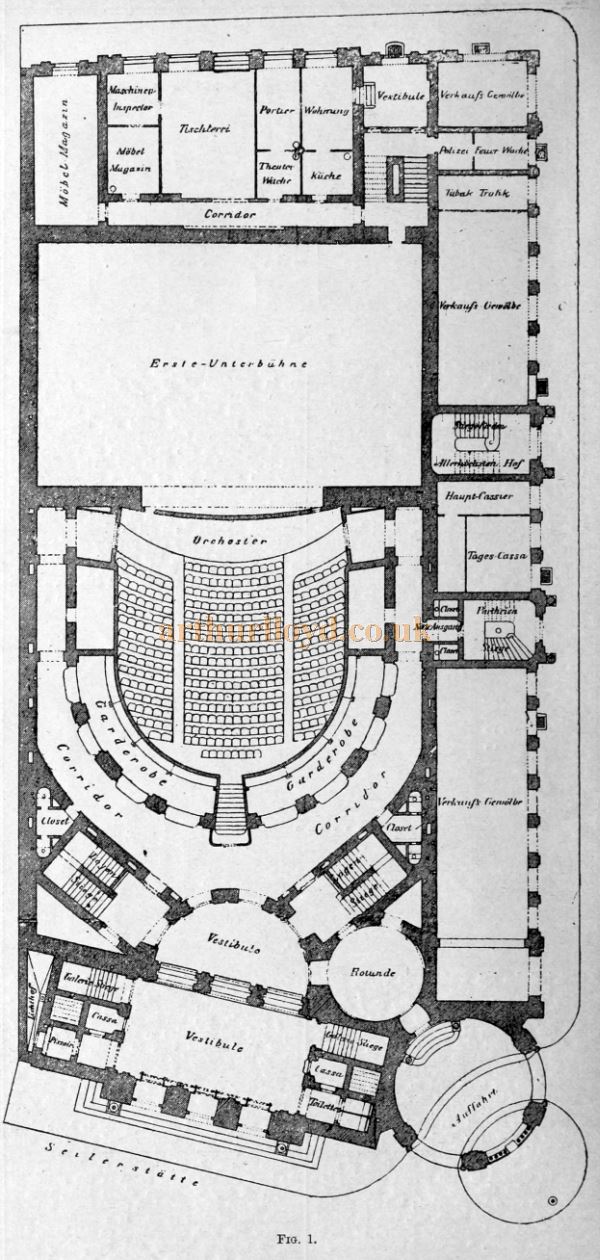
into Ronacher's Palace of Varieties. Figs. 1 and 2 represent the City
Theatre before it was altered. The stage was cut off from the theatre,
only a small portion being left for the music-hall, and the remainder
was converted into an assembly-room, with entrances from the side. To
make up the required depth for performances, the stage was advanced
beyond the proscenium opening to a considerable extent, so that plenty
of room is allowed for the purposes of a variety concert. The proscenium
opening is surmounted by a canopy or sounding-board, in the same manner
as our Alhambra Theatre.
The
concert-hall and assembly-room, which is commonly called the music-hall,
is to be found all over the world; but it will be found that each country
has its own peculiar class of music-hall. The music-halls of the Continent
are, as we understand them, distinct from theatres, but follow in most
instances the form of the auditorium. In some cases theatres have been
converted into music-halls, notably Ronacher's Variety Theatre, Vienna,
which was formed from the old City Theatre after it was partly burnt
down. The famous Continental theatre architects are Messrs. Feltner
and Helmer, and it was from their designs that the old theatre was converted
into Ronacher's Palace of Varieties. Figs. 1 and 2 represent the City
Theatre before it was altered. The stage was cut off from the theatre,
only a small portion being left for the music-hall, and the remainder
was converted into an assembly-room, with entrances from the side. To
make up the required depth for performances, the stage was advanced
beyond the proscenium opening to a considerable extent, so that plenty
of room is allowed for the purposes of a variety concert. The proscenium
opening is surmounted by a canopy or sounding-board, in the same manner
as our Alhambra Theatre.
The same famous Vienna firm of architects have carried out the Unter
den Linden Theatre of Varieties in Berlin for the same proprietor, Mr.
Ronacher. Figs. 3 and 4 are plans of the building, and Fig. 5 a view
of the staircase. Fig. 6 is part of the elevation of the same building.
(The last two illustrations have been taken from Sachs and Woodrow's
work on " Modern Opera Houses and Theatres.")
The principal feature in the plan is the auditorium with its spacious
promenade, which is on the highest tier, and affords an admirable view
of the stage. This convenient feature is unusual to Berlin variety theatres,
and has been borrowed from London and Vienna. The first tier is composed
of half-open boxes, behind which are supper-rooms, while the area is
taken up by seats and a minor promenade, from which latter, however,
no view of the stage is obtainable. A grand staircase, of good proportions,
leads to the tiers and promenade; but, besides these, there are staircases
of ample dimensions for the use of the occupants of the tiers, in connection
with which I would remark that it is not likely that they would be ever
used in case of panic, since the spectators are certain to hasten to
the grand staircase by which they came up. In plan it will be noticed
how distinctly separate the auditorium is kept from the front of the
block; but in the upper part of this front the Grand Foyer is situated,
and can be approached from the main staircase, while the lower part
is devoted to the restaurant.


The site of the Unter den Linden Theatre was only one part of a large
piece of ground which was developed by a company. This plot has its
main front, which is taken up by an hotel and restaurant towards the
thoroughfare "Unter den Linden," and its rear front to the
Behrenstrasse, which runs parallel to the main street, with the view
of having an approach to the theatre from the main thoroughfare, as
well as of complying with the regulation that requires the theatre
proper to be free on all sides, and to have a way for carriages into
the courtyards. A large passage was formed on one side of the site
from "Unter den Linden " to Behrenstrasse, which was finally
elaborated into a kind of arcade. It is, further, of interest to note
that the theatre was erected at a time when Prussia had just come
under very stringent regulations with regard to theatres, and the
owners and the architects had many difficulties to overcome in complying
with them, especially in approaching the authorities with a class
of institution combining the dramatic entertainment and variety concert
in a manner that had previously been unknown.

The establishment holds, in fact, the unique position
in a city of the size of Berlin: it is the only variety theatre, in the proper sense of the word, the others being music-halls of a very different class, and from the architect's point of view,
merely halls with a stage in them. Special credit is due to both architects
and owners that they have made this building not only an elaborate
one, and a gorgeously-decorated structure, but also one in which the
decoration is of high architectural merit. There is nothing in the
construction to call for special mention. In the decoration, however,
we again meet the clever treatment of flat surfaces with light plastic
work, which is so successful a feature in the Fenner and Helmer theatres.
These architects have certain types in theatre building, this being
their usual pattern of variety theatre, which they have repeated,
for instance, at Buda-Pesth. The cost of this building, which will
seat 2,500 persons, was £75,000.

Ventilation is a great feature in music-halls, as the
dense cloud of tobacco-smoke must be carried off, and a hall must
not be permitted to smell of stale smoke when an audience first enters.
The most practical way of keeping a hall sweet is undoubtedly the
sliding roof, which leaves the auditorium open to the sky on warm
and fine nights, and is the means of ventilating and purifying the
air in the hall during the day, when the roof can be removed. The
only time when a sliding roof may be considered a disadvantage is
when a sudden shower of rain comes on, and the occupaets of the stalls
have to put up their umbrellas until such time as the roof can be
wound back.

The usual way of forming the sliding roof is most simple.
The dome or central portion of the roof is mounted like a big dish-cover
upon wheels running upon metal rails. A steel rope is attached to
one end of this huge dish-cover, and is passed over pulleys down to
a crab on the stage level. When the roof has to be taken off, the
attendant on the stage simply winds up the steel rope on the crab,
and the roof travels along the rails. To replace it, a second rope
is attached at the farthest end. This rope passes, like the other,
down to the crab on the stage level, and when the crab is reversed
it works the roof back over the opening. This is the most effectual
way of ventilating a music-hall - in fact, no hall is perfect without
a sliding roof, and many theatres would be vastly improved if they
were provided with a similar means of purifying the air. The first
sliding roof in London erected at the Canterbury
Music-Hall, "over the water."
CONCERT-HALLS AND ASSEMBLY-ROOMS
By ERNEST A. E. WOODROW, A.R.I.B.A.
Chapter 24
Images begin again at Fig 1
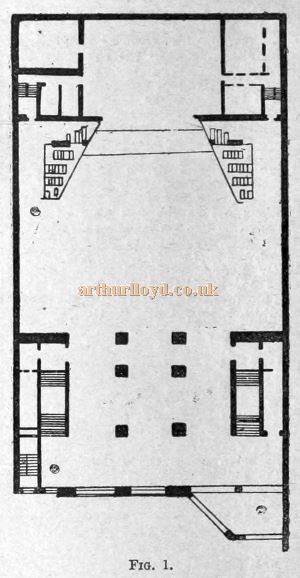 In
Germany the music-hall is frequently
placed on the first-floor level, like the Cambridge
Music-hall in London, which was so lately burnt down. This arrangement
is never satisfactory, as it increases the danger to the public by placing
them so much further from the street level than is necessary. An example
of such a hall is the Rheichshalle in Berlin.
In
Germany the music-hall is frequently
placed on the first-floor level, like the Cambridge
Music-hall in London, which was so lately burnt down. This arrangement
is never satisfactory, as it increases the danger to the public by placing
them so much further from the street level than is necessary. An example
of such a hall is the Rheichshalle in Berlin.
 The
Concordia Music-hall, Berlin, now better known as the Apollo Hall, is
an assembly-hall in which smoking is allowed, which is devoted to many
kinds of entertainment, dances, general assemblies, variety shows, spectacle
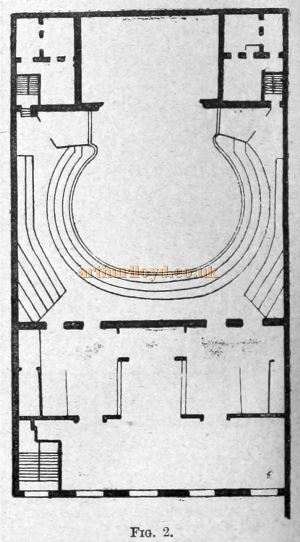
ballets, &c. Figs. 1 and 2 are the ground and first-floor plans,
and Fig. 3 the section showing the architectural treatment of the proscenium
opening, and the proscenium private boxes.
The
Concordia Music-hall, Berlin, now better known as the Apollo Hall, is
an assembly-hall in which smoking is allowed, which is devoted to many
kinds of entertainment, dances, general assemblies, variety shows, spectacle
ballets, &c. Figs. 1 and 2 are the ground and first-floor plans,
and Fig. 3 the section showing the architectural treatment of the proscenium
opening, and the proscenium private boxes.
This well-known Berlin music-hall, although chiefly devoted
to variety entertainment, has been so arranged that it can easily be
formed into a ball-room or assembly-hall. Although the present building
was erected to take the place of an older one of a similar character
on the same site, the treatment has been so little influenced by its
predecessor that it may practically be regarded as the original conception
of the talented architect, Mr. G. Ebe.

The assembly-hall proper does not front a street, the
entrance passage-way, which is not shown upon the diagrams, Figs. 1
and 2, passing through another building. To the student of public building
planning this does not commend itself; but the frontage of the hall
is upon an inclosed courtyard or garden, although there are no exits
at the sides or at the back of the hall. Between the entrance from the
street and the hall, which is 28-50 metres long by 22.50 metres wide
and 18 metres high, there is a garden, as I have already said, and this
is a feature of the establishment and much frequented in the summer
months, being easy of access from the auditorium. So much of the small
available space has been taken up by the body of the hall that the stage
is only 30ft. deep; this, however, is ample for the purpose for which
the hall is intended, but would naturally be small for a theatre of
equal proportions.
From the pillared vestibule containing the buffet there
is an excellent view of the stage to be obtained, and this, considering
the purpose for which it is used, is a most attractive feature in the
building. In the colour scheme of the hall more restraint has been shown
than in most buildings of a similar class; but the ornamentation and
painted panels, especially of the ceiling, are most elaborate. The general
scheme is ivory-white picked out with gold and blue. The decoration
of the foyer, however, is very brilliant. Fig. 3 shows that there is
true architectural treatment throughout the whole interior of the auditorium,
especially over the stage opening and the adjoining stage-boxes.
Mr. G. Ebe, the architect, completed this building in 1894, at the cost of £25,000.
Mr. Brandt, the celebrated stage engineer of the Royal Theatres, Berlin,
designed the stage machinery, which is naturally limited, considering
the purpose to which the hall is put. No stage effects are permitted,
and the scenery which is used is all painted upon asbestos cloth. These
precautions are taken to minimise the risk of fire, as the exits are
not all that one would wish, although it is stated that the entrance
from the street is sufficiently wide to allow a fire-engine to be driven
right up to the hall, and yet leave room for a good stream of people
to pass. Yet this is the only way out, and cannot be regarded as satisfactory,
as it passes under another building before reaching the street. The
stage-entrance for performers and musicians is by vaulted passages passing
under the hall, as there is no means of access from the back. The ventilation
has been carefully looked after, and the hall has, of course, been lighted
by the electric light. The effect as the spectator enters by the vestibule
is said to be most elaborate, being specially pleasing when the area
floor is used as a ball-room. At the rear of the seating on the first
floor are a number of saloons and supper-rooms; but the refreshment-bar
is in the vestibule at the back of the seats on the area level.

There is another type of German music-hall, as seen in
the large hall or winter gardens of the Central Hotel, and to a certain
extent the Flora Hall (Fig. 4) at Charlottenburg may be added to this
class, for although in reality in connection with the Botanical Gardens,
entertainments of all kinds are given in the building.
 Of
the halls devoted to variety entertainment
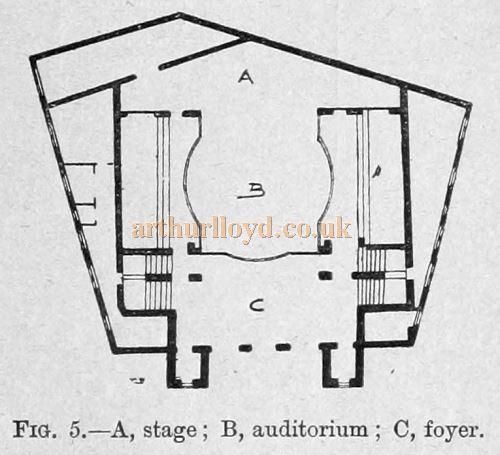
which are also in connection with hotels, the Pfauen Hall, Zurich (Fig.
5) is an example. This was erected by the architects, Messrs. Chiodera
and Tchiodera, of Zurich, who had to build a hall of the auditorium
type upon the smallest possible area without interfering in any way
with the light and air of the surrounding buildings. As, however, as
many spectators as possible had to be accommodated upon this limited
area, as will be seen by the plan, a view of the stage is obtained from
the foyer, and the stage is reduced in depth to its utmost limit.
Of
the halls devoted to variety entertainment
which are also in connection with hotels, the Pfauen Hall, Zurich (Fig.
5) is an example. This was erected by the architects, Messrs. Chiodera
and Tchiodera, of Zurich, who had to build a hall of the auditorium
type upon the smallest possible area without interfering in any way
with the light and air of the surrounding buildings. As, however, as
many spectators as possible had to be accommodated upon this limited
area, as will be seen by the plan, a view of the stage is obtained from
the foyer, and the stage is reduced in depth to its utmost limit.
Before concluding this important section of my articles,
I have to make some reference to the essentially French music-hall,
which I propose doing in my next number. In the meantime, I wish to
impress upon my readers that I have not dwelt so fully upon the details
of the planning of music-halls as I think the importance of the subject
demands, because I have so recently in this journal fully described
the methods that should be adopted in planning and constructing theatres.
As to exits and fire protection, the same rules may be applied to both
class of buildings; but with regard to the internal arrangement the
demands are quite different. A theatre must have an auditorium for a
seated audience desiring to remain quietly in their seats to witness
the drama or opera. A music-hall must be arranged for a constantly moving
audience, and there must, therefore, be wider passageways, a greater
width between the rows of seats, wider gangways, and essentially a promenade.
Again, there must be very different arrangements with regard to foyers
and refreshment-rooms. There the authorities are not faddists, the refreshment-room
should be so placed that a full view of the stage may be obtained. Another
distinct feature of an assembly-hall of this type is the communicating
staircases required between the various levels of the auditorium. The
public like to be able to go from one level to another, and this can
only be done in buildings where the want is met by good intercommunicating
staircases. The L.C.C. rules insist that a staircase shall only serve
one tier and not be entered by people at a lower level. This is, of
course, with reference to the entrance and exit staircases, so what
I have called the intercommunicating or promenade staircases must be
in addition to these, or the authorities will not permit them.
CONCERT-HALLS AND ASSEMBLY-ROOMS
By ERNEST A. E. WOODROW, A.R.I.B.A.
Chapter 25
Images begin again at Fig 1
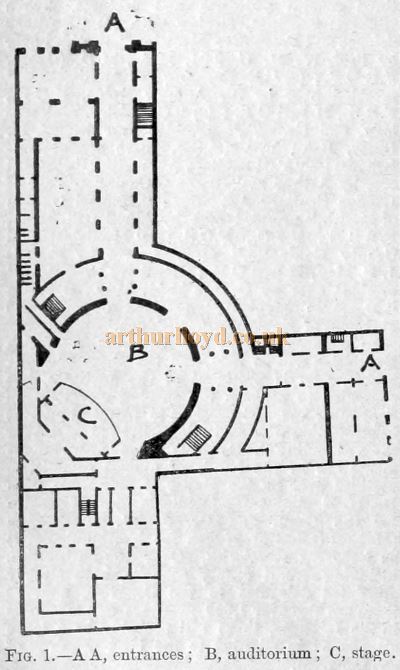 I have frequently had to refer in these papers to the excellence of the
work of Messrs. Fenner and Helmer as specialists in
theatrical architecture. The subject of the present chapter is one of
their buildings erected in Buda-Pesth, which is used as an assembly
hall of the music-hall type, and
is known as the Somossy Orpheum. As is shown by the ground-plan, Fig.
1, this building is erected in such a way that it does not come under
the regulations of a theatre, but merely as a place of public assembly,
to be used as a music-hall.
I have frequently had to refer in these papers to the excellence of the
work of Messrs. Fenner and Helmer as specialists in
theatrical architecture. The subject of the present chapter is one of
their buildings erected in Buda-Pesth, which is used as an assembly
hall of the music-hall type, and
is known as the Somossy Orpheum. As is shown by the ground-plan, Fig.
1, this building is erected in such a way that it does not come under
the regulations of a theatre, but merely as a place of public assembly,
to be used as a music-hall.
This is drawing a fine line of difference between the
theatre and the music-hall, which would not be permitted in this metropolis,
as the regulations for the one are, to all intents and purposes, the
same as for the other. Upon looking at the interior view (Fig. 3), it
is perfectly clear that this building follows the lines of a theatre
in form, as it consists of stage and auditorium with galleries.
It is true the music-hall has a different object to fulfill
from that of a theatre, and that the architects had in this case to
overcome the task set before them of providing spaces for eating and
drinking, as well as for promenading and smoking lounges in addition
to the seated auditory and stage. It is because of these features having
to be added in close proximity to the auditorium that music-hall planning
may be considered more complicated than theatre planning; for, in addition
to seating the audience comfortably, the promenades must be so placed
that those walking about will not disturb those seated, and yet the
promenaders must have a view of the stage, and be able to see the performance
over the heads of those seated.
Such we know were the problems placed before Messrs. Fenner
and Helmer when they undertook the design of the Somossy Orpheum. The
site is a most difficult one, there being only two small frontages to
the streets, the rest of the site being long and narrow, and one would
consider, from the outline, that it is most inappropriate for such a
building. The auditorium and stage are very cleverly treated. The stage
is placed at the angle formed by the two sections of the site, and the
auditorium is placed with a centre line about 45° on either side
of the street entrances. This was a most clever way of obtaining the
greatest width and depth in the site for the auditorium, as in no other
part of the land could such dimensions be procured.
The character of the entertainment does not, of course,
necessitate a deep stage, so that the narrow portion at the angle was
quite sufficient for the purpose required.

A symmetrical and regular approach, 19ft. 6in. wide, forms
the chief entrance from the Fellglasse. On either side of this approach
are showcases, as seen in Fig. 4. By this means every available inch
of space is made use of to bring in a revenue. The staircase leading
from the vestibule, as is shown in the view given in Fig. 2, consists
of two flights of stairs to the first landing, which then merge into
one, leading to the first tier. The staircase continues upwards to the
second tier, or gallery, and winter garden.

On the ground floor there is also a winter garden and
a large café. These are thrown open after the performance every
evening. The parterre or area level is arranged with tables and chairs
after the manner of the old-fashioned London
music-halls. The first tier consists entirely of private boxes,
which are, however, open at the back, and have no doors to inclose them,
a rope merely being placed across the entrance. These are somewhat similar
in arrangement to what used to be called the omnibus boxes in the London
theatres frequented by our forefathers, the last survival of which was
destroyed when the Pavilion
Theatre, Whitechapel, was rebuilt last year. On the second tier
are four rows of seats, with promenade and saloon in rear.
The interior perspective given in Fig. 3 fully shows these
arrangements and more fully explains the character of the building than
any other method. The decoration of this building is very elaborate;
the figure painting is by the artists Gastgeb, Gartner, and Peifuss;
the sculpture work is by Vogel, who was assisted by Dumbauer; the rest
of the statuary and furniture is by Lott and Bros, Thouet respectively.
There are private rooms leading from the balcony used as supper-rooms
(as shown in Fig. 3). Of these, three are decorated in Moorish style,
two in Rococo, two in Japanese, and one is Hungarian in treatment.

In the corridor behind the parterre is a very ample provision
for hats and cloaks - a thing almost unknown in a London
music-hall. Usually a few pegs on the walls of a narrow passage
have to do duty for a cloak-room, with the result that there is always
confusion when the audience is leaving the theatre, arising from those
who have left their coats and are desirous of recovering them. Messrs.
Feltner and Helmer never forget this provision, for in all their work
long counters are provided, for receiving hats and coats, and they are
never placed in such a position as to be an obstruction to the easy
exit of the audience.
Although there is much to learn and much to admire in
the manner in which the architects carried out the difficult task set
before them, in this case one cannot help dwelling on the unsuitable
site and the inadequacy of the exits, which are only at the two points
marked A A in the plan. Such a large building as is shown in Fig. 3
should certainly be provided with more ample means of exit. It is much
to be regretted that the authorities of Buda-Pesth draw such a fine
distinction between a theatre and music-hall, and allow the latter to
be placed outside the stringent regulations which rule the former. Granting
the site to be unsuitable, we must admit that the architects have worked
out an extremely clever plan.
CONCERT-HALLS AND ASSEMBLY-ROOMS
By ERNEST A. E. WOODROW, A.R.I.B.A.
Chapter 26
Images begin again at Fig 1
Among the variety
theatres, there has, perhaps, never been a more famous house than
the Eden Theatre, Paris, which unfortunately last year had to be pulled
down, having failed as a financial enterprise. This hall was a typical
example of a class which is essentially French, consisting as it did
of one large hall proper with lounge and promenade leading to a fetes
hall, which assumed the character of a winter garden.

The task intrusted to the architects of the Eden Theatre,
Paris, was to construct a house suitable for concerts and varieties,
as well as for elaborate spectacular performances, which necessitated
a stage of large proportions. Ample provision had also to be made for
promenades, smoking-rooms, and bars. At the time of its erection the
only other hall of a similar kind was the Folies Bergere. It is well
known that that Duclos and Klein, the architects to whom the work was
given, successfully combined the objects for which the theatre was intended.
Building operations were commenced and completed in the very short space
of a few months. Two stringent requirements had to be met by the architects
and greatly influenced their design - namely, that the time occupied
in construction should be as short as possible, and that the superficial
area covered should be no greater than was strictly necessary, owing
to the high price of ground in that part of Paris. On both these grounds
an exceptionally large use of iron was made - in fact, the structure
may be said to have been an iron skeleton with a clothing of cement,
plaster, and masonry.
The architects regarded this construction simply as an
enormous framework, so that the principal facade and vestibule were
apparently the only parts built with a view to permanency. The principal
facade was ornamented with columns of Scotch granite, with bronzes,
&c., in Venetian enamel. The ground floor rested upon brick walls,
and was constructed of iron girders, calculated to bear a weight of
1,000 kilograms to the superficial metre.
The circle of the first tier was formed by a wall, and
the interior divisions furnished the necessary support to the roof over
the whole structure. The grand saloon and fetes hall were in the form
of an octagon, which was 25 metres in diameter.
Messrs. Klein and Duclos employed in the Eden Theatre
two sets of supports; - first, an iron post built up of trellis-work,
with an iron plate for a back and angle irons to insure rigidity; second,
cast-iron columns on cast-iron bases, placed upon stone piers and the
walls of the ground floor. The greatest difficulty in the construction
was the Monilmontant, the same stream which passes under the Opera House,
and the large shops in the Printemps. About half the space occupied
by the theatre was inundated with water; the architects, therefore,
adopted a system of concrete caissons in erecting this building.
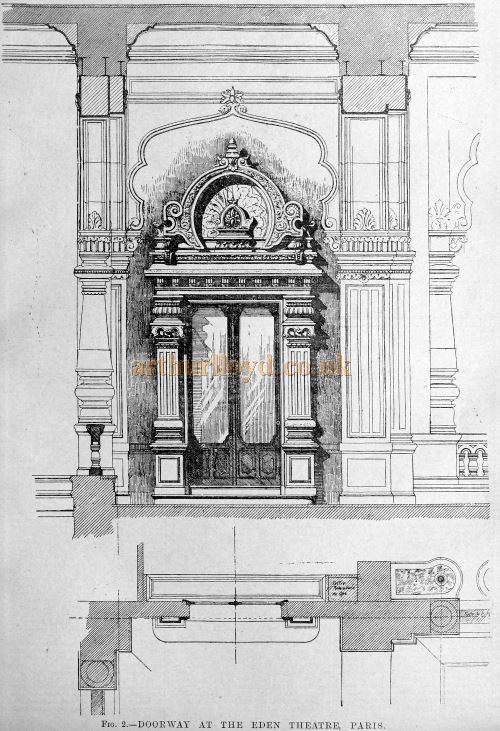 The
decoration of the interior was carried out in an Indian style, marked
by great elaboration of detail of a somewhat coarse character, and rather
heavy in the general effect (see detail of a doorway, Fig. 2). There
was little difference in the arrangement of the auditorium from that
usual in ordinary theatres.
The
decoration of the interior was carried out in an Indian style, marked
by great elaboration of detail of a somewhat coarse character, and rather
heavy in the general effect (see detail of a doorway, Fig. 2). There
was little difference in the arrangement of the auditorium from that
usual in ordinary theatres.
At the back of the house accommodation was provided for
six hundred performers, while the depth of the stage was as great as
that of the opera. In the courtyard in front of the dressing-room there
was stabling for fifty-five horses which were required upon the stage
for the spectacular ballet performances. The roof was covered in zinc.
The service staircases were made of iron, while the grand staircase
and vestibule were composed entirely of stone. The ventilation of the
house was effected by means of openings above the central light of the
auditorium, foyer, and Indian saloon, while in summer the roof of the
latter could be removed by hydraulic power, adding greatly to the comfort
of the audience in hot weather. Almost the whole of the building was
lighted by gas, electricity being only found in the gardens.
In order that this large auditorium might be comfortable
in the winter, a hot-air apparatus was used for all parts of the building
except the stage, where steam was considered safer and more satisfactory,
as giving a less dry heat and being one which is more endurable to the
artistes.
Two broad staircases, one on the right the other on the
left of the vestibule, used to lead to the first floor, which contained
the circular promenade from which an excellent view of the stage could
be obtained, allowing the spectators to follow the representation, and
at the same time to change their point of view. This promenade led on
the right to an Indian Court, and to a winter garden on the left. In
these two hall were bars of different nationalities divided by pillars,
and the walls were covered with looking-glasses, giving an unusually
long perspective vista. The area floor was occupied by stall seats,
while raised slightly above this in the rear were the private boxes.
The first tier consisted of open seats with the promenade behind. The
stage was provided with elaborate machinery, because the spectacle represented
upon it was of the highest order. Messrs. Godin, with the assistance
of M. Arnadot, one of the chief machinists of Paris, carried out the
machinery for this stage, and it is worth while here noting that in
large theatres of variety the stage and stage machinery are as complete
as in any theatre; in fact, the machinery required for the rapid changes
in a spectacular ballet needs, if anything, to be more complete than
that where a theatre is merely devoted to the drama. It is because quick
changes and elaborate sets are used on the boards of a variety theatre
that the music- hall is as liable
to fire as any theatre, and it is only right that they should be placed
under the same regulations with regard to protection and prevention
from fire as the opera-houses and theatres.
CONCERT-HALLS AND ASSEMBLY-ROOMS
By ERNEST A. E. WOODROW, A.R.I.B.A.
Chapter 27
Images begin again at Fig 1

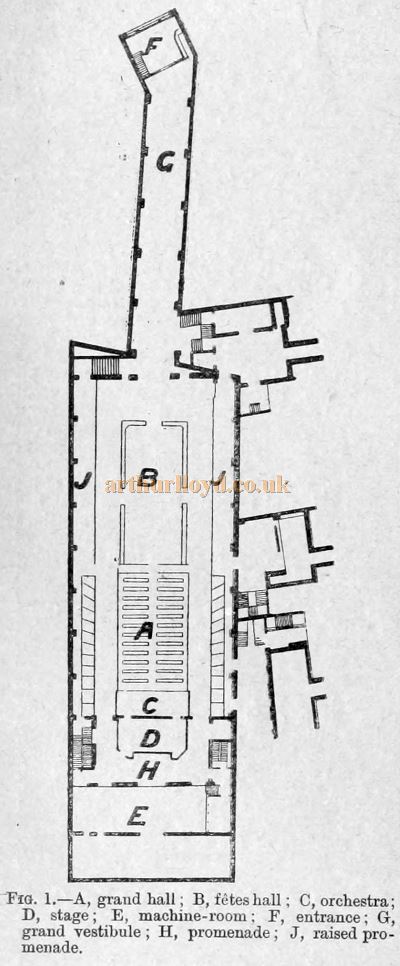 The
Olympia, in the Boulevard des Capucines at Paris, is a music-hall of the smaller type, also essentially French in character, erected from
the designs of the architect, M. Leon Carle. It is a hall built on a
very long piece of back land, with a narrow frontage to the public thoroughfare,
with just sufficient width to contain the flaming posters and advertisements
peculiar to this class of building. The entrance from the street is
by a long passage-way, between five and six metres in width. The ground
floor, or area level, is divided into two distinct parts, the fetes-hall
marked B, and the stalls of the grand hall marked A on the diagram.
The floor of the first portion is level; but the floor in the front
part, where the seats are placed, slopes downwards the stage. The fetes-hall
is quite in the character of a French music-hall, affording as it does
large space for promenading purposes. The portion marked C on the plan
is an orchestra in front of the platform which does duty for a stage.
The promenade extends along each side of the hall and round behind the
stage, and beyond this is placed the machinery-room.
The
Olympia, in the Boulevard des Capucines at Paris, is a music-hall of the smaller type, also essentially French in character, erected from
the designs of the architect, M. Leon Carle. It is a hall built on a
very long piece of back land, with a narrow frontage to the public thoroughfare,
with just sufficient width to contain the flaming posters and advertisements
peculiar to this class of building. The entrance from the street is
by a long passage-way, between five and six metres in width. The ground
floor, or area level, is divided into two distinct parts, the fetes-hall
marked B, and the stalls of the grand hall marked A on the diagram.
The floor of the first portion is level; but the floor in the front
part, where the seats are placed, slopes downwards the stage. The fetes-hall
is quite in the character of a French music-hall, affording as it does
large space for promenading purposes. The portion marked C on the plan
is an orchestra in front of the platform which does duty for a stage.
The promenade extends along each side of the hall and round behind the
stage, and beyond this is placed the machinery-room.
In the fetes-hall there are raised platforms either side,
four steps above the level of the floor, forming a promenade, from which
the stage can easily be seen.
The first floor consists of a gallery, four and a half
metres wide, running the full length on both sides of the hall as well
as across the back. This gallery is not stepped up for seats, but is
arranged for a promenade and used only for that purpose. There is, however,
at a higher level, a second gallery of six rows of seats at the back
of the hall.
Fig. 2 illustrates the longitudinal section. It is interesting
to note how totally different this plan is from the music-halls of this
country, and how it could never, under the present regulations, be erected
in London, quite apart from its unsatisfactory arrangement in being
built so far away from the street.
Figs. 3 and 4 are plans of the hall known as the Concert
de la Scala in the Boulevard de Strasbourg, Paris. This building was
erected from the designs of M. F. De La Rue, the architect, and it will
be seen it is more like the English
music-hall in arrangement than the preceding example.
The area consists of a flat floor seated with benches,
from which one would imagine it would be difficult for one seated at
the back to see the performance. As in the Olympia, there are raised
platforms at the sides of the area with one row of seats running the
length of the hall.
There are three tiers of galleries above the ground floor
planned in a horseshoe form, with elongated sides, following a line
not particularly good for sighting purposes, especially from the back
seats at the sides.

The auditorium is surmounted with a sliding roof, and
Fig. 5 gives a detail of the construction and gearing of the movable
portion over the centre of the auditorium ceiling, from which it will
be seen that by working a windlass over the proscenium wall, the sliding
dome can be moved sideways to the right or the left. This dome is mounted
upon strong metal wheels, which run upon rails bolted to the top of
the main iron girder of the roof. A plan, elevation, and section of
this method of construction is shown upon Fig. 5 to an enlarged scale.
The English manner of working the sliding roof from the stage-level
is far better than having to mount up to the roof-level before the sliding
portion can be removed. Should a sudden shower come on during the time
taken in reaching the windlass, the audience in the stalls would be
materially damped by the falling rain. I have already explained the
way of working adopted in London music-halls where sliding roofs are
provided.

From the section it will be seen that the stage is provided
with a certain amount of machinery above the stage floor, but that it
does not extend below the boards. With regard to the entrances and exits,
it will be seen from the plans that here are double staircases leading
from the vestibule to the three tiers of galleries above. These staircases
are in common to all the galleries, and eventually discharge at one
point, where a stream of people from the back of the stalls also joins
them - a most dangerous and unsatisfactory state of affairs. The staircases,
too, in themselves, are also unsatisfactory, and they are formed in
their upper parts with numerous winders, as they curve round and discharge
at the side of the tiers. Altogether the planning is not what would
be expected in a building of this size and character.
CONCERT-HALLS AND ASSEMBLY-ROOMS
By ERNEST A. E. WOODROW, A.R.I.B.A.
Chapter 28
Images begin again at Fig 1
In the present chapter I have to
deal with a class of building not to be found in London, and the reason
for this non-existence is primarily the stringent regulations under
which theatres and concert-halls have to be built in the Metropolis.
I refer to the public building which embraces a theatre and a concert-hall.
We have both German and French types of this building, and the example
set by these countries has been followed in America. The type may be
divided into two classes - the one where a concert-hall, although under
the same roof, is entirely separate from the theatre, and the one where
the concert-room is a part of the theatre, with the same approaches
and exits.
It is probable that the origin of the attachment of a
concert-hall to a theatre arose from the fact that in opera-houses large
practice and chorus-rooms are necessary for the training of the choir
as well as for the rehearsal of the orchestra. As these large rooms
have to be provided, they have in many cases been so arranged as to
serve another purpose besides that of a practice and rehearsal-room;
that is to say, a concert-hall has been built in the front part of the
house of sufficient size and architectural importance that concerts
may be given therein apart from the performances which take place in
the theatre. Operatic concerts, orchestral concerts by the band and
artists of the opera-house, are frequent attractions for morning performances
during the opera season, and there is no doubt that a more fitting location
could not be found for such performances than in a concert-hall within
the walls of the opera-house.
In large theatres the saloon and foyer are frequently
used for separate entertainments, given at a time when there is no performance
proceeding in the theatre itself. At the time I am writing this article
the foyer of the Empire Theatre,
Leicester-square, is being used for the exhibition of the moving
photography. The saloon of Drury Lane Theatre has long been well known as a place to hold functions in connection
with theatrical charities and Masonic Festivals, and the saloon of the Lyceum Theatre is also frequently
lent by Sir Henry Irving for meetings of
his brother artists; yet it is quite the exception to find entertainments
given in the saloon of a London
playhouse. The majority of them, in fact, are quite inappropriate
for such a purpose, and the chance appears to have been lost of utilising
the space to the utmost extent, and buildings have been erected with
foyers and saloons which are not designed in such a manner, with proper
means of ingress and egress, so that they may even be used for an entertainment
where the audience is limited in number.

In Figs. 1 and 2 are reproduced from an old print the
plan and elevation of a theatre in Ghent, which shows that this arrangement
of a theatre and concert hall in one building is of long standing on
the Continent. In this example the vestibule forms the centre feature
of the plan. The approaches to the concert hall are on the right of
this, and those to the theatre on the left. Whatever merits this building
may show as to economy of space, it is not an arrangement to be recommended
as far as the safety of the audience is concerned, as the two bodies
of people attending the concert-hall and the theatre at the same time
would be in great danger of meeting in two crowds in the same vestibule,
and this danger would still exist, even were other exits provided than
those into the vestibule, because the greatest number of people will
always leave by the way they have entered.

In the Theatre de Montpelier (Fig. 3), erected from the
design of Mr. Cassien Bernard, we have a building of the composite class,
of the French type. In this example the concert-hall, although a part
of the same building with the theatre, is entirely disconnected by a
solid mass of masonry - the back wall of the stage - and there is no
opening connecting the theatre and concert-hall in any way.

The building as a whole stands upon an isolated site,
and the entrances and exits to the concert-room are separate from those
of the theatre, being in the rear of the building. The front is occupied
by various entrances, as well as the vestibule of the theatre proper
leading to the grand staircase, which is of elaborate design. A large
portion of the sides of the building is taken up by a restaurant on
the right and a cafe on the left of considerable dimensions. Unlike
the concert-hall, there is a connection between these parts and the
theatre by doorways which lead into the side vestibule. As a whole,
this plan is an admirable solution of the difficulties which arise when
an architect has to erect a building to serve the two purposes, for
Mr. Cassien Bernard has, in no way sacrificed the safety of the audiences
by obstructing his exits, or by mixing the various streams of people
which would flow from the concert-hall and from the theatre. There is
no doubt, however, that the admirable site on which this building was
erected went a long way towards solving these difficulties.
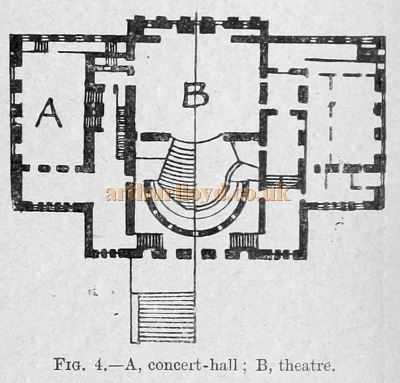 Another
example of this class of building is shown in Fig. 4 - the Konigl. Schauspielhaus
in Berlin, the architect of which was Schinkel. Here the concert-hall
was placed at the side of the theatre, and was not in direct communication
with the passages of the auditorium.
Another
example of this class of building is shown in Fig. 4 - the Konigl. Schauspielhaus
in Berlin, the architect of which was Schinkel. Here the concert-hall
was placed at the side of the theatre, and was not in direct communication
with the passages of the auditorium.
In many respects the exterior of the Royal Playhouse at
Berlin is the most elaborate work which has been produced by this well-known
German theatre specialist, Mr. Schinkel.
 The
site of this building was previously occupied by the Royal National
Theatre, which was destroyed by fire at the beginning of this century.
Schinkel, who was intrusted with the erection of the new building in
the year 1819, was, it is
stated, seriously hampered by the conditions laid down, especially that
which obliged him to use the old foundations. For this reason in its
general dimensions the new theatre had to correspond with the old one,
and it was divided into three parts - the theatre proper and two wings,
one of which is the concert-hall. The auditorium of the theatre has
a holding capacity for 1,500 persons, and is semicircular in form. The
galleries, which have been introduced to afford greater accommodation,
are said to have materially injured the effect of the front part of
the house.
The
site of this building was previously occupied by the Royal National
Theatre, which was destroyed by fire at the beginning of this century.
Schinkel, who was intrusted with the erection of the new building in
the year 1819, was, it is
stated, seriously hampered by the conditions laid down, especially that
which obliged him to use the old foundations. For this reason in its
general dimensions the new theatre had to correspond with the old one,
and it was divided into three parts - the theatre proper and two wings,
one of which is the concert-hall. The auditorium of the theatre has
a holding capacity for 1,500 persons, and is semicircular in form. The
galleries, which have been introduced to afford greater accommodation,
are said to have materially injured the effect of the front part of
the house.
The concert-hall lies to the south of the main building,
and has a separate vestibule. The hall measures 13.8 metres broad, and
is 13.5 metres high, and is said to be, without doubt, the finest interior
that has been executed by this architect. A double staircase, which
rises from the hall itself, leads to the balcony and adjoining rooms.
The hall is used for balls, fetes, and concerts, and State functions.
The theatre is Hellenic in form, with elaborate plaster
interior decoration, and an exterior chiefly carried out in sandstone.
The total cost of the block was £95,000.
Fig. 5 is the Victoria Theatre in Berlin, the architects
of which are C. F. Langhaus and Edward Silk, another building of the
composite class, where the stage occupies the centre of the building
with an auditorium on either side, forming a summer theatre on the one
side, and a winter theatre on the other.
CONCERT-HALLS AND ASSEMBLY-ROOMS
By ERNEST A. E. WOODROW, A.R.I.B.A.
Chapter 29
Images begin again at Fig 1
Note:- Figs 4, 5, and 7 were not indicated in the
text but I have placed them where I think they should be. M.L.
In the last chapter I referred to one of the reasons for the concert-hall and theatre being
in one building, stating that it was a matter of convenience for operatic
recitals. On the Continent, however, one may look to another cause for
the foyers and saloons becoming separate places of public - more especially
where they form part of the Court Theatres and of the latest development,
the People's Theatre - assembly. In Court Theatres the accessories are
designed to a lavish scale: they are peculiarly the luxury established
and maintained at the expense of reigning monarchs. In modern times
all classes are usually at liberty to enjoy the entertainments given
at these playhouses, subject, of course, to such restrictions as to
the number of spectators or the charge for admission, as may seem good
to the Royal owner, as whose guests they are in reality admitted. The
money received thus contributes to defray the cost of the entertainment,
and in this way the public are permitted to witness the performance
at a smaller outlay than would be required of them were the institution
managed merely with a view to gain. Court officials and officers of
the army and navy are on the free list; whilst university professors
and other distinguished men of learning frequently gain admission at
a nominal fee. Art is encouraged on the stage: the attendance of the
cultured classes is sought in the auditorium. Although the price of
admission is comparatively small, it is yet sufficient to secure, in
addition to the privileged, an assembly of a certain social standing.
On some occasions of national festivity, however, an exception is made,
and the auditorium is thrown open to all corners absolutely free of
payment. The pride that a Continental Court takes in its theatre is
most noticeable.
Not only does the sovereign use the building for the entertainment
of his official or private guests, or for his public receptions, but
no general Court ceremony is complete without a visit to the Royal play-house.
Indeed, some performances rank as high State functions, all the seats
being filled by special invitation.
As an example of the space which is given up in a building
of the Court Theatre type to a concert-hall for Court and other functions,
I illustrate the plans, Figs. 1 and 2, of the Grand State Theatre, Mecklenburg
Schwerin. Fig. 3 is a longitudinal section of the same building. The
space usually devoted to the foyer and grand staircases is designed
for a concert-hall extending to a height equal to two stories of the
theatre, and in length the whole front of the building. The area-level
of the concert-hall is accessible from the first flight of the staircases
which lead into the theatre, while the gallery of the concert-hall is
also approached from the third flight of the theatre staircases.


The State or Court box is placed in the centre of the
auditorium on the first tier; behind this box, and between the theatre
and the concert-room, is the Royal saloon, which can be used for Royalty
both for concert-room and theatre. This saloon has a separate entrance
from the street, and is approached by a staircase placed on the right
of the building.
In addition to the State-box here described, there is
on the right of the auditorium the Grand Ducal stage-box, generally
used by high personages. The approach to this box is arranged in the
centre of this side facade with an inclosed carriageway. A special staircase
serves for this entrance. On the ground floor large doors open from
the vestibule into a corridor behind the auditorium; the central door
leads to the parquet or stalls on the first floor, the two side doorways
lead to the staircases on the right and left of the theatre, which serve
as an approach to the second and third tiers of seats. These staircases
have special exit doors of their own leading directly into the street,
without re-entering the vestibule, so that people can depart from the
tiers above without mixing with any of the audience leaving through
the vestibule.
The staircases are planned with more steps in a flight
without intercepting landings than are accepted by authorities as wise
for the safe construction of staircases where large crowds have to descend
rapidly - in many cases there are as many as nineteen steps without
a break; the circular staircases near the proscenium are also in a form
which would seldom, if ever, be found in a theatre of the present day.
Doubtless the architect of this theatre, Herr Daniell,
was entirely influenced in his design by having to place the concert-hall
and assembly-room in front of the auditorium for the special Court functions
which would be held therein, to which he has sacrificed to some extent
the arrangements for the ingress and egress of the people.
No doubt the most magnificent building of this particular
class in the whole world is the Sunper and Hasenauer Court Theatre at
Vienna, with its magnificent auditorium, to which is attached the most
luxurious suite of reception rooms, most frequently used for Court ceremonies
and the entertainment of the Emperor's guests.
One of the most ambitious schemes of a building used for
more than one audience is to be seen in Madison-square Gardens, New
York, (Fig. 4) erected by Messrs. McKem, Mead, and White. The history
of the building is told by Mr. Horace Townsend as follows:- "When
New York was a younger city than it is now, and the city was clustered
about the lower end of the island which it now almost entirely covers,
one of the principal railway stations was built by the famous Commodore
Vanderbilt in close proximity to Madison-square; but as that locality
gradually became the heart of the city the station was moved further
northward, and the enormous building, which covered an entire 'city
block' or plot of land 425ft. by 200ft., was left on the Commodore's
hands. He did not pull it down, but at small expense turned it into
a sort of rough Agricultural Hall, where he held horse shows, dog shows,
boxing matches, and so forth, while once a year it was tenanted by Mr.
Barnum's 'Greatest Show on Earth.' It was a malodorous, ramshackle sort
of place," says Mr. Townsend; "but year after year it stood
there, producing a fair rent, but nothing approaching the interest on
the sum of money it represented. Many plans were discussed for the turning
of it to better account; but all proved abortive, until a syndicate
of the richest bankers and so forth in the city bought the property
for some million and a half dollars (£300,000), and built on its
site a comprehensive structure devoted to public amusement.

The block consists of an enormous amphitheatre 310ft.,
by 194ft., by 80ft. in height, comprising 30,000ft. super., with a track
a mile long, and it has seating capacity for 6,000 persons. In addition
to this amphitheatre is a large restaurant, (Fig. 4) with main room
80ft. by 90ft., and a number of lesser rooms attached. Over the rest
of the large hall is built a concert-room, (Fig. 5) while at the side
there is a theatre which will seat 1,200 persons (Fig. 4 and 5).

The concert-hall accommodates no less a number than 1,500
people. There are additional attractions in this enormous place of entertainment,
there being a tower 300ft. high, with a platform 200ft. above the pavement,
and the roof over the theatre is 112ft. by 200ft. This building is said
to be one of the first to be erected under the new regulations at New
York.
Fig. 6 is Mr. Kiralfy's Alhambra Palace at Philadelphia,
a building devoted to variety entertainments and spectacular shows.
Bhreeke's Concert-Room in Braunschweig, by architect Erdmann Hartig,
is another building of a class devoted to a lighter form of entertainment,
and, like Mr. Kiralfy's palace in Philadelphia, it is connected with
a winter-garden and open-air concert garden.

There is still another class of theatre (Fig. 7) which
is also used as a concert-hall; but it is a class which is distinctly
Continental. I refer to the people's theatre, the most typical example
of which is at Worms. In addition to the theatre, the block comprises
a public hall and assembly-room, with small stage for concerts, and,
further, a restaurant.
There is a large garden at the side, which can also be
used for outdoor concerts. The theatre accommodates 1,183 people, and,
with standing room, can hold 1,400. The concert-room is so arranged
that it can be used as a foyer to the theatre, and a terrace outside
is also available both to the theatre and concert-hall. The ample space
given for cloak-counters is a special feature, and attention should
be drawn to the circular lounge. The theatre is so arranged that not
only performances can be given therein, but also concerts; and in addition
to the orchestra in front of the stage, there are, in the rear of the
auditorium, an organ and seats for a choir of 100.
CONCERT-HALLS AND ASSEMBLY-ROOMS
By ERNEST A. E. WOODROW, A.R.I.B.A.
Chapter 30
Images begin again at Fig 1

I have already referred in a previous
chapter to the casinos which exist in some of the fashionable watering-places
on the Continent, and have illustrated my remarks by the plans and details
of the famous Monte Carlo gambling-rooms, showing by that example how
these pleasure resorts include places of public assembly and amusement
within their buildings. There are, however, other examples of this type
of concert-hall, which must not be overlooked in this series.

The casinos and pavilions which are erected at watering-places
and pleasure resorts may be divided into two classes - viz., those which
are erected within a short distance of the water's-edge, and those built
over the water itself, as is the case with pier pavilions. Of the first
class, Figs. 1 and 2 show the plan and elevation of a typical example
of a casino built on the edge of the water, being the Casino de Gerardmer,
of which M. L. Mougenot was the architect. This casino, situated at
an inland watering-place near the Vosges mountains, stands upon a raised
terrace overlooking the water, and consists of a central building and
two wings; nearly the whole of the front portion is treated as a colonnade.
The left wing consists of a cardroom and a billiard-room;
while the right is occupied by a library, and by the manager's offices.
The whole of the central block is devoted to the grand hall for banquets
and fetes; this is fitted up with a stage at one end, and broad flights
of steps lead from it to the pleasure-gardens in the rear.
On either side of the entrance vestibule are the refreshment-rooms
and café, so necessary in a building of this description. This
casino fulfils all the requirements of an inland pleasure resort on
the bank of a lake or river.
In designing a building of this class, the laying-out
of the surroundings is a most important feature, and the forming of
the terrace, promenades, and covered colonnades is as essential for
the pleasure of the public as the creation of the banquet-hall and gambling
rooms.
Of casinos erected on the shore, one of the most typical
examples may be seen at Ostend. This structure is circular in plan,
and is built of iron, with galleries, terraces, and esplanades surrounding
it, and a club-room devoted to gambling purposes.
In Fig. 3 I give a plan of the Ostend Casino. The concert
pavilion is the central feature of the plan, the surrounding rooms being
grouped with strict regard to symmetrical planning. The plan of the
concert-hall is based upon an octagon with 8 sides of unequal length,
and is constructed area entirely of iron. Its height is 100ft., the
form of the ceiling being vaulted. In the walls are enormous windows
which can be let down into the floor in fine weather, leaving the sides
quite open. The construction is, in fact, little more than a clever
combination of doors, windows, and looking-glasses, and the design,
which is Mr. Laurey's, is carried out in a semi-Renaissance character.

Outside the pavilion are two raised terraces, while on
the other side of it is the dancing-saloon, with orchestra at one end.
Music-rooms, card-rooms, billiard, club, and refreshment-rooms, all
find a place in the grouping of the building. There is also the well-known
Strangers' Club, with the gaming-tables. The superficial area of the
floor-space of the pavilion is 2,500 square metres, that of the dancing-room
is 700 square metres. The cost of the whole was 1,500,000 francs.
As can be seen from the provisions made in the plan, the
building is put to many purposes. Primarily, it is a fashionable rendezvous
for visitors, and all kinds of fetes are indulged in, bazaars,
balls, assemblies, and theatrical entertainments are provided for the
subscribers.

Fig. 4 represents the plan of a casino built over water.
This casino is situated at Cannes: it is erected not far from the shore,
and is approached by a promenade pier of sufficient width to allow carriages
to drive up to the entrance. The central feature is a large concert-hall;
the right wing is occupied by a theatre, and the left by the gaming
and billiard-rooms. Fig. 5 is a view of the exterior.

Most of the larger English watering-places have pavilions
erected at the pier-head, which are devoted to all classes of music,
concerts, theatrical entertainments, and variety shows; but in no case
can we boast of buildings of any architectural merit. Perhaps the best
typical examples are to be found at Hastings and Brighton, where various
entertainments are given.
At Southsea there is a wood
and iron structure devoted entirely to promenade and orchestral music,
as shown in the section, Fig. 6.

In the year 1858,
when Southsea was an unimportant town
on the outskirts of Portsmouth,
a promenade pier, on cast-iron supports, was erected. In 1881 a second pier was erected, and upon this was built, for the convenience,
comfort, and shelter of visitors, a large pavilion with reading and
club-room attached. The chief feature of this pier is, therefore, the
fine concert-room placed in the middle of the pier, having a width of
75ft. and a height of 40ft. The seating capacity of the pavilion is
for 1,000 persons, and in addition there is a promenade gallery running
right round the building.
I do not remember having heard of any serious fire in
a building of this character; but when we consider that theatrical representations
are given upon a small, cramped, and ill-provided stage, and that the
audience are in most cases divided from it only by a flimsy canvas screen,
it is a great wonder that such an accident has never happened.
There is much for architects to learn who erect piers
and pavilions, both as to architectural treatment and grouping of buildings,
and also as to the arrangement for the comfort and safety of the audience,
and the provision of more adequate accommodation for the performances.
As a rule, the pier pavilion in England gives one the impression of
a makeshift or after-thought, instead of being a portion of the structure
of the pier itself.
CONCERT-HALLS AND ASSEMBLY-ROOMS
By ERNEST A. E. WOODROW, A.R.I.B.A.
Chapter 31
Images begin again at Fig 1
The pier pavilion is a very popular
example of the public assembly-room, and the uses to which it is put
are numerous and varied. One of the most recent erections of this class
is the pavilion on the pier of Clacton-on-Sea,
erected in 1890-93,
from the designs of the engineers, Messrs. Kinipple and Jaffrey. The
construction of this building is of great interest, and it would not
be out of place to repeat the description of it given by the engineers
of the pavilion: The length is 156ft., while the width is 66ft. and
the height 38ft. 6in.
The pavilion is a steel structure with glazed sides and
roof, is two stories in height, has semicircular ends, and an outside
balcony, 6ft. wide, beyond the main principals, which forms a promenade
all round the pavilion at the level of the first floor. The balcony
is sheltered from rain by the overhanging roof, and the floor of the
balcony serves as a cover to the promenade space on the deck level round
the structure. The recesses, or alcoves, between the main principals
on the balcony and deck floors are occupied by seats.

The upper half of Fig. 1 is a half-plan of the ground
floor from which it will be seen that the concert-hall occupies the
central or rectangular portion of the structure, the semicircular end
next the pier-head being used as a spacious refreshment-room, 47ft.
by 18ft., whilst the landward end is used for eight shops or stalls,
each about 12ft. by 12ft., having doors and windows on the outer side
of the buildings, and likewise windows and counters in the interior
opening on a spacious vestibule, forming the main entrance to the concert-hall,
so that visitors, either inside or outside the building, can be attended
to.
The dimensions of the concert-hall on the ground floor
are 75ft. by 45ft. 6in., and on the balcony 104ft. by 45ft. 6in. There
are five entrances on the ground floor, two on each side, in addition
to the principal entrance through the vestibule above referred to. By
means of a sliding glazed screen the vestibule can either be separated
from, or made to form part of, the concert-hall. A roomy stage or platform
is provided at the seaward end of the hall, and at the opposite end
and along both sides there is a gallery, access to which is obtained
from two side stairs within the hall, or from a stair in a passage between
the concert-hall and the refreshment-rooms. The hall accommodates 1,500
persons, and of its acoustic properties artists on the platform and
the audience in the remotest part of the gallery speak highly.
The arrangement of the balcony floor, showing ladies'
rooms, lavatories, &c., is shown in the lower portion of Fig. 1.
There are 26 main stanchions supporting the roof and gallery,
which are placed 15ft. apart. Each main support is 24ft. 9in. high and
4ft. wide, and consists of two box columns joined together by a web;
the section of these is composed of two flanges 7½ wide and ¼in
thick, two web plates 6in. by ¼in., four inside angles 21in.
by 2½in. by ¼in., and two outside angles 3½in.
by 3in. by 3/8in. These latter angles connect the web joining the box
columns together, and thus form one main column. This web is of 3/8in.
plate, but is not continuous from top to bottom, a space on the lower,
or ground floor portion, having diagonal bracing, the intervals between
which are filled with sashes and glazed.
On the upper or balcony floor portion there are also sashes,
but of square form in the webs of the principals. To each box column
there are two sole plates, 24in. by 21½ in. by 5/8in., which
rest on 24in. by 12in. transverse timber bearers, and are secured to
them by 1¼in. screw bolts.
The main columns are further secured by timber transverse
bearers of the pier by strong anchor straps riveted to the inner and
outer faces of the columns, and bolted to the timberwork by ½in.
bolts spaced 4ft. 6in. apart, so that a wide base is thus secured to
the columns.
The roof principals are parallel lattice girders 15in.
deep, having top and bottom flangles of two angles, 3in. by 3in. by
3/8in. and lattice bars ½in. by ¼in. They are stiffened,
and some architectural effect is obtained at their junctions at the
apex of the roof with the main columns by strong curved members, between
which and the girders wrought-iron scroll-work is introduced.

The roof purlins are lattice girders 15ft. long and 9in.
deep, and spaced 5ft. 2in. apart, from centre to centre. The top and
bottom members are T section, 3in. by 3in. by 3/8in., and lattice bars.
The balcony is carried. by 5in. by 4½in. rolled joists, spaced
5ft. apart from centre to centre, laid tranversely to the line of the
balcony, and supported by two lines of 7 7/8in. by 3½in. channel
beams, riveted respectively to the inner and outer faces of the main
columns, and also to 4in. by 3½in. by ½in. angle-iron
supporting brackets. Fig. 2 shows the sections of this building.
CONCERT-HALLS AND ASSEMBLY-ROOMS
By ERNEST A. E. WOODROW, A.R.I.B.A.
Chapter 32
Images begin again at Fig 1
I have now to deal with a class of buildings
which have to serve the purposes of both healing establishments and
of places of amusement. I refer to those buildings known as hydropathic
institutions or spas in our own country, and as the "kurhaus"
on the Continent. These buildings are erected partly for the accommodation
of those wishing to undertake a course of water-cure, and partly for
social intercourse and recreation or as general pleasure resorts.
Beyond the actual bathing establishment the visitor expects a good
assembly-room, concert-hall, promenade, and covered colonnades for exercise
in wet weather, ball, billiard, and reading-rooms, and, in many cases,
even theatre - in fact, all the pleasures of the town transferred to
the country; and it is the object of the proprietor, and the duty of
the architect, to fulfill all these demands and make the establishment
a popular and profit able concern. This, it will be seen, will largely
depend on the architect's skill. The building itself sometimes takes
the form of a place for public assembly, with the water-cure establishment
attached: at others, it consists of a huge hotel, with all the adjuncts
of the assembly-rooms and bathing establishment. The former class is
the older form, and was well supported by our forefathers as a place
of fashion. Perhaps the best instance of this description is the famous
pump-room at Bath, and, indeed, the whole
town was at one time entirely supported by the visitors who either required
a "cure" or who wished to follow the fashionable crowd. The
latter of these two classes is represented by our large hydropathic
establishments. When situated in France these establishments are all
included under the very comprehensive name of casino.
On the Continent, added to the buildings containing the guests, are
the promenades, colonnades, and assembly-rooms, which are sometimes
closely connected to the "kurhaus," and at others are self-contained
buildings, forming an approach to the drinking halls and wells. Here,
in the daytime, the visitors meet for walking or conversation, and,
in the evening, for balls, concerts, lectures, besides all manner of
theatrical entertainments.
Before dealing in detail with this interesting and complex group of
buildings. I wish to impress upon my readers that, from the fire and
panic standpoint, these large assembly halls must not be excluded from
any of the stringent rules as to planning and construction upon which
I have so frequently dwelt, both in the pages of this journal and elsewhere.
It will at once be seen how great ought to be the care exercised in
this matter, when we consider that, in addition to the dangers of the
temporary stage, with its attendant flimsy appurtenances and often amateur
management, we have hundreds of people sleeping in the building of which
the hall forms a component part. It must not be forgotten that statistics
of fires show us that they frequently break out after, sometimes long
after, the stage is empty and the hall shut up for the night, so that
the dangers to the inhabitants of the boarding-house or hotel in connection
with the assembly-rooms are well-nigh without limit. This consideration
causes me to fix one rule, which should, in my opinion, never on any
account be relaxed, i.e., that in all cases the assembly-hall should
be well separated from the inhabited buildings by solid construction
or open air-space.
In the recent developments of hotel building the assembly-room has
become a necessity, as competition demands its inclusion in every large
hotel, whether in town or at a pleasure resort: but its addition to
the building is very seldom looked upon as a great fire risk.
Considering the buildings, in connection with their special objects,
we may group them as follows:
1. Spas and assembly halls altogether separated from the wells.
2. The spas, in connection with pump-rooms, promenades, bath-houses,
and often hotels.
3. The spas and assembly-rooms, with theatre and card-rooms attached.
4 The casinos and gambling places, with the adjuncts of the "water-cure"
and mineral wells.
The object of all these buildings, however grouped, is practically
the same; they are, of course, planned differently, in accordance with
the different sites, local conditions, and requirements. In all cases,
however, they should contain a saloon or assembly hall for social gatherings,
large fetes, bazaars, balls, and concerts: it is necessary, therefore,
that provision should be made for an orchestra, and the usual large
platform, which should be such as may be easily adapted to the many
and varied purposes for which it is likely to be required; perhaps the
rooms next in importance will be the reading-room, billiard-room, and
card-rooms.
In addition to these there must, of course, be the necessary ante-rooms,
lavatories, cloak-rooms, and attendants' rooms. A cafe and restaurant,
with the necessary kitchens and service-rooms, very frequently find
a place, as I have before remarked.
The terraces, halls, promenades, &c, have already been referred
to, and the hotel buildings follow very much the grouping of an ordinary
hotel, and would naturally be discussed when dealing with these latter.
A characteristic of the French Establishment de Bains is the provision
of a stage in the assembly-room for various theatrical entertainments,
or even the erection of a building which forms part of the group, and
is entirely devoted to these performances - in fact, a regular theatre,
intended principally for the use of the guests themselves in amateur
performances, but also sometimes used by professional travelling companies.
The want of a proper and efficient stage has been much felt at many
of the German hydropathic establishments, and it is only of late years
that one has been erected in the concert-room attached to the kurhaus
at Ems, where it has been found to add greatly to the popularity of
that famous watering-place.
With regard to the planning of these buildings, it may be taken generally
that on the Continent there are two principal types of ground plans
adopted; these may be termed : (1) the central plan; (2) the elongated
plan. The former of these two is more popular in Germany, Austria, and
Switzerland, while the French seem to prefer the latter. Both these
forms are naturally more noticeable in the smaller buildings than in
the large groups.

In the first illustration I have selected, the detached or isolated
"kurhaus" is planned on the central system - it is that of
the kursaal at Ischl. Here the large concert-room or public hall is
situated in the midst, with terraces, halls, and colonnades on the park
side, while on the other side, grouped round the saloon, are the entrance-hall,
porters' and service-rooms, reception, cloak, reading, and billiard-rooms,
together with a smaller, which is useful for various purposes when the
central or large hall is either engaged or unsuitable because of its
size.
The concert-hall goes the entire height of the building; but the adjoining
rooms are lower, and have offices, caretaker's-rooms, &c., over
them. The kitchens and store-rooms are situated in the basement.
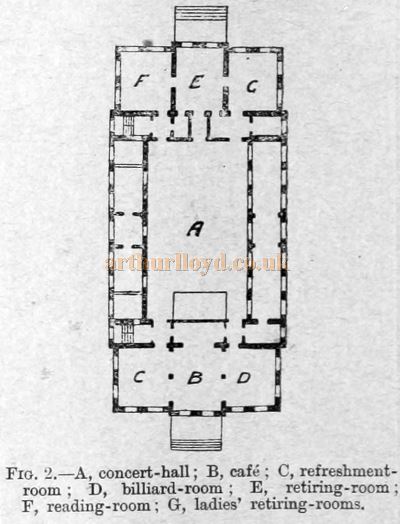 Fig.
2 is the "kurhaus" at Baden, in Switzerland, and if we compare
the plans of this with that in Fig. 1, which we have just been discussing,
the following features may be noticed: - The entrance-hall in the Baden
example is at the back of the building, that of Ischl on the side, and
the adjoining rooms are differently grouped. In Fig. 1 the orchestra
is in the chief axis, in Fig. 2 on the cross axis.
Fig.
2 is the "kurhaus" at Baden, in Switzerland, and if we compare
the plans of this with that in Fig. 1, which we have just been discussing,
the following features may be noticed: - The entrance-hall in the Baden
example is at the back of the building, that of Ischl on the side, and
the adjoining rooms are differently grouped. In Fig. 1 the orchestra
is in the chief axis, in Fig. 2 on the cross axis.
In the Baden example cloak-rooms and lavatories are on the right of
the entrance and a museum on the left, while between the cafe and the
hall is situated a very popular portion of the building, viz., the buffet.
The cost of the Ischl building was 240 marks per square metre of the
superficial area of ground covered, while that of Baden cost 276 marks.
They were built in 1872 and 1875, and the architect
of the former was M. Michel, of the latter M. Moser.
Quite a different arrangement is shown in the plan of the Ostend casino
(a diagram of which appeared in Chap. XXX of this
series, the Building News for Nov. 13 last, p. 692) although it may
still be classed as "central." The chief hall is situated
in the midst of the building, and from it there is a free and uninterrupted
view of the sea. Its domed roof, supported on columns, rises well above
the surrounding groups of buildings. The superficial area of the hall
is 2,500 square metres, and that of the ballroom 700; altogether, the
entire building covers 7,200 square metres.
Instances of the elongated plan, so much used by French architects
for this description of building, are shown in Figs. 3 and 4. As a general
rule, the concert-hall occupies the middle of the block, while right
and left are planned the various other rooms in the form of wings, connected
with the main building by long corridors.
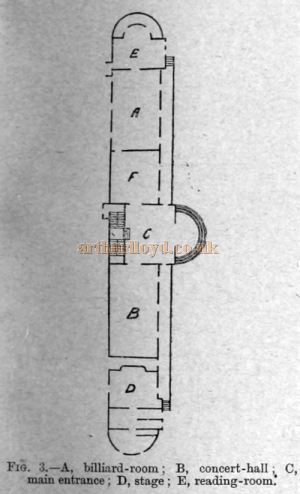 Fig.
3 is the casino at Plombieres, built in 1879 by the architect, M. Andre; this is a simple example of a well-known
French "kurhaus." The length of the block is 90 metres, while
the width is 13 metres. The reader will see from the illustration that
its chief features are the concert-hall and theatre combined, which
has accommodation for an orchestra of 40 performers (this is one side
of the vestibule), while on the other are found the reading and ladies'
room and the billiard-saloon.
Fig.
3 is the casino at Plombieres, built in 1879 by the architect, M. Andre; this is a simple example of a well-known
French "kurhaus." The length of the block is 90 metres, while
the width is 13 metres. The reader will see from the illustration that
its chief features are the concert-hall and theatre combined, which
has accommodation for an orchestra of 40 performers (this is one side
of the vestibule), while on the other are found the reading and ladies'
room and the billiard-saloon.
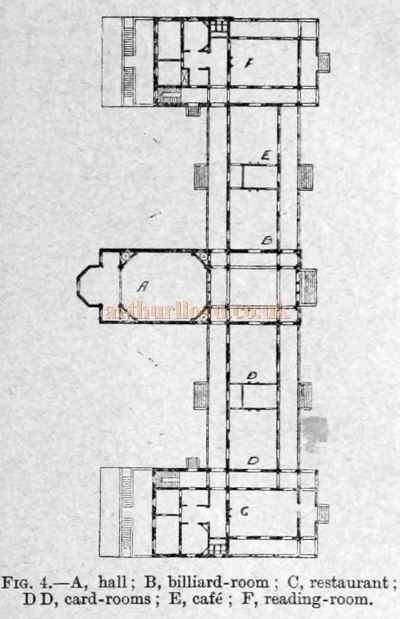 The
casino at Andona (Fig. 4) was built from designs by Messrs. Hedin and
Quellain, and is of the French type I referred to, having the large
concert-hall and theatre for its central feature, and the minor rooms
placed in the wings 'on either side.
The
casino at Andona (Fig. 4) was built from designs by Messrs. Hedin and
Quellain, and is of the French type I referred to, having the large
concert-hall and theatre for its central feature, and the minor rooms
placed in the wings 'on either side.
With regard to our own country, a German writer expresses himself in
rather curious terms when referring to the requirements of the English
people in a seaside assembly-room. He remarks that we in this country
have no desire for a social life when visiting our health resorts; that
we live there in private houses very much as when we are at home, and
that there is, therefore, no need of the multifarious rooms so universal
at the Continental "kurhaus." He says that, if any large building
is erected, it is mostly for the use of men, and is without provision
for the accommodation of ladies.
The same writer, however, informs his readers that we do possess a spa at Scarborough, which includes
a large concert-hall and winter garden, besides most of the accommodation
usual in Continental health resorts.
The above Chapters are
from an Article entitled 'Concert-Halls and Assembly-Rooms' by A.
E. Woodrow, which was Serialised in several Volumes of 'The Building
News and Engineering journal' from 1895 to 1897. So far I have been
unable to find the entire Article but if you know the whereabouts of
Chapters 1 to 7 and from 33 onwards please Contact
me.
