
Modern Stage Lighting
How the Electrician Can Help the Exhibitor
By. L. G. Applebee - From The Bioscope, 12th of March 1930
Backstage Articles Index
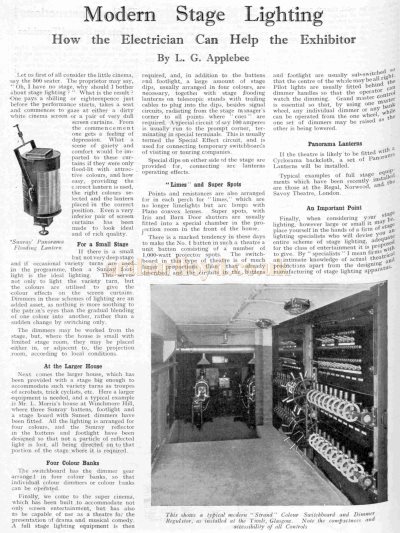 Let us first of all consider the little cinema, say the 500 seater. The proprietor may say, "Oh, I have no stage, why should I bother about stage lighting?" What is the result ? One pays a shilling or eighteenpence just before the performance starts, takes a seat and commences to gaze at either a dirty white cinema screen or a pair of very dull screen curtains. From the commencement one gets a feeling of depression. What a scene of gaiety and comfort would be imparted to these curtains if they were only flood-lit with attractive colours, and how easy, providing the correct lantern is used, the right colours selected and the lantern placed in the correct position. Even a very inferior pair of screen curtains has been made to look ideal and of rich quality.
For a Small Stage
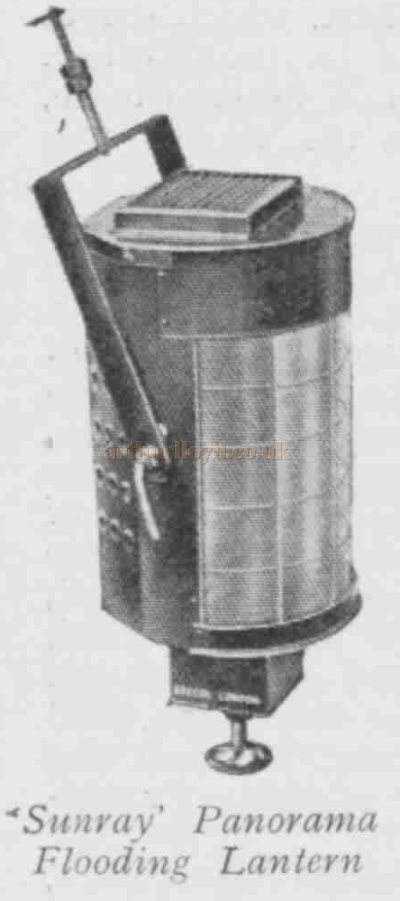 If there is a small but not very deep stage and if occasional variety turns are used in the programme, then a Sunray foot light is the ideal lighting. This serves not only to light the variety turn, but the colours are utilised to give the colour effects on the screen curtains.
Left - A Sunray Panorama Flooding Lantern - From The Bioscope, 12th of March 1930.
Dimmers in these schemes of lighting are an added asset, as nothing is more soothing to the patron's eyes than the gradual blending of one colour into another, rather than a sudden change by switching only. The dimmers may be worked from the stage, but, where the house is small with limited stage room, they may be placed either in, or adjacent to, the projection room, according to local conditions.
At the Larger House
Next comes the larger house, which has been provided with a stage big enough to accommodate such variety turns as troupes of acrobats, trick cyclists, etc. Here a larger equipment is needed, and a typical example is Mr. L. Morris's house at Winchmore Hill, where three Sunray battens, footlight and a stage board with Sunset dimmers have been fitted. All the lighting is arranged for four colours, and the Sunray reflector in the battens and footlight have been designed so that not a particle of reflected light is lost, all being directed on to that portion of the stage where it is required.
Four Colour Banks
The switchboard has the dimmer gear arranged in four colour banks, so that individual colour dimmers or colour banks can be operated.
Finally, we come to the super cinema, which has been built to accommodate not only screen entertainment, but has also to be capable of use as a theatre for the presentation of drama and musical comedy. A full stage lighting equipment is then required, and, in addition to the battens and footlight, a large amount of stage dips, usually arranged in four colours, are necessary, together with stage flooding lanterns on telescopic stands with trailing cables to plug into the dips, besides signal circuits, radiating from the stage manager's corner to all points where "cues" are required. A special circuit of say 100 amperes is usually run to the prompt corner, terminating in special terminals. This is usually termed the Special Effect circuit, and is used for connecting temporary switchboards of visiting or touring companies.
Special dips on either side of the stage are provided for, connecting arc lanterns operating effects.
"Limes" and Super Spots
Points and resistances are also arranged for in each perch for "limes," which are no longer limelights but arc lamps with Plano convex lenses. Super spots, with Iris and Barn Door shutters are usually fitted into a special chamber in the projection room in the front of the house.
There is a marked tendency in these days to make the No. 1 batten in such a theatre a unit batten consisting of a number of 1,000-watt projector spots. The switchboard in this type of theatre is of much larger proportions than that already described, and the circuits in the battens and footlight are usually sub-switched so that the centre of the whole may be all right. Pilot lights are usually fitted behind the dimmer handles so that the operator can watch the dimming. Grand master control is essential so that by using one master wheel, any individual dimmer or any bank can be operated from the one wheel, while one set of dimmers may be raised as the other is being lowered.
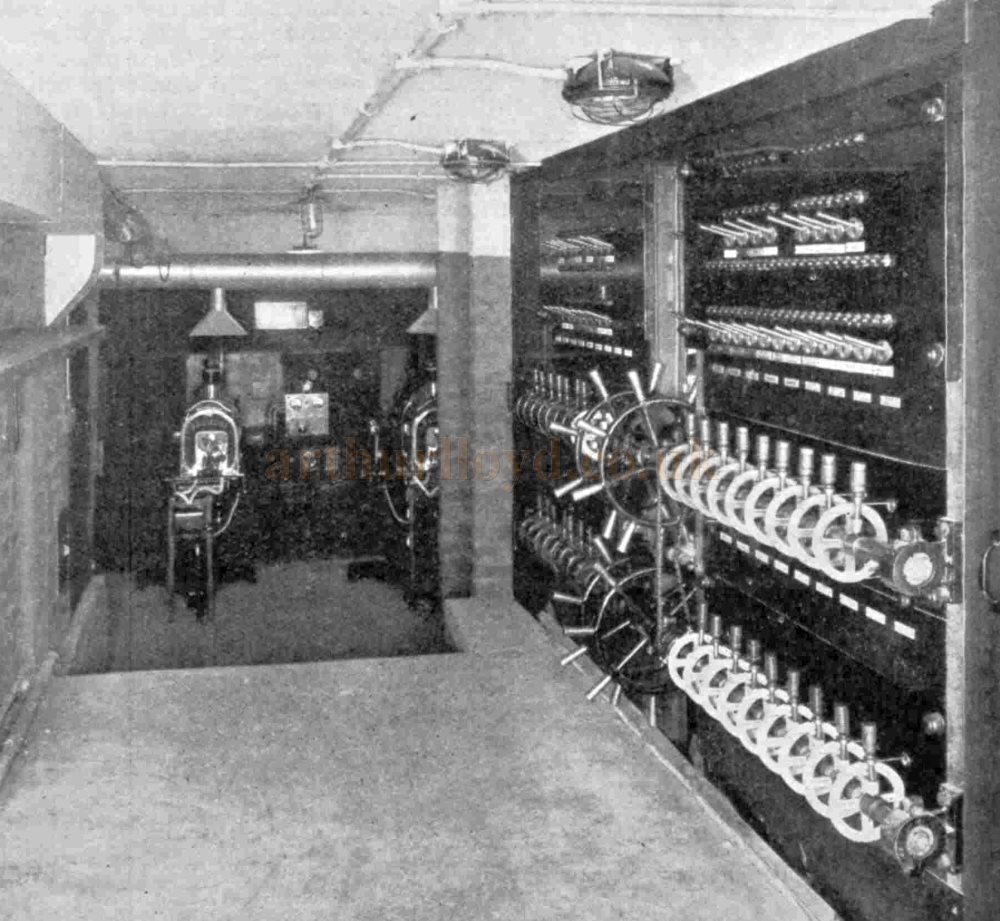
Above - A typical modern "Strand" Colour Switchboard and Dimmer Regulator, as installed at the Tivoli, Glasgow. Note the compactness and accessibility of all Controls - From The Bioscope, 12th of March 1930.
Panorama Lanterns
If the theatre is likely to be fitted with a Cyclorama backcloth, a set of Panorama Lanterns will be installed.
Typical examples of full stage eqipments which have been recently installed are those at the Regal, Norwood, and the Savoy Theatre, London.
An Important Point
Finally, when considering your stage lighting, however large or small it may be, place yourself in the hands of a firm of stage lighting specialists who will devise you an entire scheme of stage lighting, adequate for the class of entertainment it is proposed to give. By "specialists" I mean firms with an intimate knowledge of actual theatrical productions apart from the designing and manufacturing of stage lighting apparatus.
This article was first published in The Bioscope, 12th of March 1930.