
The Capitol Theatre, 794 Green Lanes, Winchmore Hill, London
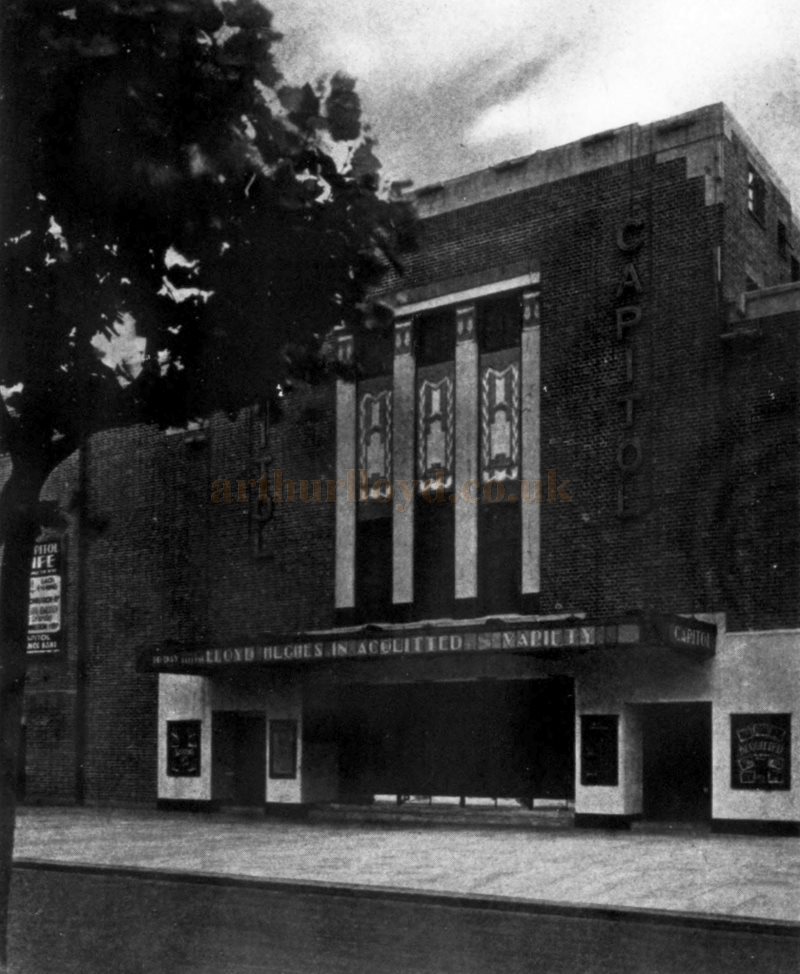
Above - The Main Entrance of the Capitol Theatre, Winchmore Hill - From The Architect's Journal, 20th of August 1930.

 The Capitol Theatre was situated on the corner of Green Lanes and Ford's Grove in Winchmore Hill, London, and was designed by Robert Cromie in the Art Deco Style for Louis Morris. The Theatre was built as a Cine Variety Theatre and had a fully equipped Stage 64 feet wide by 20 feet deep with a proscenium opening of 40 feet.
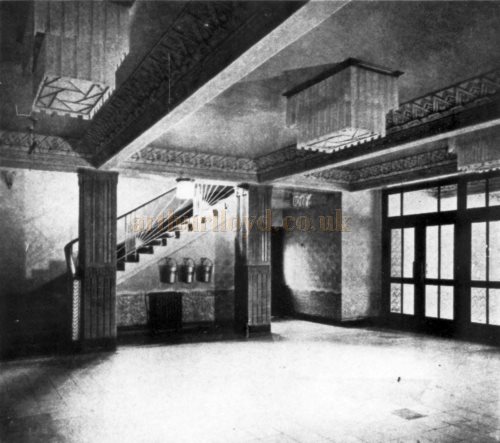
Right - The Foyer of the Capitol Theatre, Winchmore Hill - From The Architect's Journal, 20th of August 1930.
The Capitol Theatre's auditorium was built on two levels, stalls and one balcony with seating altogether for 2,000 people. There were six dressing rooms for artists, a Compton Theatre Organ, and an 18 piece Orchestra for its opening. Above the foyer and behind the Balcony was a large Tea Room and Dance Hall. The Theatre's projection room was equipped with Western Electric Projectors. There was also car parking for 100 cars.
The Theatre opened on the 26th of December 1929 with two films, 'The Burgomaster of Stilemonde' and 'Twin Beds', with news reels and a short variety show in between the features, including an Organ Recital played by Edgar F. Peto. Afterwards a reception was held in the Theatre's Tea Room which adjoined the Balcony.
The Architect's Journal reported on the Theatre in their 20th of August 1930 edition, along with several of the images shown here, saying:- 'The Capitol Cinema has been extolled in a journal devoted to the design, building and equipment of such places as an "example of what a suburban hall should be. Complete in every essential, dignified and efficient, even to its car park for 100 cars; fireproof, safe and well planned, and decorated in the best possible taste, it deserves every success." Which really means that comfort and convenience have been the first considerations in designing it. That this should be so is perfectly right, for this country has a reputation in these matters that experienced visitors from abroad have often applauded.
 Taste in decoration is a more individual concern; in this respect the house is in conformity with the current lavish criteria. It occupies a site measuring 200 ft. by 86 ft., with the long side to the main road. The main entrance is therefore at one end, and affords, with its stucco, inlaid with ceramics in green and gold, black and white, relief to the general mass of mottled brown brickwork, pointed with white cement. A marquise, cellulose-painted, shelters the doorways, and, in the fashion of the day, the building is silhouetted with neon tube lights. Nor have poster-boards, suitably illuminated, been omitted. The doors themselves are of black oak, with chromium fittings, and engraved French glass.
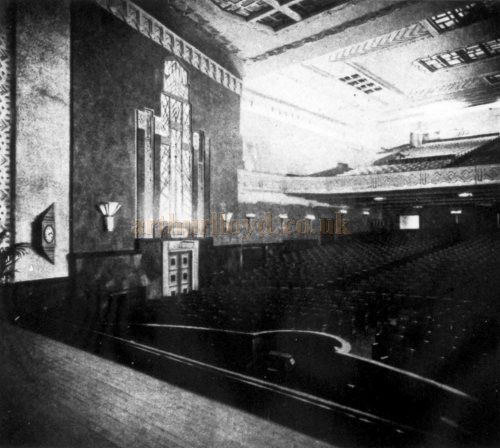
Left - The Auditorium from the Stage of the Capitol Theatre, Winchmore Hill - From The Architect's Journal, 20th of August 1930.
Passing through these, one enters, first, a vestibule, in which automatic ticket-machines are installed, and thence, the entrance foyer. Facing one are the cloakrooms; to the right, an extra exit to the street and stairway leading up to the tea-room and balcony; and, to the left, two pairs of swing-doors to the stalls. This foyer, measuring 54 ft. by 24 ft., has a floor of tiles and terrazzo, and silver, black, jade-green and blue are predominant in the colour-scheme; the joinery is of dark oak.
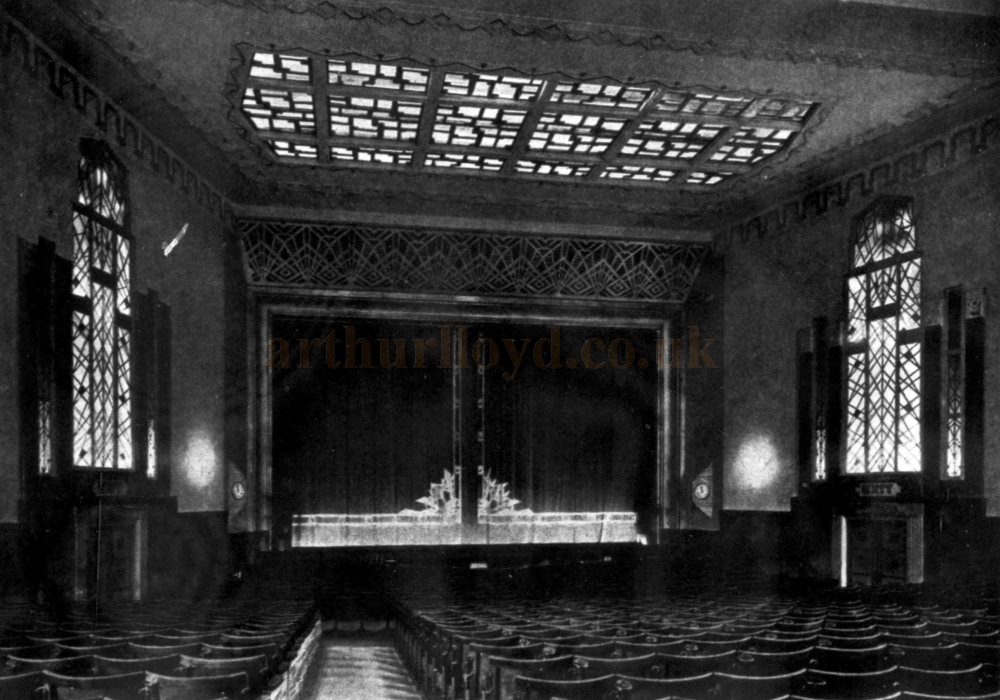
Above - The Auditorium and Stage of the Capitol Theatre, Winchmore Hill - From The Architect's Journal, 20th of August 1930.
Within the auditorium itself there is seating for 2,000 people - over 1,200 in the stalls. An interesting point is that the balcony has been placed comparatively far back, and with a rake and sight-lines calculated to provide for the arrival of the large-scale screen. The proscenium opening is 40 ft. across and 23 ft. high, with the organ grille inclined forwards above it.
The walls are in textural plaster, finished a warm champagne above a mottled dado. Orange and silver relieve the Nile green of the ceiling, which, in addition to each side-wall, has lay-light panels. The proscenium curtains and the carpets match in soft green, the chair upholstery being in green and beige.
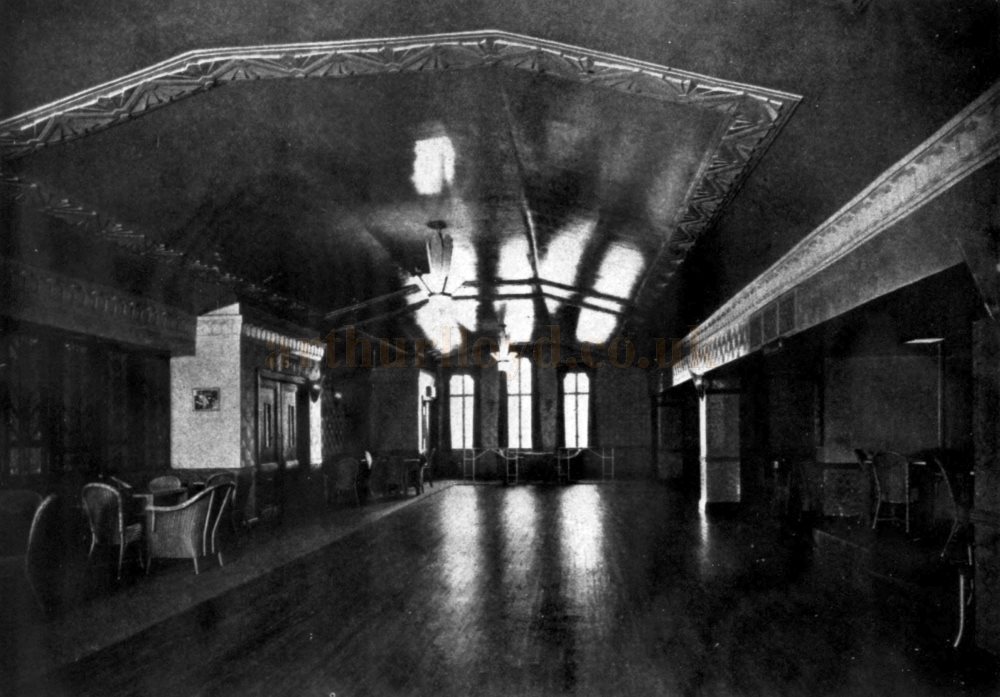
Above - The large Tea Room and Dance Hall at the Capitol Theatre, Winchmore Hill - From The Architect's Journal, 20th of August 1930. The caption for this image reads 'The tea-room has an oak floor and an orchestra alcove - one of several - for dancing, and is lit by the three-window feature of the main entrance. The walls and ceiling form a quasi-octagonal outline. The entrance from stairs leading up from the foyer is seen on the left; next to it is a glazed draught screen.'
Occupying the void behind the balcony is the tea-room, 64 ft. by 24 ft., with an oak dancing floor, and decorated in dark green and "sunshine." A number of alcoves are formed under the rake of the balcony floor, one of which can be used for a dance orchestra. The kitchen accommodation is conveniently arranged for the service of teas in the balcony. Administrative offices and stores are planned over the tea-room.
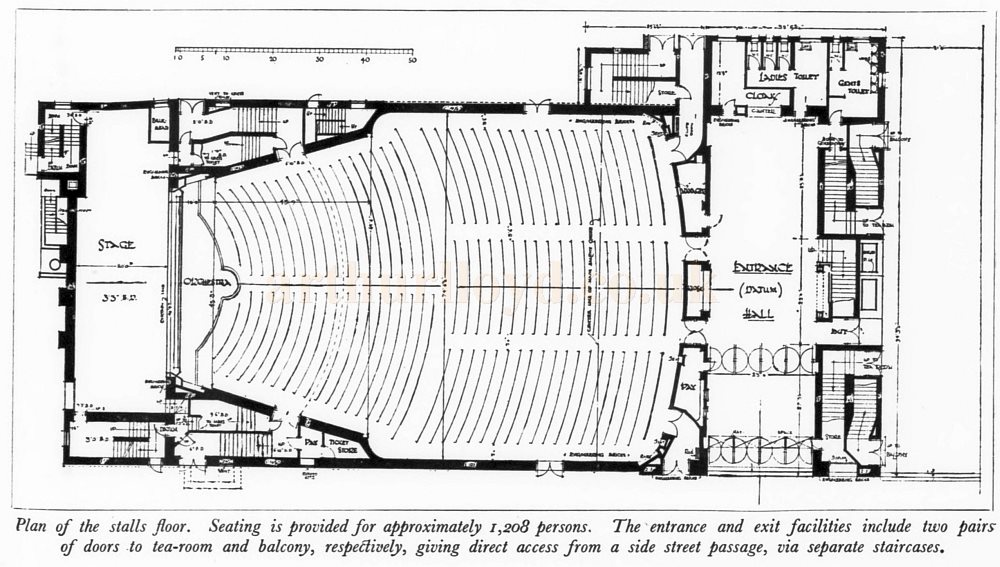
Above - Robert Cromie's Stalls Plan of the Capitol Theatre, Winchmore Hill - From The Architect's Journal, 20th of August 1930.
As usual, consideration has been given to the use of the stage for the presentation of theatrical programmes. It is some 64 ft. wide by 20 ft. deep and possesses a steel grid and fireproof curtain, while adjacent are six dressing-rooms, music store, bandsmen's and musical director's rooms. A private projection chamber is also provided. The electric installation includes a battery of accumulators for secondary and emergency use. Vacuum cleaning apparatus is fitted, and a system of electric fans, to exhaust air through grilles of large area. Heating is by a low-pressure hot-water service.'
The above text in quotes was first published in the Architect's Journal, 20th of August 1930.
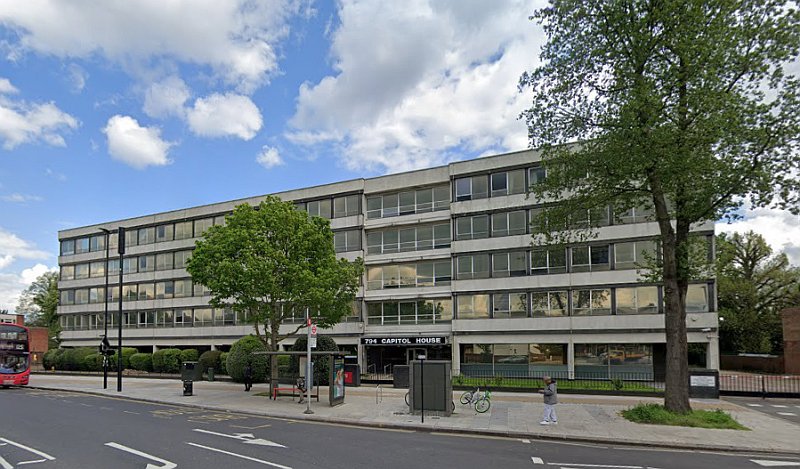
Above - A Google StreetView Image showing Capitol House, Winchmore Hill, in May 2018. The building was constructed on the site of the former Capitol Theatre in 1960 - Click to Interact.
 The Capitol Theatre, Winchmore Hill, had first opened on Boxing Day the 26th of December 1929, operated by Louis Morris. Although primarily built as a Cinema the Theatre's large stage was often used for variety performances between the features. In L. G. Applebee's article on Modern Stage Lighting in March 1930 he mentioned the stage lighting at the Capitol saying:- 'Next comes the larger house, which has been provided with a stage big enough to accommodate such variety turns as troupes of acrobats, trick cyclists, etc. Here a larger equipment is needed, and a typical example is Mr. L. Morris's house at Winchmore Hill, where three Sunray battens, footlight and a stage board with Sunset dimmers have been fitted. All the lighting is arranged for four colours, and the Sunray reflector in the battens and footlight have been designed so that not a particle of reflected light is lost, all being directed on to that portion of the stage where it is required.' - From Modern Stage Lighting by L. G. Applebee.
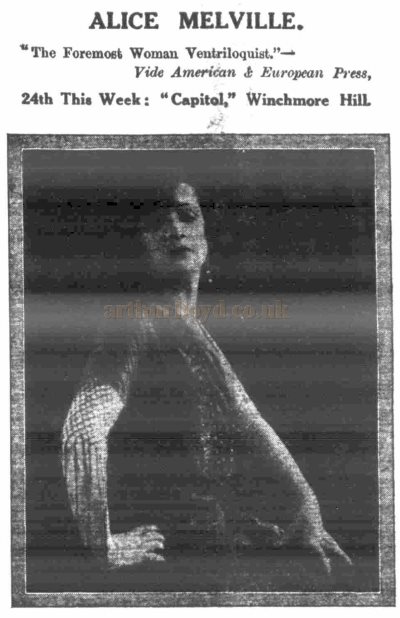
Right - An Advertisement for the Ventriloquist Alice Melville performing at the Capitol, Winchmore Hill in 1930 - From The Era, 26th of March 1930.
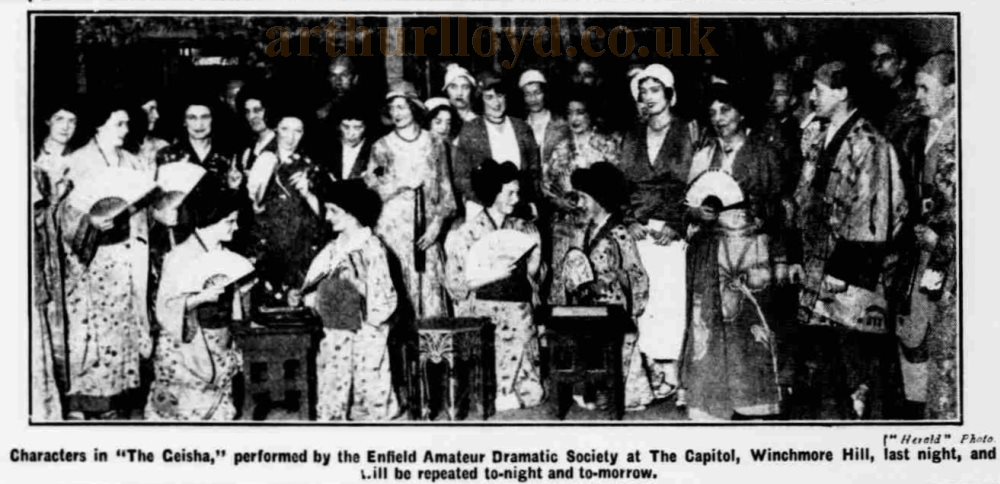
Having opened in December 1929, the following year in December 1930 the Capitol was taken over by the Associated British Cinemas chain. ABC continued to run it for the rest of its life although they would close it several times for various works. Despite the change of ownership live shows and variety were still presented along with the films at the Theatre for many years. For Christmas 1930/31 the Pantomime 'Dick Whittington' was produced on the Theatre's Stage with Billy Kay in the lead role. This was in addition to the usual film programming. The Theatre was also regularly used for Amateur production such as a performance of 'The Geisha' in January 1932, see image below.
 The Theatre was closed briefly in July 1936 for renovation work and then reopened the following month. And it was closed again on the 22nd of February 1958 for removal of the Compton Organ, it then reopened again three months later in May 1958. However, the following year it was closed again, and this time for good, on the 5th of December 1959.
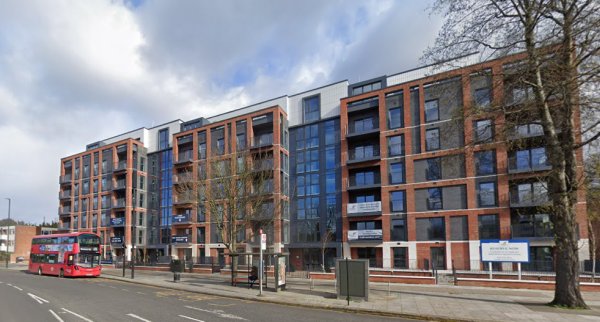
Right - A Google StreetView Image showing the site of the Capitol Theatre, Winchmore Hill, in February 2022 - Click to Interact.
The Theatre was then demolished the following year in 1960 and a Government Office Building was constructed on its site called Capitol House, see image above. This was replaced by an apartment building in 2021, see image right.
Some of the later information for this Theatre was gleaned from the excellent Cinema Treasures Website.
If you have any more information or Images for this Theatre that you are willing to share please Contact me.