
The Empire Theatre, St. Paul's Road and St. Alban's Road, Smethwick, Birmingham
See also in this area - The Windsor Theatre, Smethwick - The Theatre Royal, Smethwick
Birmingham Index

Above - A Google StreetView Image showing the former Empire Theatre, Smethwick in June 2014 - Click to Interact.
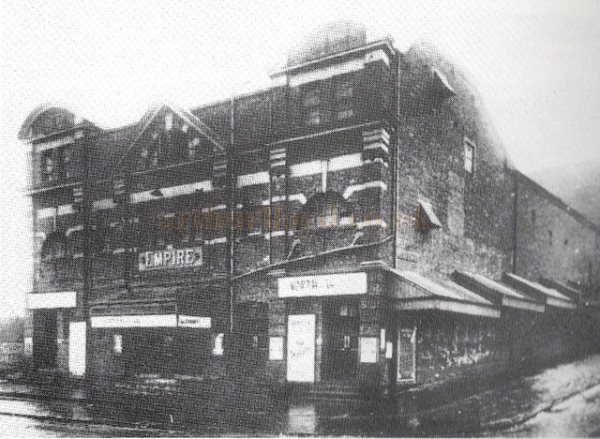 The former Empire Theatre stands on the corner of St. Paul's Road and St. Alban's Road in Smethwick. The Theatre was built as a Cinema and Variety Theatre for Kenedy and Adams and constructed by J. Dallow and Sons to the designs of a local Smethwick architect G. Bowden & Son in the Free Renaissance Style externally and the Neo-Classical style internally.
Right - An early photograph showing the Empire Theatre, Smethwick - Shown here with a Public Domain Licence from the Cinema Treasures Website.
The Theatre's Auditorium was constructed on three levels, Stalls, Dress Circle, and Upper Circle with seating for 1,500 people. The Proscenium opening was 23 foot wide by 18 feet high with a stage depth of 28 feet, an Orchestra Pit was constructed in front of the stage, and there were six Dressing Rooms underneath the stage for variety artists. The Theatre opened on the 5th of September 1910.
The Stage Newspaper reported on the imminent opening of the Theatre in their 1st of September 1910 edition saying:- 'Smethwick has yet another place of amusement - the Empire. Messrs. G, Bowden and Sons are the architects who have prepared the plans of the building, and the builders are Messrs. J. Dallow and Sons, Blackheath. The building is in St. Paul's Road, at the Corner of St. Alban's Read.
This building provides a striking architectural feature. It is a permanent structure to accommodate about 1,500 people. The elevation to St. Paul's Road is carried out in the free Renaissance style of architecture, and is in red brick with stone enrichments. The frontage to this road is 72 ft., while the building in its principal features is about 40 ft. high. There is a frontage to St. Alban's Road of about 100 ft., and on this side are entrances to the stalls and emergency exits from the pit.
The character of the entertainments will be on entirely new lines, so far as Smethwick is concerned, so that the present institutions will not come into direct competition with it. They will take the form of cinematograph entertainment, with a number of variety turns.
There are the usual parts to the house - pit (which it is proposed shall accommodate over 700), stalls, circle, private boxes, and gallery. There is admirable provision for dressing-rooms and artists' apartments. The stage is capacious and suitable for all forms of amusement, while the orchestra provides accommodation for a full band of performers.
Provision is made for very convenient seating accommodation in all parts of the auditorium. The building is brilliantly lighted with electricity, and is heated with hot-air radiators. It is interesting to note that the Empire has been designed to comply with the regulations contained in the Cinematograph act of 1909, which provides especially for the safety of the public. The conditions laid down are particularly stringent, but the architects have been materially assisted in this matter from the fact that the building is situate at the corner or two roads, thus offering exceptional facilities for meeting those emergencies which the Act was framed to meet.
The promoters feel that there has been a demand for a hall of this character in Smethwick. The proprietors are Messrs. Kennedy and Adams. Mr. B. Kennedy (who will be the managing director) has won a high reputation in connection with similar undertakings in Birmingham - at the King's Hall and the Queen's hall - and in other Midland towns. Mr. W. H. Adams will be the secretary.
There are spacious lobbies, booking offices, staircase, and a lounge at the entrance. The entrance vestibule, etc., is decorated with ornamental fibrous plaster. The operating box is fireproof and outside the auditorium. There are also cloak-rooms and lavatory conveniences. The proscenium is 23 ft. by 18 ft., and is profusely decorated with ornamental figures, the colours being cream and gold. The electric cars pass the front of the house, and the two railway stations (Smethwick, L. and N.W. Railway) are within five minutes' walk. The opening performance takes place on Monday next, September 5, and the Mayor, Aldermen, Councillors, and other prominent persons have promised their patronage.'
The above text in quotes was first published in the Stage Newspaper, 1st of September 1910.

Above - A Google StreetView Image showing the former Empire Theatre, Smethwick in June 2023, now heavily altered for its use as the Gurdwara Baba Sang Ji Sikh Temple - Click to Interact.
The Empire Theatre had first opened on the 5th of September 1910 as a Variety Theatre and Cinema but in October 1924 it was altered for full time Cinema use by removing the Upper Circle and adding a Compton Theatre Organ. The Empire Cinema was however finally closed on the 13th of April 1957, its Compton Organ was then reinstalled in the Holly Lodge Grammar School and its seats were reused in the 1960s rebuilt Elm Church in West Smethwick.
After this the Theatre was used for many years as a scenery store and scenic studio called the Empire Scenic Studios, with the stage blocked off by the iron curtain and the dressing rooms and backstage areas abandoned. The Theatre's former foyer was put to use as a 'do it yourself' DIY shop at the same time.
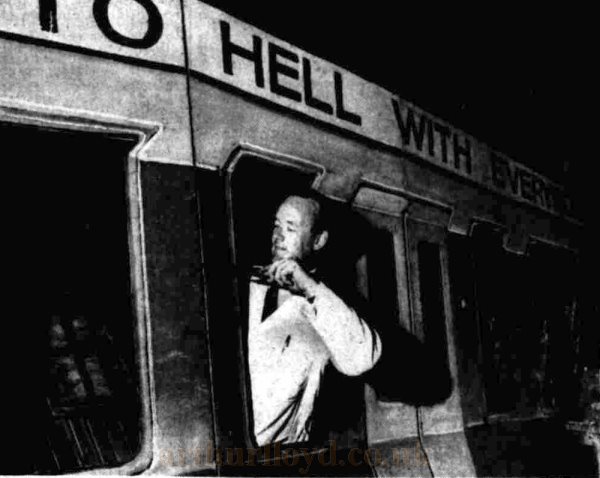 The Empire Scenic Studios were created by Roger Hewitson, whose grandfather owned the former Theatre, and Derek Wright who was a scenery builder for Television productions.
Right - Roger Hewitson working on a set for 'Orpheus in the Underworld' at the Empire Scenic studios, Smethwick, formerly the Empire Theatre - From the Birmingham Daily Post, 30th of August 1967.
They started out by using the former Theatre for building sets for repertory productions at the nearby Windsor Theatre in Bearwood, until that Theatre closed in 1960, and then went on to build sets for all manor of productions, the Theatre's Stage was later repurposed for the painting of scenic cloths and backdrops. Roger Hewitson was quoted in contemporary newspaper articles as saying that he was sure that people would tire of Television eventually and come back to Theatres, but sadly history has proved him wrong and Television still reigns supreme to this day, although Internet Streaming Services are giving it a run for its money these days.

Above - Scenic Artist David Perry working in the former Stage of the Empire Theatre, Smethwick in the 1980s - Courtesy Michael Perry who says that his father David Perry painted scenery for Roger Hewitson in the 1950s / early 1960s, and that he had a large room, possibly the former lounge bar in the dress circle, as a studio. David painted over 100 backdrops for Theatres and scenery hire companies and also did stage sets for new wave pop bands in the early 1980s, before doing full size rock and pop stadium backdrops and touring sets. He traded as David Perry, then David Perry Backdrops, the David Perry Scenic Productions, and then Perry Scenic Ltd.
The former Empire Theatre, Smethwick was eventually radically altered for use as a Sikh Temple, known as Gurgwara Baba Sing Ji, which is still in operation at the time of writing in 2025, see image above.
If you have any more information or images for this Theatre that you are willing to share, please Contact me.