
The Windsor Theatre, 377 Bearwood Road and Dunsford Road, Bearwood, Smethwick, Birmingham
See also in this area - The Theatre Royal, Smethwick - The Empire Theatre, Smethwick
Birmingham Index
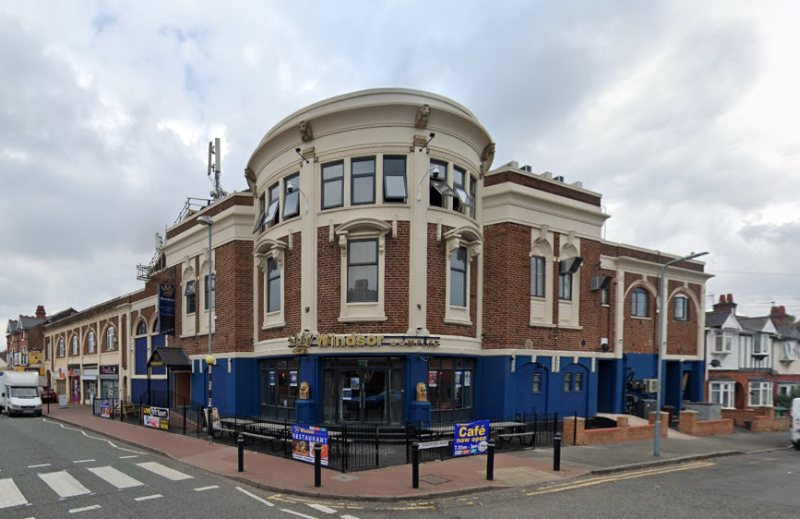
Above - A Google StreetView Image showing the former Windsor Theatre, Smethwick in June 2022 - Click to Interact.
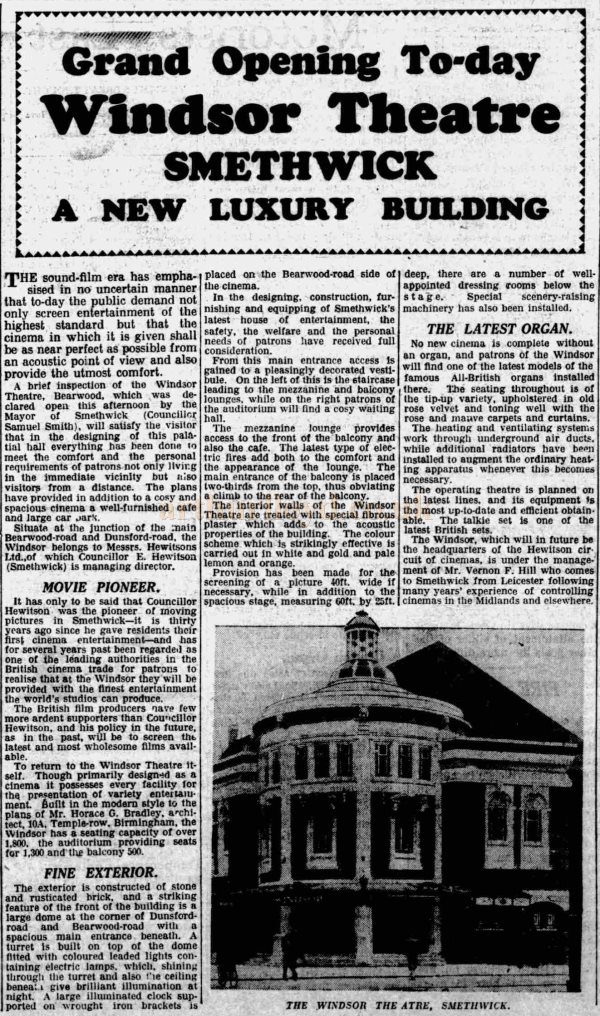 The former Windsor Theatre is situated on Bearwood Road in Bearwood just south of Smethwick, Birmingham, and first opened on the 29th of September 1930. The Theatre was built for the Hewitson's Chain of Theatres and Cinemas and was designed by Horace G. Bradley. Although primarily this was a Cinema it did also have a quite large stage, 45 foot wide at the Proscenium, and 25 foot deep, and had eight dressing rooms for artists below the stage.
Right - An Illustrated Article on the Grand Opening of the Windsor Theatre Smethwick - From the Evening Despatch, 29th of September 1930.
The Auditorium was constructed on two levels, Stalls and one Circle or Balcony, which altogether could seat around 1,800 people. The Theatre was equipped with a Compton Theatre Organ, and Patrons could enjoy the comfort of several Lounges, a Waiting Room, and also a Cafe on the Mezzanine Level.
The Ideal Cinema Supplement to Kinematograph Weekly reported on the new Windsor Theatre in their 13th of November 1930 edition saying:-'The Windsor Theatre, Smethwick, is owned and controlled by the Hewitson family. Coun. Edward Hewitson, an ex-President and General Council member of the C.E.A., has not been content to live on his local reputation as a pioneer of moving pictures. The new theatre, for which the public selected a title, gives expression not only to the modern outlook of architects and the skill and ingenuity of kinema technicians, but to the determination of the Hewitsons to march with the times and anticipate, as well as interpret, the tastes and requirements of kinema patrons.
The exterior is thoroughly modern, rusticated bricks and white stone dressings having been effectively employed for the handsome semi-circular frontage at the junction of Bearwood Road and Dunsford Road.
 The Imposing Front
Over the main entrance is an ornamental wrought-iron canopy carrying the name of the house in opal-coloured letters. Above the entrance are finely designed stained-glass windows, and there is a striking dome, surmounted by an ornamental turret. Another feature is the large, electrically-lit clock, supported by wrought-iron brackets and synchronised with the handsome clocks in coloured-glass frames in the theatre and lounges.
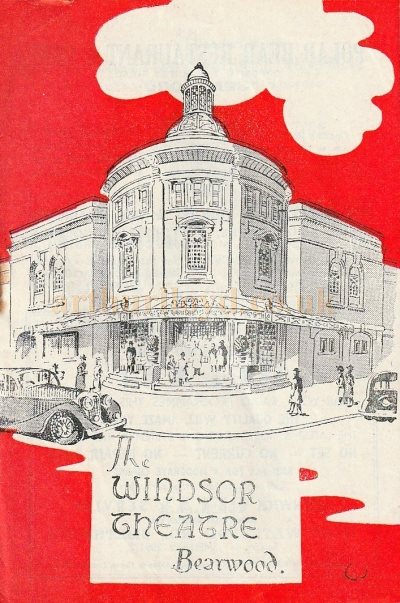
Left - A Variety Programme for the Windsor Theatre, Bearwood from May 1951 - Courtesy Simon Moss, stagememories. More of this programme can be seen below.
First impressions of beauty, luxury and comfort are gained in the well-appointed vestibule and auditorium floor crush hall. Plaster cornucopias form a decorative feature of the vestibule, which accommodates the pay-box and a chocolate and smokers' service stall. The crush hall has a washed ceiling and the walls are treated with a lemon-coloured plastic texture material, relief being obtained by means of a frieze enriched with pastoral scenes.
Cafe and Lounge
On the mezzanine level are the cafe and lounge, furnished with Lloyd Loom chairs and couches, and tastefully decorated to give the impression of refinement and restfulness. Tapestry panels, handsome mirrors (artfully distributed), and a gold-and-white ceiling, combined with electric fires of the latest type, and a soft, caressing lighting scheme, tempt one to linger.

Above - Details from a Variety Programme for the Windsor Theatre, Bearwood from May 1951 - Courtesy Simon Moss, stagememories. Notice the miss-spelling of Morecambe and Wise who would soon become the massively popular Television entertainers of the 1950s and onwards.
But we ascend, by another easy stage, to the balcony lounge, there to be fascinated by the coloured leaded lights of the dome, specially designed electric wall fittings, and the general scheme of things. The beauty of the theatre interior is commented upon by every visitor. The main walls and ceiling are finished with plastic Paint in different textures. The ceiling has a geometrical pattern, and is divided into sections, decorated with gold and white dressings and rosettes. Centrally, there is a great oval-shaped dome, set off with one of the most delicately beautiful electric light fittings in the Midlands.
 Scenic Spandrels
Sloping from the ceiling to the top of the proscenium are the decorative plaster organ grilles, flanked by scenic spandrels, one depicting Loch Ard, Aberfoyle, and the other Loch Aberfeldy, Strathtay. Scottish scenes all of which are authentic, give character and atmosphere to the mural paintings, executed with great skill by artists in the service of Fred A. Foster, of Basford, Nottingham.
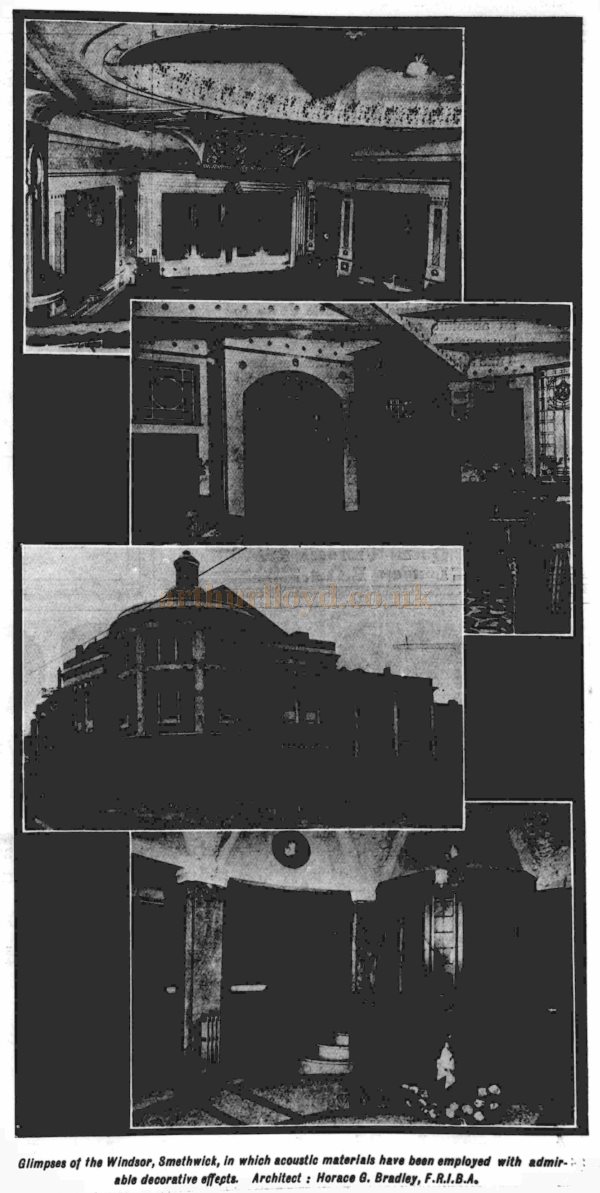
Right - Various views of the Windsor Theatre, Bearwood when it first opened in 1930 - From the Ideal Cinema Supplement to Kinematograph Weekly, 13th of November 1930.
One of the large panel paintings on either side of the auditorium represents the River Tummel, Perthshire, with a sunset view of Loch Lomond a little higher up. On the opposite side we see the Falls of Bruar, in harmony with Loch Aberfeldy, and other river, gorge and mountain mist scenes, all being typical of the land beyond the Tweed. These paintings are the feature of a scheme notable alike for its colourings, atmosphere and tone, and completely charming when brought up by the four-colour lighting system - red, blue, green and yellow.
Seating and Furnishing
In the seating and furnishing of the Windsor great care has been taken to give patrons nothing but the best. Accommodation is provided for upwards of 1,800 persons. W. W. Turner and Co., of King's Heath, Birmingham, the well-known theatre furnishers, supplied super-Wilton figured carpeting for the balcony and ground floor, and installed all the seating. Five hundred tub chairs, fitted with patent silent ball-bearing brackets, are fixed in the balcony, which has a horse-shoe front. These chairs are of the latest design, spring-edged and hair-upholstered, with rose velvet coverings. The auditorium chairs, numbering 1,270, also have patent ball-bearing brackets and are covered in old rose velvet. Turner and Co. also supplied the modern "all-over" auditorium curtains. Seats, curtains and the rose and mauve-coloured carpets tone admirably.
The Windsor stage is one of the biggest and best equipped in the Birmingham district. Hall and Dixon, of London, another enterprising and successful firm of theatre furnishers, must be complimented upon its treatment of the stage and proscenium. The proscenium tabs and pelmet are in a soft shade of green velour, with a handsome design carried out in bright satins. Shades of copper, petunia, rose, gold, cerise and mauve are artistically blended.
Side splay curtains and stage borders in rose-colour velours match the colour of the seating. The screen curtain is in a special art satin cloth of silver shade. This material was specially made for Hall and Dixon, experiments having shown that it is the best for taking the full value of the colour thrown upon it. The curtains have an original design carried out in satins, with mauve, cerise, blue, Petunia and other colourings, and trimmings of satin cloth, sprayed with real gold, giving a brilliant finish.
Electrical Installation
The electrical equipment, installed by the Midland Electric Power Co., Old Mill Street, Wolverhampton, possesses many interesting features, especially as provision has been made for variety turns as well as for talking pictures. The main control is from a large switchboard housed, of course, in the switch-room. This is divided into two sections and carries all the usual switch and fuse gear for house Lighting, motor generators, talkies, fans, small motors, etc. From this point a secondary supply is let to a separate stage switchboard controlling the battens, footlights, perch arcs, and sundry small motors connected with the general heating system, electric organs, etc.
The organ chambers are kept at a uniform temperature by means of Morganite suspended heaters controlled by thermostats. An elaborate four-colour lighting system is installed, with dimmers situated on the stage switchboard and in the projection-room, allowing dual control of the system. Two sets of electrically-controlled curtains are fitted for the proscenium front and the screen. Special floodlights illumine the central portion of the façade, and the glass dome is illuminated from inside. The circular waiting-halls are artistically lit from specially-designed circular bronze fittings, let into the walls. Some idea of the complexity of the electrical installation may be gathered from the fact that in all there are six switchboards with a total length of over 30 ft.
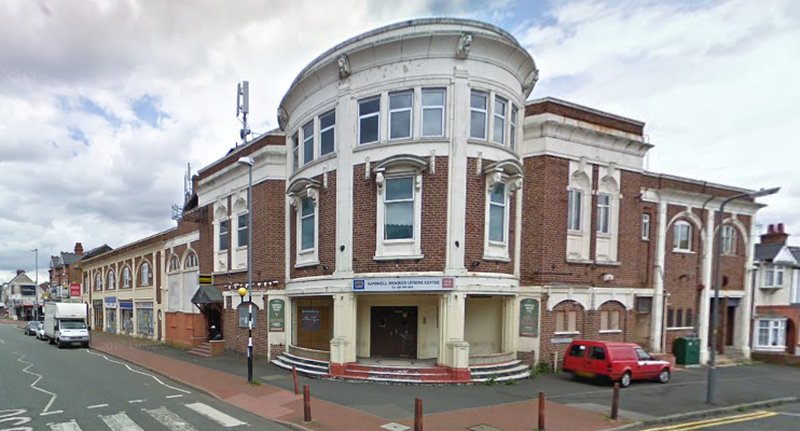
Above - A Google StreetView Image showing the former Windsor Theatre, Smethwick whilst in use as the Sandwell Snooker Leisure Centre in July 2009 - Click to Interact.
Decorative Lighting
The decorative lighting scheme was specially designed by George Franklin and Co., Ltd., 10, Vyse Street, Birmingham. The decorative fittings are constructed of steel and aluminium and finished with a new process, which gives the appearance of oxidised silver. This, it is stated, is the first time that aluminium has been extensively used for lighting fittings. The fittings are unique in design and the workmanship embodies much skill. The large fitting in the dome is 12 ft. 6 in. by 4 ft. 6 in., and the organ light is 25 ft. 6 in. long. The employment of "Francolite" glass for the panels gives a delightful colour touch to the illumination.
The operating chamber and generating resistance and rewinding rooms are hung under the balcony. Thus a perfect picture, with a shortened throw from the Kalee No. 8 projectors is assured. Provision has been made for a 40 ft. wide picture should future developments demand it. Below the stage, which measures 60 ft. by 25 ft., are several well appointed dressing-rooms, and the equipment includes special machinery for raising scenery.
The musical accompaniments to films presented at the Windsor come from an organ of the latest type, installed by the John Compton Organ Co., Ltd., of London.
 B.T.H. Equipment
B.T.H. Sound equipment (Type "B") has been installed at the Windsor. The installation comprises two Universal bases with sound heads and synchronous disc drives fitted with Kalee mute-heads. A dual change-over control-box incorporates the fader and the 40 watt "B" type amplifier has two 20 watt undistorted output amplifiers in parallel, feeding eight R.K. loudspeakers behind a porous screen and a monitor R.K. speaker in the operating box.
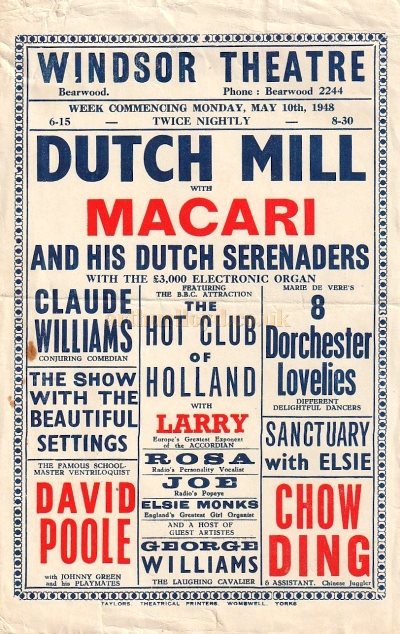
Right - A Flyer for a Variety Show at the Windsor Theatre, Bearwood in May 1948 - Courtesy Simon Moss, stagememories.
The conversion gear consists of five h.p. motor, fed from the town supply, driving a 110 volt D.C. generator for projector motors, speaker fields and rotary converter, and a 10-volt D.C. generator for exciter lamps, also a rotary converter, 110 volt D.C. to 110 volt 60 cycles A.C. for amplifier supply.
A non-synchronous twin turn-table unit, for incidental music during the presentation of silent films, or, as otherwise required, is also installed. This work has been carried out by Sound Equipment, Ltd., London, on behalf of the British Thomson-Houston, Co., Ltd.
Ample exits and retiring rooms are provided, and the safety of the public has been carefully considered, in consultation with the local fire brigade chiefs. The plan provides for a row of shops on the Bearwood Road frontage and the inclusion in it of offices and a boardroom has resulted in the Windsor becoming the new business headquarters of the Hewitson circuit.'
The above text in quotes was first published in the Ideal Cinema Supplement to Kinematograph Weekly, 13th of November 1930.

Above - A Google StreetView Image showing the former Windsor Theatre, Bearwood, Smethwick in use as the Windsor Complex in June 2024 - Click to Interact.
The Windsor Theatre, Bearwood, Smethwick had first opened on the 29th of September 1930 and was programmed with Films and Variety Shows on its stage from the start. After the Second World War ended in 1945 the Theatre went over to full time theatrical use for many years until its eventual closure on the 6th of February 1960 with a final performance of the Pantomime 'Mother Goose'.
After its closure the Theatre's Compton Organ was removed and then installed in the Oxley Parish Church in Wolverhampton, and the Theatre then remained closed and boarded up for many years until it was eventually reimagined as an Ice Skating Rink. This use ended in 1973 however, and the former Theatre then remained unused again until 1980 when it was converted into a Nightclub for a couple of years, closing again in 1982. Conversion into a Snooker Club followed this but it was later altered for use as a Bar called the Windsor Theatre with live music acts entertaining the patrons. However, this also ended in 2021 and the former Theatre was put up for sale.
At the time of writing, in April 2025, the former Theatre has been reimagined yet again, this time as a Family Friendly Indian Restaurant, along with Ten Pin Bowling and Pool Tables, called the Windsor Complex. Their own Website can be visited here.
If you have any more information or images for this Theatre that you are willing to share, please Contact me.