
Obituaries and Information on Frank Thomas Verity, Architect
Frank T. Verity's Theatres - Frank T. Verity's Theatres with S. Beverley
Obituary from the Architects' Journal - Obituary from Journal of the Royal Institute of British Architects - The Work of Frank T. Verity By A. TRYSTAN EDWARDS
Frank T. Verity's Obituary from the Architects' Journal 1937
 It is with deep regret we record the death of Mr. Frank Thomas Verity, F.R.I.B.A. He was responsible for the design of a large number of cinemas, theatres and flats, first of all on his own account and latterly in partnership with his son-in-law, Mr. S. Beverley, F.R.I.B.A.
Mr. Verity was articled to his father, the late Thomas Verity, and was also a pupil of R. Phene Spiers. He studied at the Royal College of Art, Kensington; University College; the A.A. and the R. A. Schools; and in Paris. He was the R.I.B.A. Tite Prizeman in 1889, in which year he was elected an Associate of the R.I.B.A. Seven years later he became a Fellow.
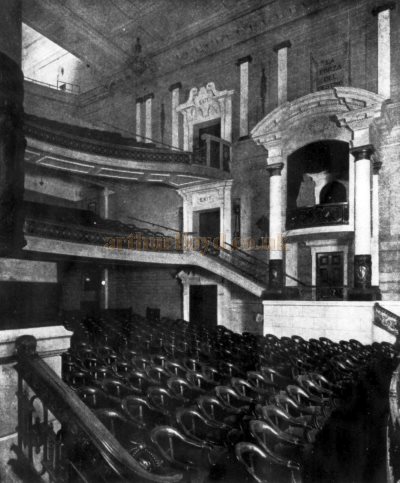
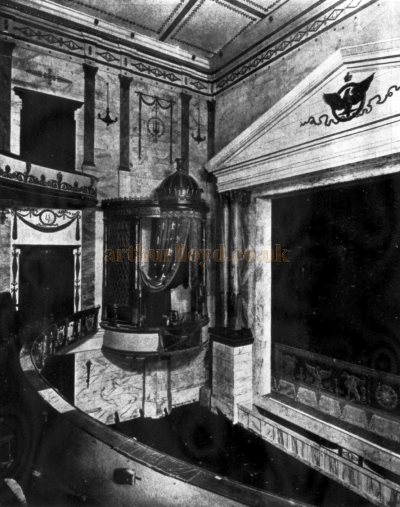
Right - Frank T. Verity's Auditorium of the Scala Theatre, London - From The Architects' Journal, 1st of July 1925.
Mr. Verity held the appointment of Architect to the Lord Chamberlain's Department, was corresponding member to the Societe Archeologique de France and also served on the Council of the R.I.B.A. In 1923 he won the R.I.B.A. London Architecture Medal with the Shepherd's Bush Pavilion. The cinemas and theatres designed by Mr. Verity include: Imperial Theatre, Westminster (now demolished); old Empire, Leicester Square; Scala, Charlotte Street; Carlton Theatre, Haymarket; Pavilion, Marble Arch; Theatre Royal, Bath; Theatre Royal, Windsor; and the Vaudeville Theatre, Paris.
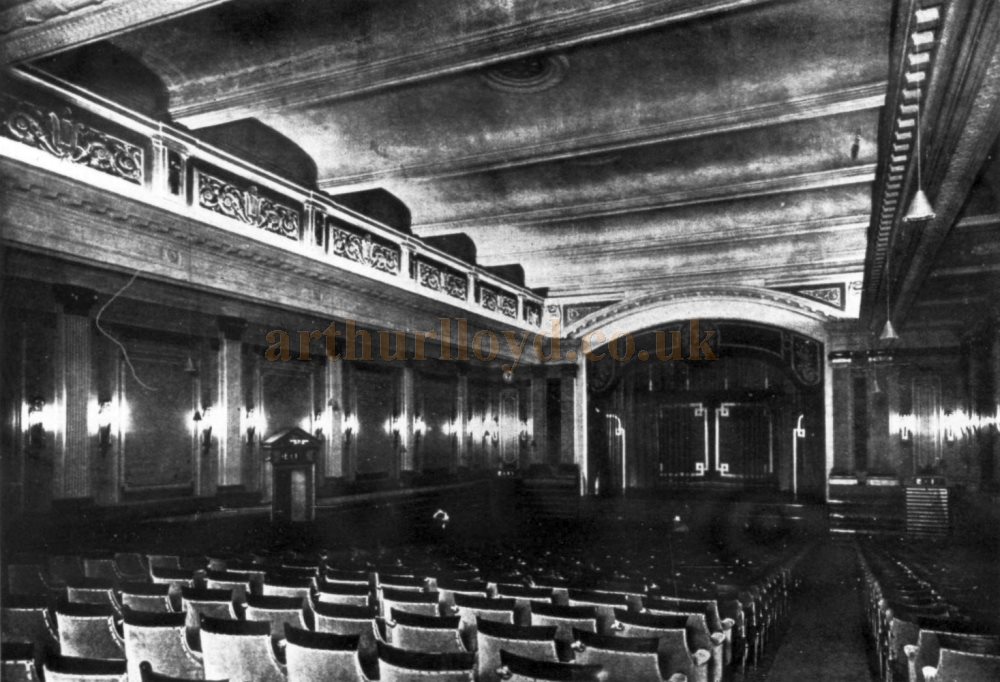
Above - Frank T. Verity's Auditorium of the Marble Arch Pavilion, London - From The Architects' Journal, 1st of July 1925.
Mr. Verity acted as European architect for the Paramount Film Company, for whom he built the Plaza, Regent Street; the cinema recently completed in Tottenham Court Road, and a number of cinemas in provincial towns. Some of these were designed in collaboration with Mr. S. Beverley, F.R.I.B.A.
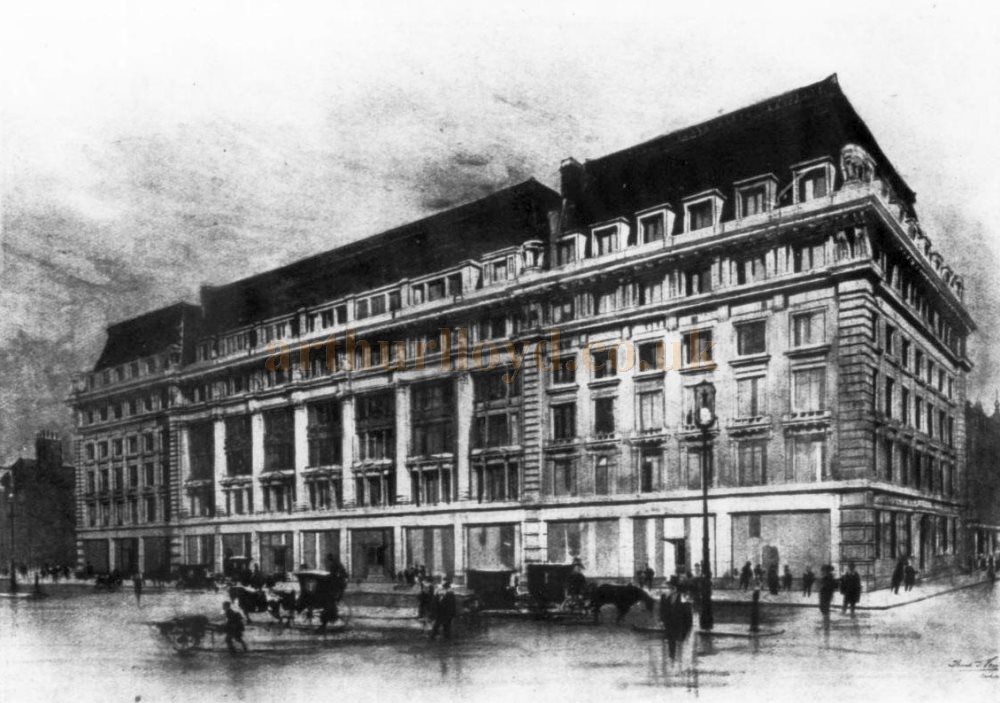
Above - Frank T. Verity's Polytechnic, regent Street, London - From The Architects' Journal, 1st of July 1925.
Other work executed by Mr. Verity included: new facade, Polytechnic, Regent Street; Junior Naval and Military Club, Piccadilly; Civil Service Co-operative Society's building, Haymarket; annexe to French Hospital, Shaftesbury Avenue; and flats in several parts of London.
The above article was first published in the The Architects' Journal 1937.
Frank T. Verity's obituary from the Royal Institute of British Architects 1937
By H. S. GOODHART-RENDEL
 I suppose that most architects can remember some building or picture of a building that first woke their critical sense, that first upset the cocksure preferences of their inexperience. My awakening came when I was fifteen years old, and the Building News (to which a kind grandmother had given me a subscription) published a drawing by Professor Adshead entitled "Mansion Flats, Hyde Park Place W. Frank T. Verity, F.R.I.B.A., Archt."
Right - Frank T. Verity's Flats in Hyde Park Place, London - From The Architects' Journal, 1st of July 1925.
How this picture struck me at fifteen could hardly be of interest to anybody if it were not, as I fancy, that the same picture must have struck my elders in the same way, and no doubt more forcibly. Nobody then was building any flats like that in London. Flats that had no gables, no turrets, no visible chimneys, no glazing in small squares. Flats that had six equal storeys allowed to look equal, and in which the only cornice was a large one at the top of the wall.
 I recognised those flats as extremely Parisian, and realised for the first time how barbarous Parisian common sense made our common nonsense seem in comparison.
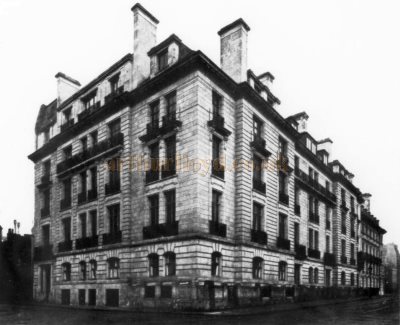
In the years immediately after their appearance, Mr. Verity went on being Parisian in other London flats, in those on the site of Thomas's Hotel in Berkeley Square, in two blocks in Portland Place and in another block in Cleveland Row.
Left - Frank T. Verity's Block of Houses and Flats in Cleveland Row, London - From The Architects' Journal, 1st of July 1925.
Last of the series came the big block at the Oxford Street corner of Park Lane, a block that still seems to me to present much the best architecture that can be found in that thoroughfare.
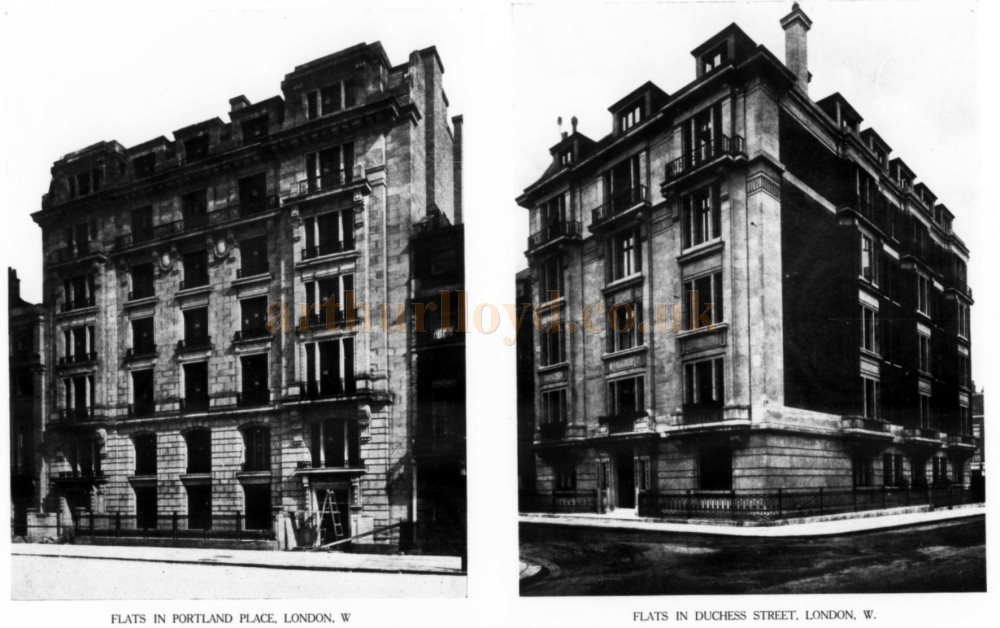
Above - Frank T. Verity's Flats in Portland Place and Duchess Street, London - From The Architects' Journal, 1st of July 1925.
All of these buildings are French, not only in their reasonableness but in their style: their details, although original, suggest the epoch of Louis Seize. There is also a strong French flavour in the neo-Grec facade of the London Polytechnic and in the one realised fragment lower down of Mr. Verity's splendid design for the whole of Regent Street. How a street so imagined by a great artist can have been afterwards thrown to the tender mercies of the architectural jungle is a mystery that the Woods and Forests authority, happily, is no longer present to explain. Even the block of which Mr. Verity's design now forms part was not finished by his hand.
 French reasonableness marks everything that Mr. Verity did, although the style of his most frequent choice was not French but Italian. In the year 1889 he won the Tite prize with his design for a theatre in the Venetian style of the sixteenth century, and never did a student win that prize with a design more prophetic of what he was afterwards to execute in practice. The interiors of his Imperial Theatre (now pulled down) and of his Scala Theatre link this prize design naturally with his comparatively recent cinemas, the Plaza and the Carlton. All are Italian and all architecturally are most successful.
Right - Frank T. Verity's Auditorium of the Imperial Theatre, London - From The Architects' Journal, 1st of July 1925.
It is reasonable to hold that for a modern commercial theatre, and, still more, for a modern commercial cinema, rich Italian architecture is inappropriate. Too much stylishness makes an unkind frame for a scene or a picture that will most often have no stylishness at all. If we decide, as we may, that the Plaza and the Carlton are buildings of a sort we do not now desire for film display, it will be a providential let-off for the increasing number of architects unable to handle any forms but the most elementary, but it also, I think, will be wise. Yet Mr. Verity's more sumptuous cinemas are examples of such high architectural accomplishment that anyone is to be pitied who cannot enjoy them for their own sake. In designing them he did what he never failed to do - he dignified the requirements of his employers by the art he expended in supplying them.
 I think it probable that if he had tried his hand at the simplified architecture now in vogue he would have given it a distinction it has not yet secured. His was the masterly ease in designing certain things that shows its possessor to be capable of designing anything. The stylism of his work is but a superficial quality, whereas its excellence lies deep in the fundaments of architecture. He could plan sensibly and beautifully, he could combine masses harmoniously, he could decorate them consistently and gracefully, and in a complex design he could give its due proportion to every detail, even the smallest.
Left - A period postcard showing Frank T. Verity's Plaza Theatre of 1926.
 These abilities ought, no doubt, to be commoner than they are, seeing that they are obviously desirable and that by study and training they can be acquired. Very few people, however, acquire them, and those who do are rewarded with but little public praise. An architect who designs within accepted conventions as skilfully as Mr. Verity designed does so only from love of his art. The same sort of designing with the art left out would be just as well received by the world at large. But other architects can recognise the art and pay it their tribute of praise.
Right - The Exterior Frontage of the Carlton Theatre, Haymarket - From the opening night programme of 'Lady Luck'.
Work of the quality of Mr. Verity's is the fruit of a civilisation in which intellect and experience were held in high honour. They are not always so held to-day. Those who dread the decay of culture with which Europe seems to be threatened must be jealous for the fame of all art in which the values are purely artistic. Such art was Mr. Verity's, not very progressive, perhaps, but elegant, accomplished and mature. That its activity should be over is a heavy loss to English architecture.
The above article was first published in the Journal of the Royal Institute of British Architects 1937.
The Work of Frank T. Verity
By A. TRYSTAN EDWARDS
From The Architects' Journal, 1st of July 1925
 The Royal Institute of British Architects having awarded the medal for the best street façade of the year to Mr. Verity, the event is naturally an occasion for attempting an analysis of the qualities which have gained him such distinction. As Mr. Verity has enjoyed a large practice for many years and has designed many theatres, shops, and blocks of flats, we are fortunate in being provided with plenty of material for such a judgment.
Right - Frank T. Verity's St. George's House, Regent Street, London - From The Architects' Journal, 1st of July 1925.
The first thing that strikes one in Mr. Verity's work is its consistency. He has chosen a particular variant of the Classic style, and he sees no reason to depart from it. We shall see no Mendelsohnian pranks from him. And not only is his style consistent, but it has the merit (and a rather rare one, these days) of being an urban style. Mr. Verity's buildings belong to the town. I should very much doubt if he has ever designed a gable in his life. He has certainly never put one on an urban façade. Take the block of flats in Bayswater Road. A single glance at this building is sufficient to make us aware that Mr. Verity has exactly caught the metropolitan character, the solidity, the assurance, combined with restraint, which a domestic building set in a great city ought to have. And these flats have not only metropolitan character, but the domestic character. How is this latter attained in the case of flats? By the compliance with certain rules of composition, mostly of a negative character. If in the design of flats certain conspicuous faults are avoided, the result will be sure to give a certain quite definite satisfaction. A common tendency is to group the flats into too conspicuous a unity, with the result that the block acquires the character of an institution rather than the abode of private individuals who do not happen to be united in any close social relation. All Mr. Verity's flats express this domestic quality admirably by the flat-topped rectangularity of the facades and the fairly even distribution of points of interest over the façades themselves. Thus the occupants do not group themselves into an architectural whole, such as might be expressive of a semi-public building, nor is there instituted among them a kind of hierarchy of social importance as would be the case if certain portions of the façade were conspicuously emphasized by pediments or other prominent architectural features.
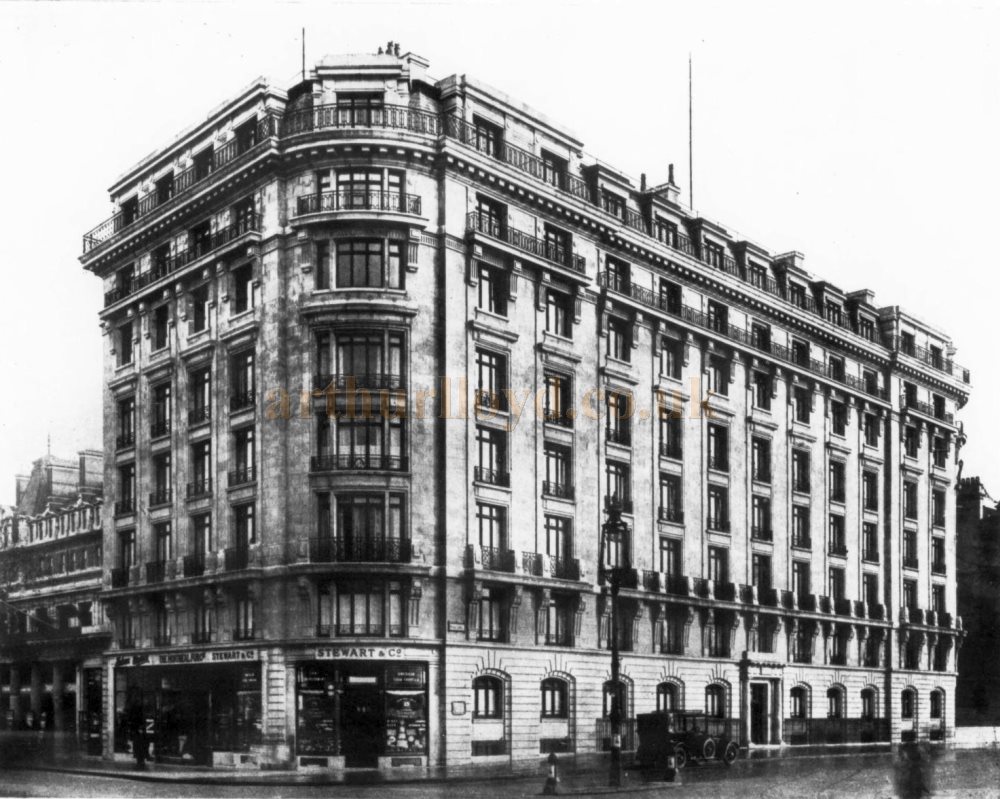
Above - Frank T. Verity's Flats in Park Lane, Marble Arch, London - From The Architects' Journal, 1st of July 1925.
Let us glance at the illustrations of some of these street fronts to blocks of flats. That at Hyde Park Place possesses in a special degree the merits which may be looked for in Mr. Verity's work. Here the domestic character of the building is further enforced by the verandahs with their cast-iron railings of excellent detail, while the whole design has a competence, a breadth and vigour which only too obviously puts to shame the atrocious red-brick "country cousin" of a building which abuts upon its east flank.
Right - Frank T. Verity's Flats in Hyde Park Place, London - From The Architects' Journal, 1st of July 1925.
The Park Lane block (see page 59) has similar qualities; but has not quite the same degree of repose as marks the building at Hyde Park Place, inasmuch as the parapet which forms such a satisfactory crowning feature to the latter is here absent, and in its place we see a railing, interesting in itself, but a little too flimsy to contribute effectively to the punctuation of such an important facade, while the dormers, being of stone set against a slate background, must necessarily be read in conjunction with the stone facade beneath, and thus comprise a somewhat jagged pattern.
 One of the difficulties to be encountered in the design of blocks of flats is that each floor is apt to be of the same height as the one below, with the result that we do not get the gradation of the stories which forms such a pleasant feature in the eighteenth-century houses that still remain in the vicinity of the Marble Arch. In spite of this difficulty, however, which really is inherent in the programme the architect is here asked to solve, Mr. Verity contrives to obtain by variations in hood, architrave, bracket, and other subsidiary elements, a considerable diversity of interest in his façade, a diversity, moreover, which never steps beyond the limits of harmonious composition.
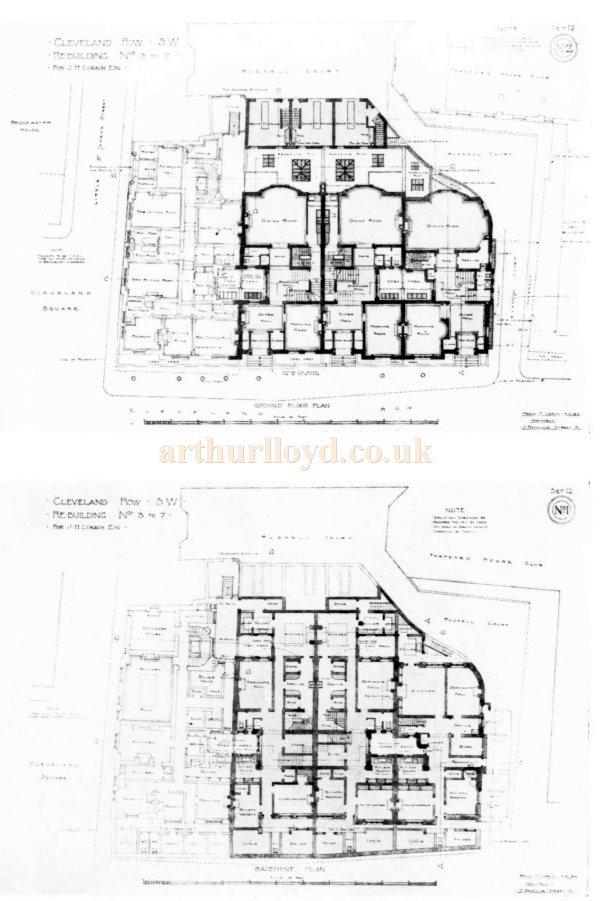
Left - Frank T. Verity's Plans for the conversion of a building into Flats at 3 to 7 Cleveland Row, London - From The Architects' Journal, 1st of July 1925.
It would be quite wrong to leave the subject of Mr. Verity's flats without making reference to the extremely skilful planning for which he has acquired great repute. And this internal convenience, this satisfactory solution of the utilitarian problem is never attained at the expense of his facades, for Mr. Verity contrives, quite adequately, to light and ventilate the smaller domestic offices from areas. His flats seem spacious and orderly, whether we view them from the outside or from the inside, and may well bear comparison with the very best "apartment-house" designs executed in America during recent years.
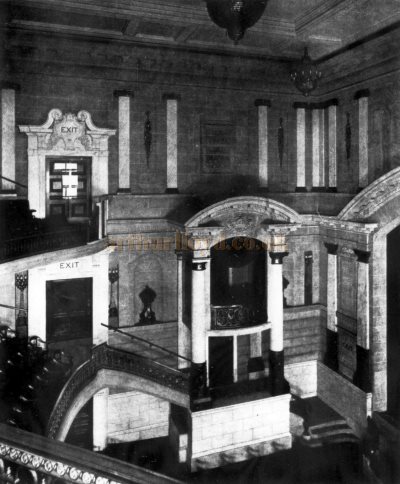 Let us next consider how Mr. Verity has tackled the very different problem of theatre design. Here again he has made a careful study of the most modern requirements of the building under consideration, and he has had the advantage of the designers of older theatres, in that the new methods of steel and of ferro-concrete construction enable him to span very wide distances without the aid of vertical supports to the galleries. Thus not a single person in the body of the theatre need have his view of the stage spoilt by obstructive piers or stanchions.
Right - Frank T. Verity's Auditorium of the Scala Theatre, London - From The Architects' Journal, 1st of July 1925.
In the Scala Theatre (see page 42) Mr. Verity has designed a comfortable and pleasant auditorium, and has decorated the walls with a simple Classic treatment. The formal junctions of the galleries and box have been cleverly contrived, the entablature of the latter being united to a short screen which, in its turn, is ramped to the railing of the upper circle.
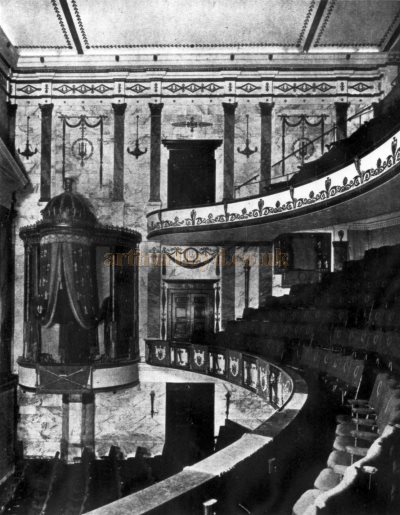 The Imperial Theatre, Westminster (long-since demolished), and the Empire, Leicester Square, are good examples of Mr. Verity's interiors, and show how he is able to give the exact note of somewhat opulent geniality which a modern theatre seems to require for its expression.
Left - Frank T. Verity's Auditorium of the Imperial Theatre, London - From The Architects' Journal, 1st of July 1925.
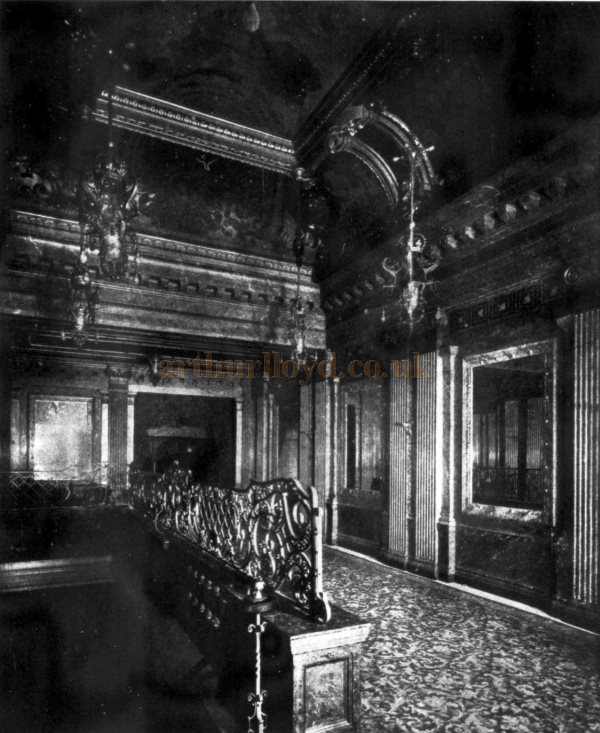 Right - Frank T. Verity's Foyer of the Empire Theatre, Leicester Square - From The Architects' Journal, 1st of July 1925.
The Hammersmith Picture Palace, which was awarded the medal of the Royal Institute of British Architects, has an immense seating accommodation, but this orderly interior does not overbear us by its size. A notable feature is the novel arrangement whereby a series of rooms is placed beneath the gallery, so that this is given an appearance of greater strength and stability. Without this substructure the very wide span of such a slender beam would have had an unpleasant effect. The exterior is a bold conception.
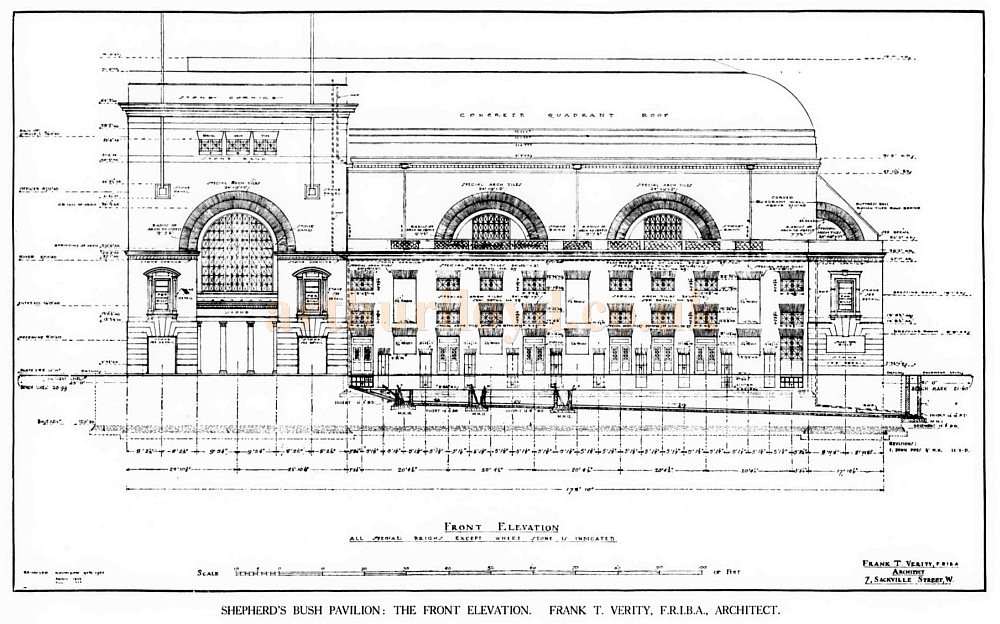
Above - Above - Frank T. Verity's Plans of the Shepherd's Bush Pavilion, Hammersmith, London - From The Architects' Journal, 1st of July 1925.
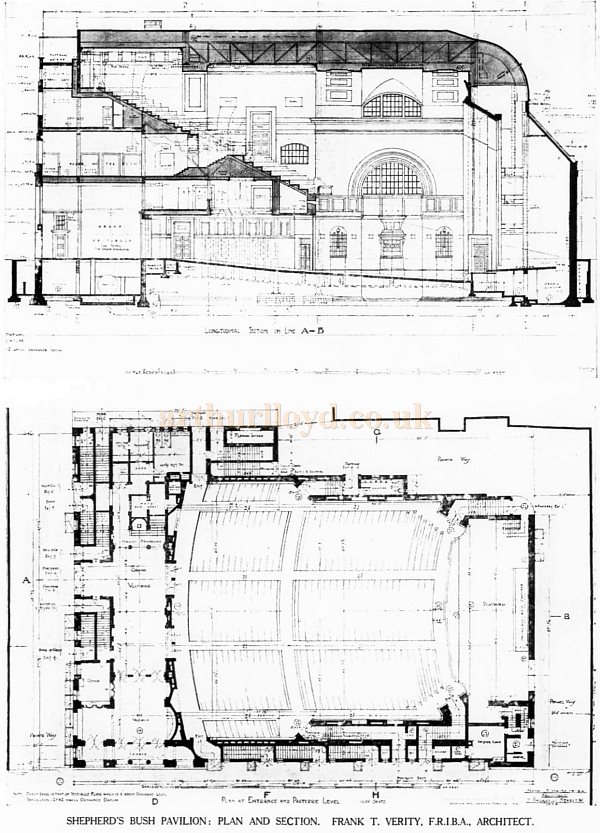 The hall itself is articulated by means of the large concrete curved roof which surmounts a stretch of plain wallage relieved by two large arches with tile voussoirs. Brought forward a few feet is the main wall of the facade, which has the function of providing window space for that miscellany of small apartments apparently required in the modern picture theatre. This is as yet an unsolved problem of design - how to arrange these little windows.
Right - Frank T. Verity's Plans of the Shepherd's Bush Pavilion, Hammersmith, London - From The Architects' Journal, 1st of July 1925.
Mr. Verity has done the best he can by grouping them into a large pattern, yet it can scarcely be denied that they detract from the degree of breadth and scale that an important street front should have. But there can be no doubt that this building does much to enhance the status of the cinematograph by giving it an architectural form worthy of the growing importance of this institution as an agent both for the drama and for the general entertainment and education of the public.
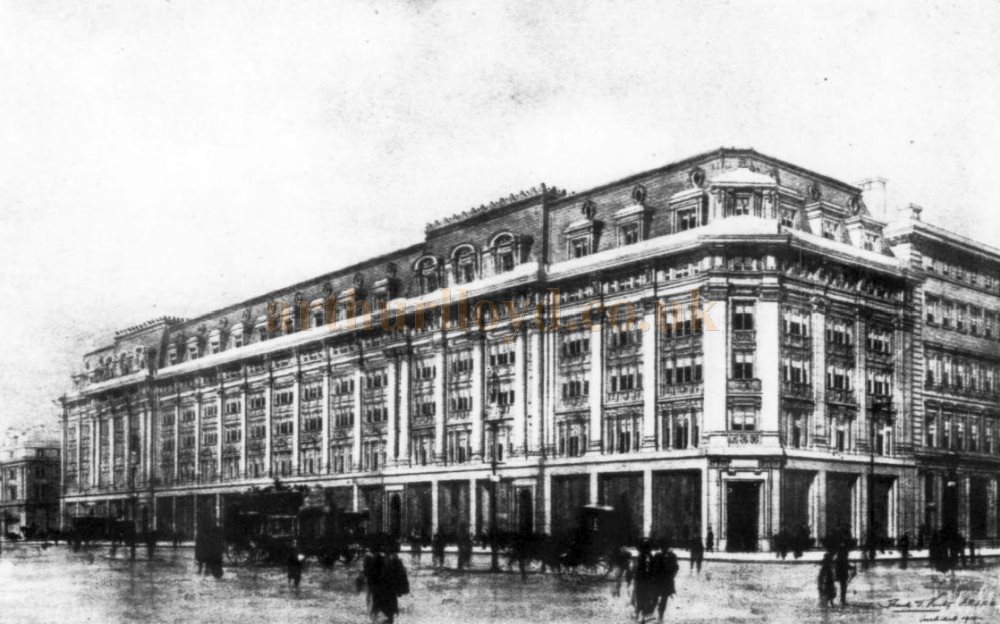
Above - Frank T. Verity's St. George's House, London - From The Architects' Journal, 1st of July 1925.
Mr. Verity's desire to impart a dignified quality to urban building is witnessed in his imposing design for a block of shops in Regent Street. And the Polytechnic itself, perhaps Mr. Verity's chief work, has long ago taken its place as a classic example of metropolitan style in the twentieth century.
The above article was first published in the Architects' Journal, 1st of July 1925.