
The Prince of Wales Theatre, Clayton Square, Liverpool, Merseyside
Later - The Varieties Theatre
See Also - The Prince of Wales Theatre, Lime Street, Liverpool
Liverpool Theatres Index

Above - The Prince of Wales Theatre, Clayton Square, Liverpool - From 'The Annals of the Liverpool Stage' by R. T. Broadbent, first published in 1908.

 The Prince of Wales Theatre which was situated on Clayton Square, Liverpool, and shouldn't be confused with the later Prince of Wales Theatre on Lime Street, first opened on the 26th of December 1861 and was a reconstruction of the former Clayton Hall, which was itself a reconstruction of a former residential property called Clayton House, built in the early 18th century as a home for the daughter of William Clayton, a Liverpool MP in 1698 and 1714.
Right - A Sketch of the Prince of Wales Theatre, Clayton Square, Liverpool - From 'The Playgoer' of 1901 - Courtesy Iain Wotherspoon.
Reconstruction of Clayton Hall into a Theatre was the result of Alexander Henderson having visited the Hall by chance and realising it's potential. He set to work six months later, when he was able to secure the lease, and the resulting Theatre was open by December 1861.
The Prince of Wales Theatre had a three story frontage to Clayton Square, spanned by a canopy for its whole length. There were three entrances to the Theatre which led to individual foyers for each part of the Auditorium.
The auditorium itself was 55 feet long by 35 feet wide and consisted of a large Pit covering almost the entire ground floor with only three rows of higher priced seats nearest the Orchestra. Above the Pit was a Dress Circle with a curved front and boxes on either end adjacent to the proscenium, and above this a Gallery. Dressing Rooms and a Property Room were situated under the stage.
 The Theatre was enlarged a year later by incorporating the neighbouring Brunswick Hotel which provided a new entrance from Cases Street and a new Crush Room for the Theatre. This all goes to show that Henderson's plan had paid off and the Theatre was very successful. He ran the Theatre with a stock company of young actors supplemented by better known stars of the stage including for several productions the popular and renowned actor Henry Irving who played there three times, the last being in 1865.
Left - Kate Everleigh who performed in the last Pantomime in this Theatre under Alexander Henderson's Management. The Pantomime was 'Dick Whittington' and Kate Everleigh played the lead - From the Illustrated Sporting and Dramatic News, 23rd of October 1866.
J. L. Toole was another famous name to play in this Theatre, indeed he made his first appearance in Liverpool at the Prince of Wales Theatre, on the 23rd of January 1862, shortly after it had opened, playing Simmonds in 'The Sptalfields Weaver' to great acclaim, and in the comedy 'Ici on Parle Francais' he brought the house down, it was said in the press that 'if any one wishes to see high art in low comedy, there it is'.
In October 1866 Alexander Henderson left the Theatre to open the new Prince of Wales Theatre on Lime Street, which would much later become the present Empire Theatre.
 Because of this and its new owner William Brough the Clayton Square Theatre then had a name change to The Varieties which opened as such on the 26th of December 1866.
Right - An Advertisement for Ethardo playing at The Varieties Theatre, Liverpool when it first opened, formerly the Prince of Wales Theatre - From the ERA, 14th of October 1866.
Over the next fifteen years the Theatre had around six other Lessees but eventually Alexander Henderson returned to take over the Theatre in April 1884, he set about improving the Theatre internally and externally including increasing the height above the gable pilasters and adding a stone balustrade incorporating an ornamental model of the Prince of Wales Feathers within the pediment. The Theatre was renamed for its reopening back to the Prince of Wales Theatre, which was made possible because the Prince of Wales Theatre on Lime Street had by this time been renamed the Royal Alexandra Theatre.
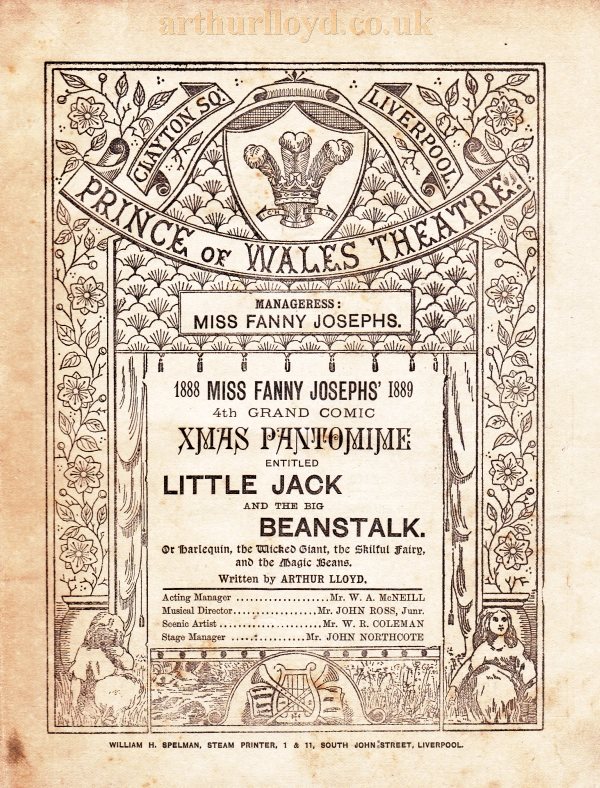
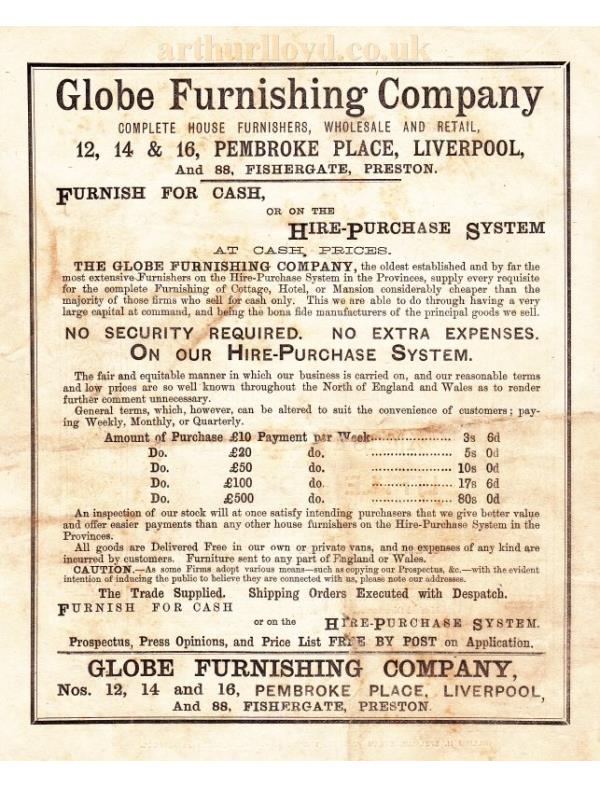
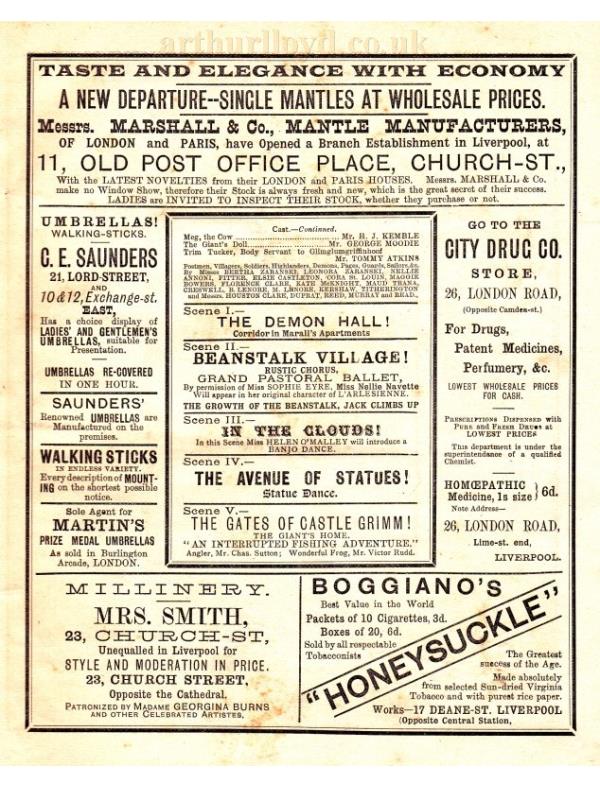
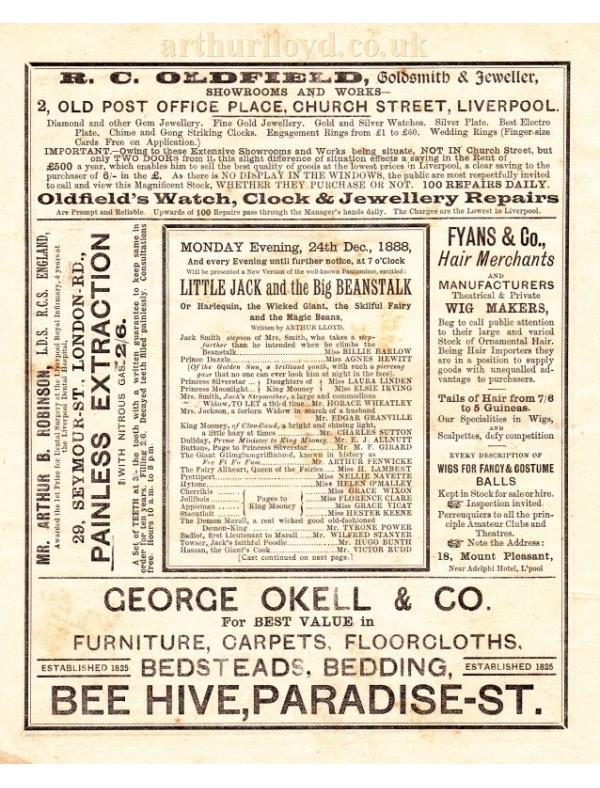
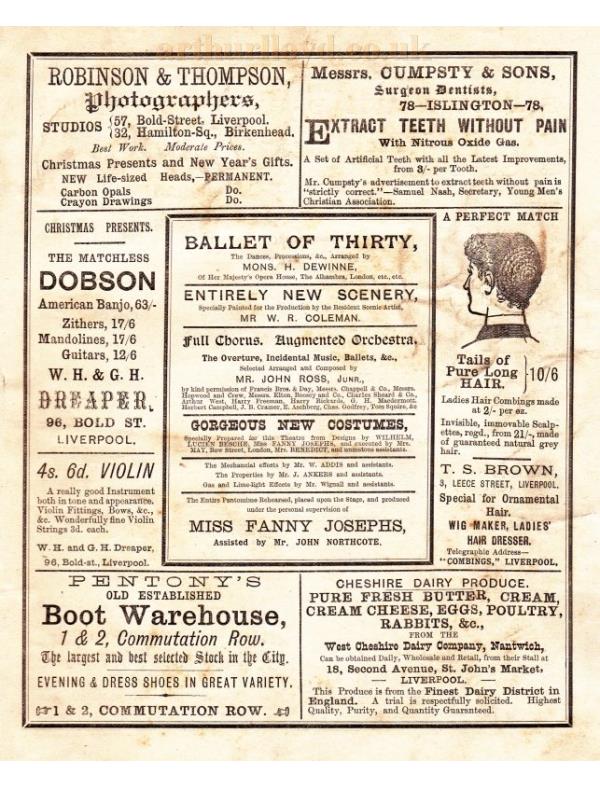
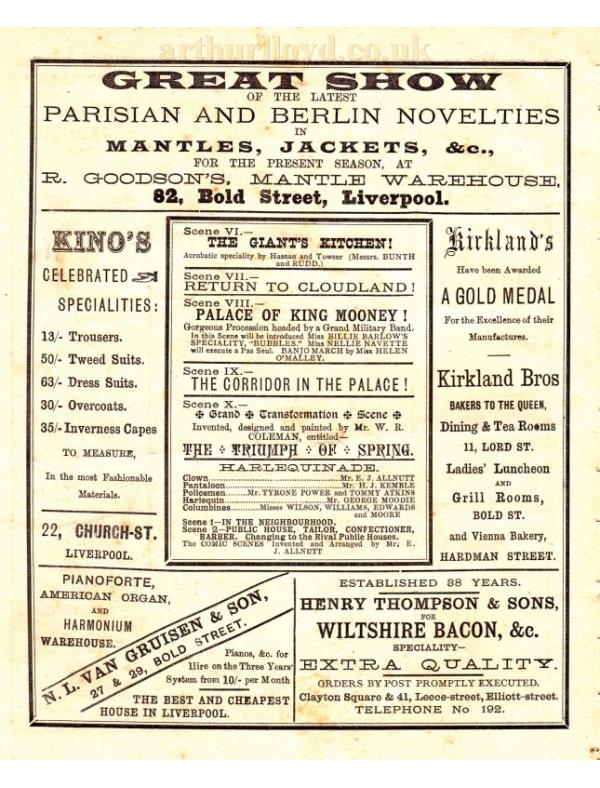
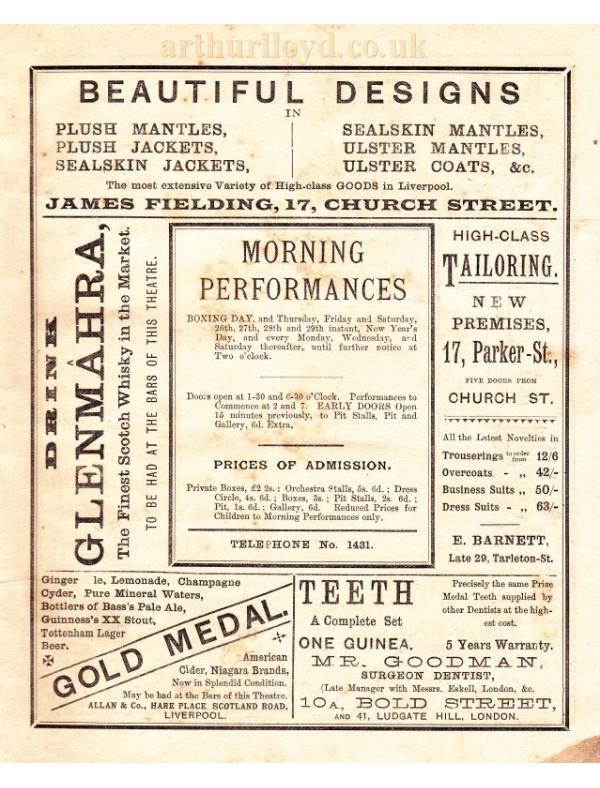
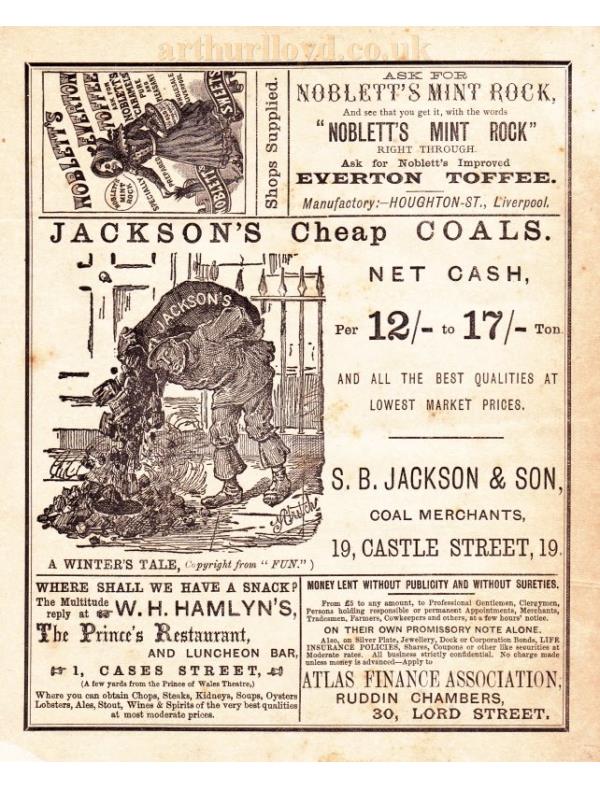


Above - A Programme for 'Little Jack and the Big Beanstalk' Written by Arthur Lloyd and performed at the Prince of Wales Theatre, Liverpool Christmas 1888/89.


Despite all the alterations carried out by Alexander Henderson he ended up only running the Theatre for another year before he departed for good, and the Theatre would have another three lessees before it was closed for a while in June 1901.
The programme shown right is for a Benefit for Arthur Wilkinson at the Prince of Wales Theatre in 1894, some background information for this Benefit can be read below.
Left - A Programme for a Benefit for Arthur Wilkinson at the Prince of Wales Theatre, Liverpool in 1894 - Courtesy Simon Moss, stagememories, See details below.
Arthur Wilkinson had appeared in principal roles in various D'Oyly Carte Opera companies in the UK and America between 1879 and 1886, but in 1894 the 34-year-old actor was playing in "The Golden Web" at the Court Theatre in Liverpool. Returning to the venue from the Liverpool Races his carriage overturned and he sustained serious injuries, dying some days later on 31 March. By this time the C-Company of the D'Oyly Carte had moved into the Court, presenting a series of Gilbert & Sullivan operas. On the afternoon of Thursday the 5th of April the nearby Prince of Wales Theatre hosted a Benefit Matinee in aid of Wilkinson's widow and it is not surprising that the members of the C-Company turned out in force, commemorating their former colleague with a selection of songs and a full performance of "Trial by Jury". Fred Billington lead the cast as The Learned Judge and the rest of the company was that which had performed the piece at the Court three days earlier. This is probably the only time a D'Oyly Carte company performed "Trial by Jury" at a benefit outside of London and it is a remarkable twist of fate that they were there on the spot and able to do so. Other actors playing in Liverpool offered their services too, including the Carl Rosa Company. Note that the "Trial by Jury" Bridesmaids sold the programmes! - Text courtesy Simon Moss, stagememories.
The Prince of Wales Theatre was reopened by a new owner, George C. Cleaver, on the 25th of November 1901 as an early home for moving pictures with music provided by a military band. These films were called Pringle's Pictures and covered a wide variety of subjects including news from around the world and local events. After a year of this, variety entertainment was added to the Bill of animated pictures along with a live orchestra, but it all came to an end on the 20th of January 1902 when the Theatre closed and wouldn't reopen for another seven months.
On the 1st of September 1902 the Theatre was reopened by John Denton and George Blunt as a high class Theatre for the presentation of the latest successes from London including comedies, musical plays, and even light opera, followed by a pantomime at Christmas, and this became a regular and popular feature at the Theatre for its remaining years.
In 1904 the Theatre's Lease was taken over by John H. French, the former owners having retired from the business. French would turn out to be the last Lessee of the Theatre, its last production being the Pantomime 'Cinderella' which opened on the 25th of February 1905.
After this the Theatre was closed and the building was not used again until in 1910 it was converted for use as an auctioneers establishment for George Turner & Sons. But even this didn't last long and the old Theatre was finally demolished in July 1912.
Much of the information on this Theatre was gleaned from the excellent little book by Harold Ackroyd called 'The Liverpool Stage' first published in 1996 and well worth purchasing if you are interested in some of the more obscure Liverpool Theatres that are featured in its pages, along with the more well known ones.
If you have any more information or Images for this Theatre that you are willing to share please Contact me.