
Toole's Theatre, King William IV Street, Strand, London
Formerly - The Polygraphic Hall / The Charing Cross Theatre / The Folly Theatre
Introduction - The Polygraphic Hall - The Charing Cross Theatre - The Folly Theatre - Toole's Theatre - Closure and Demolition - About J. L. Toole

Above - A Google StreetView Image of the site of the former Toole's / Folly / Charing Cross Theatre in April 2023 - Click to Interact.

 Toole's
Theatre was situated on King William Street, just off the Strand,
in London, and was named after its owner J. L. Toole in 1882, although Toole had been
running the previous Theatre on the site, the Folly, since 1879. Toole eventually had the Folly reconstructed and it was then reopened as Toole's Theatre on the 16th of February 1882.
Toole's
Theatre was situated on King William Street, just off the Strand,
in London, and was named after its owner J. L. Toole in 1882, although Toole had been
running the previous Theatre on the site, the Folly, since 1879. Toole eventually had the Folly reconstructed and it was then reopened as Toole's Theatre on the 16th of February 1882.
Toole's Theatre was the latest of a string of reconstructions of a building which had originally been a Chapel but was later renamed the Polygraphic Hall, then the Charing Cross Theatre, and finally the Folly Theatre before becoming Toole's Theatre in 1882. More information on Tool's Theatre can be seen below, but first some details of the earlier Theatres on the site.
Right - A programme for the farcical comedy 'The Bungalow' produced at Toole's Theatre on October 7th 1889. More of this programme is shown below.
The Polygraphic Hall
The Polygraphic Hall had originally been a Roman Catholic Chapel for the Oratorians but was renamed the Polygraphic Hall whilst under the ownership of Mr. S. Woodin. In 1869 the Polygraphic Hall was itself reconstructed as a Theatre and renamed the Charing Cross Theatre.
The ERA reported on the soon to be opened building in their 6th of June edition saying: 'This Theatre, which will shortly open, has been altered from what used to be the Polygraphic Hall of Mr. W. S. Woodin, in King William-street, Strand. The audience portion consists of stalls, pit, dress circle, upper boxes, and eight private boxes; no gallery. The seats will be roomy and most comfortable, no expense having been spared. There are two distinct fireproof entrances, one for the stalls and dress circle, the other for upper boxes and pit, and every requisite in the way of cloak-rooms, ladies'-rooms, &c. All approaches and staircases are of stone; extra doors and stairs are provided in case of necessity. The entrances will be, as before, in King William-street.
The Theatre in extent will be about the size of the Prince of Wales's, but the general appearance will be somewhat different from most Theatres, the upper boxes not extending round the entire building, the space over private boxes being decorated with paintings in lunette panels by T. Ballard. The proscenium also contains paintings by the same artist in the two spandrills, illustrating the serious and the comic Muses. In the centre of the ceiling is an ornamental dome, from the centre of which hangs the sunlight, four panels of figure subjects completing the ceiling. The decorations generally consist of white and gold, with light tints introduced, the colour of draperies &c., being light blue. The proscenium is hung with real drapery instead of the usual painted one. The: new act-drop, representing "The Mall in St. James's-park - time, Charles the Second," has been painted by Mr. J. H. Meadows, the eminent artist; the decorations and general fittings are by Mr. E. W. Bradwell; and the whole has been carried out under the supervision of Arthur Evers, Esq., architect.' - The ERA, 6th June, 1869.
The Charing Cross Theatre, 1869
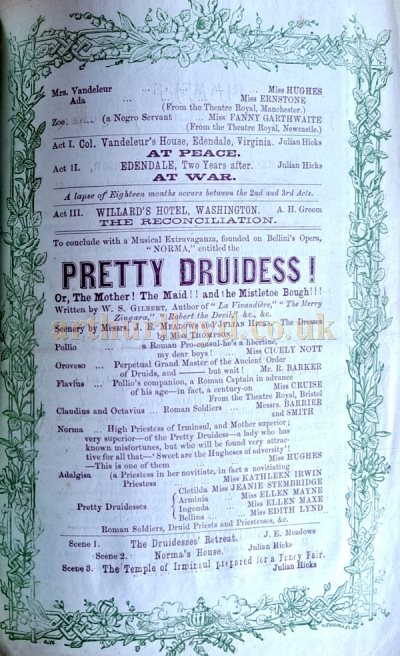
The Charing Cross Theatre opened on Saturday the 20th of June 1869 with a performance of the operetta 'Coming of Age', a three act play called 'Edendale,' which was a play about the American Civil War, and concluded with W. S. Gilbert's "Musical Extravaganza" 'Pretty Druidess!', see the opening programme Below.
The Pall Mall Gaazette reported on the opening of the new Theatre in their 21st of June edition saying:- 'The premises in King William-street, Strand, at one time occupied by the Oratorians and used as a chapel, and lately known as Mr. Woodin's Polygraphic Hall, having undergone reconstruction, were opened on Saturday night as the Charing Cross Theatre. The house is very small, and what is called the "auditorium" has the look of being rather a tight fit for the audience. Much has been done, however, to recreate the eyes of the spectator if it has been found less practicable to regard his physical comfort in other respects. The interior of the building is as bright and smart as gilding, colour, gas, carton-pierre decorations, and new upholstery can make it.' - The Pall Mall Gazette, 21st June 1869.
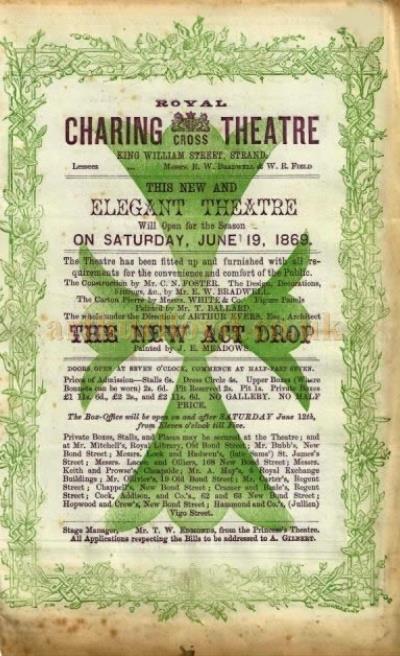
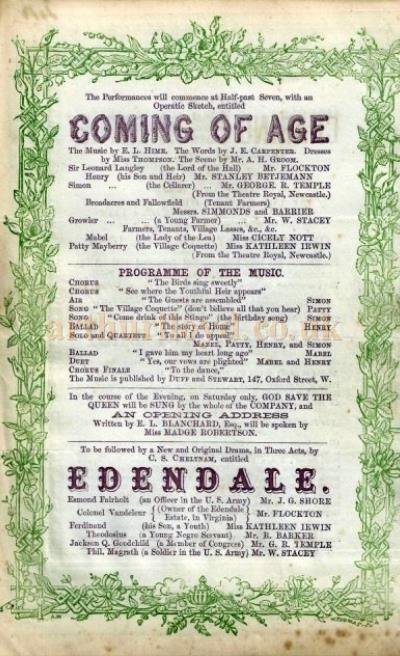
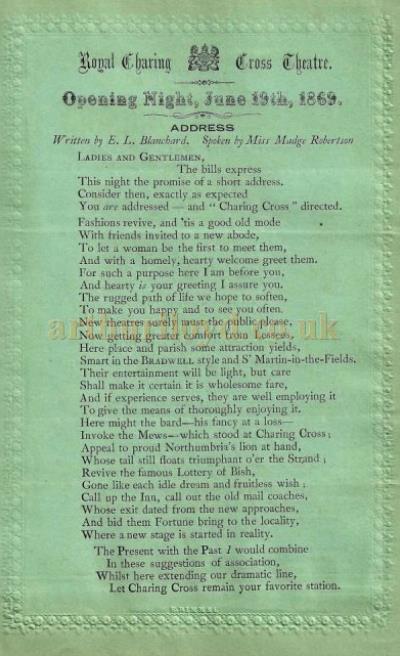 A slip that was with the programme featuring the opening night address written by E. L. Blanchard and spoken by Madge Robertson referencing the interior designer Mr. Bradwell.


Above - The Opening Programme for the Charing Cross Theatre on the 19th of June 1869 - Courtesy Simon Moss, stagememories. The last page is a slip which was with the programme featuring the opening night address written by E. L. Blanchard and spoken by Madge Robertson referencing the interior designer Mr. Bradwell.
The Pall Mall Gazette wasn't really very enthusiastic about the new Charing Cross Theatre or the operetta but was a bit more polite about 'Edendale'. They went on to say that the evening concluded at a 'very late hour' with a performance of a burlesque called 'Norma' by Mr. Gilbert which was apparently "well received". Norma was the name of the original opera by Bellini which 'Pretty Druidess!' was based on and featured on the last page of the programme shown above.
The Folly Theatre, 1876
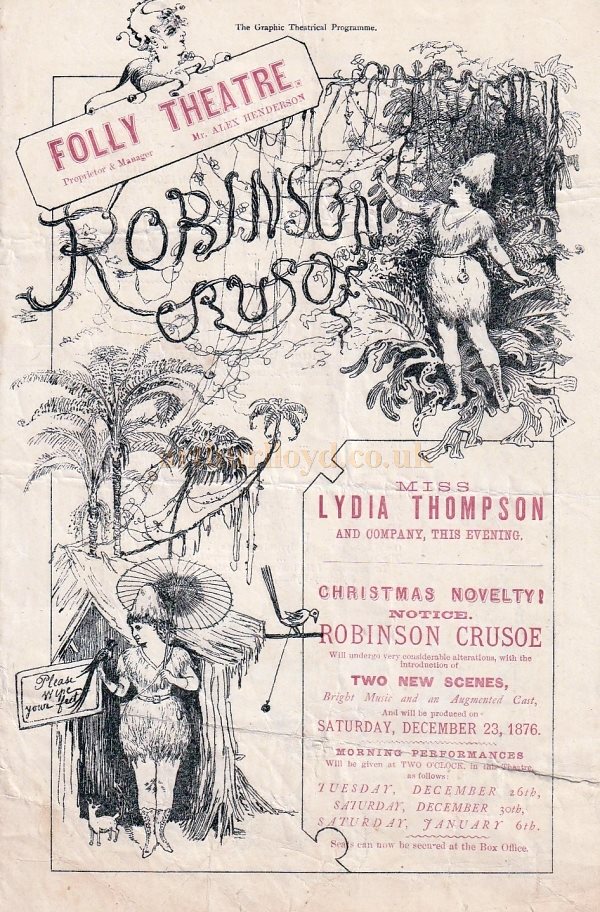 In 1876 the Charing Cross Theatre was the subject of major reconstruction and redecoration
to the designs of the well known Theatre Architect Thomas
Verity for the then proprietor and Manager Alexander Henderson.
In 1876 the Charing Cross Theatre was the subject of major reconstruction and redecoration
to the designs of the well known Theatre Architect Thomas
Verity for the then proprietor and Manager Alexander Henderson.
Right - A Programme for 'Robinson Crusoe', the first pantomime at the Folly Theatre in its opening year of 1876,. The Production opened on the 23rd of December 1876 - Courtesy Simon Moss, stagememories.
The Theatre reopened on Monday October the 16th 1876 as the Folly Theatre with Lydia Thompson and Company in Farnie's burlesque 'Blue Beard,' preceded by the comic drama 'Man is not Perfect.' The Theatre also had a new ceiling by Signor Emilio Marolda and a new Act Drop and Scenery by Messrs. Grieve and Son.
The Morning Post reported on the opening of the Folly Theatre in their 17th of October 1876 edition saying:- 'The little theatre in King William-street, Strand, heretofore known as the Charing-cross, has bean advanced to the dignity of "The Folly," under which imposing title it was opened for the winter season last night. Entirely reconstructed and elaborately decorated from designs by Mr. T. Verity, it is now one of the prettiest and most comfortable playhouses in London. Nothing that liberal expenditure, directed by good taste, could do has been left undone to make the place suitable for the purposes within the contemplation of the new lessee, Mr. Alexander Henderson, who intends to make it the home for a light description of dramatic entertainment, akin to that to be witnessed at the Parisian theatre bearing a similar name.
 Pending the production of noveltie which are in the state known as "active preparation," the management had recourse to Mr. Farnie's popular burlesque of "Blue Beard," which, notwithstanding that it has already been performed by Miss Lydia Thompson's company upwards of 1,000 times, was received with as much applause as ever.
Left - An Advertisement for the Opening of the Folly Theatre in 1876 - From the Pall Mall Gazette, 14th of October 1876.
The dialogue has been retouched with a view to bring it en rapport with current topics and the new scenery gives freshness and picturesqueness of aspect to the favourite old piece. Miss Lydia Thompson experienced an enthusiastic reception on her reappearance in her celebrated character of Selim, and played the part with her customary spirit and ability, she was admirably supported by that very clever comedian Mr. Lionel Brough, as Blue Beard, and their famous duet was encored half a dozen times. The Heathen Chines found, as usual, an inimitable exponent in Mr. Willie Edonin, and the other parts were so well sustained that the burlesque passed off in the smoothest style imaginable. A comedy by Mr. Harry Paulton, entitled "Pecksniff," and a spectacular burlesque by Mr. Famie, called "Robinson Crusoe," are in rehearsal.'
The above text in quotes was first published in the Morning Post, 17th of October 1876.
Toole's Theatre, 1882
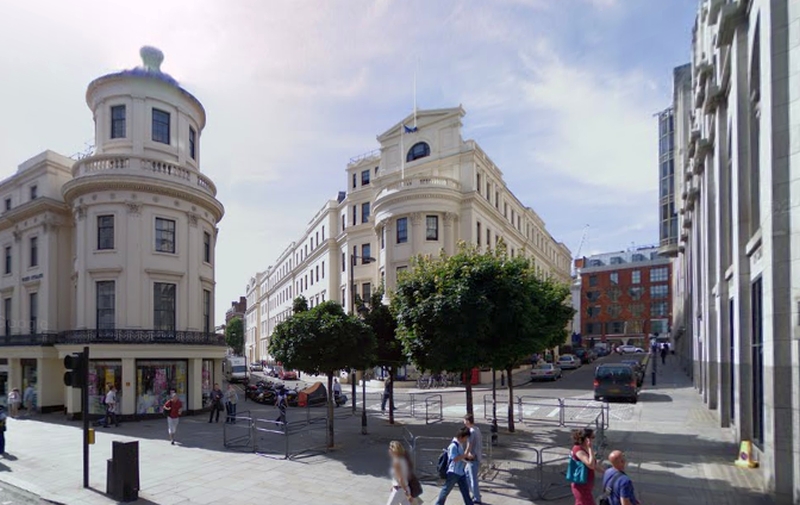
Above - A Google StreetView Image of the site of the former Toole's Theatre in July 2008 - Click to Interact.
 In 1879 J. L.
Toole took over the management of the Folly Theatre and in 1882 he had it reconstructed by Messrs Laing and Son and reopened it as Tool's Theatre on the 16th of February 1882. The ERA reported on the soon to be opened Theatre in their 4th of February edition 1882 saying:
'The old Polygraphic Hall has had many transformations, but none so
thorough and complete as those now carried out by Mr
Toole.
In 1879 J. L.
Toole took over the management of the Folly Theatre and in 1882 he had it reconstructed by Messrs Laing and Son and reopened it as Tool's Theatre on the 16th of February 1882. The ERA reported on the soon to be opened Theatre in their 4th of February edition 1882 saying:
'The old Polygraphic Hall has had many transformations, but none so
thorough and complete as those now carried out by Mr
Toole.
Right - A cartoon of J . L. Toole at the entrance to his new Theatre showing house full signs - From the Penny Illustrated Paper, Saturday the 18th of February 1882.
Those who knew it when the famous Woodin was wont to open his " Carpet Bag " for the amusement of young and old, and those who have followed its varying fortunes through its career as the "Charing-cross" and the "Folly" Theatres, will, we are sure, open very wide their eyes with astonishment and admiration when they see the metamorphosis that has been effected, at a liberal outlay, by the popular, esteemed, and enterprising comedian, and through the judgment and taste of the architect intrusted with the task, Mr John I. Thomson, of Charing-cross.
The chief motif of the alterations has been to improve and enlarge the entrances and exits. This he has been able to do in a most satisfactory manner by the acquisition of adjoining premises in King William-street, and, at the same time, to materially improve the theatre itself.
 To give a concise idea of what has been effected, we may explain that
the pit level is but little below that of the street. Under the old
regime visitors to pit and gallery had to burrow underground, and then
ascend narrow flights of steps to reach their respective levels. All
this is changed. Pit and gallery have each a separate entrance twice
the width of the old, and there are no unnecessary stops or subterranean
passages.
To give a concise idea of what has been effected, we may explain that
the pit level is but little below that of the street. Under the old
regime visitors to pit and gallery had to burrow underground, and then
ascend narrow flights of steps to reach their respective levels. All
this is changed. Pit and gallery have each a separate entrance twice
the width of the old, and there are no unnecessary stops or subterranean
passages.
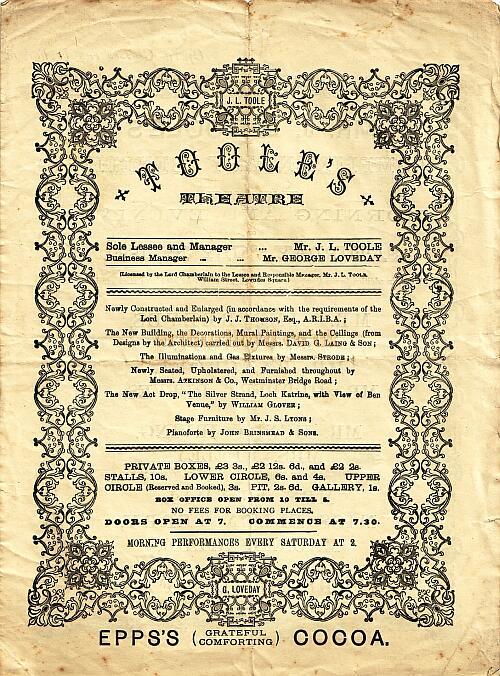
Left - A Benefit programme for the newly constructed Toole's Theatre on July the 1st 1882.
Ascending higher, the badly used upper circle patrons have now a broad staircase of their own, and no longer have to be coaxed out of the dress circle, through which they had to pass.
The greatest improvement is, however, manifest in the entrance to the dress circle and stalls. Broad flights of stairs 6ft. wide give access to these parts of the house, and, the entrance from the street being absolutely wider than the collective width of the corridors leading thereto, crushing is simply an impossibility.
Ascending the staircase a handsome and spacious foyer and refreshment room is provided on the first floor. This, with the staircase itself, will have to be seen to be appreciated by those who remember the entrance of old, with the lobby in which the picture of the Chinese lady was exhibited.
The auditorium next claims our attention, and exhibits an equally startling metamorphosis. The consciousness that we were in an adapted lecture-room or Roman Catholic chapel (for this property has had many experiences) has departed for ever, and we now behold a most commodious little theatre. Mr Toole evidently believes in the pit, and the whole of the enlargement on this floor has been given to his critical friends who patronise him there.

Above - The inside of a Benefit programme for the newly constructed Toole's Theatre on July the 1st 1882.
 On the first tier the dress circle gains about fifty new seats, and
on the next tier the upper circle and gallery share the increased space.
Greater headroom, and consequently better ventilation, are, thereby
assured. The private boxes have not been forgotten, and are made to
project by a graceful curve so as to afford, not only more room, but
a better view of the stage.
On the first tier the dress circle gains about fifty new seats, and
on the next tier the upper circle and gallery share the increased space.
Greater headroom, and consequently better ventilation, are, thereby
assured. The private boxes have not been forgotten, and are made to
project by a graceful curve so as to afford, not only more room, but
a better view of the stage.
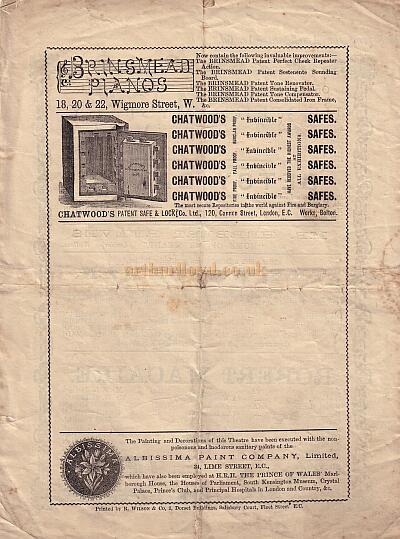
Right - The back of a Benefit programme for the newly constructed Toole's Theatre on July the 1st 1882.
The decorations, though claiming early attention by reason of their pleasing character, are naturally the last to be described. We may say at once they are the most architectural of anything we have seen for a long time. They are not, however, of the modern aisthetic school, for there is not a poppy or a lily, or " dirty green" in the whole of them. The design of the central ceiling gives a key to the rest, which may be described as of a Raphaelesque character. Very delicate colouring of " primary" colours, with not too much gilding, gives a refined effect. The prevailing colours of the upholstery are light blue in satin and crimson plush. The private boxes and proscenium also show special architectural treatment, the return face of the latter being entirely novel in character.
Passing to the stage an important alteration, or addition, is the provision of a stage entrance in Chandos-street, which, with a good staircase on this side of the house, is available as a means of exit in case of panic. This, however, though always open, could hardly ever be required, as the other exits are so ample, affording sufficient means of egress to enable the whole of the auditory to quietly leave in less than one minute. Further, the stage is improved, and the dressing-rooms increased in size and number, with good service stairs.
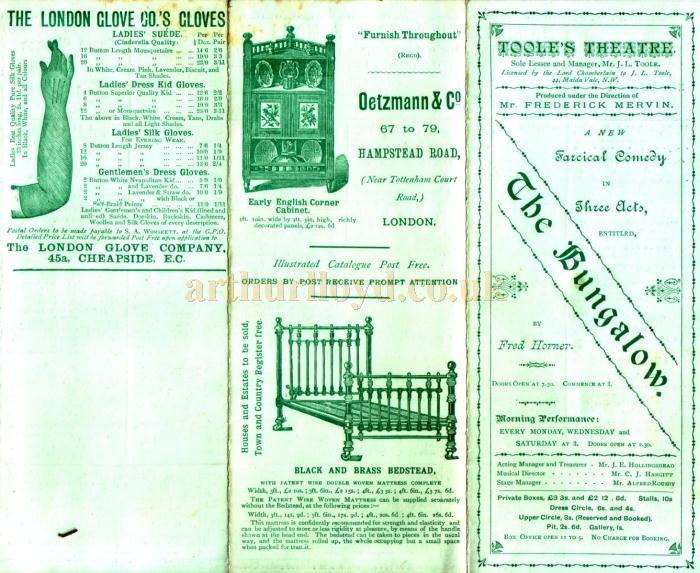
Above - A programme for the farcical comedy 'The Bungalow' produced at Toole's Theatre on October 7th 1889.
All the sanitary arrangements have been overhauled. The gas services have been entirely renewed, the pilot and flash system being introduced, the floats being lighted in this manner for the first time in any theatre. There are, of course, two separate gas services for the front and stage, and oil lamps are to be suspended in various parts to provide for all contingencies. A fire main on the high-pressure constant supply has been led from the Strand, and fitted with numerous hydrants.

Above - A programme for the farcical comedy 'The Bungalow' produced at Toole's Theatre on October 7th 1889.
In leaving we must not forget to notice the covered way, which, though a new departure, is so sadly needed to most of our public buildings. This is carried out in a most artistic and substantial manner. There are no posts to obstruct, and five or six carriages can set down and take up at once, no slight assistance in rapidly clearing a theatre at night. Messrs Laing and Son are the builders. Messrs Battiscombe and Harris supplied the enrichments from the architect's designs. Messrs Atkinson have undertaken the upholstery. The gas is by Messrs Strode; the fire appliances by Messrs Merryweatlaer. The new act-drop is by Mr William Glover, the celebrated artist, and late lessee and manager of the Theatre Royal, Glasgow. The subject is Loch Katrine, with view of the Silver Strand and Ben Nevis.
Altogether, Mr Toole has spared no expense to secure the safety, comfort, and welfare of his patrons, to say nothing of pleasing their tastes; and we trust he may soon recoup himself the heavy outlay he has so bravely incurred.' The ERA, 4th February 1882.
Closure and Demolition, 1896
Toole's Theatre had opened on the 16th of February 1882 but was to have a fairly short life, and was not always successful, although the Daly's Theatre company would make their first London appearance at the Theatre in 1884, and in 1892 Barrie's first play, 'Walker, London', did have a successful run there.
Toole's Theatre was closed in 1896 due to the noise of the Theatre causing a nuisance to the occupants of the nearby Charing Cross Hospital. The Hospital then had the Theatre demolished so as to use its site for the Hospital's enlargement.
The Hospital eventually relocated to new premises built on the site of the former Fulham Hospital on Fulham Palace Road, and the last patients to be treated at the old Hospital were in 1973. The Hospital was then demolished and a Police Station was erected on the site. Looking at the building today, Toole's Theatre was right in the middle of the enormous police station that now occupies the site.
If you have any more information or images for this Theatre that you are willing to share please Contact me.
About J. L. Toole
The Oxford Companion to the Theatre (First edition - 1951)
TOOLE, JOHN LAURENCE (1830-1906), English actor and theatre manager. Born in London, where his father was Toastmaster to the East India Company, he was for a short time, like Garrick, clerk to a wine-merchant, but success in amateur theatricals, notably as Jacob Earwig in Boots at the Swan, turned his thoughts to the stage. Encouraged by Dickens, he joined Dillon's company in Dublin in 1852 as a low comedian, [1] and two years later made a fleeting appearance in London, returning to establish himself, after further experience in the provinces, in 1856.
He was seen at the Lyceum as Fanfaronade in Belphegor, in which Marie Wilton, later Lady Bancroft, also made her first appearance in London. On the recommendation of Dickens, Toole was engaged by Ben Webster for the New Adelphi in 1858, and remained there nine years.
Among his successful parts were Bob Cratchit in A Christmas Carol (1859) and Caleb Plummer in Dot (1862), Boucicault's dramatization of The Cricket on the Hearth. In this he combined humour with a pathos which showed how well he might have played serious character parts; but the public preferred him in farce.
He was for many years a close friend of Irving, with whom he first played at the Queen's, Long Acre, in 1857, and subsequently on tour. In 1869 he began a long association with Hollingshead at the Gaiety, being excellent in burlesque and opera bouffe, and in 1879 he went into management at the Charing Cross Theatre, with a good resident stock company, giving it his own name in 1882.
The most important production of his last years was Barrie's first play, a farce entitled Walker, London (1892). He habitually toured the provinces in summer, with a good company, gaining thereby much profit and reputation.
Crippled by gout, he left the stage in 1895, when his theatre was pulled down, and retired to Brighton, where he died. He made one appearance in New York, in 1874, at Wallack's, but was not very successful, his humour being too cockneyfied for the Americans. Clement Scott called him 'one of the kindest and most genial men who ever drew breath.... No one acted with more spirit or enjoyed so thoroughly the mere pleasure of acting.' He was much respected in his profession, and always on good terms with his audience, being particularly good at end-of-performance speeches.
The above text on J. L. Toole is from The Oxford Companion to the Theatre (First edition - 1951) - Later annotations are by Matthew Lloyd.
[1] Toole joined Charles Dillon’s company at the Queens Royal Theatre, Dublin, on Saturday 2 Oct 1852, as a low comedian, this being his first engagement in the provinces.
 Please
note that J. L. Tool's first appearance on any stage appears to have
been for one night only at the Theatre
Royal, Haymarket on the 22nd of July 1852 when he performed there in 'The Spitalfields Weaver'. T.
C. King also performed there the same evening, in his first London
Performance, when he played Shylock in 'The Merchant of Venice'.
Please
note that J. L. Tool's first appearance on any stage appears to have
been for one night only at the Theatre
Royal, Haymarket on the 22nd of July 1852 when he performed there in 'The Spitalfields Weaver'. T.
C. King also performed there the same evening, in his first London
Performance, when he played Shylock in 'The Merchant of Venice'.
Right - A Notice from the ERA of the 18th of July 1852 which is advertising 'One Night more - Brilliant array of Talent for this Night only' at the Theatre Royal, Haymarket on the 22nd of July 1852. In the cast for these productions were T. C. King in his first London Appearance, and J. L. Toole in his first performance on any stage.
Some of the archive newspaper reports on this page were kindly collated and sent in for inclusion by B.F.