
Marconi House, Strand, Aldwych, London
Formerly the Gaiety Restaurant

Above - Marconi House in 1924 - Courtesy John A. Strubbe F.R.I.B.A. Click for more internal and external views.

 A visitor to the site, John A. Strubbe, who was the architect responsible
for the internal reconstruction of Marconi House in 1950-53 when English
Electric aquired the Marconi company along with their building, has
very kindly sent in a great deal of information and images on Marconi
House, formerly the Gaiety Restaurant.
A visitor to the site, John A. Strubbe, who was the architect responsible
for the internal reconstruction of Marconi House in 1950-53 when English
Electric aquired the Marconi company along with their building, has
very kindly sent in a great deal of information and images on Marconi
House, formerly the Gaiety Restaurant.
Right - The original entrance to Marconi House can be seen on the left of the site as the Citibank building has finished being demolished and Marconi House is gutted leaving only the retaining walls, in December 2006 - Photo M.L. 06 - Site access kindly granted by Lee Horsley, project manager for the demolition/temporary works/facade retention scheme at the former Citibank/Marconi House. Click for more pictures of the demolition.
 The
aquisition of Marconi House enabled English Electric to move their
HQ from Kingsway to a larger home. Since its original construction
Marconi House had never been seriously converted from its early form
as the Gaiety Restaurant / Hotel
/ Ballroom etc. In fact the whole of the basement was renewed to the
company restaurant / cinema with a smaller new kitchen also serving
private dining rooms on upper floors and the company's residential
club on the top floor. As hard woods were used extensivly, their use
was the subject in 'WOOD' (TOTHILL PRESS) pages 13-16 which
is reproduced below.
The
aquisition of Marconi House enabled English Electric to move their
HQ from Kingsway to a larger home. Since its original construction
Marconi House had never been seriously converted from its early form
as the Gaiety Restaurant / Hotel
/ Ballroom etc. In fact the whole of the basement was renewed to the
company restaurant / cinema with a smaller new kitchen also serving
private dining rooms on upper floors and the company's residential
club on the top floor. As hard woods were used extensivly, their use
was the subject in 'WOOD' (TOTHILL PRESS) pages 13-16 which
is reproduced below.
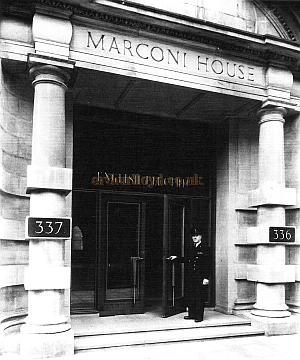
Left - The Entrance to Marconi House in 1953 after the new lettering had been cut and guilded. - Courtesy John A. Strubbe F.R.I.B.A.
In 2005 work began on gutting Marconi House internally, leaving only the retaining walls, along with the demolition of the Citibank building, formerly the site of the Gaiety Theatre. The whole site was then redeveloped for the building of a new Hotel by Foster and Partners for the Spanish Silken Hotel Group, although due to financial difficulties it would eventually open as the ME London Hotel in the summer of 2012. For images of the site from the early 1800s to the present day Click Here.
See also - Internal, external images 1920s to 1950s and Coronation Images.
MARCONI HOUSE-STRAND
The Uses of Hardwood in its Internal Reconstruction 1950-1953
BY JOHN A. STRUBBE, A.R.LB.A., L.S.LA.

Above - Marconi Wireless Telegraph Co. Ltd. Photograph of the Accountants Department of Marconi House in 1923 occupying the space of the former Gaiety Restaurant Ballroom on the upper floors. A new floor was created at gallery level. - Courtesy John A. Strubbe F.R.I.B.A. - Click here for more internal photographs of Marconi House from this series.
 MARCONI
House, originally built as the Gaiety
Restaurant in 1904-6 to the elevations of Norman Shaw, had a very short life as a hotel,
being occupied by the Marconi Companies from 1912-33
as their main offices.
MARCONI
House, originally built as the Gaiety
Restaurant in 1904-6 to the elevations of Norman Shaw, had a very short life as a hotel,
being occupied by the Marconi Companies from 1912-33
as their main offices.
It was also the headquarters of Marchese Marconi and thus became intimately associated with the phenomenal advances that were made with wireless during those 21 years.
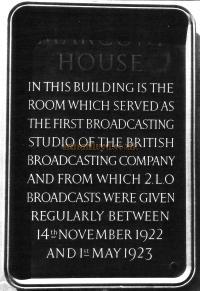
Right - Copy of the first Plaque in 1953 near to the Strand Entrance of Marconi House to record 2.L.O. The Plaque reads: In this building is the room which served as the first broadcasting studio of the British Broadcasting Company and from which 2.L.O Broadcasts were given regularly between 14th November 1922 and 1st May 1923. - Courtesy John A. Strubbe F.R.I.B.A. Click here for more images from this period.
From this building in 1922 and 1923 were broadcast the first programmes from the London Broadcasting Station, "2LO," the studios of which were situated on the seventh floor. In 1933, the Marconi Companies vacated the building, returning in 1950 as part of the English Electric group.

Above - Norman Shaw's Gaiety Theatre and Marconi House, both with Coronation Decorations, during the conversion of the old Gaiety Restaurant, Strand, to Marconi House for English Electric. The first transmitter of the BBC was on the 7th floor of this building from November the 15th 1922. Image drawn by John A. Strubbe and E. J. Thring A.R.C.A. For more on the coronation decorations Click Here. - The Gaiety Theatre was demolished in 1957 and replaced by a new building for the English Electric Company, later to become Citibank House, which was itself demolished in 2005 - 2007. The site was then redeveloped and reopened as the ME London Hotel in the summer of 2012 - Click here for images of all these incarnations.)
 Since
its original construction the building had never seriously been converted
from its early form and it became necessary to carry out extensive internal
reconstruction to provide the maximum office accommodation, together
with up-to-date services.
Since
its original construction the building had never seriously been converted
from its early form and it became necessary to carry out extensive internal
reconstruction to provide the maximum office accommodation, together
with up-to-date services.
Right - The Main Entrance to Marconi House - Courtesy John A. Strubbe.
 When designing and detailing the internal
reconstruction, I decided to use hardwoods as a sympathetic material
both in classical and contemporary interiors, and their use considerably
assisted in the moulding together of contemporary ideas and the classical
character of the building. As there already existed a certain amount
of mahogany, we decided to extend the use of this wood, with oak as
a much lighter contrast.
When designing and detailing the internal
reconstruction, I decided to use hardwoods as a sympathetic material
both in classical and contemporary interiors, and their use considerably
assisted in the moulding together of contemporary ideas and the classical
character of the building. As there already existed a certain amount
of mahogany, we decided to extend the use of this wood, with oak as
a much lighter contrast.
 Wherever
possible, a standard unit partitioning was adopted, constructed of hardwood
framing faced with hardboard, with oak frames, glazing beads and skirtings.
This partitioning in 3-ft. units (see illustration above left) was
painted in to match the existing walls and brought further into harmony
with existing surroundings by the use of similar oak skirtings and a
continuation of the obeche cornice. Wherever it was, necessary to construct
new suspended ceilings, these were kept at one level to allow standard
height units.
Wherever
possible, a standard unit partitioning was adopted, constructed of hardwood
framing faced with hardboard, with oak frames, glazing beads and skirtings.
This partitioning in 3-ft. units (see illustration above left) was
painted in to match the existing walls and brought further into harmony
with existing surroundings by the use of similar oak skirtings and a
continuation of the obeche cornice. Wherever it was, necessary to construct
new suspended ceilings, these were kept at one level to allow standard
height units.

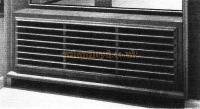
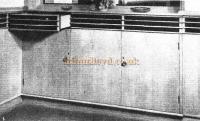
 It
was also decided to adopt a standard form of ventilator and heating
grille, and for these mainly oak, and in a few cases mahogany, was used.
A typical example being that shown in illustration above right. In some cases, the same form of horizontal louvre was extended on to
the return walls with an ebonised backing as a decorative feature. See illustration left.
It
was also decided to adopt a standard form of ventilator and heating
grille, and for these mainly oak, and in a few cases mahogany, was used.
A typical example being that shown in illustration above right. In some cases, the same form of horizontal louvre was extended on to
the return walls with an ebonised backing as a decorative feature. See illustration left.
On the seventh floor, the Companies required a residential club for the use of their overseas visitors when in England. In providing and furnishing this accommodation. considerable use was made of hardwood, again mainly oak with contrasting mahogany.
 Part
of the mahogany panelling, as shown in illustration above right, was reclaimed from other parts of the building. revived and set in oak
frames ; this illustration also shows a specially-designed writing table.
Wherever possible, the furniture in this club was built-in ; in the
bedrooms there are fixed bed-heads and recessed wardrobes. and in the
small dining room a drawer and cupboard unit was designed as a continuation
of the dado panelling. (See illustration left).
Part
of the mahogany panelling, as shown in illustration above right, was reclaimed from other parts of the building. revived and set in oak
frames ; this illustration also shows a specially-designed writing table.
Wherever possible, the furniture in this club was built-in ; in the
bedrooms there are fixed bed-heads and recessed wardrobes. and in the
small dining room a drawer and cupboard unit was designed as a continuation
of the dado panelling. (See illustration left).
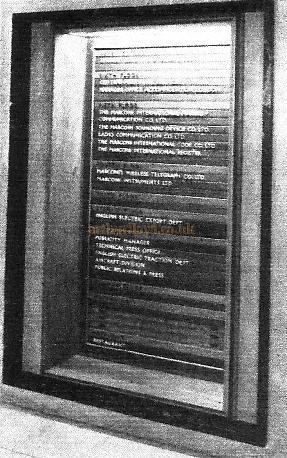
A further decorative use of contrasting oak and mahogany is that employed on the floor indicator boards; each Cornpany name is on a separate hardwood slat with backbutton fastenings, allowing easy removal or readjustment. (See illustration right).
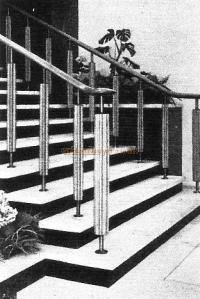 The
entrances to the building were entirely reconstructed and considerable
use was made of mahogany, both Bisselon and Honduras. The lighter, Honduras,
was used for the staircase balustrade and handrail. (see illustration
left).
The
entrances to the building were entirely reconstructed and considerable
use was made of mahogany, both Bisselon and Honduras. The lighter, Honduras,
was used for the staircase balustrade and handrail. (see illustration
left).
The balusters are threaded over a steel core with bronze top and bottom sleeves, the latter to avoid marking and damage to the mahogany when cleaning the marble steps.
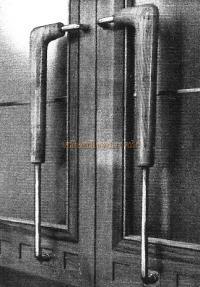
The only other hardwood used was that for the main entrance door handles, these being in English yew on a solid bronze core. (See illustration below right).
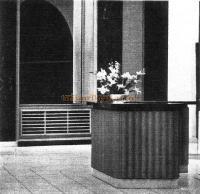
 The illustration below left shows the fluted mahogany front
to the reception counter and the horizontal oak louvre as a radiator
casing.
The illustration below left shows the fluted mahogany front
to the reception counter and the horizontal oak louvre as a radiator
casing.
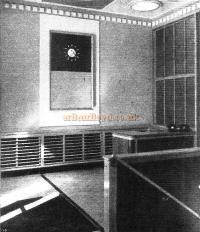
 The
small separate Aldwych entrance has a
dado panelling of Indian laurel and oak framing. (See illustration
below).
The
small separate Aldwych entrance has a
dado panelling of Indian laurel and oak framing. (See illustration
below).
This also shows the horizontal oak grilles and an Indian laurel back to the recessed clock, the lower section of this panel being in cork for use as a notice-board.

Above - One end of the general purpose room and restaurant in the basement. The lower central flush panelling is of Indian laurel with light contrasting obeche parting bead continued upwards through the mural decoration by E.J.THRING ARCA. His drawing for this, the Greek Gods of Food and Wine, was in the Architectural Room, Royal Academy the same year 1953. The mural disappeared some time during the construction of the E.E.Building or shortly after. If anyone knows of its relocation, it would be greatly appreciated if you would Contact me. Photo Courtesy John A. Strubbe F.R.I.B.A. (Retired).
 In
the basement is provided a general-purpose room, used primarily as a
restaurant but also designed as a cinema and exhibition room, see
illustration above which shows one end of this room, the lower central
flush panelling being in Indian laurel. with a light contrasting obeche
parting bead which is continued upwards through the mural decoration;
the latter itself has been painted on hardboard-faced units of standard
flush door construction, allowing the whole of the painting to be completed
away from the site and thus quickly assembled in position. The remaining
lower wall surfaces were covered by the standard horizontal oaklouvred
heating grilles and. above this, polished perforated hardboard in oak
framing and capping, with obeche parting beads and an internal filling
of glass-wool to provide the required acoustic absorbent.
In
the basement is provided a general-purpose room, used primarily as a
restaurant but also designed as a cinema and exhibition room, see
illustration above which shows one end of this room, the lower central
flush panelling being in Indian laurel. with a light contrasting obeche
parting bead which is continued upwards through the mural decoration;
the latter itself has been painted on hardboard-faced units of standard
flush door construction, allowing the whole of the painting to be completed
away from the site and thus quickly assembled in position. The remaining
lower wall surfaces were covered by the standard horizontal oaklouvred
heating grilles and. above this, polished perforated hardboard in oak
framing and capping, with obeche parting beads and an internal filling
of glass-wool to provide the required acoustic absorbent.
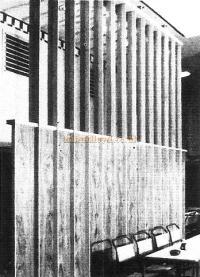
 At
the opposite end of the room, a screen was constructed. both to shield
the entrance doors and provide a backing for the removable film screen.
This is open above 7 ft. to allow warmed-air circulation and a loud-speaker
to be placed behind the screen which has oak fins and horizontal capping
with a lower Indian laurel filling. (See illustration above right).
At
the opposite end of the room, a screen was constructed. both to shield
the entrance doors and provide a backing for the removable film screen.
This is open above 7 ft. to allow warmed-air circulation and a loud-speaker
to be placed behind the screen which has oak fins and horizontal capping
with a lower Indian laurel filling. (See illustration above right).
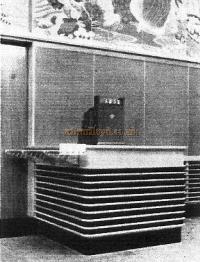
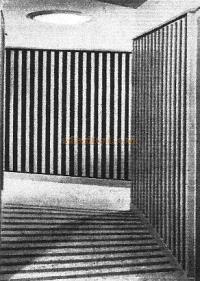
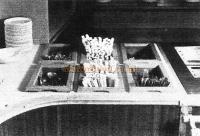 The
removable cashier's desk, illustrated above left, is in oak with
contrasting ebonised backing. This has a sliding door closed from the
end of the cafetaria service. For this purpose, the continuous cafeteria
rail is made to slide, allowing the flush door to close. Further uses
of oak were made in the removable cafeteria cutlery boxes, (See illustration
right) and as vertical protection to the service ramp corridor to
the kitchen (see illustration left). The latter is subjected
to considerable traffic of tea-trolleys to and from the lifts and clearing-trolleys
from the restaurant.
The
removable cashier's desk, illustrated above left, is in oak with
contrasting ebonised backing. This has a sliding door closed from the
end of the cafetaria service. For this purpose, the continuous cafeteria
rail is made to slide, allowing the flush door to close. Further uses
of oak were made in the removable cafeteria cutlery boxes, (See illustration
right) and as vertical protection to the service ramp corridor to
the kitchen (see illustration left). The latter is subjected
to considerable traffic of tea-trolleys to and from the lifts and clearing-trolleys
from the restaurant.
The above article and images are from 'WOOD' (TOTHILL PRESS) pages 13-16 - Marconi House - Strand. The Uses of Hardwood in its Internal Reconstruction by John A. Strubbe, A.R.LB.A. - Courtesy John A. Strubbe F.R.I.B.A. (Ret.)
Click Here for more Coronation photographs of Marconi House and the Gaiety Theatre.
Click here for more internal photographs of Marconi House from 1922, 1923, 1924 and 1950.
Click here for images of the demolition of Marconi House in 2005 / 2007