
The Raglan Music Hall, 172, Union Street, Borough, Southwark
Formerly - The Salmon Concert Room / Salmon Saloon / Borough Music Hall / Alexandra Music Hall
See also - The Raglan Music Hall, Holborn

Above - A Google Street View image of the site of the Raglan Music Hall, Union Street and Ewer Street, Southwark in June 2008 Click to interact.

The Raglan Music Hall was situated at 172 Union Street in Borough, Southwark and was built on the site of the former Alexandra Music Hall which had been in business since the 1840s in one form or another. Starting life as a concert room attached to the Salmon Public House in Union Street, the Hall, which extended to Ewer Street and under the arches of the South Eastern Railway behind it, had several changes of name over the years including the Salmon Concert Room, the Salmon Saloon, the Borough Music Hall, the Alexandra Music Hall, and lastly the Raglan Music Hall which was built on the site of the Alexandra Music Hall when that building had burnt down in 1871.
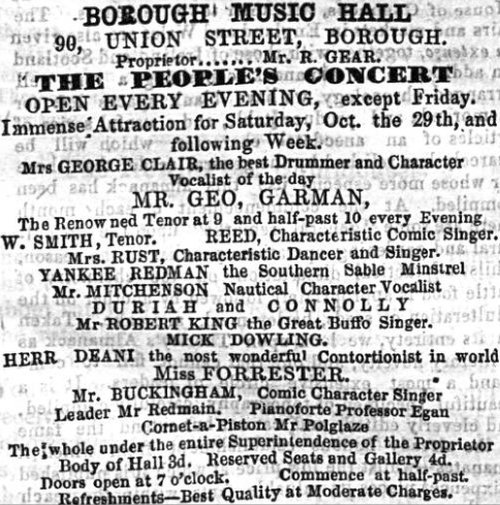 One of the earliest incarnations of this Music Hall was the Borough Music Hall which had been opened by Robert Gear in 1858 after extensive improvements to the former Salmon Saloon.
Right - An Advertisement for the Borough music Hall under the Management of Robert Gear in 1859 - From the South London Times and Lambeth Observer, 29th of October 1859.
An interesting article on this in the South London Times and Lambeth Observer of Saturday the 11th of December 1858 says:- 'Who has not heard of the once famous "Salmon Saloon," of Union Street, Boro' - famous for its dirt, its darkness, and its dingy decorations - famous for its cracked piano, its bad refreshments, uncivil waiters, faulty ventilation, un-globed gas-lights, and excessively low character both of audience and entertainment? Who does not remember the general "cobwebby" air of the whole place, from the slovenly-kept bar to the far end of the Saloon, where stood the mahogany packing-case, miscalled "the instrument," in which (when not in use) the spiders would dance upon the strings to a "Tarantula" of their own composing? We have vivid recollections of all this, as, doubtless have many of our readers.
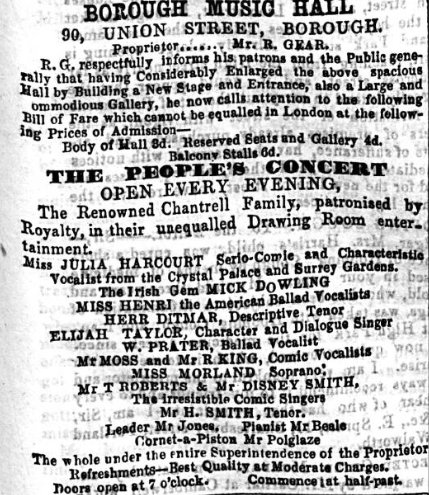 Passing through Union Street a few nights since, we were somewhat startled at the metamorphosis which the Salmon had undergone. Three noble lamps in coloured glass informed us that we were then in front of the Boro' Music Hall, whilst the freshly-painted facia gave us to understand that Mr. Robert Gear was the proprietor of what we may now term the new establishment.
Left - An Advertisement for the Borough music Hall under the Management of Robert Gear in 1860 - From the South London Times and Lambeth Observer, 11th of February 1860.
Anxious to see what improvements (besides re-christening) he had effected in the place and the character of the entertainments, we passed through the elegant plate-glass doors on the right, when we came to a spacious refreshment bar at the entrance to the Hall - the said Hall having been newly-decorated, and well-warmed, lighted, and ventilated, presented a neat and comfortable appearance. Two large crystal chandeliers suspended from the ceiling effectively illuminated every portion of the building, whilst the new and enlarged stage, with its prettily-painted proscenium, was well lit up by a row of brilliant footlights. On the left of the stage stood a fine-toned grand piano, presided over with much skill and taste by Mr. Halliday, ably assisted by Mr. Birchenell (violin) and Mr. Devonport (cornopean).
 In the vocal department, Mrs. Frankford was very successful in her spirited Scotch ballads. Miss Baker, Miss West and Miss Watson were also very effective, and appeared to merit their title of "favorites." Some capital sentimental and descriptive songs were sung by Mr. W. Summers, Mr. H. Gilbert, and the comic William Richards, who appears to be as popular at this establishment now as he was some 14 years ago.
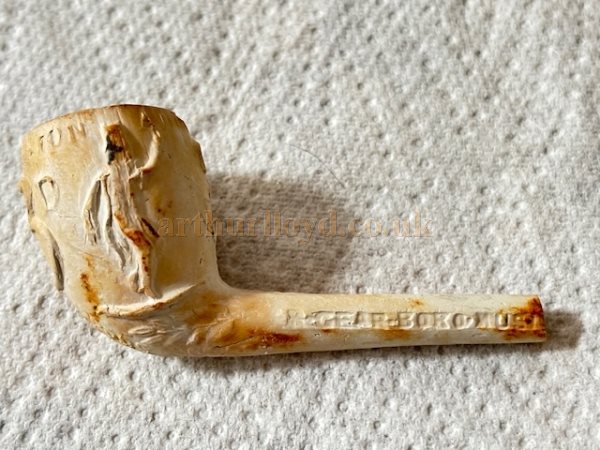
Right - A recently found Clay Pipe bearing the names of Robert Gear and his Borough Music Hall on it - Kindly sent in by its finder Sally Sampson.
We must not forget the humourous delineations of Irish character by Mr. J. W. Duriah, or the novel performance of Mr. Whautsonne, and his company of trained dogs. Mr. Booth, the Lancashire dancer, also appeared to give great satisfaction, if we may judge from the applause he received, and the repeated encores.
 As a whole, the company was far superior to those usually met with at the old Salmon Saloon, the audience more numerous and respectable, the refreshments of a better quality, (whilst they were supplied at reduced prices), the attendants were more civil, and the whole character of the place decidedly improved under the new management.
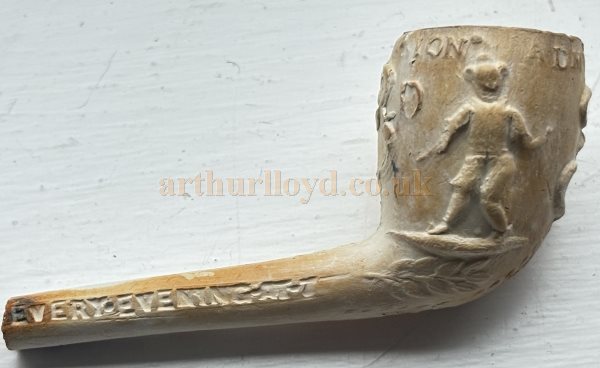
Left - A recently found Clay Pipe bearing the names of Robert Gear and his Borough Music Hall on it along with the inscription 'Every Evening at 7' - Kindly sent in by its finder Sally Sampson.
As a proof that liberality in catering for the public's amusement is always acknowledged by the said public, we may mention that on the evening referred to, about 400 persons were present - chiefly working men and their families - who appeared thoroughly to appreciate and enjoy the opportunity of spending an hour or two in rational entertainment and recreation at the Borough Music Hall.'
The above text in quotes was first published in the South London Times and Lambeth Observer, 11th of December 1858.
The Clay Pipe shown in the photographs above was found recently on the Thames Foreshore opposite the Globe Theatre and Swan Pub by Sally Sampson who kindly sent them in. The Pipe bears the names of Robert Gear and his Borough Music Hall on it along with the inscription 'Every Evening at 7'. It's quite amazing that this Clay Pipe has washed up after being in the river for probably 150 years and with the inscriptions still readable.
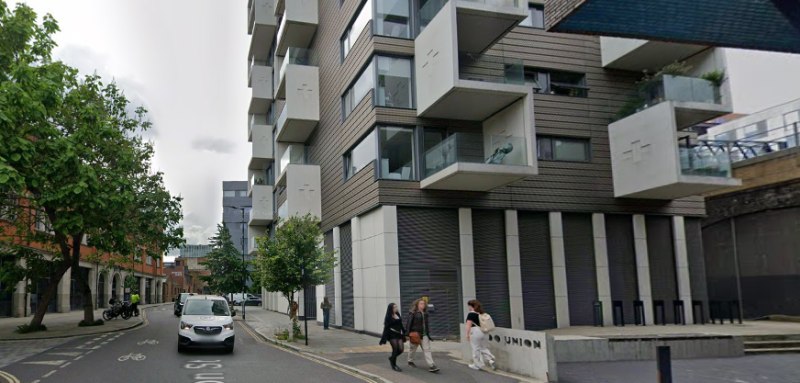
Above - A Google Street View image showing the site of the Raglan Music Hall, Union Street and Ewer Street, Southwark in June 2025 Click to interact.
The Borough Music Hall, under the Management of Robert Gear, had first opened in 1858 and would continue in business until the mid 1860s when it was taken over and reopened as the Alexandra Music Hall by Henry Hart who had also been running the popular Raglan Music Hall in Holborn for many years. (Robert Gear would go on to run the Harp Lounge in Ramsgate until his death in 1893 at the age of 73.)
The Alexandra Music Hall, having opened in the mid 1860s remained in business until it was destroyed by fire on the 28th of September 1871 whilst undergoing repairs. However, it was then rebuilt by Henry Hart, reopening in December in 1872 as the Raglan Music Hall with George Wane as its Manager. The new Hall had an auditorium consisting of a large ground floor space with a circular gallery and a balcony above with a capacity all in all of around 1,000 people. The stage and dressing rooms were built into one of the arches of the South Eastern Railway behind it.
Sadly the Raglan Music Hall was burnt down again on the 13th of November 1883 whilst still under the ownership of the proprietor Henry Hart. The Hall was actually being improved again at the time and, although the Music Hall was almost completely destroyed, the Salmon Pub which fronted it survived the worst of the fire.
The Raglan Music Hall was eventually rebuilt yet again in 1887 with a capacity of some 906 people, and would then be in business as a Music Hall until 1892. The building was used in its final years as a venue for Boxing Matches up until 1894 and later still, when it had been vacant for a year, it was even suggested as a good place to use as a mortuary in 1895, but this was decided against, and in the end the building, which never reopened again, was instead eventually demolished. A modern Apartment building stands on the site today, see image above.
If you have any more information or images for this Music Hall that you are willing to share please Contact me.