
The Savoy Theatre, York Road, Wandsworth, London

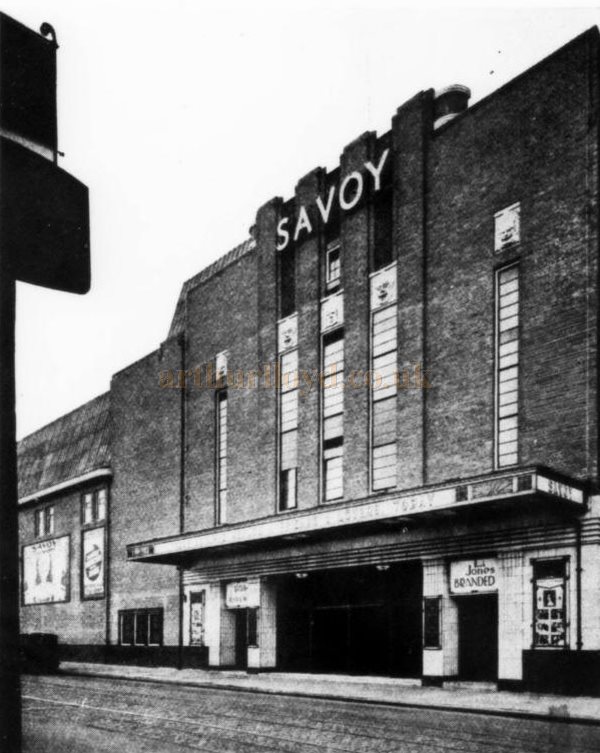
Above - The Exterior and Main Entrance of the Savoy Theatre, Wandsworth - From The Bioscope, April 27th 1932.

 The Savoy Theatre was situated on York Road in Wandsworth and opened on the 22nd of February 1932 with a showing of the films 'Graft' and 'Common Law' and a live performance on stage of Alan Green and his Wonder Band. The Theatre was primarily built as a Cinema but it also had a fully equipped stage with a width of 45ft and depth of 25ft for variety productions.
The Theatre was designed by William R. Glen for ABC in the Art Deco Style and had a large auditorium on two levels, stalls and circle, with accommodation for 2,200 people.
Right - The Entrance Hall of the Savoy Theatre, Wandsworth, looking down from the Balcony Staircase - From The Architect's Journal, 29th of June 1932.
The Kinematograph Weekly reported on the new Theatre in their 18th of February 1932 edition saying:- 'Wandsworth is justly proud of its new kinema, the Savoy, which opens on Monday, February 22. This has been provided by Associated British Cinemas, and occupies a prominent position in York Road, with main and secondary entrances from that thoroughfare. It is yet another link in the chain of fine theatres produced by the company's well-known architect, W. R. Glen, F.R.I.A.S. Strong-looking and essentially modern, it pleasing in proportion and line. The frontage is 186 ft. in length, and is, in main, constructed of sandfaced bricks. A contrast from an almost flat surface provided by light terra cotta columns and panels standing out in relief over each of the two main entrances, and a deep terra cotta plinth which extends across the base of the whole of the frontage. The columns are headed by carved figures.
Accommodation for 2,200
The Savoy accommodates 2,200 persons, and is so well planned that with its excellent sight lines and best possible acoustics one seat is almost as good as another in any part of the house. Every consideration has been given by A.B.C. for the comfort of their patrons and the creation of a pleasing atmosphere.
Access to the rear stalls and circle is gained by the larger entrance, while the entrance at the other end of the frontage leads to the front of the house. Patrons, on entering by the aforementioned entrance, pass through mahogany doors with chromium fittings into a foyer where tickets may be obtained from either of the two payboxes.
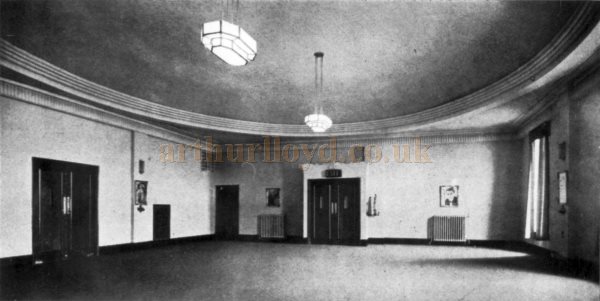
From here, the next step is into a large and warmly-decorated waiting-lounge. This is 31 ft. wide and 44 ft. deep, and is floored in mosaic and terrazzo. A short flight of steps gives entrance to the auditorium, while another stairway at the side leads up to the circle by way of a waiting-room. This place is situated directly over the main foyer, and is notable for a fine, oval domed ceiling illuminated by concealed lighting.
Warm Coloured Decorations
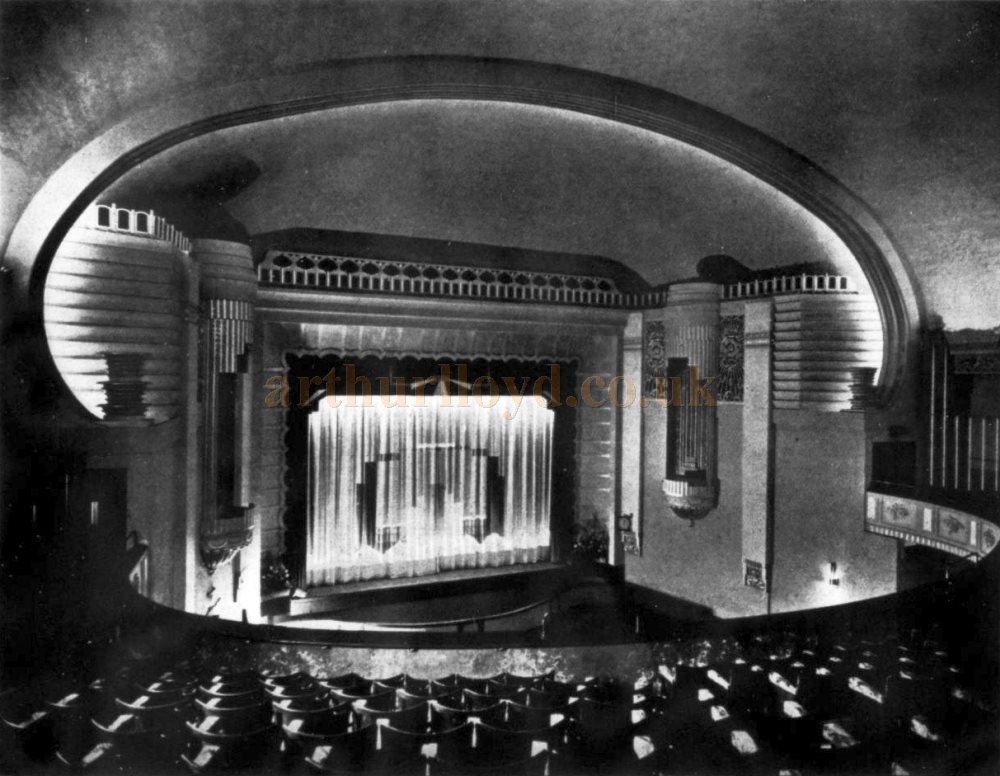
Above - The Auditorium of the Savoy Theatre, Wandsworth when it first opened in 1932 - From The Architect's Journal, 29th of June 1932.
On proceeding into the auditorium, patrons are met with a cheerful and warm atmosphere. It is a spacious building, but this is not over-apparent by reason of cleverly-schemed decorations, executed by Adam Bros., of 4-8, Edge Hill, Liverpool ,in conjunction with Meaton, Tebb and Co., Ltd., of 56, Bold Street, Liverpool. The treatment is based generally on modern lines in pleasing tones of orange and brown, with silver enrichments stumbled and wiped on the high-light surfaces. An effective piece of work is a frieze of silver fluted plaster work, which runs high up on the auditorium wall. On each side of the proscenium opening is a large, oblong grille, and behind one of these the mechanism of a three-manual Compton organ is to he installed. Following what has now become a general practice, the proscenium arch merges into the ceiling.
Effective Lighting
Colour lighting effects will be provided round the three sides of the proscenium arch by Holophane No. 70 type patented three-colour troughing, employing only one lamp per 3-ft. run of troughing per colour, and giving even diffusion between all light sources. W. Draper and Co., who are responsible for, and who have designed, the electrical installation, are lighting the stage by means of Holophane No. 4 type footlight and batten. The colour circuits in the stage lighting equipment, and also of the auditorium lighting, are controlled by a dead-front type dimmer switchboard, supplied by Holophane, Ltd., to the designs of W. Draper, apparatus incorporating the special features associated with this type of Holophane dimmer switchboard.
Colour Blending
The colour circuits in the Holophane troughing in the proscenium cove are controlled by means of special motor-driven dimmers, designed and manufactured by Holophane, Ltd., which ensure perfect colour blending of the proscenium cove colour circuits. A number of Holophane No. 60 type one-colour troughing provide amber light for the concealed cornice lighting of the auditorium. The decorative lighting was in the capable hands of F. H. Pride, of 52, Great Marlborough Street, W.1, and has been carried out along modern lines by fitments in cubist designs. Of particular interest are the wall brackets for the stalls and circle. These are all in metal with pale amber bottom panels through which a soft light is thrown on to the gangways. F. H. Pride was also responsible for the canopy lighting. Here are introduced modern box-shaped fitments which, while increasing the exterior lighting of the front entrances, gives it a striking appearance. While on the subject of lighting, credit must be given to the Boro' Electric Signs, of Ranelagh Road, S.W., who, in their usual efficient manner, carried out the work of installing Neon signs.
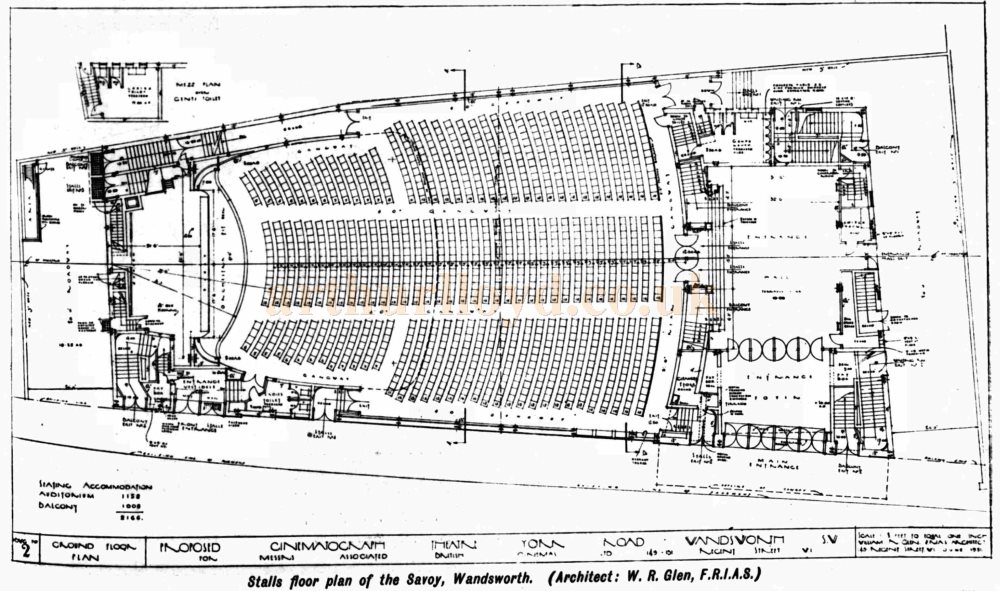
Above - William R. Glen's Stalls Floor Plan of the Savoy Theatre, Wandsworth - From the Supplement to the Kinematograph Weekly, February 18th 1932.
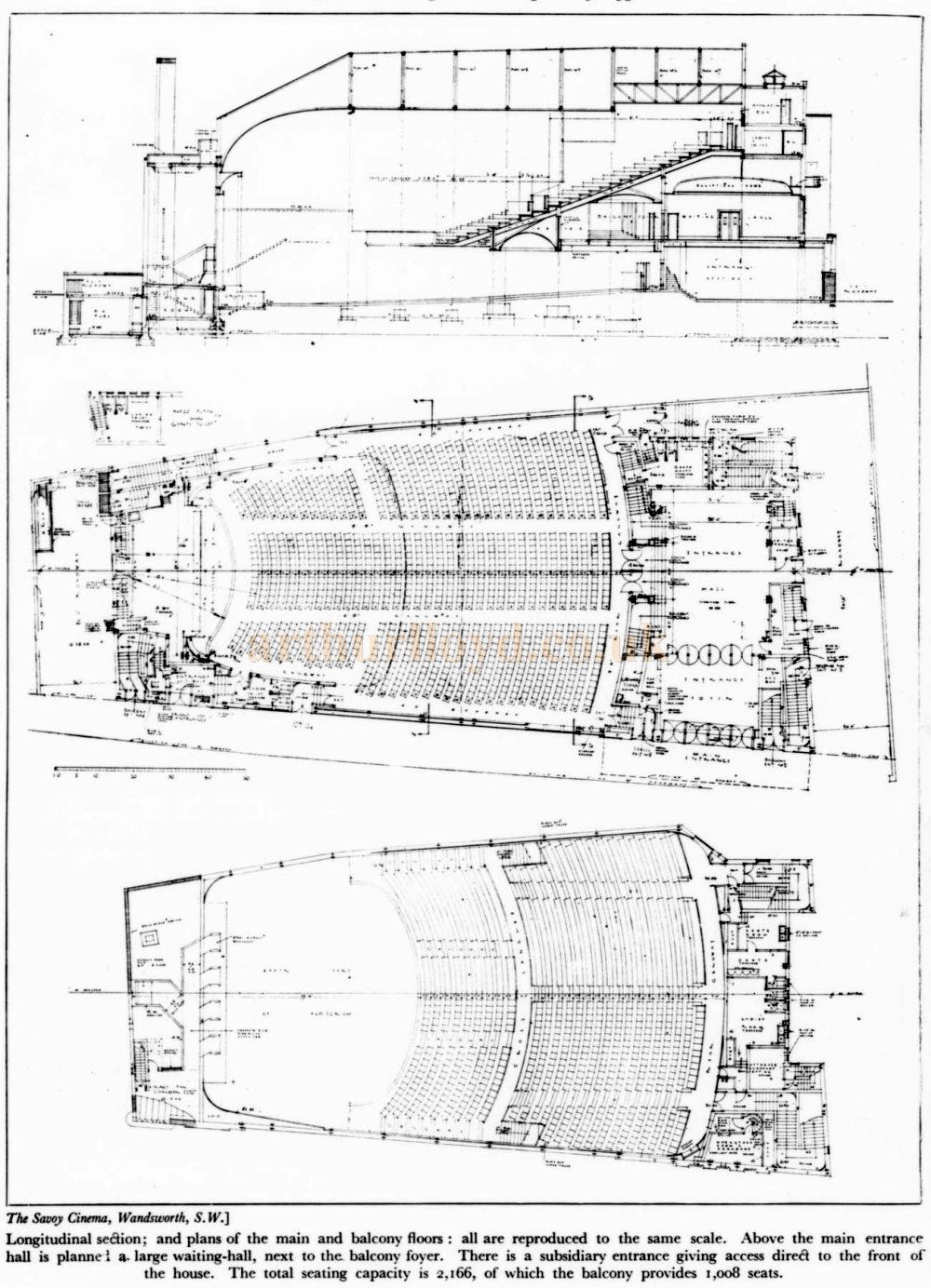
Above - William R. Glen's Plans of the Savoy Theatre, Wandsworth - From The Architect's Journal, 29th of June 1932.
Large Circle
 On the heavy construction side of the building the circle is of particular interest on account of its large proportions. This gives accommodation to a thousand persons. Nearly half-way up is a gangway running right across, and it is at the extreme of this that the circle entrance doors are placed.
Right - The Circle Waiting Hall at the Savoy Theatre, Wandsworth - From The Architect's Journal, 29th of June 1932.
A well-equipped stage having a depth of 25 ft. and a width of 45 ft. is provided. Dressing rooms, band rooms and accommodation for other purposes are included. Heating and ventilating is on the Plenum principle. Fans and ducts extract the vitiated air, according a complete change of air without draught six times every hour. Inlet and extra grilles are ingeniously embodied in the scheme of decoration.
Tiled Projection-room
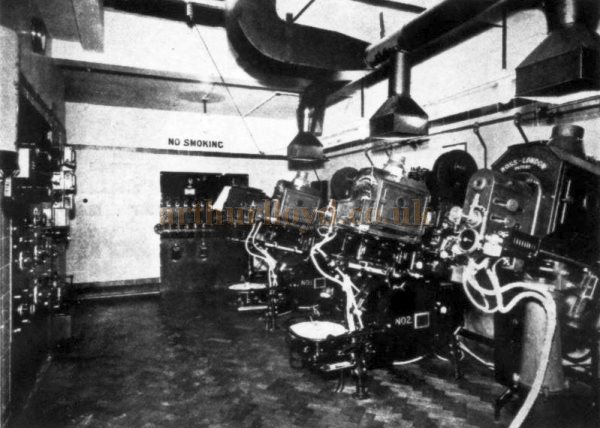 A very fine projection-room has been built with tiled walls. This is equipped with two of the latest Ross projectors and the company's new high-intensity arc lamps, back shutters and proportionate masking outfit. Western Electric is the sound system.'
The Above text in quotes was first published in the Kinematograph Weekly, 18th of February 1932.
Left - The Projection Room of the Savoy Theatre, Wandsworth - From the Architect's Journal, 29th of June 1932.
The Caption for the image shown left reads: In the operating box, above and behind the balcony, are installed four projectors, with ventilation hoods and ducts. Here also are switchboards and spotlights.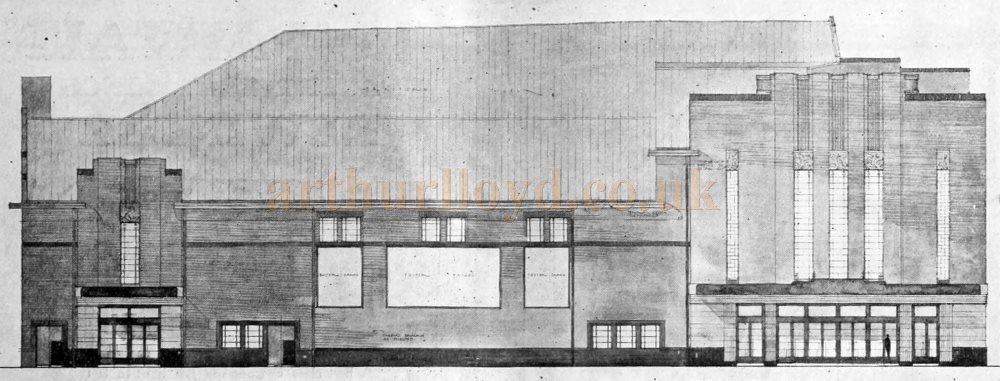
Above - The whole of the planned York Road Elevation of the Savoy Theatre, Wandsworth - From Modern Cinema Technique, 19th of August 1931.
 The Savoy Theatre, Wandsworth first opened on the 22nd of February 1932, surprisingly without its Compton Organ, which was unfinished at the time of the opening. An unceremonious opening with no official ceremony was also the order of the day and so the Theatre just opened and began its film showings and stage presentations without any pomp and ceremony. It's Manager for the opening was James Beresford, a descendent of the well known actor J. L. Toole, and the assistant manager was Fordham Ellis.
Right - The Savoy Theatre, Wandsworth when it first opened in 1932 - From The Architect's Journal, 29th of June 1932.
The Theatre had a pretty short early life because it was hit by a rocket bomb during the war in January 1945 which put it out of action until it could be repaired. After the repairs were completed it was reopened in January the following year, 1946.
In 1958 it was closed again for a short time because of the much hated Entertainment Tax, it put on wrestling matches on its stage instead from March until May 1958. When it did reopen for films it was just using the stalls as attendances had reduced considerably. And the following year the Savoy was closed for good after a last showing of the film 'Some Came Running' on the 6th of June 1959. It was just too large a Theatre for the smaller audiences since Television began to dominate. The Theatre was subsequently demolished, less than 30 years after it first opened, in April 1960.
If you have any more information or Images for this Theatre that you are willing to share please Contact me.