
The Olympia Theatre, Dame Street, Dublin
Formerly - Connell's Monster Saloon / The Star of Erin Music Hall / Dan Lowrey's Music Hall / Dan Lowrey's Palace of Varieties / The Empire Palace Theatre
The Olympia Theatre Main Article - Arthur Lloyd at Dan Lowrey's Music Hall
Dublin Theatres Index

Above - A Google StreetView Image of the Olympia Theatre, Dublin - Click to Interact

 Dublin's
Olympia Theatre originally opened as the Empire Palace Theatre in November 1897. The Theatre was built
on the site of a former Saloon and Music Hall which had originally opened
as Connell's Monster Saloon in 1855.
Dublin's
Olympia Theatre originally opened as the Empire Palace Theatre in November 1897. The Theatre was built
on the site of a former Saloon and Music Hall which had originally opened
as Connell's Monster Saloon in 1855.
In 1879 Dan Lowrey acquired this Hall and on the 22nd of December that year he reopened it as the The Star of Erin Music Hall.
In August of 1881 his son took over, Dan Lowrey Junior, and renamed the building Dan Lowrey's Music Hall. In 1889 it was renamed again, this time to Dan Lowrey's Palace of Varieties. Dan Senior died the following year.
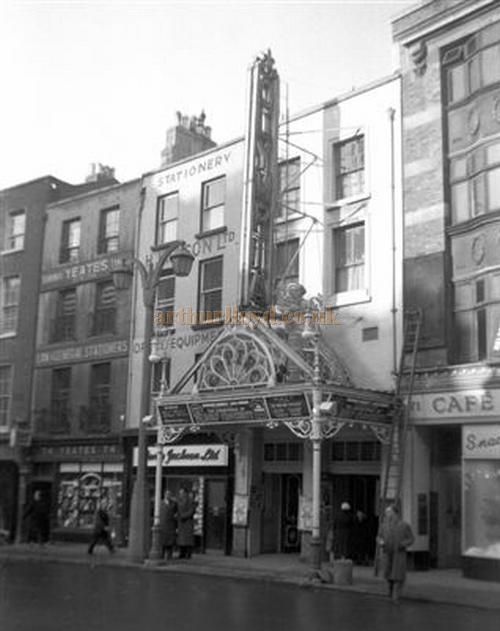
Right - The Olympia Theatre, Dublin during the run of 'The Adventures of Davey Crockett' in December 1956 / 1957 - Courtesy Gerry Atkins whose partner in the production was Jill Gascoine.
After many years the Music Hall finally closed in February of 1897 and was then completely rebuilt as a proper Variety Theatre for Adam Findlater, reopening on the 15th of November the same year as the Empire Palace Theatre.
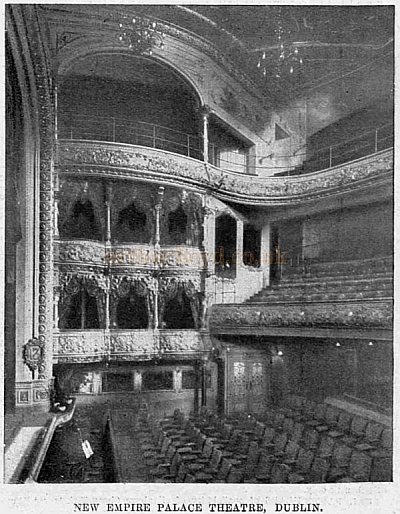 The new Theatre had seating for 1,500 people in its Stalls, Circle, Gallery levels along with 12 Private Boxes. There were four cloakrooms, four large bars, scenery stores and eleven dressing rooms for artists.
Left - The Auditorium of the Empire Palace Theatre, later the Olympia Theatre, Dublin when it first opened in 1897 - From The Sketch, 19th of January 1898.
The Theatre was renamed The Olympia Theatre in 1922 when it was taken over by Bradlaw and Morrison who ran it successfully as such for many years. In 1957 its then owners Stanley Illsely and Leo McCabe refurbished the Theatre at a cost of £15,000 installing modern oil fired central heating, new air conditioning, redesigning the Gallery and Circle, and carrying out reconstruction work backstage. However, in 1963 Illsely and McCabe put the Theatre up for sale by auction and it was subsequently bought by a London based syndicate of Irish Businessmen who intended to alter it into a Ballroom and Restaurant.
The Sale Brochure for the Olympia Theatre, 10th of October 1963
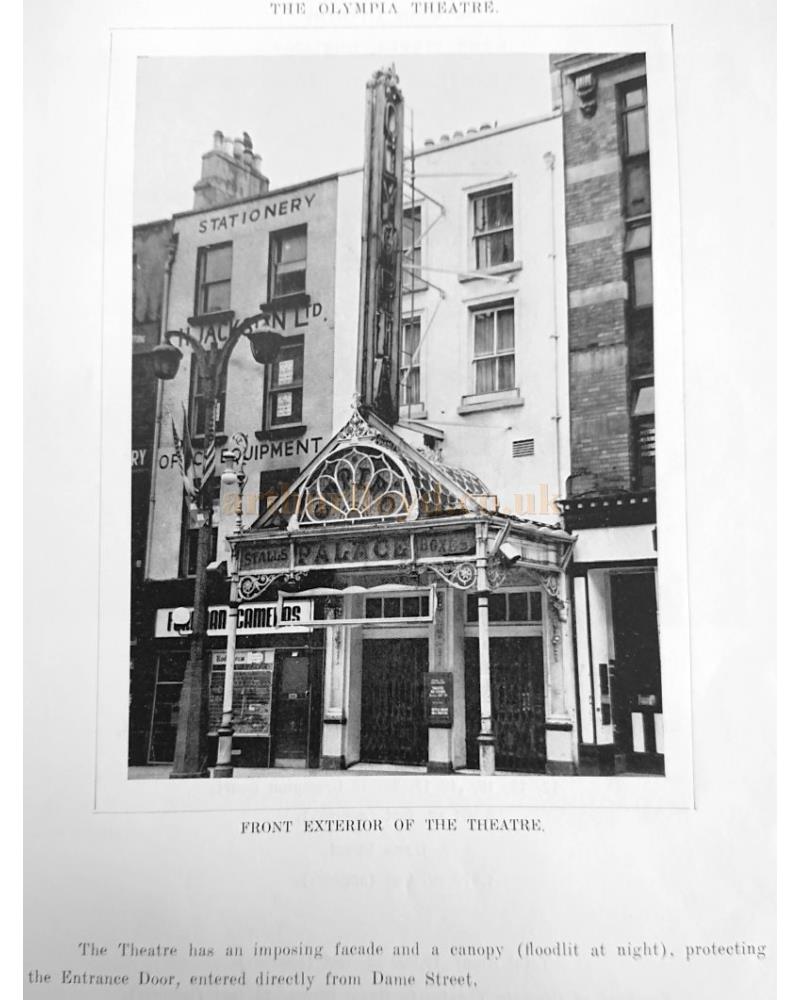
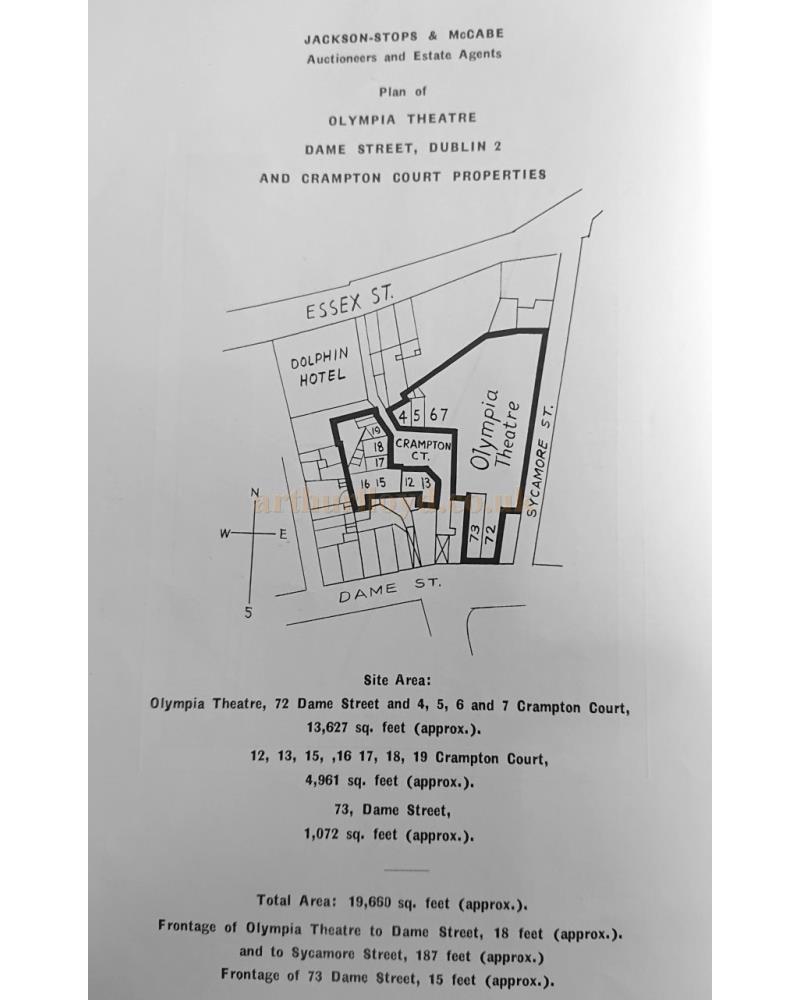
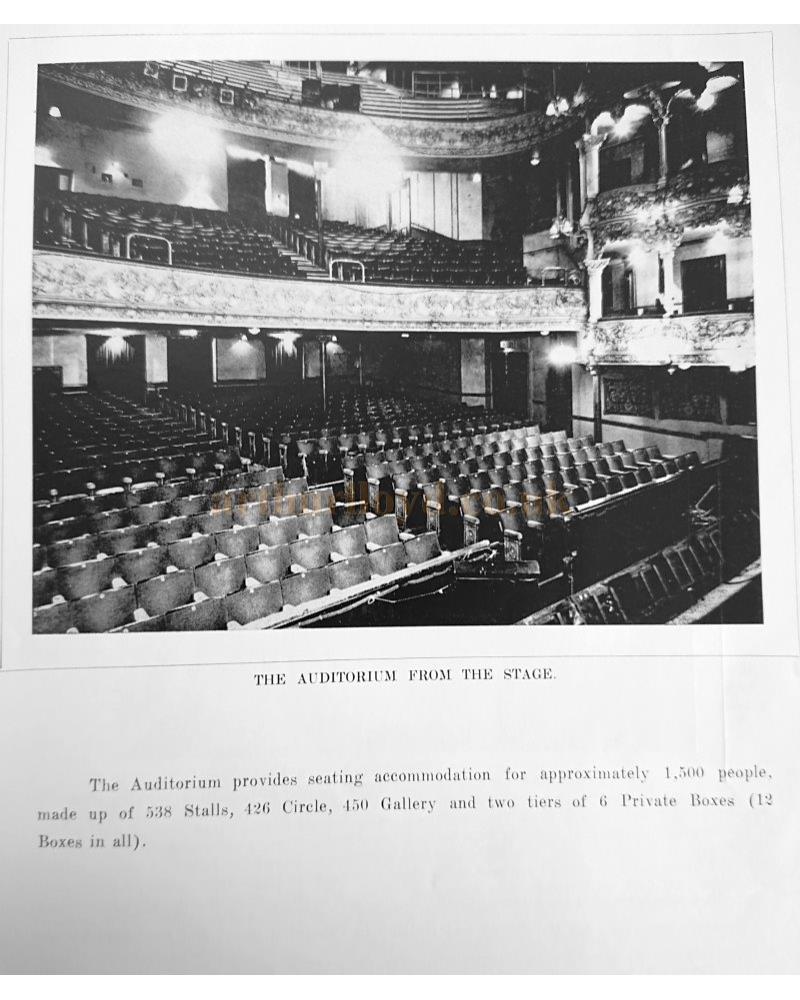
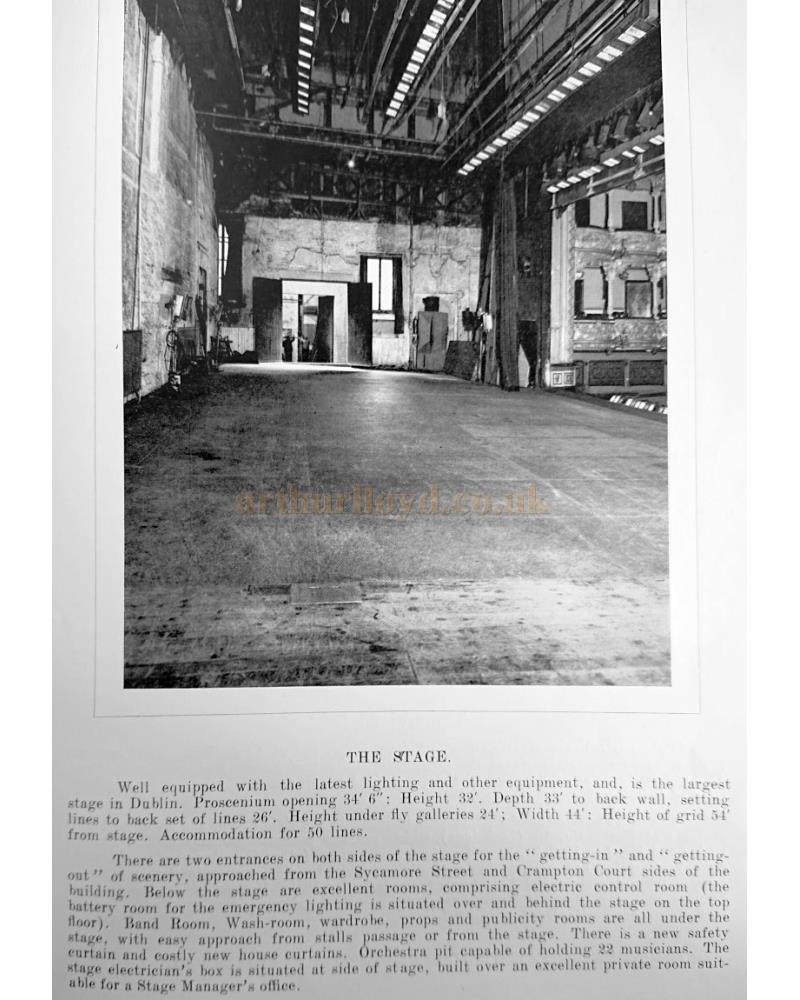
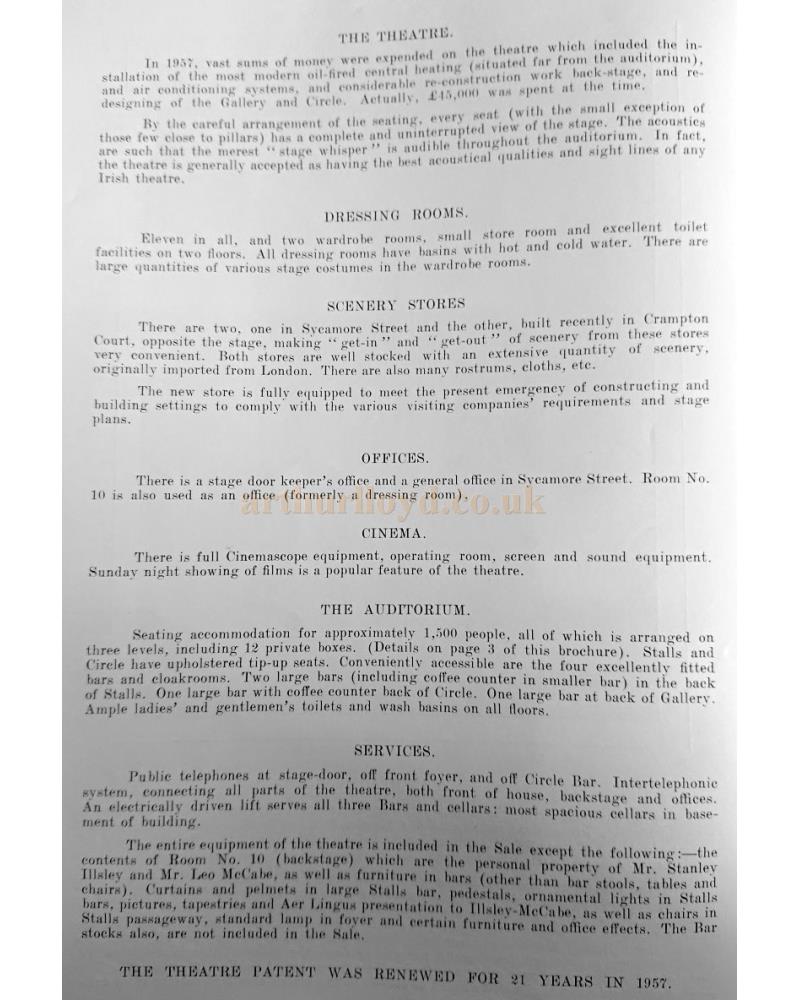
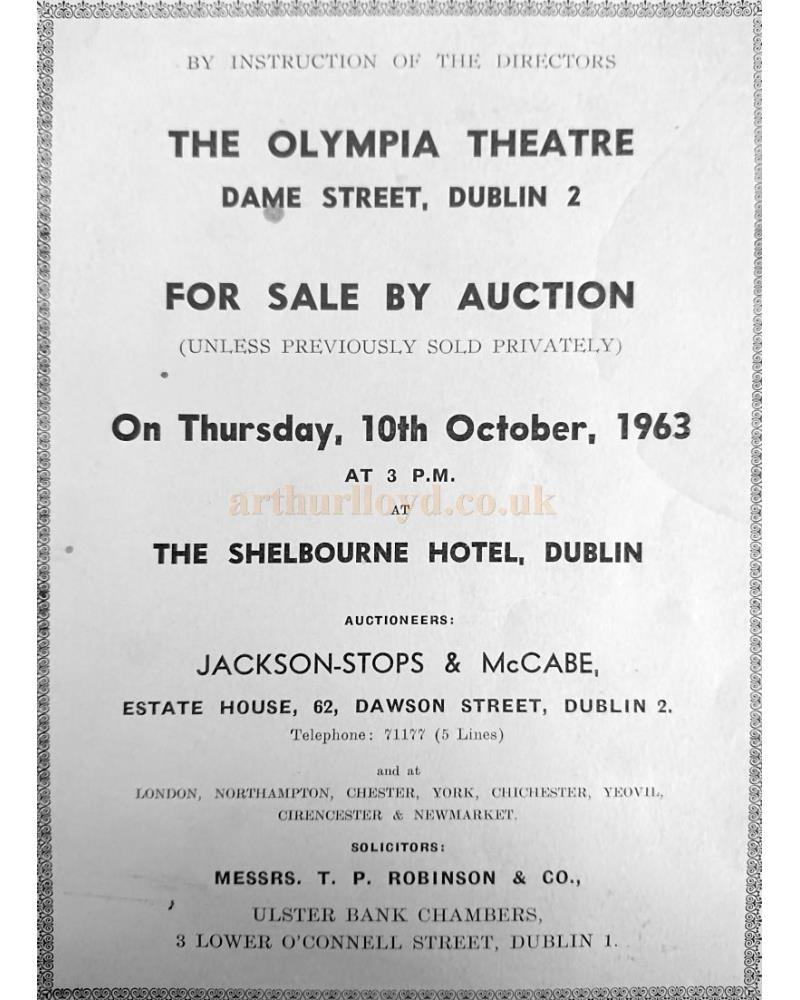

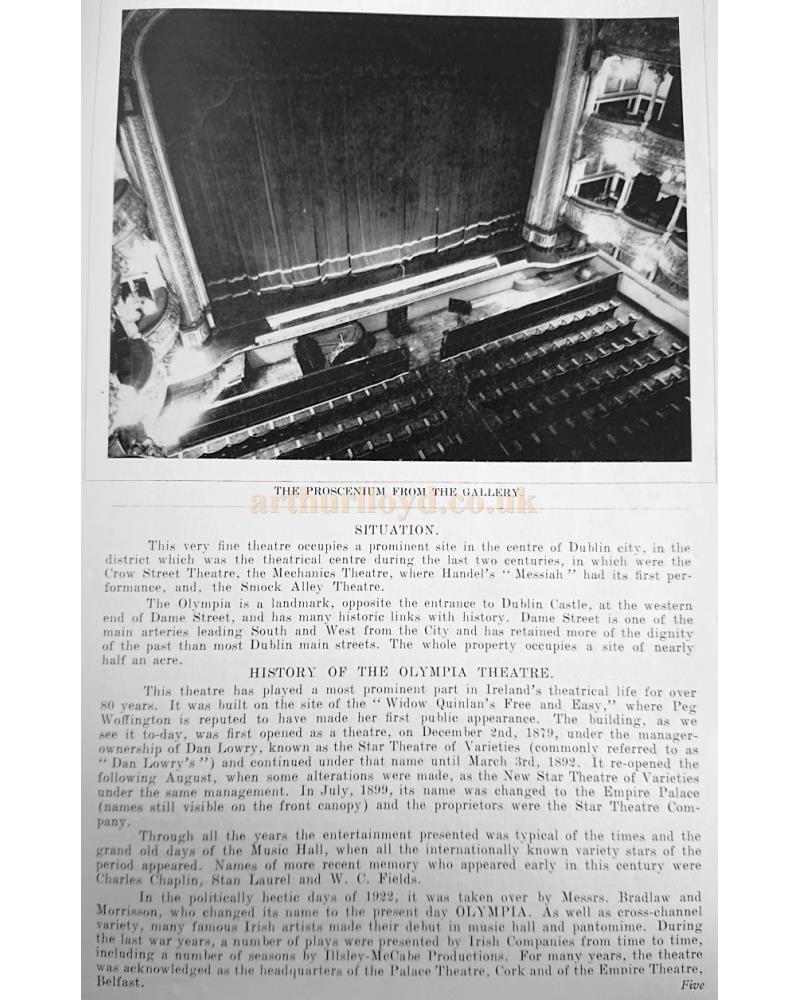


Above - The Sale Brochure for the Olympia Theatre, 10th of October 1963 - Courtesy John Findlater, whose father, grandfather and great granduncle were chairmen of the Theatre from 1897-1963.
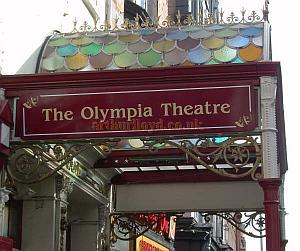 The Syndicate, which comprised of Lorcan Bourke, Jack Cruise, Richard Hallinan, and Brendan Smith, paid £80,000 for the Theatre but their plans were refused, even on appeal.
Right - The Canopy of the Olympia Theatre, Dublin in March 2009 - Courtesy Des Kerins.
However, the Theatre was still doing very good business so they settled into running it as a Theatre despite their original ideas. Indeed they even re-equipped the Theatre in 1964 and reopened it as a Theatre for "First Class Companies".
Theatre use continued successfully until it was forced to close after major structural damage to the building occurred in November 1974 when parts of the proscenium arch and the ceiling above collapsed during a break in rehearsals for a production of West Side Story, which was to have opened that night.

Above - The Auditorium of the Olympia Theatre, Dublin in 1990 - Courtesy Ted Bottle

Above - The Auditorium and Stage of the Olympia Theatre, Dublin in 1990 - Courtesy Ted Bottle.
 After
the Theatre closed in November 1974 that looked like it might be the
end for the building. The local Council seemed to favour demolition,
and the London owners of the Theatre were in agreement, but there was
much local opposition and a restoration fund was begun.
After
the Theatre closed in November 1974 that looked like it might be the
end for the building. The local Council seemed to favour demolition,
and the London owners of the Theatre were in agreement, but there was
much local opposition and a restoration fund was begun.
Tireless efforts by the staff of the Theatre and local people, organising raffles and sponsored walks, followed.
Right - The Olympia Theatre, Dublin in March 2009 - Courtesy Des Kerins.
The stalls bar was turned into a small Theatre and performers from all over appeared nightly to swell the restoration fund.
Eventually, after a huge sponsored walk by just about everyone in the profession brought so much attention to the Theatre's plight that people were queuing up at the box office to donate money, the City Councilors decided to back their efforts and placed a preservation order on the Theatre and added to the fund themselves.
And so, because of the tireless efforts of local campaigners, and the foresight of the City Councilors , the Olympia Theatre was finally restored and redecorated, at a cost of some £250,000, and on the 14th of March 1977 the Theatre was reopened, and happily it is still open to this day.
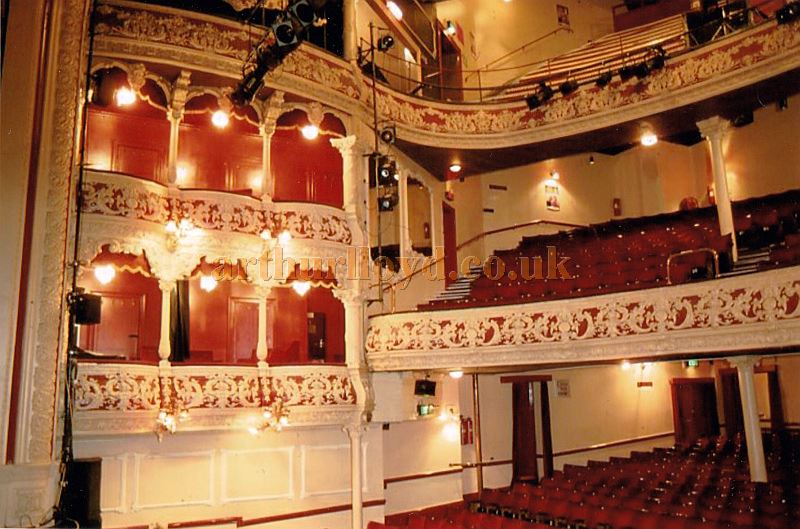
Above - The Auditorium of the Olympia Theatre, Dublin in 1990 - Courtesy Ted Bottle.

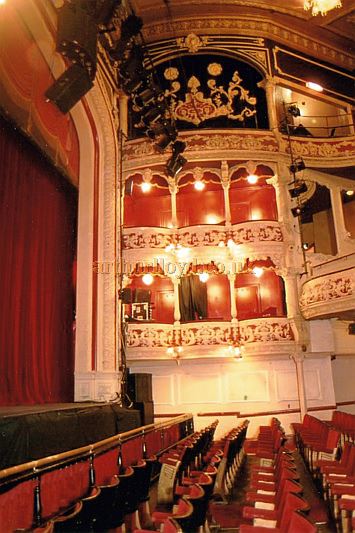
Above - The Circle and Upper Circle Entrances of the Olympia Theatre, Dublin in March 2009 - Courtesy Des Kerins. And the Auditorium and Stage of the Olympia Theatre, Dublin in 1990 - Courtesy Ted Bottle who says:- 'The Olympia was designed by Brunton who was also the architect for the Palace Theatre, Cork. It was at the Olympia that part of the proscenium arch collapsed during a rehearsal break and although a member of staff pointed out to me where the break had been I couldn't spot the repair. I think it is a delightful theatre - pity the house tabs are so plain.'
You may like to visit the Olympia Theatre's own website here.
Arthur Lloyd is known to have performed in Dublin on various occasions including the years 1867, 1868, 1870, 1871, 1872, 1874, 1879, 1880, and 1892. He also performed at The Star and Dan Lowrey's Music Hall, the predecessors of the Olympia Theatre, on several occasions. A short article about his career and performing at Dan's is reproduced below.
Arthur Lloyd at Dan Lowrey's Music Hall
From ' Infinite Variety: Dan Lowrey's Music Hall 1879-97'
 Top
of the year's Bill was Arthur
Lloyd, (December). He was a Music-Hall man in a way that was new to Lowrey. He waved no flags. The speech
and the attitudes of the common man everywhere, brilliantly delineated,
were the themes of his art. He was expensive, taking a nice slice
out of the fortnight's takings; but he did entice a little of Dublin's
bon ton, and many who had never before ventured down the tunnel to
Crampton Court now flocked to see the Face that had launched a thousand Song-Sheets. Lloyd sang in evening-dress,
a Scots voice with London overtones:
Top
of the year's Bill was Arthur
Lloyd, (December). He was a Music-Hall man in a way that was new to Lowrey. He waved no flags. The speech
and the attitudes of the common man everywhere, brilliantly delineated,
were the themes of his art. He was expensive, taking a nice slice
out of the fortnight's takings; but he did entice a little of Dublin's
bon ton, and many who had never before ventured down the tunnel to
Crampton Court now flocked to see the Face that had launched a thousand Song-Sheets. Lloyd sang in evening-dress,
a Scots voice with London overtones:
I loved her, and she might have been
The happiest in the land,
But she fancied a foreigner who played the flageolet,
In the middle of a German Band.
 He
had been trained from childhood as an Actor in an Edinburgh Company in which his father was Comedian at £5 a week. Young Arthur discovered a gift for
writing songs to be sung before the curtain while the scenery was being changed and, though he hankered to be a Great Actor, he
went into Music Hall because,
cannily enough, he felt there was more money in it. Having tried himself
out at The Whitebait Tavern in Glasgow, he felt he was ripe for London.
He
had been trained from childhood as an Actor in an Edinburgh Company in which his father was Comedian at £5 a week. Young Arthur discovered a gift for
writing songs to be sung before the curtain while the scenery was being changed and, though he hankered to be a Great Actor, he
went into Music Hall because,
cannily enough, he felt there was more money in it. Having tried himself
out at The Whitebait Tavern in Glasgow, he felt he was ripe for London.
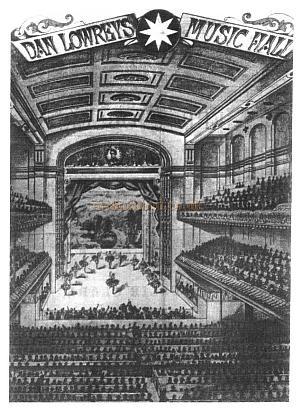
Right - Dan Lowrey's Music Hall - From the detailed book: 'The Lost Theatres Of Dublin' by Philip B Ryan.
An unknown Scots boy doing the round of the Saloons and the Penny Gaffs, he was on the starvation list and to make ends meet he took a job with a hatter in the Strand. There he learned to shake off the trappings of the fustian Stage and to listen to how people really talked. (Please Note: - This information is incorrect, Arthur's father Horatio Lloyd was born in a shop on the Strand where his father Robert Lloyd was a hatter. This is often mistakenly attributed to Arthur being a hatter. M.L.)
In the streets he came alive to attitudes and speech habits; he picked up catch-phrases, spotted a comic sense of pathos, a vocal delight in sheer nonsense, a knack of cutting pretension down to size; and he distilled something of all this into the songs he composed and presented. In his time he published more than two hundred of these ditties, all of them of considerable popular appeal.
 He
rode every day into town on an omnibus driven by a chatty Cockney
named Joe. Joe's caustic criticism of everything under the sun was,
'No thankyer. Not for Joseph!' The Scotsman's quick ear caught the
tone of the phrase and enshrined it in a song entitled 'Not
for Joseph!' It was an immediate success. 'Not for Joseph!' became
a cant phrase on the lips of all classes, in all circumstances. The
song sold 80,000 copies, a record for the time and for a long time
after, and on a wave of acclaim young Lloyd came to The
London Pavilion.
He
rode every day into town on an omnibus driven by a chatty Cockney
named Joe. Joe's caustic criticism of everything under the sun was,
'No thankyer. Not for Joseph!' The Scotsman's quick ear caught the
tone of the phrase and enshrined it in a song entitled 'Not
for Joseph!' It was an immediate success. 'Not for Joseph!' became
a cant phrase on the lips of all classes, in all circumstances. The
song sold 80,000 copies, a record for the time and for a long time
after, and on a wave of acclaim young Lloyd came to The
London Pavilion.
The Pavilion was a new venture, recently renovated as a refreshment-cum-variety premises by a pair of Jewish restaurateurs, Loibl and Sonnenhammer. An air of champagne and the glitter of diamonds lingered there from the earlier establishment, The Argyll Rooms, while at the same time it had the aura of a tavern from its days as The Blackhorse Inn. Shrewd Lloyd seized the essential: combine the Argyll air with the Blackhorse aura, the diamonds with the beer, a place on the stage and in the bars and balconies for both the bon ton cravat and the New Cut coat of the fishmonger. Lloyd could in his own style combine both, and he engaged and trained artistes to do the same. He made a fortune and a name, and The 'Pav' became the Centre of the World.
The face that came into the light at Dan's was heavy, homely and dimpled when he smiled. The voice was of a rich timbre with a wealth of comic tone. He was a bigger draw than the Chicks even, and with Ashcroft, Pat Kinsella and Old Dan himself, he established the Male Comic as the heart of the Night Rite.
The above text is from 'Infinite Variety: Dan Lowrey's Music Hall 1879-97' - Courtesy John Grice.