
The Apollo Victoria Theatre, 17 Wilton Road, Westminster, London
Formerly - The New Victoria Theatre

Above - The Apollo Victoria during the run of 'Wicked' in October 2006.


 The
Apollo Victoria Theatre was designed by W. E. Trent, with E. Wamsley
Lewis, and constructed in 1930 for Provincial Cinematograph Theatres,
who were part of Gaumont British. The Theatre is unusual in that it occupies a site that
gives it two main entrances and two almost identical facades, one on
Wilton Road, the other on Vauxhall Bridge Road.
The
Apollo Victoria Theatre was designed by W. E. Trent, with E. Wamsley
Lewis, and constructed in 1930 for Provincial Cinematograph Theatres,
who were part of Gaumont British. The Theatre is unusual in that it occupies a site that
gives it two main entrances and two almost identical facades, one on
Wilton Road, the other on Vauxhall Bridge Road.

The Theatre was designed as a Super Cinema with full stage facilities, and originally opened as the New Victoria Theatre on the 15th of October 1930 with the film 'Old English', along with an accompanying stage show called 'Hoop-La'. The Theatre's auditorium, with an original capacity of 2,860, today 2,328, was designed in the art deco style and lavishly decorated in an underwater theme with an extravaganza of scallops around a huge dome.

Above - The New Victoria Theatre on its opening with the film 'Old English' - From The Sphere, 18th October 1930.
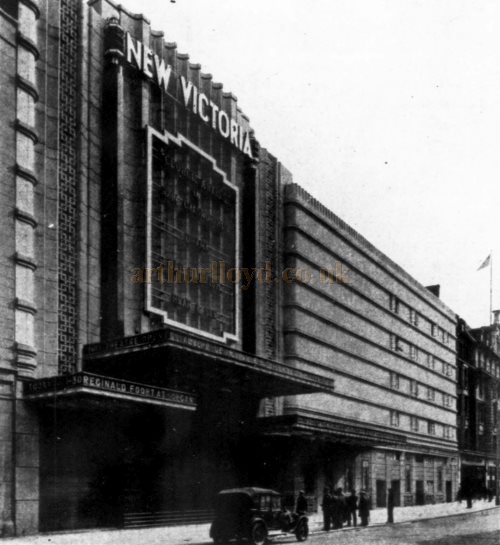 The Architect's Journal reported on the New Victoria Theatre in their 22nd of October 1930 edition, along with some of the images shown here, saying:- 'Perhaps no building in London has provoked so much criticism, favourable and otherwise, as the New Victoria Cinema Theatre which opened its doors to the public on Wednesday last.
Right - The Wilton Road Facade and Entrance to the New Victoria Theatre when it first opened in 1930 - From The Architect's Journal, 22nd of October 1930.
The building stands in a popular shopping district in the immediate vicinity to Victoria Station, with long frontages to two streets, crowded daily with shoppers and with travellers to and from the suburbs, the South Coast and the Continent. It is not surprising, therefore, that since the building first began to take shape much comment has taken place concerning its unorthodox appearance and its unusual constructional features.
In planning the theatre the architects encountered considerable difficulties owing to the perfect rectangular shape of the site. It was essential to provide the theatre with as many seats as possible and at the same time to leave ample space for entrances, exits, stairs, rest-rooms, etc. To attain this object the whole of the stalls floor has been placed below street level, and the entrance hall arranged in the depth of the balcony.
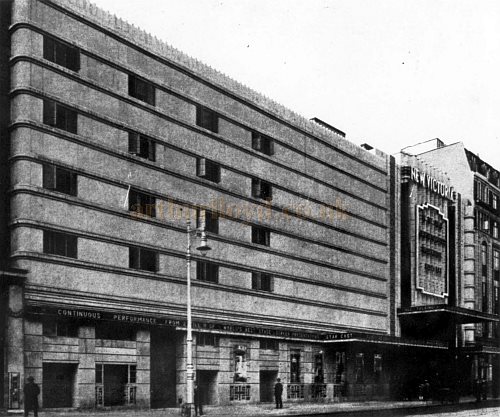 At the stage end the floor of the stalls is 22 ft. below street level, and the side gangways are actually under the pavement in Wilton Road and Vauxhall Bridge Road. Above the stalls there is a large single balcony. It extends the full width of the theatre, and is about 90 ft. deep from back to front. This balcony seats 1,000 persons, and with the stalls provides a total seating accommodation of three thousand.
Left - The Vauxhall Bridge Road Facade and Entrance to the New Victoria Theatre when it first opened in 1930 - From The Architect's Journal, 22nd of October 1930.
Having sunk the stalls beneath the street level it was necessary to provide heavy concrete retaining walls varying from three to seven feet in thickness on both sides of them. At the stage end the adjoining building, a big drapery store, erected on four great stanchions loaded up to about three hundred tons, had to be underpinned as the cinema excavations went down 10 ft. lower.
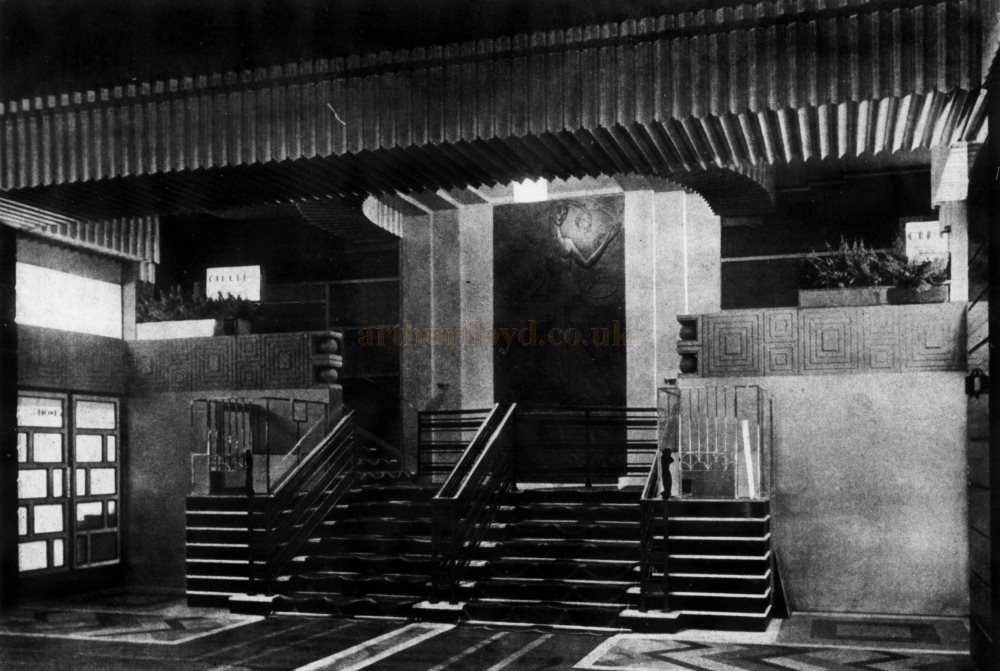
Above - The Main Foyer of the New Victoria Theatre when it first opened in 1930 - From The Architect's Journal, 22nd of October 1930. On the left of the picture are the Wilton Road Entrance Doors, the Centre Staircase leads up to the Upper Foyer and Balcony, stairs either side of this lead down to the Stalls.
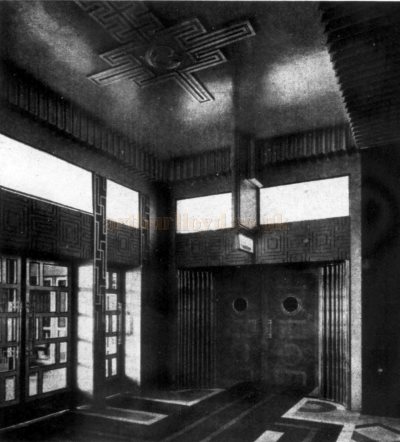 The entrance floor hall is suspended from the girders carrying the balcony. There are two main balcony girders, one weighing 93 tons, the other 70 tons, and each 101 ft. long. The smaller of these was brought by rail to London from the North of England in one piece, taken through the streets in one piece to the site, and lifted straight into position. It is said that this is the biggest girder ever handled in this way.
Right - The Main Foyer and Vauxhall Bridge Road Entrance Doors of the New Victoria Theatre when it first opened in 1930 - From The Architect's Journal, 22nd of October 1930.
The whole building is a steel-framed structure, and the total weight of the steel involved is upwards of 1,600 tons. All the stanchions rest on large steel grillages, filled in solid with concrete. As in two cases the point loads reach nearly nine hundred tons, very heavy foundations have been rendered necessary.
Owing to the restricted nature of the site the whole of the drainage is within the building and in many cases the suspended floors and drains have been constructed together.
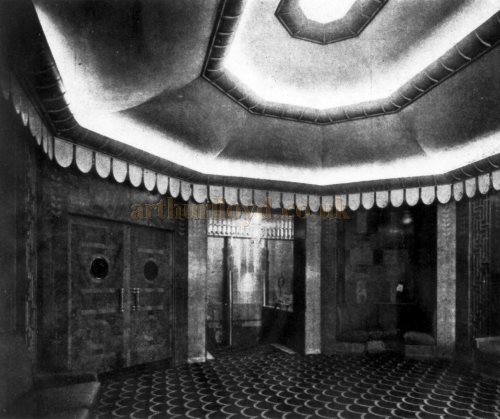 All the sewage is lifted by a pump to the level of the sewer in the street. For the same reason, that of a restricted site, the boiler house and the heating and ventilating plant are placed in the roof, where are also the projection rooms, electrical workshops, etc. Air is drawn in and, after being filtered, washed and warmed, is forced into the auditorium from the ceiling downwards and extracted under the seats.
Left - The Upper Foyer of the New Victoria Theatre when it first opened in 1930 - From The Architect's Journal, 22nd of October 1930.
The height from the floor under the stage to the roof of the stage is 94 ft. Over the centre of the auditorium is a dome 65 ft. in diameter, the steel ribs being filled in with concrete. The eye of this dome, 20 ft. in diameter, is glazed to admit such daylight and sunlight as is required by the London County Council during the day. At other times a steel rolling shutter excludes daylight.
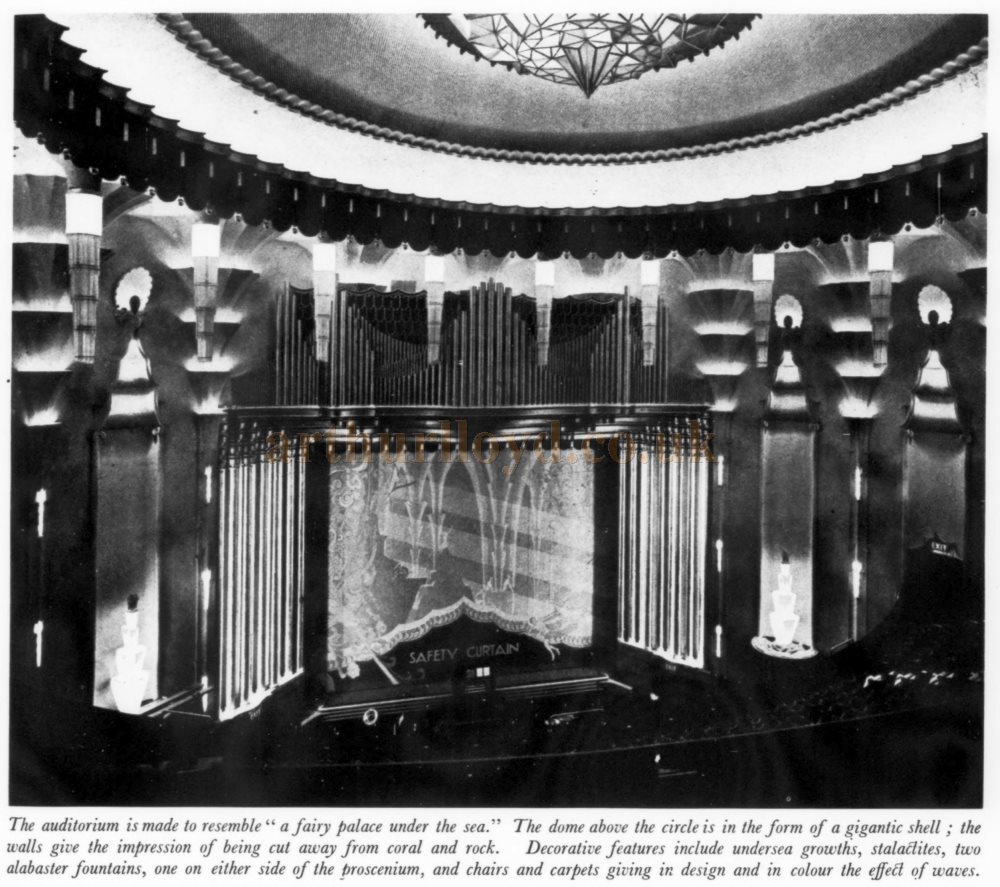
Above - The Auditorium of the New Victoria Theatre when it first opened in 1930 - From The Architect's Journal, 22nd of October 1930.
 The striking and mysterious lighting effects of Mr. E. G. Nichols, chief engineer of the cinema company, and his assistants, Mr. Humphrey and Mr. Cucksey, contribute enormously to the success of the architects' conception. Among the effects obtainable are those of clouds, fire and snow.
Right - The Auditorium of the New Victoria Theatre when it first opened in 1930 - From The Architect's Journal, 22nd of October 1930.
The latest type of mercury-vapour rectifier is installed to give "short-circuit proof" d.c. supply for the projectors and the organ.
In carrying out the deep excavations an interesting piece of Old London was discovered. At a depth of about 14 ft. and running diagonally from end to end of the site a line of old mooring posts and the camp-sheeting of an old wharf were uncovered.
On one side of the posts was a layer of black river mud, showing that in earlier days a water-way (probably an arm of the Thames) extended to this point, and that barges came up to discharge their cargoes here. To present-day Londoners the idea of a wharf at Victoria may sound incongruous, but here was obvious proof that it once existed.'
The above text in quotes was first published in The Architect's Journal, 22nd of October 1930.
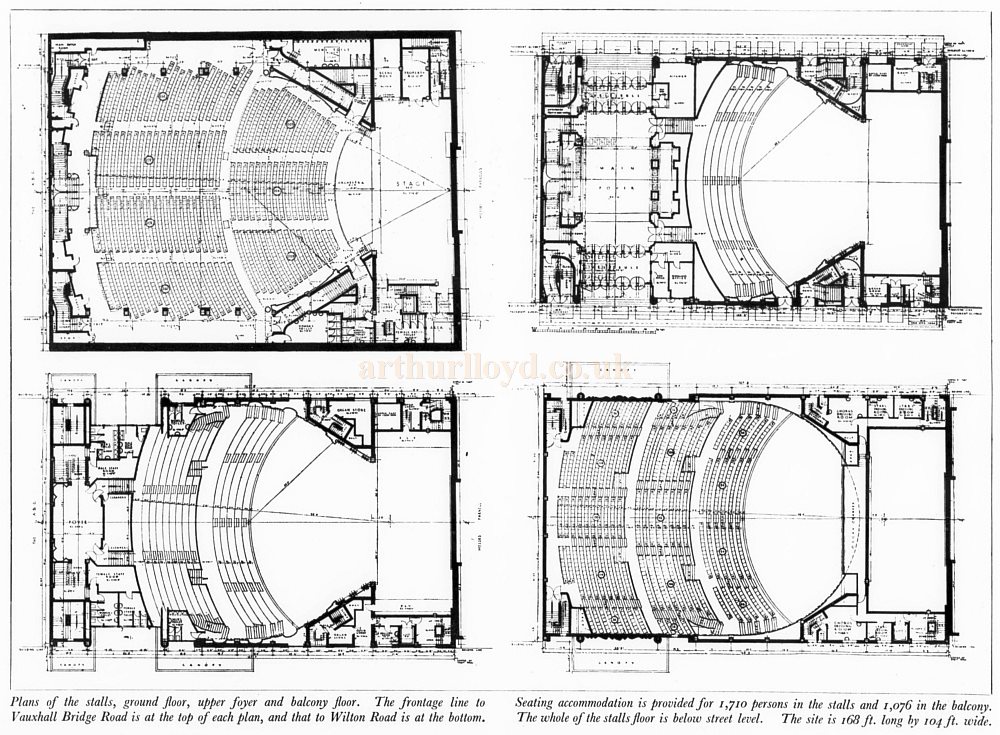
Above - Plans of the New Victoria Theatre - From The Architect's Journal, 22nd of October 1930.
 The ERA also reported on the new Victoria Theatre, in their 15th of October 1930 edition, saying:- 'There was a Press view last week of the new Provincial Cinematograph Theatre house, "The New Victoria." It is a really beautiful building, and seems to represent quite the last thing in artistic cinemas.
Right - A Scene from 'Old English' the opening film at the New Victoria in October 1930 - From The Bystander, 15th October 1930.
Situate between Wilton-road and Vauxhall Bridge-road, it is a most imposing building. Over the main entrance, the lines change abruptly from horizontal to vertical, and the aim of the architect "to stop the passer by in the street and bid him to enter" seems to be sound, for we have ourselves many times been struck when passing, with the quaintness of the construction.

Above - The Auditorium of the New Victoria Theatre when it first opened - From The Bioscope, 22nd October 1930.
The interior is real magnificence. It has been described as "a fairy palace under the sea," and the whole interior decorative scheme, as well as the wonderful lighting achieved by Mr. Nichols, and his able lieutenants, Mr. Humphrey and Mr. Cucksey, go a long way to justify this description. There is no pretence at any period or any particular style, but there is certainly atmosphere in "The New Victoria," and Mr. W. E. Trent, F.S.I., who designed it, is to be congratulated on his success.

Above - George Arliss opening the New Victoria Theatre for P.C.T. - From The Bioscope, 22nd October 1930.
 It is good news that stage shows are to form an important feature of programmes here, and although the dressing rooms were not on view last week, we understand that all of them are most commodious, with every modern convenience. Each dressing-room has not only hot and cold baths, but a shower bath as well.
Right - All Star Programme Sellers at the Gala Opening of the New Victoria Theatre - From The Sketch, 12th November 1930.
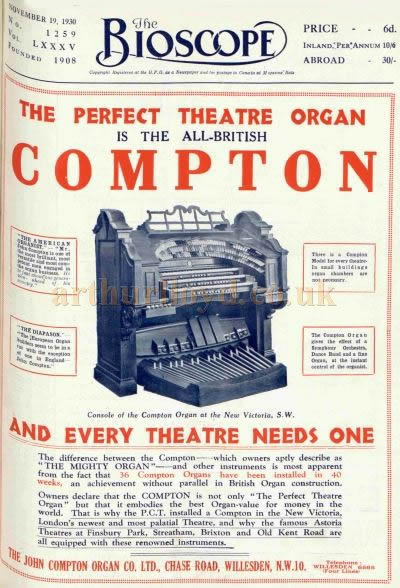
The stage, too, is fully equipped. There is a large John Compton organ installed. The console is placed in the orchestra, and the organ is electrically operated. There is also to be an orchestra at this new cinema, which again is all in the right direction. The theatre is to be formally opened to-night, and we hope to give an account of the first programme in our next issue, together with any other details that are then available.'
The above text in quotes was first published in the ERA, 15th of October 1930.

Above - A Detailed Report on the New Victoria Theatre - From The Bioscope, 1st October 1930.
 A few weeks after the Theatre's opening the ERA reported on one of the Theatre's first shows saying:- 'Wonderful business is being done at this new Gaumont British House with its programme comprising the best films, a first-class symphony orchestra and a modern stage presentation. When I looked in, Mr. E. C. C. Nichols, who I met in the vestibule, and is in charge of all those wonderful lighting schemes for which the P.C.T. Halls are famous, told me a remarkable thing. When one stands in the entrance hall, there are only seven steps up to the circle, and 11 down to the stalls. It was a great pleasure, too, to renew acquaintance with Mr. Sidney F. Lyndon, now the Circuit Manager, and also to meet Mr. J. Hanbury, the New Victoria's own manager.
Right - The New Victoria Theatre on its opening in October 1930 - From The Bioscope, 22nd October 1930.
The stage show was "Petals," and I sat with Mr. E. C. Peall and saw Mr. de Courville's beautiful production, which we both enjoyed and admired. The opening was a most picturesque one, with the ladies of the chorus forming a huge caterpillar, which descended the stairs at the back. Then three baby caterpillars followed. This was most picturesque, the colouring and lighting being very artistic.
Another big scene was a huge crinoline effect with a bowl of flowers (the chorus) on the other side of the stage. The finale too was very beautiful, the arrangement of the chorus with baskets of flowers forming a veritable feast for the eye.
 There were many other good things in this show, which lasted well over half an hour, and was extremely popular with the audience; quite as popular as that great talkie film "On Approval" which I thoroughly enjoyed.
Left - An Advertisement for Compton's Theatre Organs as installed at the New Victoria Theatre for its opening in October 1930 - From The Bioscope, 19th November 1930.
Miss Queenie Ashton's fine voice was heard to distinct advantage in various numbers, and Imito, a speciality sauffleur, scored heavily with some marvellous whistling. Both Mr. George Wolkowsky and Miss Jane Sells danced several dances delightfully, and I liked the work of Madie and Ray immensely. These two clever dancers not only scored in a clever step dancing effort, but, brought down the house with their "ropes" specialite. This is Ingenious and funny and really very skilful. Mr. Albert de Courville's lovely ladies included the Misses Dorothy Day, Diana Day, Peggy Cochrane, Gwen Wilby, Josephine Dalmaine, Helen Kitson, Joan Kitson, Ina Scarlet, Joan Burnet-Smith, Eileen Cameron, Audrey Rayward, Zoe Sully, Bonita Allsworth, Kathleen Hawkins, Betty Bersi, Pamela Marshall, Dorane Adair, and Lillian Lewis. "Dreams" is the title of this week's stage show.'
The above text in quotes was first published in the ERA, 5th of November 1930.
The New Victoria Theatre was the subject of some criticism, when it was first constructed, by various newspaper journalists. Its Architect, W. E. Trent was quick to respond by explaining his vision for the Theatre, as published in The Bioscope on the Theatre's opening night of the 15th of October 1930, which you can see below.
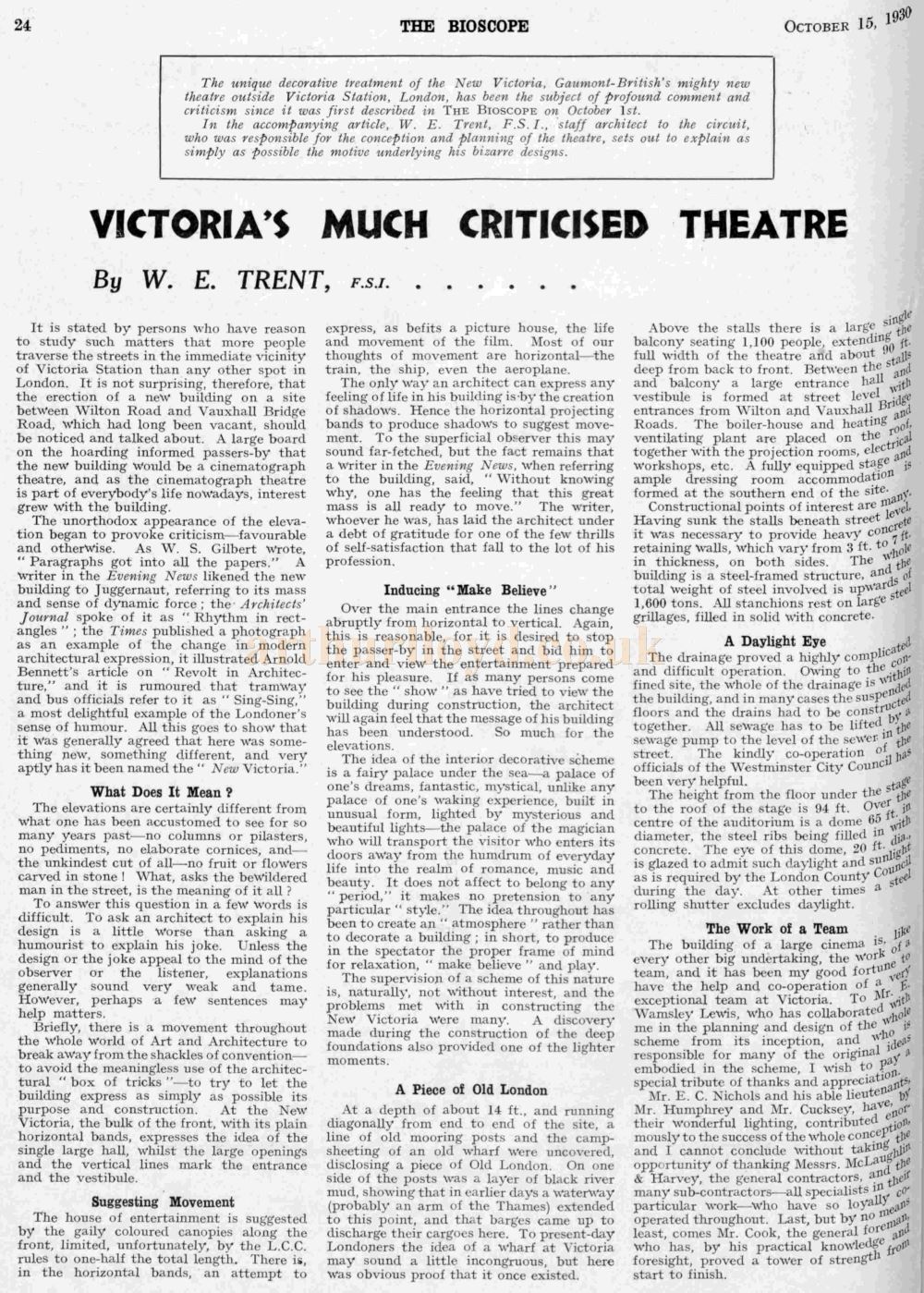
Above - W. E. Trent explains his vision for the New Victoria Theatre - From The Bioscope, 15th of October 1930.
 The New Victoria first opened on the 15th of October 1930, and along with its major film presentations it began its early career showing stage shows along with the films. However, this was soon given up in favour of
full time Cinema use. The Theatre did however, sometimes play host to Big Band concerts and small scale
live acts during its first decade.
The New Victoria first opened on the 15th of October 1930, and along with its major film presentations it began its early career showing stage shows along with the films. However, this was soon given up in favour of
full time Cinema use. The Theatre did however, sometimes play host to Big Band concerts and small scale
live acts during its first decade.
The Theatre was later run by Gaumont British Theatres, who closed it for a brief period during the war, from September 1940 to May 1941.
Right - The Apollo Victoria, formerly the New Victoria Theatre, during the run of 'Wicked' in October 2006. Photo M.L.
Unusually for a Theatre of this period the New Victoria was saved from demolition by property developers in the 1950s - who were at the time willing to sacrifice just about anything for their new building projects - by its location opposite Victoria Station, and the fact that it was also equipped for live theatre with a fully equipped stage. Indeed, with its large stage and plenty of dressing rooms the building was instead spruced up in 1958 and began playing host to Ballet and Live Shows, as well as Film presentations.
The Theatre was later operated by the Rank Organisation, who eventually closed it completely in November 1975 and the Theatre then went 'Dark' for nearly five years until its reopening as the Apollo Victoria in September 1980, see details below.

Above - A Seating Plan for the Apollo Victoria Theatre, probably early 1980s.
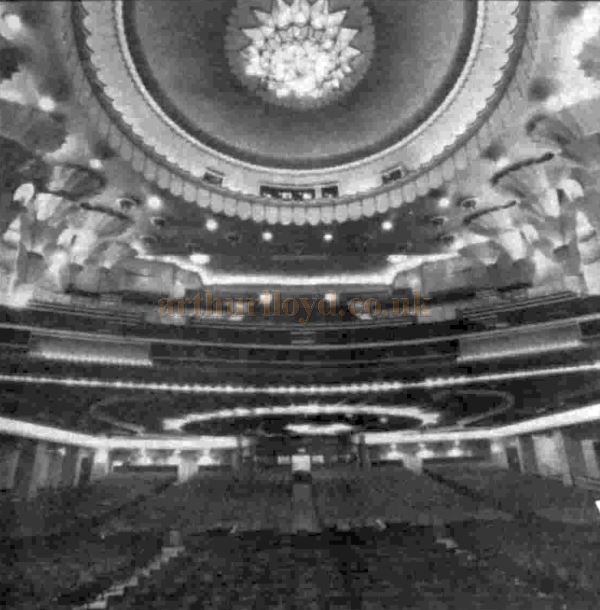 The Theatre was later taken over by the Apollo Leisure Group who renovated the Theatre, redecorating the FOH areas and adding dressing rooms, all to the designs of the architect Michael Sassoon. The Theatre reopened as the Apollo Victoria on the 15th of September 1980 with a week of Shirley Bassey in Concert, and this was followed by Concerts by such big names as Cliff Richard, Gladys Knight, Elkie Brooks, Dean Martin, and Liza Minnelli.
Right - The Auditorium of the Apollo Victoria - From the Stage Newspaper, 11th December 1980.
However, the Theatre would later find its place as a bona fide West End Theatre when it started staging full scale musicals such as 'The Sound of Music', which opened in August 1981.
The Stage Newspaper reported on the restoration of the Theatre and the announced opening of 'The Sound of Music', along with the photos shown here, in their 11th of December 1980 edition saying:- 'They probably haven't realised it yet themselves, but Apollo Leisure have been responsible for creating an entirely new profession. Theatre Doctors. They take ailing theatres refurbish them, prescribe a far sighted marketing policy and set them on their feet again.
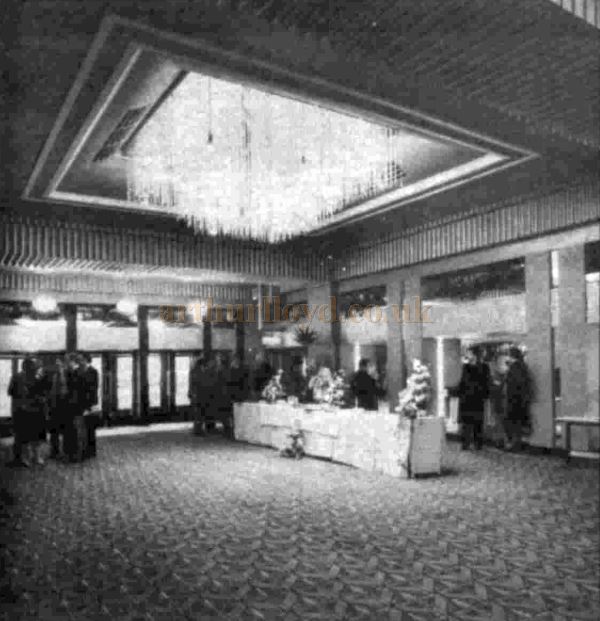 Over the past couple of years Apollo, as General Practitioners have worked therapeutic miracles with houses in Glasgow, Manchester, Coventry and Oxford. Since September they have acquired Harley Street status, moving into the Specialist class with the acquisition of London's 2,600 seater New Victoria, and turning a lifeless shell, dark for four years into the bursting with health, spectacularly successful, Apollo Victoria.
Left - The Foyer of the Apollo Victoria - From the Stage Newspaper, 11th December 1980.
How really successful the treatment has been can be measured by the Apollo Victoria's autumn billing which, since September 20, 1980 has grossed over a million pounds with short season block-busting attractions like Shirley Bassey and Cliff Richard. Last week came a double accolade, the staging of its first Royal Charity Show in the presence of Princess Anne and Captain Mark Phillips and the equivalent of a Royal College of Physicians diploma with the news that the Apollo Victoria will house a new £750,000 presentation of 'The Sound Of Music' produced by Ross Taylor and starring Petula Clark. Within 24 hours of the announcement, the advance-bookings telephones started ringing, although the show doesn't open till next year, on August 17, 1981. It probably looks to theatregoers like the showbiz bargain of the era, the number one American musical with our own Petula Clark making, amazingly enough, her West End debut in a stage musical, and prices pegged - for the first six months at least - at £7.50 top. At the Apollo Victoria press conference last week, journalists wanted to know how, with a £750,000 show, tickets could be pegged for as low as £2.50. According to the Apollo's Managing Director, Paul Gregg, it's because Apollo think big. They pay big prices. They present big stars. The stars fill a big theatre - the biggest in the West End, and full houses slash overheads and facilitate cheaper ticket scales.
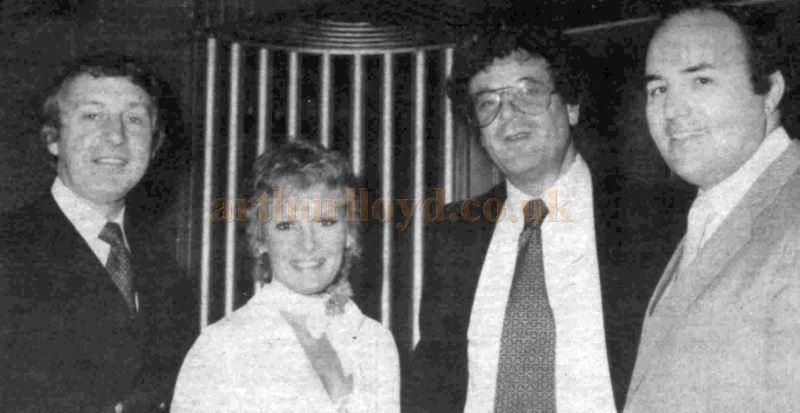
Above - After making the first announcement of the new production of 'The Sound of Music' four very interested parties pose for cameraman Doug McKenzie in the foyer of the Apollo Victoria, Ross and Petula have been joined by Claude Wolff, Petula's husband, and Apollo Leisure UK's Managing Director, Paul Gregg - From the Stage Newspaper, 11th December 1980.
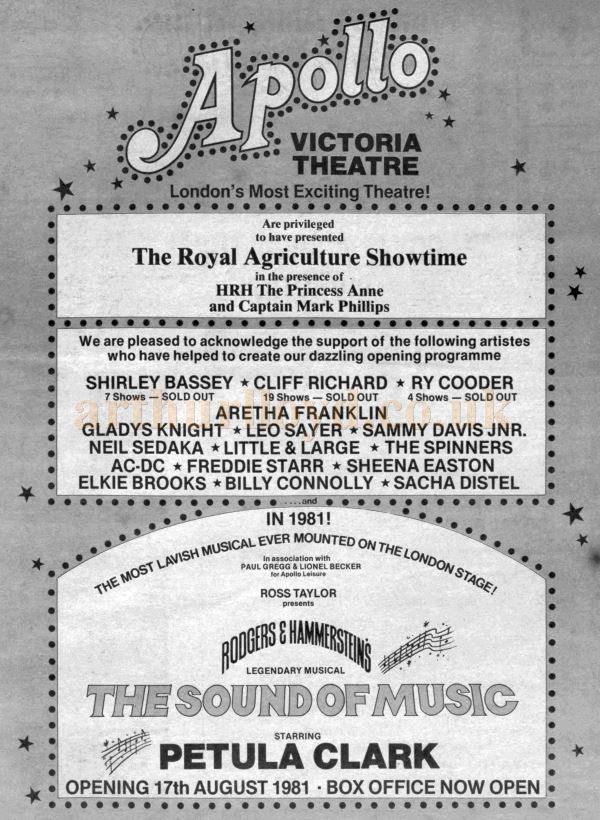 With 'The Sound Of Music' the Apollo Victoria has what Gregg considers the biggest attraction of all time, the world's favourite musical. He has something else, a huge theatre opposite a rail terminus, making the whole country a catchment area. Ross Taylor was responsible for the production of the Yul Brynner revival of 'The King And I' at the Palladium where it grossed £7,500,000 during its 18-months run. With this considerable success under his belt, Taylor was able to obtain from the Hammerstein and Rodgers estates the much sought after English rights of 'The Sound of Music' for the Apollo Victoria.
Right - An Advertisement for the Apollo Victoria - From the Stage Newspaper, 11th December 1980.
The Palladium mammoth musical experience behind him, Ross confidently predicts that despite the expenditure of three-quarters-of-a-million pounds on the show, it will easily recoup its costs, allowing for massive sets, 30 musicians, two months rehearsals and four lots of child actors, and go on to make a handsome profit for evermore.
Of course a great deal is scheduled to happen at the Apollo before Petula and company move in: Little and Large take charge later this month for the holiday season with their fun-packed 'Christmas Cracker' and a host of other superstar attractions are promised for 1981. The Apollo Victoria theatre was originally designed by William Edward Trent and opened to the public in October 1930. Its magnificent art deco design makes it one of the most architecturally interesting theatres in the West. End.
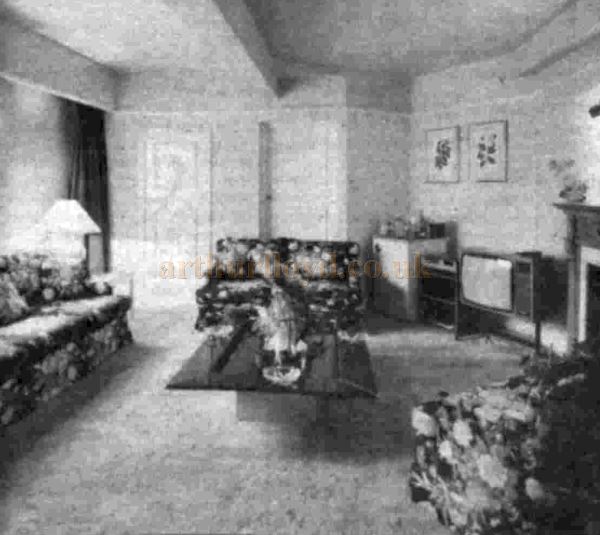 Because most of the original interior decoration has remained intact, it has now become a GLC listed building. Inside this superb structure, Apollo are installing the first computerised ticket system to appear in the West End and a hugely expensive Rank-Strand lighting console, the new Galaxy, which Gregg claims to be one of only four in the entire world. Additionally, some £30,000 has gone into the construction of the most up to date dressing rooms in the country - one is even fitted with a Jacuzzi - everything however is designed to harmonise with the original Trent decor.
Left - The Lounge of the Star Dressing Room at the Apollo Victoria - From the Stage Newspaper, 11th December 1980.
Before Gregg became involved with the Isle of Man based Apollo Leisure Group, he was an Entertainments Manager at Oxford, and for eight years, until 1978, the Director of Public Relations and Entertainment at Southport. A hard-headed Yorkshireman, Gregg, 39, has gathered round him an experienced team headed by General Manager Alan Mackenzie to run the third and latest Apollo - certainly there will be more - but he is personally supervising every facet of the London theatre's development. He regards it as the brightest jewel in the Apollo chain's crown.'
The above text in quotes was first published in the Stage Newspaper, 11th of December 1980.
 The Apollo Victoria has gone on to have incredible success as a home for Musical Theatre, especially after it became home
to the hit show 'Starlight Express' in 1984 which was to
run for a staggering 18 years.
The Apollo Victoria has gone on to have incredible success as a home for Musical Theatre, especially after it became home
to the hit show 'Starlight Express' in 1984 which was to
run for a staggering 18 years.
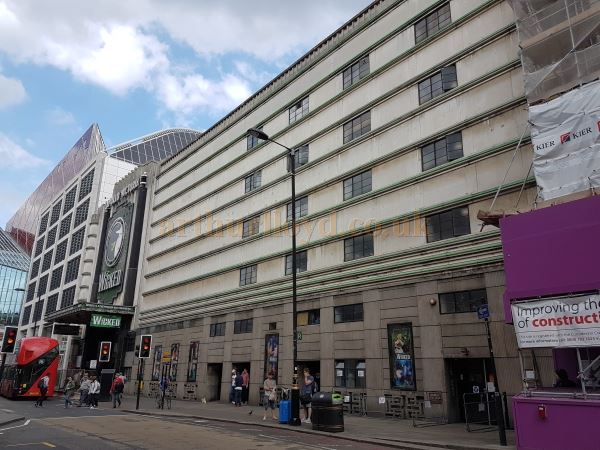
Right - The Apoll Victoria Theatre during the run of 'Wicked' in August 2016 - Photo M.L.
In 2002, after Starlight Express had finally closed, the Theatre's Auditorium was the subject of a partial restoration when the balcony fronts were removed and some of the original lighting features, such as the fountain lights, were reinstated. The architects for this were Jaques Muir & Partners.
In recent years the Theatre has staged a variety of large scale musicals including the 2006 production of 'Wicked' which at the time of writing in 2025 had already clocked up almost 20 years at the Theatre.
The Theatre has also undergone several improvements over the ensuing years, the late John Earl said: 'After many years of being blotted out by alterations and general clutter from a series of big musicals, the interior has recently enjoyed the first phase of a programme of painstaking restoration. It is already revealed as one of the most spectacular Art Deco interiors in Britain and the process will continue as breaks occur (somewhat rarely!) between productions. The original 'streamlined effect' lighting on the Wilton Road front is also being reinstated. It is worth buying a ticket for 'Wicked' to see the magical auditorium lighting, not seen for a generation or so!' - John Earl.
The Apollo Victoria is probably one of the best surviving examples of a 1930s Super Cinema in the Country and is Grade II Listed. The Theatre was bought by The Ambassador Theatre Group in November 2009 and you may like to visit their own Website for the Theatre here.
Adelphi Aldwych Ambassadors Apollo Apollo Victoria Arts Cambridge Charing Cross Theatre Criterion Dominion Donmar Warehouse Drury Lane Duchess Tom Stoppard Theatre Fortune Garrick Gielgud Gillian Lynne Harold Pinter Haymarket His Majesty's Leicester Square Theatre London Coliseum London Palladium Lyceum Lyric Menier Chocolate Factory Noel Coward Novello Old Vic Palace Peacock Phoenix Piccadilly Playhouse Prince Edward Prince of Wales Royal Opera House Sadler's Wells Theatre Savoy Shaftesbury Sondheim St. Martin's Trafalgar Theatre Vaudeville Victoria Palace Wyndham's