
The Tom Stoppard Theatre, St. Martin's Lane, London
Formerly - The Trafalgar Square Theatre / Trafalgar Theatre / The Duke of York's Theatre
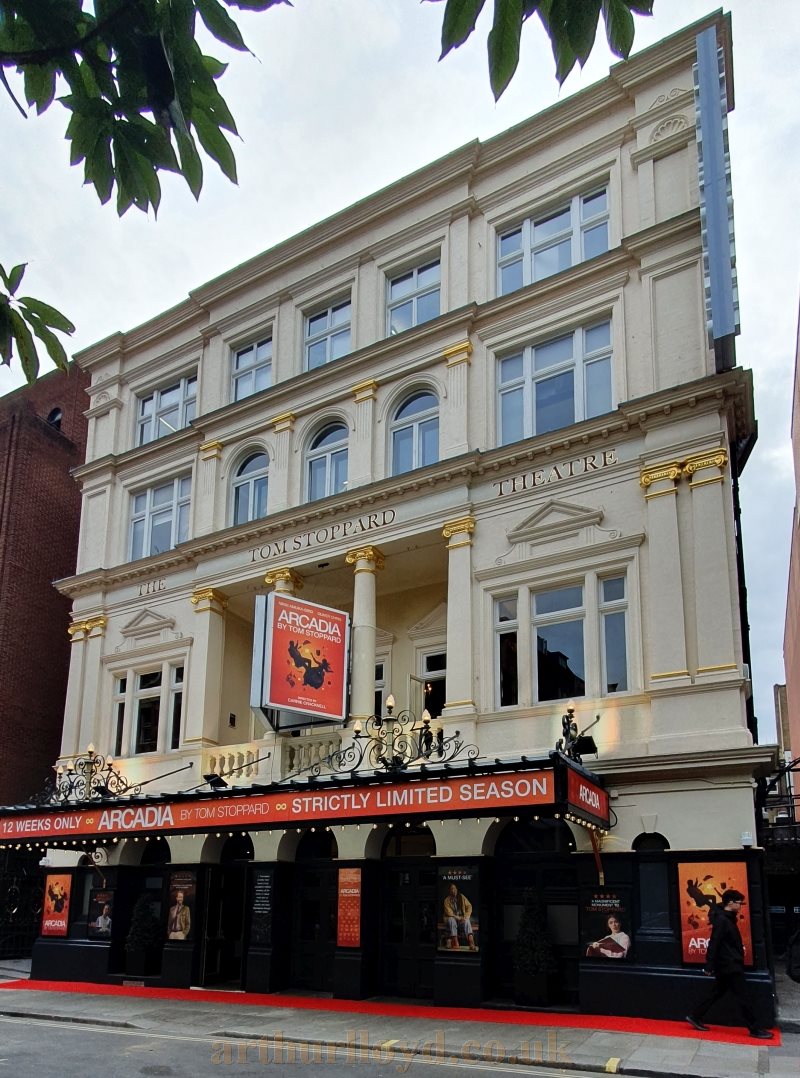
Above - The Tom Stoppard Theatre on the day of the Theatre's Renaming from the Duke Of York's Theatre and during the run of 'Arcadia' by Tom Stoppard on the 10th of September 2026 - Photo M.L.


 The
Tom Stoppard Theatre is situated on St. Martin's Lane in London and
originally opened as the Trafalgar Square Theatre on the 10th of September 1892 with a comic Opera called
'The Wedding Eve' by F. Toulmouche
The
Tom Stoppard Theatre is situated on St. Martin's Lane in London and
originally opened as the Trafalgar Square Theatre on the 10th of September 1892 with a comic Opera called
'The Wedding Eve' by F. Toulmouche

Sadly for the Theatre's Manager Michael Levenston the Wedding Eve was not a great success for the newly opened Theatre and it was quickly followed by a production of 'Dorothy' in November, which itself only ran until January the following year when a disagreement between Levenston and the Theatre's Proprietor Frank Wyatt caused the closure of the production. The Theatre reopened again in February however, with a production of 'The Country Councillor' which had more success.
Right - A programme for 'A Husband in Clover' and Mam'Zelle Nitouche' at the Trafalgar Square Theatre for the 7th of September 1893, a year after the Theatre first opened - Click to see the whole programme.
 The Theatre was the
first to be built on St. Martin's Lane and backs onto the Garrick
Theatre in Charing Cross Road. The Theatre was designed by the well known Theatre
Architect Walter Emden
and was constructed by Frank Kirk and built for Frank Wyatt and his wife
Violet Melnotte, Violet would later become the first proprietor of the Duke of York's Theatre in Brighton in 1910.
The Theatre was the
first to be built on St. Martin's Lane and backs onto the Garrick
Theatre in Charing Cross Road. The Theatre was designed by the well known Theatre
Architect Walter Emden
and was constructed by Frank Kirk and built for Frank Wyatt and his wife
Violet Melnotte, Violet would later become the first proprietor of the Duke of York's Theatre in Brighton in 1910.
Left - A Bill for 'The Wedding Eve', the opening production at the Trafalgar Square Theatre on the 10th of September 1892 - From London and Fashionable Resorts published in 1892.
The Theatre's auditorium was constructed on three levels, stalls, dress circle, and upper circle or gallery, with several boxes on all three levels, and the Theatre was unique in that it had real fire places in its auditorium.
The Theatre would often be referred to in the press of the day as the Trafalgar Theatre rather than the Trafalgar Square Theatre, and the two names were used interchangeably from 1893 until its name was officially changed to The Duke Of York's Theatre on Thursday the 26th of September 1895 for it's reopening under the new Lesseeship of Cartwright and Dana with a production of 'Her Advocate'.
More information on the building itself, and its later history, follows.

Above - An early Seating Plan for the Duke of York's Theatre
 Just
prior to the Theatre's original opening as the Trafalgar Square Theatre
the ERA printed a review of the building in its
3rd of September 1892 issue
saying:- 'The new Theatre is pretty and unpretentious, the general effect
being created by the judicious use of cream and gold and yellow tints,
the back of the boxes being of a warm russet hue. The corridors are
ornamented with coloured portraits of well-known actresses, and the
decorations generally are remarkably chaste and refined. The stalls
and dress-circle will be entered from St Martin's Lane.
Just
prior to the Theatre's original opening as the Trafalgar Square Theatre
the ERA printed a review of the building in its
3rd of September 1892 issue
saying:- 'The new Theatre is pretty and unpretentious, the general effect
being created by the judicious use of cream and gold and yellow tints,
the back of the boxes being of a warm russet hue. The corridors are
ornamented with coloured portraits of well-known actresses, and the
decorations generally are remarkably chaste and refined. The stalls
and dress-circle will be entered from St Martin's Lane.
Right - A Programme detail for 'The Twin Sister' during Charles Frohman's reign at the Duke Of York's Theatre early 1900s.
 On
the upper-circle tier are a large and ornamental vestibule and a pleasant
saloon, with a balcony facing the roadway. The pit entrance is on the
north side, and the entrance to the large gallery on the south side.
On
the upper-circle tier are a large and ornamental vestibule and a pleasant
saloon, with a balcony facing the roadway. The pit entrance is on the
north side, and the entrance to the large gallery on the south side.
Left - A Pre 1905 Seating Plan for the Duke of York's Theatre - Click to enlarge.
The theatre is completely isolated, and from each of its four sections an extra exit has been made. It will be lighted by electricity, but in case of need gas will be available. The dressing rooms are in a detached building, connected to the theatre by a short, covered iron bridge; and a broad stone staircase leads from the stage to the open air.'
The above text in quotes was first published in the ERA, 3rd September 1892.
A Report on the specifications of the proposed Theatre, 8th December 1890
NEW THEATRE. ST MARTIN'S LANE W.C.
for Miss Violet Melnotte (Mrs Wyatt)
 DESCRIPTION
- This theatre will be erected on the site of Nos 103, 104,
105 & 106 St Martin's Lane and will be completely isolated.
The theatre will be of fireproof construction similar to Terry's, the Court, and the Garrick theatres with the exception
of the stage roof which will be of wood with a large lantern
light in the middle, as it is understood to be the desire of
the Theatres Committee it should be of wood but it can be if
preferred fireproof.
DESCRIPTION
- This theatre will be erected on the site of Nos 103, 104,
105 & 106 St Martin's Lane and will be completely isolated.
The theatre will be of fireproof construction similar to Terry's, the Court, and the Garrick theatres with the exception
of the stage roof which will be of wood with a large lantern
light in the middle, as it is understood to be the desire of
the Theatres Committee it should be of wood but it can be if
preferred fireproof.
Right - A Sketch of the Front Elevation of the Duke of York's Theatre - From 'Modern Opera Houses and Theatres' by Edwin O Sachs, Published 1896-1898, and held at the Library of the Technical University (TU) in Delft - Kindly sent in by John Otto.
The dressing rooms will be erected in an entirely separate block the stage being approached by means of a subway and the flies by a passage formed of corrugated iron both being cut off from the stage by iron doors.
The front will be composed of Grimshill stone and brick with Portland Stone cornices copings weatherings etc. the sides and the Dressing room fronts being of picked stock bricks.
The theatre will consist of four tiers:- Pit Dress Circle, Upper Circle, and Gallery and is entered from St Martin's Lane through a Vestibule with a large Entrance Hall on the Ground level the Dress Circle being entered from each-side as are also the approaches to the Stalls. On the north side of Entrance Hall are placed the stairs leading to the Upper Circle and Saloon which opens on to a Balcony extending over the centre portion of the front .
The Gallery entrance is placed on the S.E. and the Pit on the N.E. corners of the building. There are two separate exits to the Stalls, Upper Circle, Pit and Gallery the Dress Circle having besides the two side exits into the Main Entrance two entirely separate exits. The stage is also provided with a separate exit. The exit accommodation is in excess of that required by the regulations of the County Council...

Above - A Plan of the Duke of York's Theatre - From 'Modern Opera Houses and Theatres' by Edwin O Sachs, Published 1896-1898, and held at the Library of the Technical University (TU) in Delft - Kindly sent in by John Otto.
 ...On each level retiring rooms are provided and the sanitary
arrangements will be that of the best description all drains
being thoroughly cut off from the building and ventilated and
the drains from all W.Cs, Urinals, Lavatories, and Rain water
pipes being laid with a good fall to the junction with main
sewer.
...On each level retiring rooms are provided and the sanitary
arrangements will be that of the best description all drains
being thoroughly cut off from the building and ventilated and
the drains from all W.Cs, Urinals, Lavatories, and Rain water
pipes being laid with a good fall to the junction with main
sewer.
Right - A Programme Cover for Archibald de Bear's Musical Review 'C.O.D.' at the Duke of York's Theatre in the 1920s.
 Over the front portion of the building rooms are provided for
the management. All doors will be made to open outwards and
all exit doors fitted with automatic locks. The openings in
the proscenium wall will be shut off by iron doors tilted to
close of themselves. The stage and flies will be of wood the
mezzanine of concrete. The stairs from the stage to the mezzanine
will be of stone and iron. All rooms off the stage and mezzanine
will be shut off by iron doors.
Over the front portion of the building rooms are provided for
the management. All doors will be made to open outwards and
all exit doors fitted with automatic locks. The openings in
the proscenium wall will be shut off by iron doors tilted to
close of themselves. The stage and flies will be of wood the
mezzanine of concrete. The stairs from the stage to the mezzanine
will be of stone and iron. All rooms off the stage and mezzanine
will be shut off by iron doors.
Left - A Programme Cover for Herbert Farjeon's Musical Revue 'Many Happy Returns' at the Duke of York's Theatre in the 1920s.
 The boiler house will be shut
off from the stage by solid brick walls and will be entered
from a passage from the dressing room stairs and shut off by
an iron door. The dressing rooms will be entirely fireproof
the floors being of iron and concrete covered with wood.
The boiler house will be shut
off from the stage by solid brick walls and will be entered
from a passage from the dressing room stairs and shut off by
an iron door. The dressing rooms will be entirely fireproof
the floors being of iron and concrete covered with wood.
Right - A Programme Cover for P. G. Wodehouse's 'Good Morning Bill !' at the Duke of York's Theatre in the 1920s. In the cast were Barbara Wilcox, Lawrence Grossmith, Dorothy Minto, Ernest Truex, E. Hallows, Vera Lennox, and Frank Cellier.
 The
sanitary arrangements of the dressing room will be of the best
description and as before described being properly trapped and
ventilated. The stage will be dominated with sprinklers on the
non-automatic system and hydrants are also provided on the stage
and flies. The theatre will have a thorough system of hydrants
throughout the hydrants being let into the walls so as not to
project into the corridors.
The
sanitary arrangements of the dressing room will be of the best
description and as before described being properly trapped and
ventilated. The stage will be dominated with sprinklers on the
non-automatic system and hydrants are also provided on the stage
and flies. The theatre will have a thorough system of hydrants
throughout the hydrants being let into the walls so as not to
project into the corridors.
Left - A Programme Cover for Merrill Rogers and Frederick Jackson's 'Her First Affaire' at the Duke of York's Theatre in the 1920s. In the cast were Henry Hewitt, Zillah Bateman, Ellen Pollock, Jack Hobbs, Margery Binner, and Douglas L. Webster. The play was preceded by the musical comedy 'Colour Blind'.
The whole of the steel construction throughout the theatre will be protected by wire and plaster. The staircases will all be of Metallic patent concrete. All woodwork throughout the building will be coated with fireproof paint. The heating will be by means of hot water on the low pressure system. The house will be lighted throughout by electricity. The corridor round the Dress Circle will be constructed so as to slope and by this means the necessity of steps to each, row of seats is avoided. The roof of the stage will be fitted with a large lantern light glazed on top and the sides fitted with fixed louvres with a large exhaust in the centre besides which there are two further exhausts provided. The auditorium will have several self acting exhausts in the roof and round the exhaust in the centre of the dome the roof will be trimmed and the top portion raised and the fibrous plaster of the inner dome perforated so as to allow the air to escape. The space below the ground will be ventilated by shafts in the walls...

Above - A Plan of the Duke of York's Theatre - From 'Modern Opera Houses and Theatres' by Edwin O Sachs, Published 1896-1898, and held at the Library of the Technical University (TU) in Delft - Kindly sent in by John Otto.
...MATERIALS - The front in St Martin's Lane will be of Grimshill stone and bricks with Portland stone cornices copings, weatherings &c. The sides and dressing room fronts will be of brick. All brickwork will be executed in mortar composed of blue lias lime and sharp washed sand mixed in the proportion of 3 to l. All concrete in the foundations to be of Portland cement and clean gravel mixed in the proportion of 4 to 1. The concrete of the circles to be composed of coke breeze and cement mixed in the proportion of 3 to 1 and covered on the top with patent metallic concrete composed of the slag of iron cement and sand. The whole of the floors will be constructed in steel filled in with concrete in cement and overlaid with metallic patent concrete and the steel work will be protected on the underside by plaster on wire. The staircases in the interior will be of patent metallic concrete. The roof will be of steel filled in with concrete and covered with patent metallic concrete and on the underside the steel will be protected by plaster on wire and the whole of the ornamental parts will be of fibrous plaster. The floors will have a cement surface or where ornamental mosaic and tiles laid directly on the concrete and where covered with wood it will be laid directly on the concrete. The Pit floor will be of wood blocks laid on the concrete.
ACCOMMODATION - Stalls 155 persons, Dress Circle 115, Upper Circle 140, Pit 400, Gallery 400, 14 Private Boxes 56 (4 persons in each). Total Accommodation 1,266 persons.
This document was rescued, along with many others, from skips at the GLC and Westminster Council, by Dave Spink, and then kindly sent in for inclusion here by Roger Fox.

Above - A Seating Plan for the Duke Of York's Theatre - From 'Who's Who in the Theatre' published in 1930 - Courtesy Martin Clark. Click to see more Seating Plans from this publication.

 The
Theatre's name had been changed from The Trafalgar Square Theatre to The
Duke Of York's Theatre when it reopened under the new Lesseeship of
Cartwright and Dana, with a production of 'Her Advocate' on Thursday
the 26th of September 1895.
The
Theatre's name had been changed from The Trafalgar Square Theatre to The
Duke Of York's Theatre when it reopened under the new Lesseeship of
Cartwright and Dana, with a production of 'Her Advocate' on Thursday
the 26th of September 1895.
Right - A Fragment of a Duke Of York's Theatre Programme front for 1902 which sadly was torn in half and the other half lost. And a Postcard showing the front of the Duke Of York's Theatre in 1910.
Just two years later in 1897 Charles Frohman, the American Theatrical Manager, took over the running of the Theatre and put on a some very successful productions using American Actors which he exchanged for British ones performing there.
 Frank Wyatt owned the Theatre until his death in 1926 when his wife took over but she sold the Theatre in 1928 to William Hunter.
Left - A Programme detail for 'Merely Mary Ann' during Charles Frohman's reign at the Duke Of York's Theatre early 1900s.
The Duke Of York's was closed during the Second World War after the production of the successful farce 'High Temperature' ended there in August 1940. The Theatre would not reopen again until Charles Killick and Tom Arnold took over the Theatre in May 1943, opening their first production there, Paul Vincent Carrol's 'Shadow and Substance', on Tuesday the 25th of May 1943, this was followed by Ibsen's 'Ghosts', on the 25th of June 1943, which featured Edward Byrne, Beatrix Lehmann and her son John Carol in the leading rolls.
 The Theatre was redecorated in 1950
when new management took over in May of that year. This management saw
the Theatre's shortest runs; 'All The Year Round' which opened in October
1951 ran for just three nights, and then 'Thirteen for Dinner', which
opened on the 17th of December 1953, closed the same night!
The Theatre was redecorated in 1950
when new management took over in May of that year. This management saw
the Theatre's shortest runs; 'All The Year Round' which opened in October
1951 ran for just three nights, and then 'Thirteen for Dinner', which
opened on the 17th of December 1953, closed the same night!
Right - A Programme detail for 'The Admirable Crichton' during Charles Frohman's reign at the Duke Of York's Theatre in 1902. On the first night of this production the scene-shifters went on strike after the second act and the cast had to shift the scenery themselves.
The Theatre's Facade was renovated and repainted in October 2014 when new gold leaf was added, and the signwriting was replaced (see image below).

Above - The Duke Of York's Theatre during the run of 'Neville's Island' in October 2014, and a few days after the Theatre's facade was revealed after its restoration - Photo M.L.
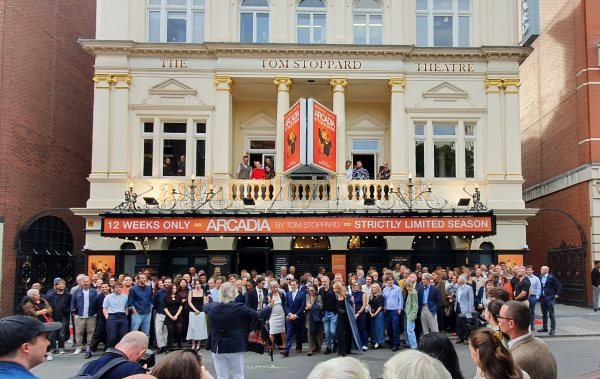 On the 1st of July 2026 it was announced that the Theatre would be renamed in honour of the playwright Tom Stoppard who had died in November 2025. Stoppard's 'Arcadia' was playing at the Theatre when the announcement of the name change was made.
Right - The Cast and Crew of 'Arcadia', FOH Staff, ATG Directors, and Members of Tom Stoppard's Family pose for photographs outside the newly Renamed Tom Stoppard Theatre on the 10th of September 2026 - Photo M.L.
On the 10th of September 2026 the Theatre's name was officially changed to the Tom Stoppard Theatre with a Ribbon Cutting outside the Theatre and speeches on stage by Ed Stoppard, Sonia Friedman, and the Directors of ATG, a Bust of Stoppard, to be situated in the Theatre's Foyer, was unveiled on stage by Sabrina Guinness, Lady Stoppard, at the same time.
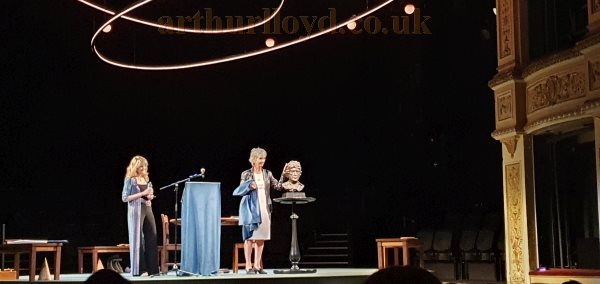 As 'Arcadia' was playing at the Theatre at the time the play would consequently become the last at the Duke of York's Theatre and the first at the Tom Stoppard Theatre. 'Arcadia' was scheduled to close on the 12th of September just two days later.
Left - Sonia Friedman and Sabrina Guinness on stage at the newly renamed Tom Stoppard Theatre unveiling a Bust of Tom Stoppard on the 10th of September 2026 - Photo M.L.
The Tom Stoppard Theatre is one of the West End's most successful playhouses and is rarely dark. The Theatre is currently run by the Ambassador Theatre Group (ATG), you may like to visit their own Website for the Theatre here.
You may also be interested in Neil Sean's Article and Film on the Duke Of York's Theatre here.

Above - The Duke Of York's Theatre looking down St. Martin's Lane towards Trafalgar Square in October 2006 - Photo M.L.

Above - The Duke Of York's Theatre during the run of Tom Stoppard's 'Rock 'N Roll' in October 2006 - Photo M.L.

Above - The Duke Of York's Theatre during the run of 'Doctor Faustus' in May 2016.
Adelphi Aldwych Ambassadors Apollo Apollo Victoria Arts Cambridge Charing Cross Theatre Criterion Dominion Donmar Warehouse Drury Lane Duchess Tom Stoppard Theatre Fortune Garrick Gielgud Gillian Lynne Harold Pinter Haymarket His Majesty's Leicester Square Theatre London Coliseum London Palladium Lyceum Lyric Menier Chocolate Factory Noel Coward Novello Old Vic Palace Peacock Phoenix Piccadilly Playhouse Prince Edward Prince of Wales Royal Opera House Sadler's Wells Theatre Savoy Shaftesbury Sondheim St. Martin's Trafalgar Theatre Vaudeville Victoria Palace Wyndham's