
St. Martin's Theatre, West Street, London WC2
Proposed Name - The Irving Theatre

Above - The St. Martin's Theatre during the 54th year of 'The Moustrap" in 2006.


 The
St. Martin's Theatre was designed by the well known Theatre
Architect W. G. R. Sprague and opened on the 23rd of November 1916 with a production of 'Houp La!' by Fred Thompson, with Gertie Millar
and George Graves, and under the direction of Charles B. Cochran who
was the Lessee of the building on its opening.
The
St. Martin's Theatre was designed by the well known Theatre
Architect W. G. R. Sprague and opened on the 23rd of November 1916 with a production of 'Houp La!' by Fred Thompson, with Gertie Millar
and George Graves, and under the direction of Charles B. Cochran who
was the Lessee of the building on its opening.

The proposed name for the Theatre, when it was first discussed in 1912, was to be the Irving Theatre, after Henry Irving, but the name was not used in the end and the Theatre actually opened as the St. Martin's Theatre. The Irving Theatre name was eventually used for a small review Theatre nearby in Leicester Square which opened in 1951 as an art gallery by day and a Theatre at night, closing in 1964.
 The Architectural Review reported on the new St. Martin's Theatre in 1916 saying:- 'There are more than fifty regular theatres in the London area, nearly as many music halls, and an uncounted host of kinema "palaces,'' which very ample provision of places of entertainment of a theatrical and spectacular nature might be thought to be sufficient both for present needs and for needs to come; but the facts belie that supposition, for with the advent of every new theatre there seems to spring into being a fresh audience.
Left - A Programme for 'Plan For A Hostess' by Thomas Browne at the St. Martin's Theatre in 1938 - Kindly donated by Clive Crayfourd. The cast included Yvonne Arnaud, Ronald Squire, Jacqueline Squire, Jack Brown, Adrianne Allen, William Douglas Home, and Patricia McGrath. The show ran for 161 performances.
 Only two explanations can be offered for this curious state of affairs either the number of theatres is always insufficient to accommodate the number of people who desire to fill them, or the regular patrons are possessed with such an insatiable thirst for the theatre that they must sip at every new shrine which is opened. The latter would seem to be the more exact of the two explanations.
Right - A Programme for 'Penny Plain' with Joyce Grenfell, Elisabeth Welch, and Max Adrian at the St. Martin's Theatre in 1951 - Courtesy Jean Lloyd - Part of a collection of programmes from my parents' Theatre visits in their first years of marriage.
The latest of all the London theatres is the one which has been opened during the past month - the St. Martin's Theatre - and in point of size and treatment it is significant of a change that has been slowly taking place during recent years, inasmuch as this is not a large but a comparatively small theatre, and its interior, instead of revelling in a lavish display of modelled plasterwork tricked out with gold-leaf and paint, has an intimate, almost domestic, character.
 In general style it is based on what is known as English Georgian, and gives one the impression of being a private theatre provided by some patron of the dramatic arts for the entertainment of his guests. The proscenium and the flanking walls of the auditorium are panelled for their full height in Italian walnut, * a range of columns and pilasters on either side, with gilded capitals and bases, carrying a bold entablature, which is continued across the proscenium.
Left - An advertisement for the Interior Woodwork of the St. Martin's Theatre by Elliot & Sons Reading Ltd in the Academy Architecture and Architectural Review of 1921. The caption for the image reads: 'St. Martin's Theatre, London, W.C.: Columns, Balustrading, Panelling and Proscenium, etc., executed by us in African Walnut. Plasterwork by Messrs. F. De Jong & Co., Ltd. W.G.R.Sprague Esq., Architect.
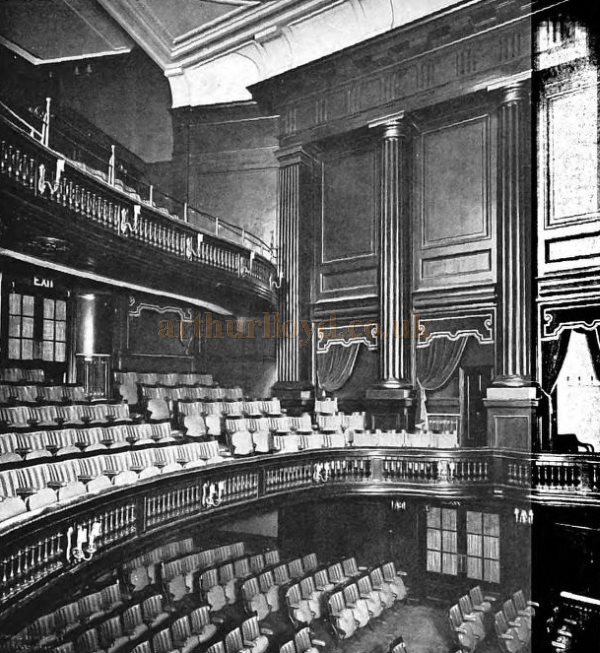
It is a two-tier house, the lower tier forming the dress circle, and the upper tier the family circle and gallery. There is no pit, the whole of the lower floor being treated as a parterre for stalls. Three boxes are provided on each side, framed in between the columns and pilasters, and at the back of the dress circle are two other boxes, one of them being the Royal box, with ante-room and separate entrance. The circle fronts are treated as balustrades, and here, as elsewhere in the theatre, we may note some excellent bracket lights modelled on the robust and pleasing forms of Georgian sconces. The ceiling is treated quite simply with plain plasterwork in strongly-marked panels, but over the centre of the auditorium is a large glass dome, so lighted from above that the whole presents a most agreeable appearance of sunlight. The upholstery throughout is of a soft blue shade, in keeping with the subdued and unobtrusive character of the general design.
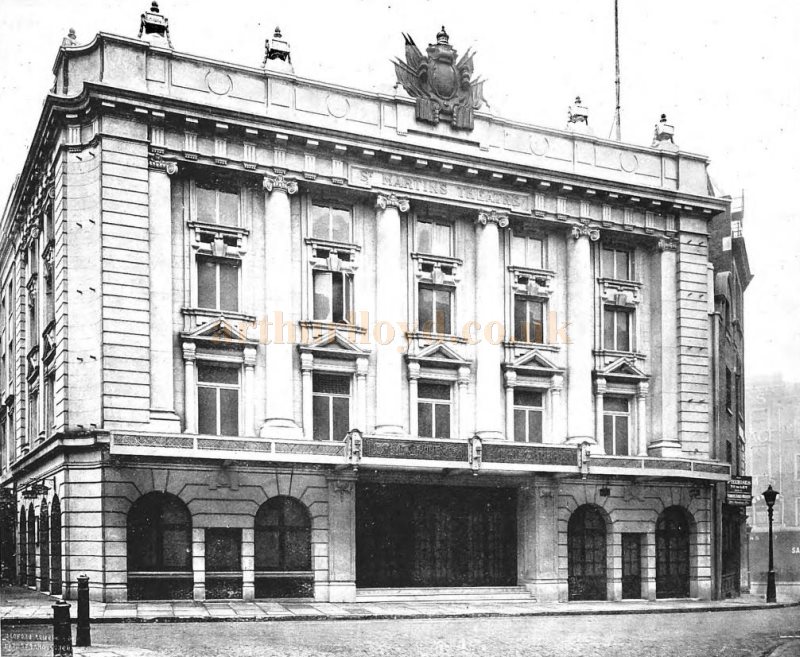
Above - St. Martin's Theatre when it first opened in 1916 - From The Architectural Review of 1916.
 The theatre occupies an island site between Charing Cross Road and St. Martin's Lane. Its front is to Litchfield Street. The facade comprises a range of columns standing on a plain base and carrying an entablature and parapet. On the cornice, at the centre, is a large bronzed cartouche with flags grouped around, and on either side of this are vases. Three ranges of windows are included by the Order, the two lower ranges lighting the saloons attached to the two circles, and the top range lighting the offices. This front is carried out entirely in artificial stone. A marquise covers the whole length of the pavement in front of the main entrances.
Right - A Programme for 'The Wrong Side Of The Park' by John Mortimer at the St. Martin's Theatre in 1960 - Courtesy Roy Cross.
The architect of the theatre was Mr. W. G. R. Sprague. The general contractors were Messrs. Lenn Thornton & Co. The steelwork was erected by Messrs. Smith, Walker & Co. Messrs. F. de Jong & Co., Ltd., carried out the whole of the interior decoration of the theatre. Messrs. Hampton & Sons were responsible for the furnishing, including the drop curtain, carpets, and hangings. The glass dome auditorium was executed by Messrs. Wotton & Sons., the light fittings were supplied by Messrs. Strode & Co., and Messrs. Peyton & Peyton, Ltd.; and hydrants and curtain by Messrs. Oldroyd & Son. The heating instalation was carried out by Messrs. Strode & Co., and the ventilation system by Messrs. David Rowell & Co., Ltd. The stone front was executed by Messrs. Arrowsmith & Co.'
The above text in quotes was first published in the Architectural Review of 1916.
Note that the article above describes the woodwork in the auditorium as being of Italian Walnut but an advertisement for Elliot & Sons Reading Ltd., shown above left, who supplied the woodwork for the Theatre, says that it was of African Walnut.
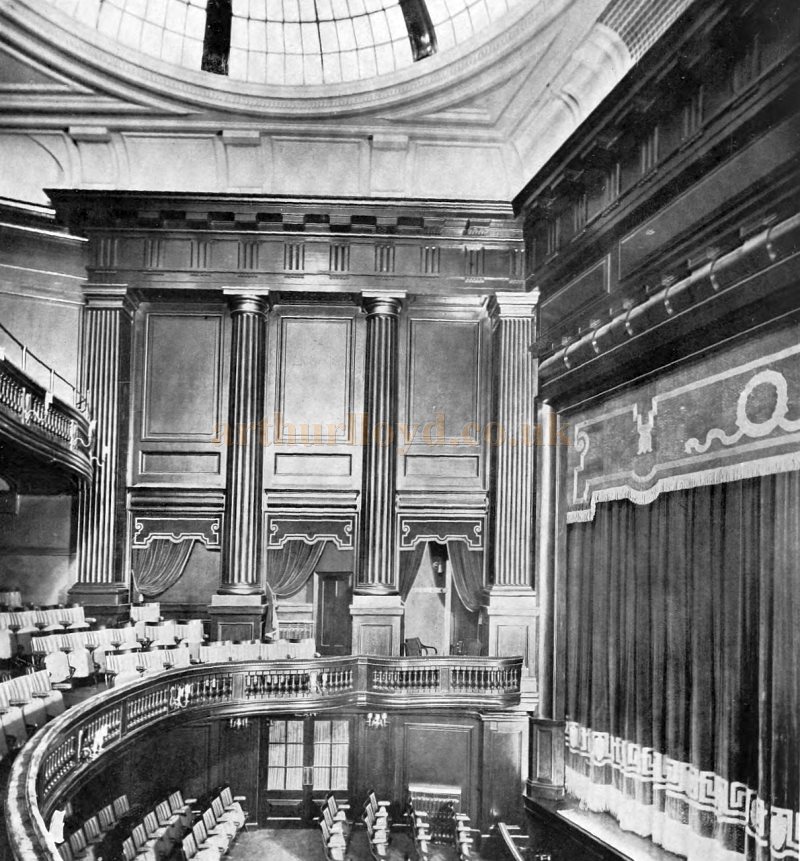
Above - The Auditorium and Stage of St. Martin's Theatre when it first opened in 1916 - From The Architectural Review of 1916.
 The
St. Martin's Theatre had first opened on the 23rd of November 1916 and the original plan was to build two Theatres side by side at the same time, The Ambassadors and St. Martin's,
but the war caused the building of the second Theatre, St. Martin's,
to be delayed until 1916. Both
Theatres were designed by the well known Theatre
Architect W. G. R. Sprague.
The
St. Martin's Theatre had first opened on the 23rd of November 1916 and the original plan was to build two Theatres side by side at the same time, The Ambassadors and St. Martin's,
but the war caused the building of the second Theatre, St. Martin's,
to be delayed until 1916. Both
Theatres were designed by the well known Theatre
Architect W. G. R. Sprague.
Right - The Auditorium of St. Martin's Theatre when it first opened in 1916 - From an Advertisement in The Architectural Review of 1916 for Hamptons Pall Mall, Builders & Decorators who supplied all the seating, carpets and curtains for the Theatre.
The world's longest running play 'The Mousetrap' by Agatha
Christie, started its run at the Ambassadors
Theatre next door to St. Martin's on the 25 November 1952, with
Richard Attenborough and his wife Sheila Sim in the lead roles, before
moving to St.  Martin's Theatre in 1974 where it is still going strong
today.
Martin's Theatre in 1974 where it is still going strong
today.
Left - An early Programme for 'The Mousetrap' at the Ambassadors Theatre with Richard Attenborough still in the cast, although his wife, Sheila Sim, was no longer in the play - Click to see the Entire Programme.
A Gala performance for the play's 25,000th performance was staged at the Theatre in aid of 'Mousetrap Theatre Projects' and consisted of a performance in costume by celebrity guests who acted the play but read from the script. The gala cast included Hugh Bonneville, Miranda Hart, Patrick Stewart, Julie Walters, Harry Lloyd, Iain Glen, Tamsin Greig, and Nicholas Farrell, who had less than 24 hours to learn the play and memorise the stage directions. To celebrate its 60 year run the play also began its first ever tour in September 2012 for a projected 60 week run. In November 2022 the production celebrated its 70th year in the West End.

Above - A Painting by George Richmond depicting the auditorium of W. G. R. Sprague's St. Martin's Theatre of 1916. George says 'The colour scheme for the painting was dictated by the fact that the interior of the auditorium was entirely panelled in African Walnut, I have tried to convey the Gentleman's Club ambiance of this type of decor.' - Click for an Index to all of George Richmond's Paintings on this site.

Above - A Seating Plan for the St. Martin's Theatre - From 'Who's Who in the Theatre' published in 1930 - Courtesy Martin Clark. Click to see more Seating Plans from this publication.

Above - A Seating Plan for the St. Martin's Theatre, London, which at the time had a unique way of numbering - in strict numerical order (it's no longer like that). The plan is from the pre-computerised days of manual ticketing - Courtesy Martin Clark and Doreen Gould.
The St. Martin's Theatre has recently been refurbished inside and out. You may like to visit the Theatre's own website here.
Adelphi Aldwych Ambassadors Apollo Apollo Victoria Arts Cambridge Charing Cross Theatre Criterion Dominion Donmar Warehouse Drury Lane Duchess Duke Of Yorks Fortune Garrick Gielgud Gillian Lynne Harold Pinter Haymarket His Majesty's Leicester Square Theatre London Coliseum London Palladium Lyceum Lyric Menier Chocolate Factory Noel Coward Novello Old Vic Palace Peacock Phoenix Piccadilly Playhouse Prince Edward Prince of Wales Royal Opera House Sadler's Wells Theatre Savoy Shaftesbury Sondheim St. Martin's Trafalgar Theatre Vaudeville Victoria Palace Wyndham's