
The Piccadilly Theatre, Denman Street, London

Above - The Piccadilly Theatre during the run of 'Moulin Rouge!' in January 2022 - Photo M.L.


 The
Piccadilly Theatre opened on the 27th of April 1928 with a musical play
called 'Blue Eyes' starring Evelyn Laye, and written by Jerome Kern.
The Theatre was designed by the Architects Bertie Crewe and Edward
A. Stone, and was built by Griggs and Sons on land which was previously
home to some derelict stables.
The
Piccadilly Theatre opened on the 27th of April 1928 with a musical play
called 'Blue Eyes' starring Evelyn Laye, and written by Jerome Kern.
The Theatre was designed by the Architects Bertie Crewe and Edward
A. Stone, and was built by Griggs and Sons on land which was previously
home to some derelict stables.

The Birmingham Daily Gazette reported on the new Theatre in their 25th of April 1928 edition saying:- 'I was privileged to scramble over paint-pots and under ladders to see something of the interior of the new Piccadilly Theatre this afternoon, and the adventure proved to be well worth while.
 The theatre is what a decorator would probably call an arrangement in sage green and silver. The carpets, the upholstery, and even the walls of the corridors are green. The hand-rails and metal fittings of all kinds have the appearance of silver.
The roof in front of the proscenium is of painted glass, and conceals some very effective ventilating apparatus. The seats, even those nearest to the ceiling, are comfortable, padded fauteuils of the "tip-up" variety, and from every one of them an excellent view of the stage may be had. The private garage is to hold some 400 cars.'
- The Birmingham Daily Gazette, 25th of April 1928.
The theatre is what a decorator would probably call an arrangement in sage green and silver. The carpets, the upholstery, and even the walls of the corridors are green. The hand-rails and metal fittings of all kinds have the appearance of silver.
The roof in front of the proscenium is of painted glass, and conceals some very effective ventilating apparatus. The seats, even those nearest to the ceiling, are comfortable, padded fauteuils of the "tip-up" variety, and from every one of them an excellent view of the stage may be had. The private garage is to hold some 400 cars.'
- The Birmingham Daily Gazette, 25th of April 1928.
Right - A Painting depicting the auditorium of the Piccadilly Theatre in 1928 - Courtesy George Richmond, who says 'The painting is based on the architects' drawing of the interior shown lower down on this page. I have included the unusual treatment to the front of the box and dress circle shown in the drawing. The colours used are those described for the 1928 opening shown on this page, although the 2017 restoration had the Theatre re-seated in red with red F O H tabs.' - Click for an Index to all of George Richmond's Paintings on this site.
The Builder also reported on the new Theatre, in their 4th of May 1928 edition, along with some of the images shown here, saying:- 'The Piccadilly Theatre, which was opened last week, has been erected at the corner of Sherwood and Denman-streets, near Piccadilly Circus. It is of the popular intime type, providing seating accommodation for 1,200 persons only. The house is divided into stalls, dress-circle and upper circle, and a clear view of the stage is provided from every seat. There is no gallery. Comfortable tub seats are fitted throughout the theatre.
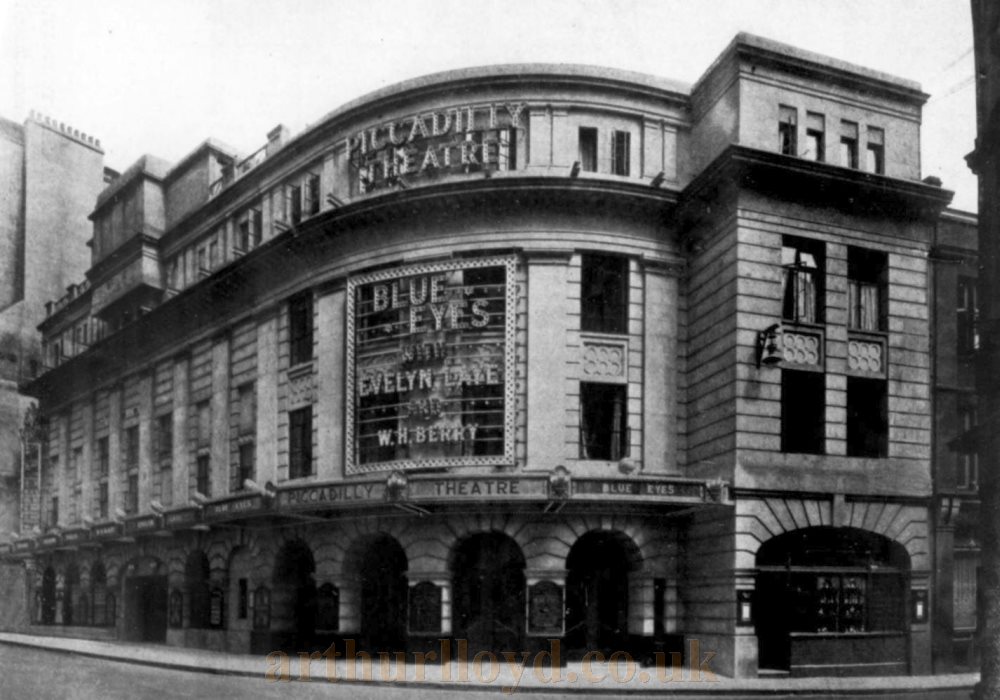
Above - The Piccadilly Theatre on its opening with 'Blue Eyes' in 1928 - From The Builder, 4th of May 1928.
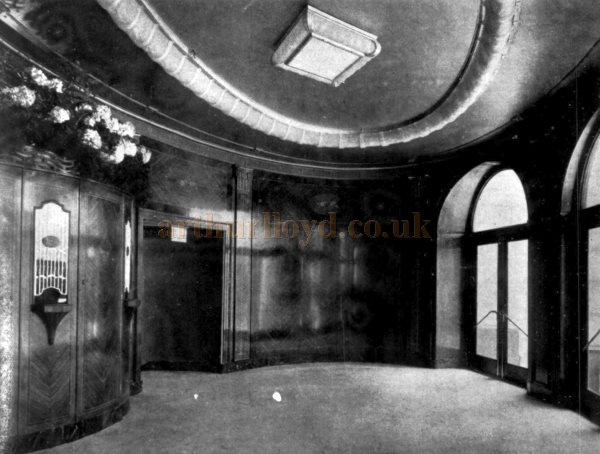 Ample exits are provided, there being five feet of doorway for every seventy-five persons. A special feature is the system of heating and ventilating. By the Method employed, fresh air, washed and warmed to the required temperature, enters the auditorium from the roof and is extracted from under every seat. Overheated air and tobacco smoke thus cannot rise, which is a great advantage in a theatre to be given over to the production of musical comedy.
Right - The Entrance Hall of the Piccadilly Theatre when it first opened in 1928 - From The Builder, 4th of May 1928.
"Back stage" there are over forty dressing-rooms spread over five floors, and-all connected by lifts. The stage, although not exceptionally large, is fitted with every known modern appliance, including a system of floodlighting and electric counter-weighting of "tabs" (the battens to which the scenery is attached) that is comparatively new to this country.
Some features new to London theatre planning are incorporated in the structure. For instance, a special ladies' buffet and retiring-room have been provided, while a feature of the general bars is the extreme length of counter. Cloakroom and lavatory accommodation is on the same generous scale, these apartments being decorated pleasantly with a glazed wall treatment.
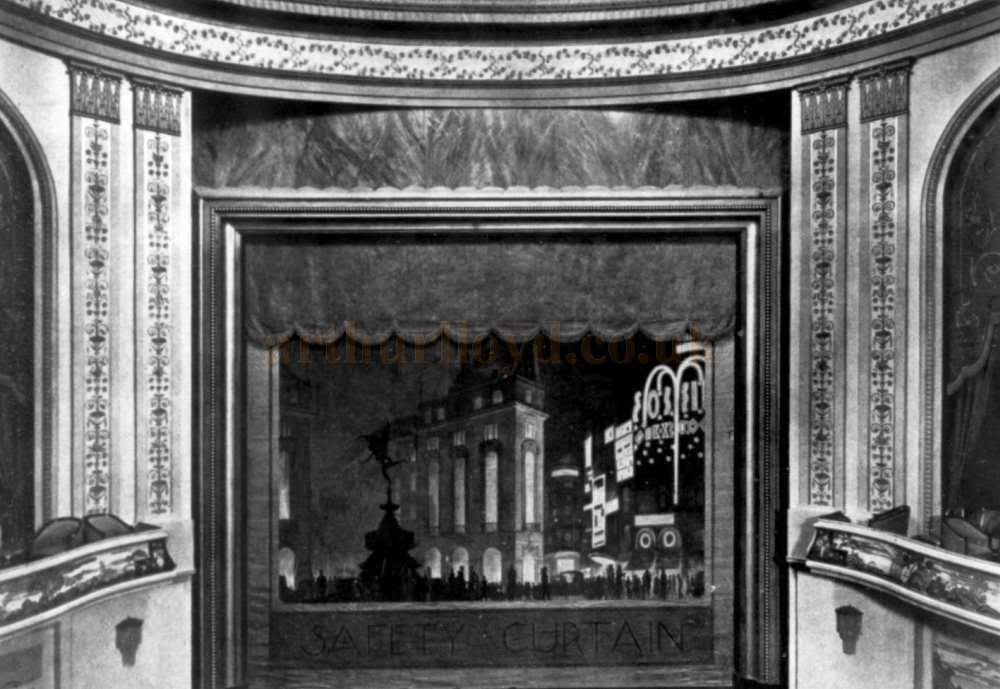
Above - The Auditorium and Stage Safety Curtain of the Piccadilly Theatre when it first opened in 1928 - From The Builder, 4th of May 1928.
Internally the theatre has for its colour motifs eau-de-Nil and gold, which, with the help of darker decorative panels around the well, give a cool, refreshing and yet cosy appearance. A principal source of artificial lighting is a crystal ceiling light, set in a shallow elliptical saucer dome, which is also illuminated by concealed lighting. Dainty Japanese designs are used to adorn the fronts of the boxes and circles. These have been painted by the Japanese craftsmen of Messrs. Marc-Henri and Laverdet, of Paris, who, under the direction of the joint architects, are responsible for the decoration.
Portland cement has been used for the exterior, which is modern in that it carries no superfluous detail. Some fine walnut wood inlay is being used in the front of the house and foyers which produce a warm, pleasing tone.
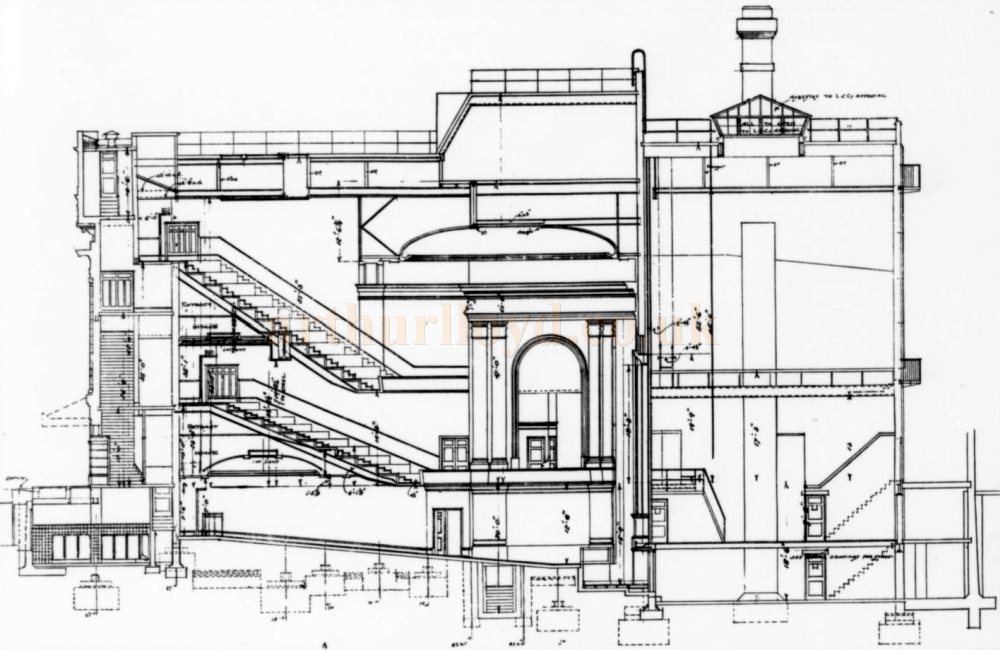

Above - A Section Plan and Stalls and Entrance Level Plans for the Piccadilly Theatre - From The Builder, 4th of May 1928.
Messrs. Bertie Crewe and E. A. Stone. F.S.I., were the joint architects for the theatre, and the general contractors were Messrs. Griggs & Son, of Westminster, who have given special attention to cinema and theatre construction. Following is a list of the sub-contractors:- J. Jeffreys & Co., Ltd., ventilating; A. D. Dawnay & Son, steelwork; The Berkeley Electrical Eng. Co., electrical work; H. E. Gaze. Ltd.. plaster work; Mr. J. A. Eshelby, entrance hall, foyers, saloons and staircases, Bagues, Ltd., chief electrical fittings; Starkie Gardner, Ltd., ceiling lights, canopy. etc.; F. Knight & Co., handrails and door furniture; Leeds Fireclay Co., sanitary appliances; Shoolbreds and Geo. piliton & Co., seating and carpets; Bell's Poilite and Everite Co., wall lining of lavatories; The Door Unit Co., doors; Brookes. Ltd., marble work; Merryweather & Son, fire extinguishers and appliances; Mr. L. D. Wood, soda fountains.'
The above text in quotes was first published in The Builder, 4th of May 1928.
 The Piccadilly Theatre's opening was followed by a flurry
of Theatre Building in London's
West End. 1930 saw the opening of the Prince
Edward Theatre on April the 3rd, then the Cambridge
Theatre on the 4th of September, then the Phoenix on the 24th of September, and the Whitehall
Theatre on the29th of September. Then came the rebuilt Adelphi
Theatre on 3rd of December, and finally the Leicester
Square Theatre which opened on December the 19th.
The Piccadilly Theatre's opening was followed by a flurry
of Theatre Building in London's
West End. 1930 saw the opening of the Prince
Edward Theatre on April the 3rd, then the Cambridge
Theatre on the 4th of September, then the Phoenix on the 24th of September, and the Whitehall
Theatre on the29th of September. Then came the rebuilt Adelphi
Theatre on 3rd of December, and finally the Leicester
Square Theatre which opened on December the 19th.
Right - The Cast of 'Blue Eyes' - From the Souvenir Programme produced for the opening of the Piccadilly Theatre on the 27th of April 1928 - Courtesy Adam Harrison.
The Theatre was built for the Piccadilly Theatre Company and it's auditorium was decorated by Marc-Henri & Laverdet on three levels, Stalls, Dress, and Upper Circles, now called Stalls, Royal, and Grand Circles, with a capacity on opening of 1,395, although today the capacity is a more modest 1,232. The stage is large enough for musicals at 29' 10" Wide by 35' Deep.

Above - A Seating Plan for the Piccadilly Theatre - From 'Who's Who in the Theatre' published in 1930 - Courtesy Martin Clark. Click to see more Seating Plans from this publication.
Details of the newly opened Piccadilly Theatre
From the Souvenir Programme produced for the opening of the Piccadilly Theatre on the 27th of April 1928
 A few months ago an interesting article appeared
in the Evening News dealing with the acquisition of the site on which
the Piccadilly Theatre has now been erected. It is only known to those
closely connected with the building of a theatre in the West
End of London the enormous amount of difficulties which have to
be overcome before the final completion is reached. Details of the various
negotiations would be interesting reading, but space does not allow
me to go into these facts. Suffice it to say that after jumping many
hurdles those directly connected with the erection of this theatre have
achieved their purpose.
A few months ago an interesting article appeared
in the Evening News dealing with the acquisition of the site on which
the Piccadilly Theatre has now been erected. It is only known to those
closely connected with the building of a theatre in the West
End of London the enormous amount of difficulties which have to
be overcome before the final completion is reached. Details of the various
negotiations would be interesting reading, but space does not allow
me to go into these facts. Suffice it to say that after jumping many
hurdles those directly connected with the erection of this theatre have
achieved their purpose.
Right - The Cover of the Souvenir Programme produced for the opening of the Piccadilly Theatre on the 27th of April 1928 - Courtesy Adam Harrison.
It may be of interest to know that the building of the theatre involved
the labour of 200 men per day for twelve months, the auditorium holds
1,400 people, exclusive of standing, there are over 550 tons of cement
and 600 tons of steel in the construction, and that the number of bricks
employed in the building if placed end to end in one straight line would
reach from London to Paris. As against these dramatic details the sober
facts are that the Piccadilly Theatre, while laying no special claims
to Gargantuan proportions; is one of the first in London for luxurious
comfort and practical utility as a theatre, both from the point of view
of the audience and the artist.
Above - A scene from 'Blue Eyes' the opening production at the Piccadilly Theatre - From the ILN of May 19th 1928.
 Following
the approved scheme of decoration, the directors selected the finest
quality of Saxony pile carpet in a special shade of green from Messrs.
James Shoolbred for the whole of the stalls and circles, the same firm
also providing a specially designed chair covered in a gold ground velour,
with raised pattern in shades of green, finished with a shaped back
and arms in natural finish English walnut. The whole of the doors, bar
counters and fittings throughout the entire theatre are in beautifully
figured walnut wood. Mouldings have been avoided throughout; the effect
of panels being obtained by inlaid wood.
Following
the approved scheme of decoration, the directors selected the finest
quality of Saxony pile carpet in a special shade of green from Messrs.
James Shoolbred for the whole of the stalls and circles, the same firm
also providing a specially designed chair covered in a gold ground velour,
with raised pattern in shades of green, finished with a shaped back
and arms in natural finish English walnut. The whole of the doors, bar
counters and fittings throughout the entire theatre are in beautifully
figured walnut wood. Mouldings have been avoided throughout; the effect
of panels being obtained by inlaid wood.
Right - The auditorium of the Piccadilly Theatre - From the Theatre's opening Souvenir Programme on the 27th of April 1928 - Courtesy Adam Harrison.
 The entire decoration of the auditorium has been carried
out by Marc-Henri, the famous French artist, who has decorated many
theatres on the Continent, including the Plaza, the Carlton, and the
latest cinema theatre, the Paramount, in Paris.
The entire decoration of the auditorium has been carried
out by Marc-Henri, the famous French artist, who has decorated many
theatres on the Continent, including the Plaza, the Carlton, and the
latest cinema theatre, the Paramount, in Paris.
Special provision has been made at all levels for long lengths of bar counter so that patrons may obtain quick service between the acts. The same applies to cloak rooms and lavatories at all levels. The total length of bar counters amounts to nearly 100 feet. The walls of the Ladies' Saloons are fitted with mirrors and dressing tables round the whole area, and it is quite safe to say that in no other theatre in London are these apartments so well and completely equipped, the fittings of which alone cost several thousand pounds.
Entrances and exits have been arranged at all four corners of the auditorium, and at the high and low levels of the circle on both sides, and the staircases and corridors from these are so spacious that it will be possible to entirely clear the house in Two Minutes in case of emergency.
 Behind
the stage there are thirty luxurious dressing rooms, all supplied with
hot and cold water, and the principal artists have special reception
rooms adjoining, an electric passenger lift has been installed for easy
access to the higher levels of the dressing rooms, while no effort has
been spared to give the necessary convenience and safety to artists.
Behind
the stage there are thirty luxurious dressing rooms, all supplied with
hot and cold water, and the principal artists have special reception
rooms adjoining, an electric passenger lift has been installed for easy
access to the higher levels of the dressing rooms, while no effort has
been spared to give the necessary convenience and safety to artists.
Left - A 1970s Seating Plan for the Piccadilly Theatre.
The site of the Piccadilly Theatre originally was covered with derelict stables and out-of-date buildings, but the demolishing of these was only accomplished under very great difficulties owing to the necessity of protection being given to the surrounding buildings on the site.
The excavation particularly was an extremely difficult task for the contractors, and it speaks well for the ability of Messrs. Griggs & Son that they pulled down these buildings and accomplished the feat of underpinning and excavating to a depth of over 20 feet below the pavement line, without any serious accident.
 The
whole of the designing and constructional work of this theatre has been
carried out, from first to last, under the direct supervision of Mr.
Edward A. Stone (shown right) and Mr.
Bertie Crewe, whose names are eminent in the realm of architecture.
The
whole of the designing and constructional work of this theatre has been
carried out, from first to last, under the direct supervision of Mr.
Edward A. Stone (shown right) and Mr.
Bertie Crewe, whose names are eminent in the realm of architecture.
The new Piccadilly Theatre, apart from many other means of transport, will be served by the largest tube station in the world, the new Piccadilly Tube Station which, as against 26,000,000 passengers in 1927, will in future, with a battery of 15 passimeter booths, be able to serve 50,000,000 a year. The completed station, over the central dome of which Eros will be replaced, will have 7 subway entrances, 9 escalators and, 15 feet beneath the roadway, the booking hall will have a circular area of over 15,000 square feet, encompassed by a broad subway from which short staircases will connect with seven principal parts of the Circus. Fifty-seven stone stanchions will support the roof of the booking hall, which will have a special scheme of concealed lighting, the surrounding subway will be lined with brilliantly illuminated showcases in which well-known London stores will display their wares, and there will be a special corridor of public phone-call rooms. The work on this station was begun in February, 1925, and the approximate total cost of it will be £430,000.

Above - Serving the new Piccadilly Theatre will be the largest Tube Station in the World - From the Souvenir Programme produced for the opening of the Piccadilly Theatre on the 27th of April 1928 - Courtesy Adam Harrison.
The Electrical Equipment of The New Piccadilly Theatre
From the Souvenir Programme produced for the opening of the Piccadilly Theatre on the 27th of April 1928
 I have been asked to say something about the Lighting Equipment, Ventilation
and various other Technical Installations at the Piccadilly Theatre.
I do not believe in saying that the theatre contains 22 miles of wire
and 17,000 lamps, which is the usual thing one reads in a Brochure,
and that the ventilation produces 5 million cubic feet of air per hour.
I have been asked to say something about the Lighting Equipment, Ventilation
and various other Technical Installations at the Piccadilly Theatre.
I do not believe in saying that the theatre contains 22 miles of wire
and 17,000 lamps, which is the usual thing one reads in a Brochure,
and that the ventilation produces 5 million cubic feet of air per hour.
Right - An advertisement for the Electrical Installation at the Piccadilly Theatre by Berkeley Electrical Engineering Co., Ltd - From the Souvenir Programme produced for the opening of the Theatre on the 27th of April 1928 - Courtesy Adam Harrison.
A system of lighting has been installed in the Piccadilly Theatre which it is hoped will satisfy the public, and in this respect attention is called to the very novel idea of illumination of Staircases by means of small panels, as against the usual wall or bracket fitting. In the Foyers we have a system of direct and indirect lighting served by two complete services, so that in the event of the breakdown of the supply from one source, the whole of this important part of the theatre, including the Staircases and Exits, will still remain illuminated to such an extent as to allow the public clear passage. In the Auditorium every endeavour has been made to produce adequate illumination with the maximum comfort to the patron. As few fittings as possible have been used in the Auditorium, and here again a system of direct and indirect lighting produces the illumination necessary. In the centre of the theatre, we have a large Crystal Lustre, which actually weighs four tons, with all its necessary raising and lowering gear. The construction of the main platform supporting this is made of steel. Its size of 14 ft. by 8 ft. is hardly appreciated from the Stalls level, and the fact that it contains 200 lamps. This is in my opinion, the "crystal spot" of the theatre. The system of lighting around the Dome is intended to produce a soft but effective illumination to the Auditorium in general, and the use of laylights for indirect lighting over the Balcony and Dress Circle produces that soft velvet effect which is considered the art of perfect illumination.
 On
the Stage we have a very up-to-date system of lighting, comprising,
as it does, all the latest devices for producing lighting effects. The
Footlights are of entirely new design and are so placed as to produce
a maximum of light evenly distributed all over the stage. They are wired
in four distinct colours, and are capable of producing eight different
combinations of colour by means of blending. The Stage Battens comprise
a new unit used for the first time in this theatre, and are wired on
the same principle as the Footlights.
On
the Stage we have a very up-to-date system of lighting, comprising,
as it does, all the latest devices for producing lighting effects. The
Footlights are of entirely new design and are so placed as to produce
a maximum of light evenly distributed all over the stage. They are wired
in four distinct colours, and are capable of producing eight different
combinations of colour by means of blending. The Stage Battens comprise
a new unit used for the first time in this theatre, and are wired on
the same principle as the Footlights.
Left - A Programme for 'Living Dangerously' at the Piccadilly Theatre in 1934.
By an elaborate system of control installed on a platform on the Prompt side and above the Stage, almost any combination of colour used in stage lighting can be produced. Cloud and water effects are as easy to produce as ordinary lighting, and in addition brilliant sunlight for a day-time scene representing a spring garden or a summer effect can equally well be produced. This is a point very often overlooked by Lighting Engineers, and special attention has been paid to this particular item.
 From
the front of the theatre, and projected above the Balcony, two new Spotlights,
the first of their kind to be used in Europe, have been installed. These
lamps have been brought over specially from America, where they have
caused a sensation, and with this Effect Lamp it is possible to produce
any combination of colour flood or spot instantaneously, the operator
having complete control at all times without having to remove his hands
from the lamp to get any new colour he requires. This lamp is a considerable
advance on anything produced heretofore for this class of work, and
I look forward to great results from this particular part of the scheme.
From
the front of the theatre, and projected above the Balcony, two new Spotlights,
the first of their kind to be used in Europe, have been installed. These
lamps have been brought over specially from America, where they have
caused a sensation, and with this Effect Lamp it is possible to produce
any combination of colour flood or spot instantaneously, the operator
having complete control at all times without having to remove his hands
from the lamp to get any new colour he requires. This lamp is a considerable
advance on anything produced heretofore for this class of work, and
I look forward to great results from this particular part of the scheme.
Right - A Programme for 'Counsellor At Law' at the Piccadilly Theatre in 1934.
The Stage Lighting, when working at full load, will require about 200 KW, and no less than 3000 lamps of various sizes and types will be in use on this stage when a brilliant sunlight effect is produced.
The Ventilation of this theatre is dealt with in a new way, the air being admitted from the Roof and extracted at the Floor level, in accordance with the very latest methods of ventilation. With this system it is hoped to maintain atmospheric conditions within the theatre of a character very much in advance of the general conditions maintained in a London theatre.
A very adequate and up-to-date system of Stage Equipment for the operation of scenery has been installed, by means of which almost any change of scene can be made in two minutes, it being possible by means of this equipment for one man, without any special effort, to pull a large cloth weighing half a ton out of the way, whereas with the ordinary equipment four men would be required to remove this amount of weight, and then only under very great strain.
The theatre is equipped with a complete Projection Booth, having the very latest type of Projectors, Screen, etc., and the sighting of this has been so arranged that the full picture can be seen from all parts of the theatre.
The above (edited) details on the Piccadilly Theatre are from the Souvenir Programme produced for the opening of the Theatre on the 27th of April 1928 - Courtesy Adam Harrison.
 The
first production at the Piccadilly Theatre, a musical play called 'Blue
Eyes' with Evelyn Laye, written by Jerome Kern, ran from April the 27th
1928 until August of the same year before transferring to Daly's
Theatre, (now the View Cinema in the Warner Village, Leicester Square.)
After this though Warner took over the Piccadilly and began using it
as a cinema to show the new craze of the time, 'Talkies,' using their
Vitaphone system. Indeed, it was at the Piccadilly that the very first
Talkie was shown in Britain, 'The Singing Fool' staring Al Jolson.
The
first production at the Piccadilly Theatre, a musical play called 'Blue
Eyes' with Evelyn Laye, written by Jerome Kern, ran from April the 27th
1928 until August of the same year before transferring to Daly's
Theatre, (now the View Cinema in the Warner Village, Leicester Square.)
After this though Warner took over the Piccadilly and began using it
as a cinema to show the new craze of the time, 'Talkies,' using their
Vitaphone system. Indeed, it was at the Piccadilly that the very first
Talkie was shown in Britain, 'The Singing Fool' staring Al Jolson.
Right - A Programme for 'The Corn Is Green' at the Piccadilly Theatre in 1938.
 However,
the Theatre was back in live theatre use again in November 1929 with
a production of 'The Student Prince', and then in January 1931 it had
its first success with 'Folly To Be Wise' which ran for 257 performances.
Then came Robert Donat and Ernest Thesiger in September 1933 with 'A
Sleeping Clergyman' and 'Counsellor at Law' (shown above) in
April 1934, 'Queer Cargo' in August, and 'Living Dangerously' (shown
above) in November of the same year.
However,
the Theatre was back in live theatre use again in November 1929 with
a production of 'The Student Prince', and then in January 1931 it had
its first success with 'Folly To Be Wise' which ran for 257 performances.
Then came Robert Donat and Ernest Thesiger in September 1933 with 'A
Sleeping Clergyman' and 'Counsellor at Law' (shown above) in
April 1934, 'Queer Cargo' in August, and 'Living Dangerously' (shown
above) in November of the same year.
Left - In February 1937 The Windmill Theatre Revudeville programmes were carrying this add for the Revudeville Pot-Pourri at the Piccadilly Theatre, continuous Two Hour Review, a Vivian Van Damm Production. - Courtesy Maurice Poole.
 The
Theatre began to lose business after this and the Windmill
Theatre company took over for a while, giving them more room for
their activities, but in late 1937 Frith Shephard opened his new entertainment
at the Piccadilly called 'Choose Your Time' which was a mixture of News
Reels, music with the 'Swingphonic Orchestra,' comedy in the form of
a short play called 'Talk Of The Devil' with a young John Mills, and
Yvonne Arnaud, and amazingly, a Donald Duck film.
The
Theatre began to lose business after this and the Windmill
Theatre company took over for a while, giving them more room for
their activities, but in late 1937 Frith Shephard opened his new entertainment
at the Piccadilly called 'Choose Your Time' which was a mixture of News
Reels, music with the 'Swingphonic Orchestra,' comedy in the form of
a short play called 'Talk Of The Devil' with a young John Mills, and
Yvonne Arnaud, and amazingly, a Donald Duck film.
The Theatre was closed at the outbreak of the War in 1939 but in July 1941 it reopened with a production of Noel Coward's 'Blithe Spirit'. Various productions were then put on including John Gielgud in 'Macbeth' in 1942, and two musical comedies in 1943; Emile Littler's 'Sunny River' (see programme right), and 'Panama Hattie'.
Right - A Programme for Emile Littler's 'Sunny River' at the Piccadilly Theatre in 1943 - Courtesy Roy Cross.
The Theatre was later damaged by flying bombs and was closed until it reopened under the management of The Piccadilly Theatre Ltd., with a production of Agatha Christie's 'Appointment With Death' in 1945. A succession of successes and failures followed for the next decade or so including one very notable flop in May 1960; 'Bachelor Flat' which only ran for 4 performances.
 In December 1960 Donald Albery fought off Bernard Delfont
for the purchase of the Theatre and before long he had redecorated the
Theatre and made improvements backstage, whilst Ian Albery became general
Manager. In 1979 Albery installed a false ceiling which could be lowered down to the level of the top of the Dress Circle, cutting off the Upper Circle, to make the Theatre feel more intimate. Although rarely used it would stay in place until it was finally removed and replaced with a recreation of the original auditorium ceiling and dome in 2017.
In December 1960 Donald Albery fought off Bernard Delfont
for the purchase of the Theatre and before long he had redecorated the
Theatre and made improvements backstage, whilst Ian Albery became general
Manager. In 1979 Albery installed a false ceiling which could be lowered down to the level of the top of the Dress Circle, cutting off the Upper Circle, to make the Theatre feel more intimate. Although rarely used it would stay in place until it was finally removed and replaced with a recreation of the original auditorium ceiling and dome in 2017.
Left - A Poster for 'Man of Magic', a Musical about Harry Houdini which was staged at the Piccadilly Theatre in November 1966 and ran for 135 performances - Courtesy Chris Woodward.
The Piccadilly Theatre has had something of a checkered history over the years, sometimes successful, but often host to some rather less fortunate productions. Recently however, the Theatre has been more successful. In 2005 the Theatre was home to a revival of the hit musical 'Guys And Dolls' which opened on the 1st of June that year and ran for two years until the equally successful production of the stage musical 'Grease' opened at the Theatre in July 2007.
'Ghost' the musical also ran very successfully in 2011 / 2012. The Theatre then staged a production the Spice Girls musical 'Viva for Ever!' and a revival of 'Dirty Dancing'. The Theatre then became the new home for 'Jersey Boys' in March 2014 when it transferred from the Prince Edward Theatre. Some restoration of the Theatre was carried out after 'Jersey Boys' closed in March 2017 and before a revival of the musical 'Annie' opened in May 2017, ('Annie' was first produced in London's West End at the Victoria Palace Theatre in 1978). The works included the removal of the 1979 false ceiling hanging over the auditorium, as mentioned above, and redecoration of dressing rooms, offices, and toilet facilities.
The Piccadilly Theatre is currently run by the Ambassador Theatre Group whose own website for the Theatre can be found here.

Above - The Piccadilly Theatre during the run of 'Guys And Dolls' in October 2006 - Photo M.L.

Above - The Piccadilly Theatre during the run of 'Grease' in September 2008 - Photo M.L.

Above - The Piccadilly Theatre during the run of 'Ghost The Musical' in August 2011 - Photo M.L.

Above - The Piccadilly Theatre during the run of 'Jersey Boys' in October 2014 - Photo M.L.
Adelphi Aldwych Ambassadors Apollo Apollo Victoria Arts Cambridge Charing Cross Theatre Criterion Dominion Donmar Warehouse Drury Lane Duchess Tom Stoppard Theatre Fortune Garrick Gielgud Gillian Lynne Harold Pinter Haymarket His Majesty's Leicester Square Theatre London Coliseum London Palladium Lyceum Lyric Menier Chocolate Factory Noel Coward Novello Old Vic Palace Peacock Phoenix Piccadilly Playhouse Prince Edward Prince of Wales Royal Opera House Sadler's Wells Theatre Savoy Shaftesbury Sondheim St. Martin's Trafalgar Theatre Vaudeville Victoria Palace Wyndham's